How to Test Speaker Polarity with a Test Tone
Play a mono test tone in the roughly 60–100 Hz range, compare the in-phase and inverted versions at a centered listening seat, and keep the wiring that gives the stronger, fuller bass; if the sound gets thinner or hollower, the original polarity was likely wrong. A bad call here can send you after wiring that is fine, or leave a speaker out of phase and lose bass, image center, and output.
What you’ll need
- A stereo source with two front speakers
- A sine-wave test tone in the bass range
- A file or app with in-phase and inverted versions of the same tone
- Access to balance, fader, and any DSP or EQ menus
- Basic access to amplifier and speaker terminals
- A listening seat that can be held near the centerline of the cabin
How do you test speaker polarity with a tone?
Use two speakers, not headphones, and sit on the cabin centerline as closely as the seat allows. Play a bass-focused sine tone, compare the normal version with the version that inverts one channel, and listen for the version with stronger bass and a more solid center image. The correct wiring makes the low end fill out and the center image lock in.
Set the system for a clean comparison
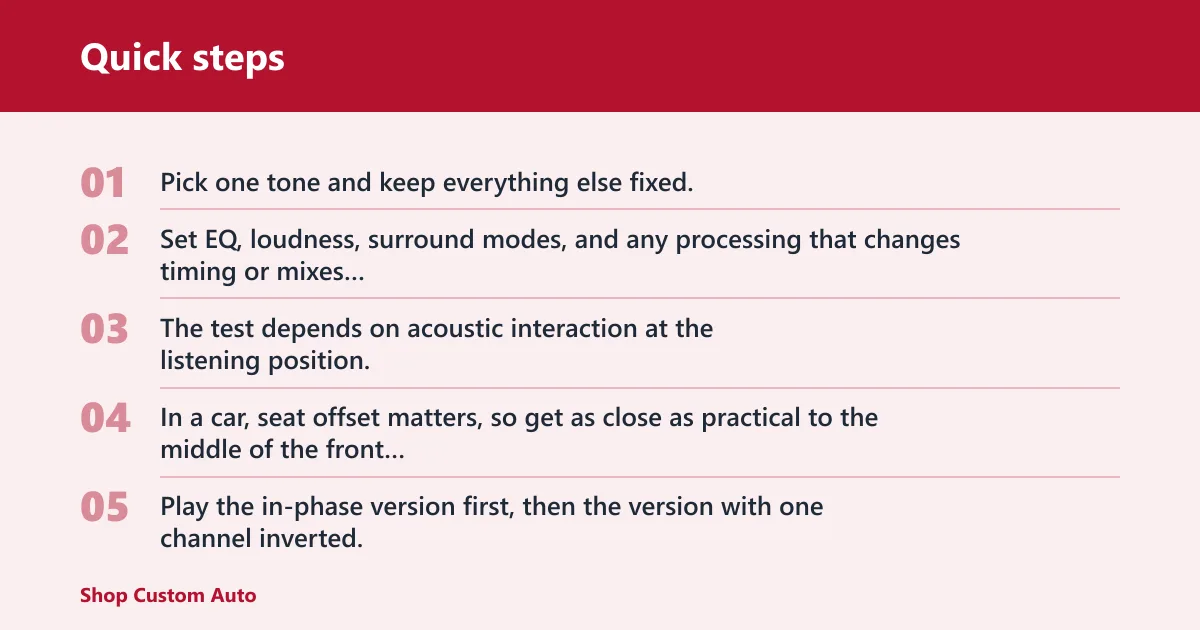
Pick one tone and keep everything else fixed. Set EQ, loudness, surround modes, and any processing that changes timing or mixes channels to off before comparing the two versions of the file.
Use the right listening position
The test depends on acoustic interaction at the listening position. In a car, seat offset matters, so get as close as practical to the middle of the front sound stage before judging the tone.
Compare the two signals
Play the in-phase version first, then the version with one channel inverted. The key clue is bass cancellation: when the speakers oppose each other, low end weakens more than midrange does.
Listen for the change that matters
If the bass gets stronger and the vocal or phantom center snaps into place on the in-phase version, the wiring is probably correct. If the inverted version sounds fuller, the channel order or polarity path needs checking.
Speaker polarity test steps
- Turn off EQ, loudness, surround, and time alignment: use Settings > Audio > Processing or the DSP menu, then set every effect to flat or off.
- Set balance and fader to center: use Settings > Audio > Balance/Fader, because an offset control can fake a polarity fault.
- Play the same bass tone through both front speakers: a 110 Hz tone gives the most dramatic difference, and some guides use 75 Hz or 200 Hz for the same comparison.
- Switch to the inverted version and compare from the same seat: keep the volume fixed, since the result should be judged by the change in bass and center image, not loudness alone.
- If the sound thins out, inspect terminals: check the amplifier end and the speaker end for one swapped positive or negative lead.
- Reverse one speaker only, then retest: flip that speaker’s connecting wires, not both, and replay both versions of the tone to confirm the fix.
When a test tone suggests reversed polarity vs. when it does not
A tone only points to reversed polarity when the weaker result follows the speaker pair, not the seat, processing, or source mode. A single bad listening position, mono downmix, or balance setting can create the same thin sound, so use the pattern of the result, not one playback alone.
| Symptom | Likely cause | Quick check | Next action |
|---|---|---|---|
| Centered bass drops out when one channel is inverted | Speaker wiring reversal | Play the same tone with balance centered and compare both versions | Check one speaker’s + and – at both ends |
| Only one seat hears cancellation | Seat offset or cabin asymmetry | Move closer to the centerline and repeat the tone | Do not change wiring yet; recheck from the new seat |
| Thin sound appears after DSP mono mode is enabled | Mono downmix or DSP processing | Bypass DSP and repeat the same file | Return the DSP to flat or off before judging polarity |
| Left-right image shifts when balance is off-center | Balance or fader error | Set both controls to center and replay the tone | Reassess before touching any wires |
| Bass loss follows one speaker after rewiring | Speaker wiring reversal | Check the speaker terminals and compare against the other side | Swap only that speaker’s leads |
| Both channels behave strangely after an amp swap | Swapped amp terminals | Inspect the amplifier outputs for reversed + and – | Correct the amp end first, then retest |
| Headphones seem to cancel bass | Headphone test, not a car-cabin polarity check | Repeat on stereo speakers in the vehicle | Use the car speakers for the real comparison |
| Subwoofer only sounds weak on the inverted file | Sub polarity or crossover interaction | Mute the mains and test the sub alone, then with mains active | Check sub leads and crossover settings together |
How do you know if a speaker is wired backwards?
A speaker is likely wired backwards when one channel change makes the same bass tone thinner from the centered listening seat, and the fix is a single lead swap on that speaker. Check both amplifier and speaker ends, because a reversed pair anywhere in the path creates the same result.
Check the amplifier end and the speaker end
Inspect the positive and negative terminals at each end of the run. A wiring mistake at the amp output or at the speaker tabs can flip polarity, so the correction has to match the point where the reversal exists.
Fix one reversed channel only
Swap the leads on one speaker only. Do not reverse both speakers, because that keeps the channels matched while preserving the same problem.
Retest after the fix
Play the same tone again with balance centered. The corrected setup should sound fuller, bassier, and more centered on the in-phase version, and the inverted version should lose bass instead of gaining it.
Common mistakes
Most bad calls come from changing too many variables at once. Keep the tone, seat, balance, and processing fixed, then change only one thing at a time.
- Testing from an off-center seat: move closer to the centerline before deciding that wiring is wrong.
- Leaving DSP active: bypass time alignment, surround, and mono downmix before comparing the two files.
- Trusting one result alone: repeat the check after one correction so the bass change is consistent.
- Swapping both speakers: correct one channel only, then retest.
- Using headphones for this car check: they do not show the cabin’s bass interaction the same way stereo speakers do.
Common first-timer mistake: seat position
Say your driver seat is 15 cm left of center and the bass seems weak only on the left side. That can be seat offset, not wiring. Slide closer to the middle, replay the same tone, and see whether the cancellation follows the seat or the speaker pair.
If that didn’t work, try this next
If the centered tone still sounds wrong after the lead swap, recheck source mode, DSP routing, and any subwoofer crossover settings. A mono downmix can cancel an inverted signal, which can make a correct wire repair look wrong until processing is bypassed.
Why bass is the main audible clue
Bass cancellation shows up first because low frequencies are more likely to cancel when one speaker is reversed. A low tone makes the difference easier to hear in a cabin.
Picture a compact sedan with the seat pulled slightly forward. The in-phase tone can still sound centered, but the inverted version loses weight fast if the channels oppose each other. That change is the clue; the seat location just changes how easy it is to hear.
Frequently asked questions
What tone should I use to check speaker polarity?
A sine wave in the bass range is the right choice for this car check. A 110 Hz bass tone is commonly used because it produces the most dramatic difference, while 75 Hz and 200 Hz are also used in speaker phase tests.
How close do I need to sit when testing speaker polarity?
Sit as close to the centerline as the cabin allows, then keep that position fixed while you compare the two tones. A small seat move can change the result, so repeat the same playback from the same spot before judging the wiring.
Does an out-of-phase test tone always mean the wiring is wrong?
No. Mono downmix, DSP timing, balance, fader settings, and seat offset can all make an inverted tone sound weak. Treat one thin result as a clue, then confirm it by bypassing processing and repeating the same comparison from the centered seat.
Can I use a sine wave to test speaker polarity?
Yes. A sine-wave test tone is the standard choice because it gives a clean comparison between the normal and inverted versions. Keep the tone in the bass range, replay it through stereo speakers, and judge the change in bass and center image.
What should an in-phase speaker test sound like?
The in-phase version should sound fuller, bassier, and centered when the wiring is correct. If the image feels solid and the low end fills in, that is the result to keep. Then flip to the inverted version and confirm that it sounds thinner.
How do I fix reversed speaker polarity after a tone test?
Swap the positive and negative leads on one speaker only, at whichever end is reversed. Then replay the same tone with balance centered and the same processing settings. The fix is confirmed when the in-phase version regains bass and the center image locks in.