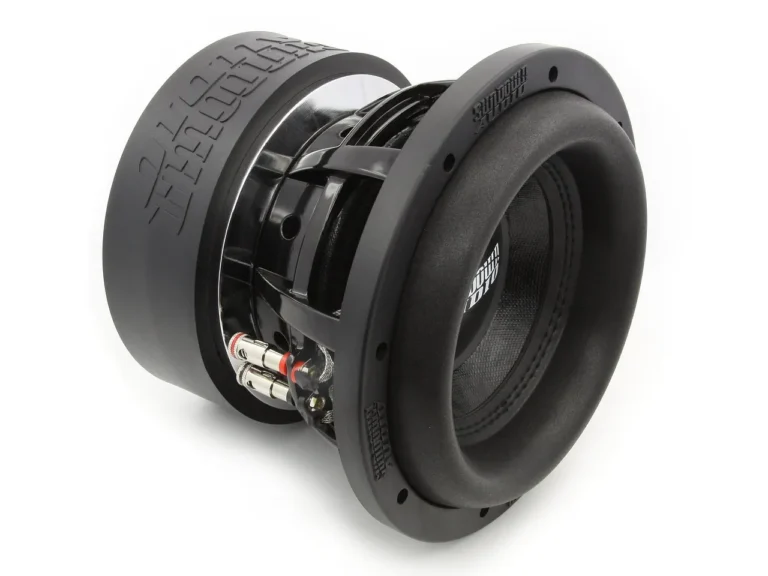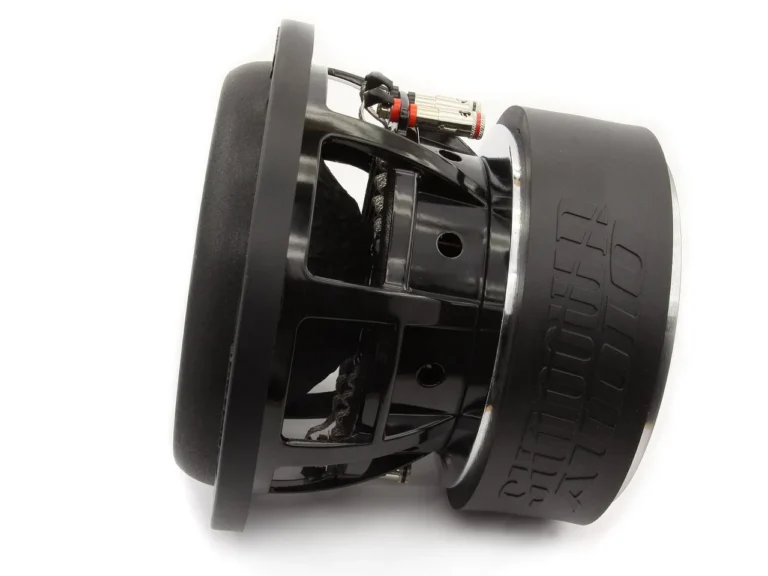
How Do You Know If Your Subwoofer Is Out of Phase?
A subwoofer can sound out of phase when bass gets weaker at the listening seat after you flip the sub’s polarity; if the low end gets stronger, the new setting may be the better match. Fixing the wrong problem wastes time and can leave you chasing weak bass caused by wiring, crossover settings, seat position, or a damaged sub. This guide shows how to test phase, check polarity, and separate those look-alike faults before you change settings.
What you’ll need
- A 40 to 80 Hz sine tone or sweep
- A familiar bass-heavy track for a cross-check
- Access to the subwoofer phase control or DSP settings
- Access to the head unit audio settings
- A multimeter with continuity and DC voltage modes
- Basic access to the subwoofer terminals or amp outputs
Subwoofer phase test matrix
| Symptom | Likely cause | Quick test | Next action |
|---|---|---|---|
| Bass gets fuller at 180° | Phase mismatch with the front speakers | Play about a 50 Hz tone, then switch from 0° to 180° and compare which sounds fuller. | Leave the setting that sounds fuller at the driver seat |
| Bass stays weak in both positions | Seat null, crossover issue, or low sub output | Move the seat and retest with the same tone | Check crossover, placement, and sub output before changing phase again |
| Bass disappears only at one seat | Cabin cancellation at that position | Compare driver seat and passenger seat | Adjust box location or time alignment before assuming a bad sub |
| Rattling, buzzing, or scraping | Blown subwoofer or loose parts | Lower volume and sweep 40 to 80 Hz | Stop testing hard and inspect the sub for damage |
| Very little or no output | Wrong polarity, wiring fault, or failed sub | Verify terminals with a multimeter | Correct wiring or troubleshoot the amplifier and driver |
How do you know if your subwoofer is out of phase?
Set the phase switch to 0° and 180° with a steady 40 to 80 Hz tone at about normal listening volume. The better setting is the one that gives fuller bass near the crossover region at the driver seat. If both settings sound similar, the issue may be polarity, crossover overlap, or a seat null. If your sub uses a variable phase knob instead of a two-position switch, sweep through the available range and stop at the setting that gives the fullest bass at the listening seat.
Use a repeatable test
- Set the head unit EQ flat and loudness off.
- Play a 50 Hz sine tone or a slow 40 to 80 Hz sweep.
- Switch the sub from 0° to 180° while staying in the driver seat.
- Choose the setting with stronger bass at the crossover region.
Say the driver seat sounds thin at 0° and fuller at 180° while the passenger seat sounds nearly the same either way. That points to phase interaction with the front speakers at the driver seat, not proof that the sub is broken.
Is it phase or polarity?
Polarity is the positive and negative wire orientation at the speaker terminals. Phase is the timing relationship between the subwoofer and the rest of the system. A phase switch on the amp or DSP does not fix reversed speaker wires, and reversed speaker wires do not mean the phase control is wrong.
Check wiring before changing settings
- Turn the system off.
- Inspect the subwoofer terminals for positive to positive and negative to negative.
- Use a multimeter in continuity mode to verify which conductor goes to each speaker lead.
- Confirm speaker-level inputs and RCA-level inputs are wired to the correct amp terminals.
If the sub seems louder after the leads are corrected, the issue is likely polarity rather than a phase setting. That matters because a polarity error can make bass feel weak even when the phase switch is already on the best position.
Could the seat or box placement be the problem?
Yes. Bass can drop at one seat and sound fine at another because the cabin creates nulls at specific spots. A sealed box and a ported box can respond differently to placement, and moving the enclosure in the trunk or cargo area can change how the sub sums with the front speakers.
Compare positions before you retune
- Play the same 50 Hz tone from the driver seat.
- Move the seat forward or back about 2 inches and retest.
- Compare the driver seat with the passenger seat.
- If bass changes a lot, shift the enclosure a few inches and retest.
Picture a sealed 12-inch sub in the trunk that sounds weak at the driver seat but louder after the box is pulled 4 inches away from the rear panel. That change points to cabin interaction, not a bad phase switch.
Sealed and ported behavior
A sealed box and a ported box can respond differently when you flip phase. That makes box type part of the diagnosis.
Can crossover or time alignment mimic phase issues?
Yes. Front speaker crossover settings can overlap the subwoofer around the crossover point, where cancellation is easiest to hear. Head unit time alignment uses delay to line up arrival times, so it is related to phase, but it is not the same as a phase switch or a wiring correction.
Adjust crossover first
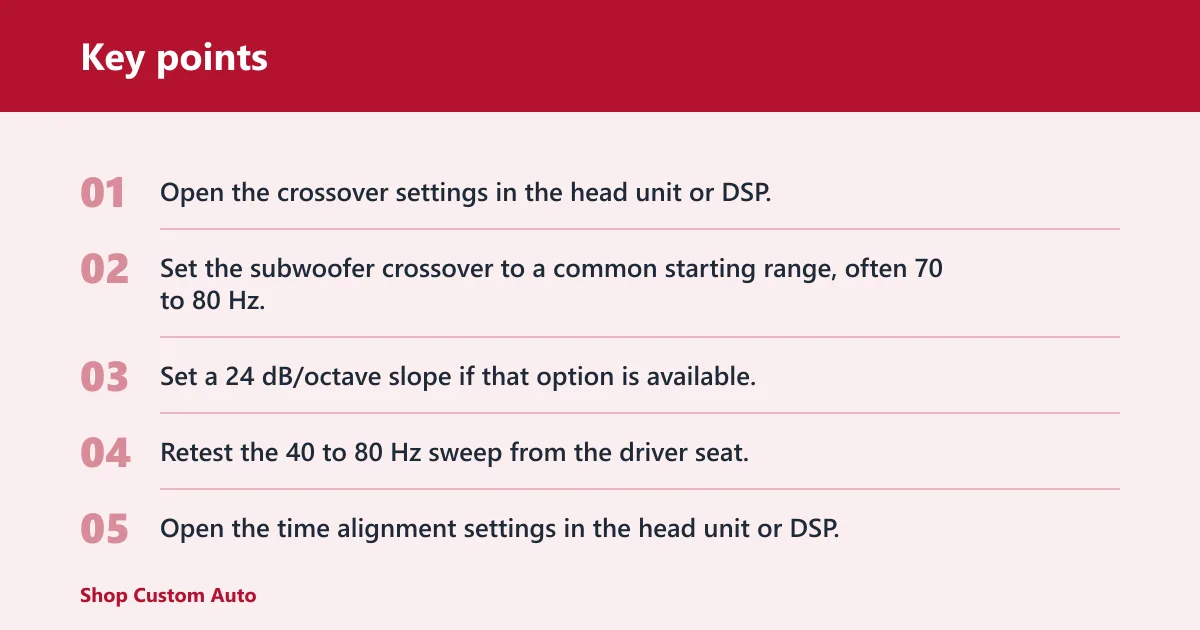
- Open the crossover settings in the head unit or DSP.
- Set the subwoofer crossover to a common starting range, often 70 to 80 Hz.
- Set a 24 dB/octave slope if that option is available.
- Retest the 40 to 80 Hz sweep from the driver seat.
Then check time alignment
- Open the time alignment settings in the head unit or DSP.
- Set the subwoofer delay to match the front stage as closely as the unit allows.
- Retest phase at 0° and 180° after each delay change.
- Use the setting that gives the strongest blend near crossover.
If time alignment improves the handoff but bass still drops at one phase position, the sub and front speakers still need the better phase setting. Delay can help alignment. It cannot fix reversed speaker wires or a damaged driver.
How can I tell if my subwoofer is working?
A working sub usually produces clean low-frequency output that changes with volume and test tones. A failed or blown sub often makes rubbing, buzzing, or scraping sounds, or it may stay nearly silent. If the cone barely moves, or the sound distorts at low volume, inspect the driver before changing phase again.
Check for basic output
- Set the volume low.
- Play a 50 Hz tone.
- Make sure the system is powered off before you press on the cone.
- Listen for clean bass, not scraping or chatter.
A common first-timer mistake is assuming weak bass means a phase error even when the sub is rubbing. If the voice coil is damaged, flipping 0° to 180° will not cure the noise.
What does it sound like when a subwoofer is out of phase?

Out-of-phase bass often sounds thin, hollow, or weak at the listening seat, especially around the crossover region. The sub may still play, but its output cancels part of the front speakers’ bass instead of adding to it. The result can change a lot with seating position or box placement.
Listen for summation, not volume alone
- Use a steady 40 to 80 Hz tone.
- Listen from the driver seat, then the passenger seat.
- Choose the phase position that fills in the crossover region.
- Keep the same volume for both tests.
Suppose bass sounds strong at 0° in the passenger seat but weak at the driver seat, then flips at 180°. That pattern usually means cabin interaction and phase summation are both involved.
Common mistakes
- Changing the phase switch before checking speaker wire polarity
- Using only one song instead of a 40 to 80 Hz tone
- Testing from only one seat and calling it conclusive
- Assuming a ported box behaves like a sealed box
- Ignoring crossover overlap at the front speakers
- Missing blown-sub signs such as rubbing, distortion, or no output
If that didn’t work, try this next
If phase, polarity, and crossover checks do not fix the problem, move to the physical system. The next likely causes are a weak amplifier channel, a damaged voice coil, or an enclosure problem that changes how the sub loads the cabin. Do not keep toggling settings once the tests stop changing the result.
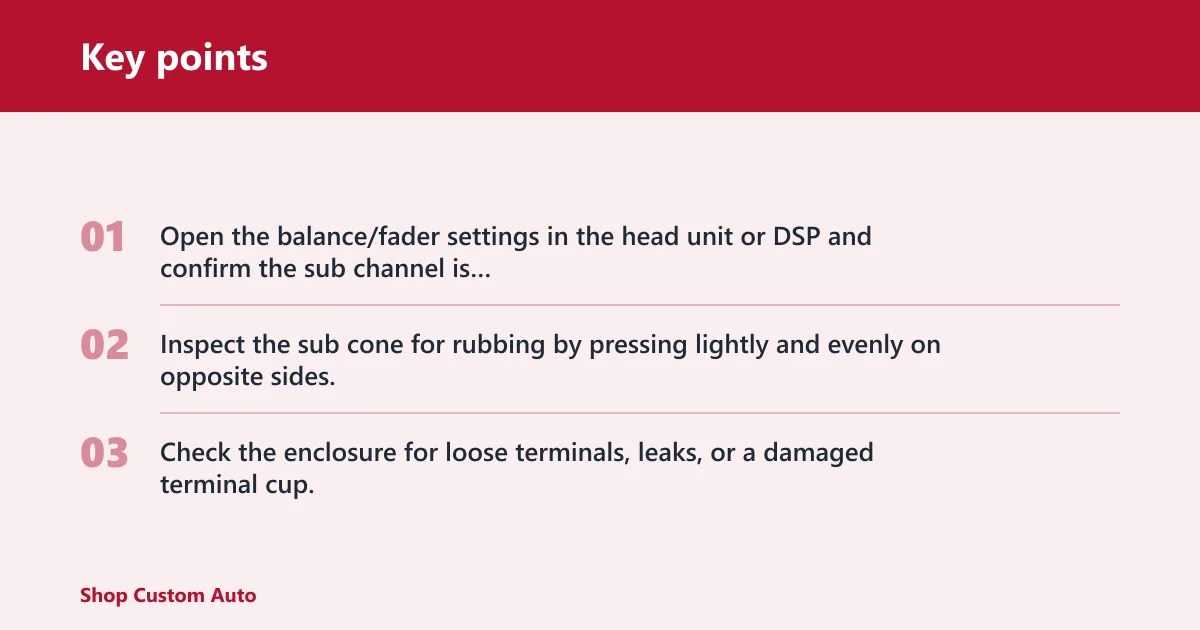
- Open the balance/fader settings in the head unit or DSP and confirm the sub channel is active.
- Inspect the sub cone for rubbing by pressing lightly and evenly on opposite sides.
- Check the enclosure for loose terminals, leaks, or a damaged terminal cup.
If bass returns after a wiring fix, leave the phase setting alone and retest later with the same tone. That prevents chasing two problems at once.
Prevention
Before you tune again, label the sub leads and document the crossover, phase, and time-alignment settings. A simple note makes it easier to spot which change actually improved the blend and keeps the same wiring mistake from coming back.
Frequently asked questions
Can a subwoofer be out of phase even if it still plays bass?
Yes. The sub can still make sound and still cancel part of the front stage. That is why a phase error may feel like reduced bass rather than complete silence. Compare 0° and 180° with the same tone before assuming the driver is bad.
How do I test subwoofer phase with music?
Use a track with steady bass notes and a fixed listening position, then toggle 0° and 180° once per pass. Music is useful for confirmation, but a tone is easier to judge. Keep EQ flat and retest at the same volume each time.
What is the difference between phase and polarity on a subwoofer?
Polarity is the positive and negative wire orientation. Phase is how the sub’s output lines up in time with the front speakers. A multimeter can help verify polarity, while the phase control only changes timing, usually in 0° and 180° steps.