What Ohm Subwoofer Is Best for Your Amplifier Setup?
The best ohm subwoofer for your amplifier is the one that can wire to the amp’s safe minimum load, usually 1 ohm, 2 ohms, or 4 ohms, while still leaving the series/parallel options you need. Wire it wrong and you can trigger protection, lose output, or overheat the amp. This guide shows how SVC and DVC subs connect, how to match them to common amp ratings, and which impedance choice keeps your options open.
What does subwoofer impedance mean?
Subwoofer impedance is the electrical load a subwoofer puts on an amplifier, measured in ohms (Ω). The printed rating is nominal, not exact. A multimeter can read DC resistance in ohms, but that number is usually lower than the speaker’s nominal impedance and is only a quick sanity check.
Nominal ohms vs. measured DC resistance
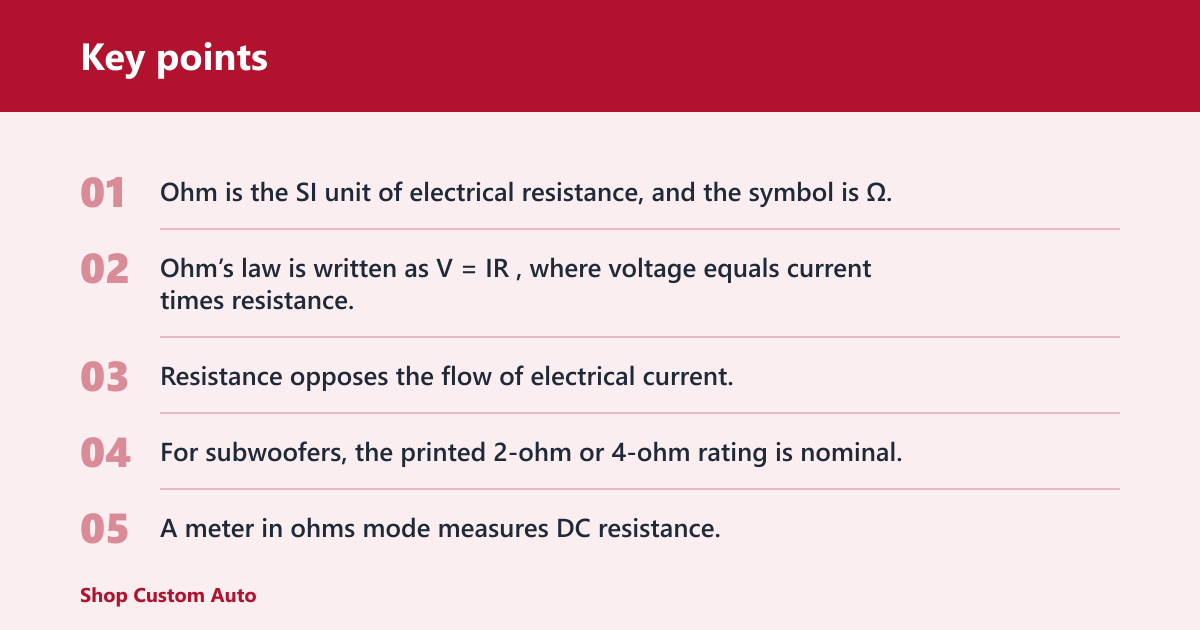
Ohm is the SI unit of electrical resistance, and the symbol is Ω. One ohm is defined as one volt per ampere. Ohm’s law is written as V = IR, where voltage equals current times resistance. Resistance opposes the flow of electrical current.
For subwoofers, the printed 2-ohm or 4-ohm rating is nominal. A meter in ohms mode measures DC resistance, not the full AC load the amp sees while music is playing. That is why a “4-ohm” sub often reads below 4 ohms on a multimeter.
Why the Ω rating matters for amp matching
The amplifier does not care about the label by itself. It cares about the load it must drive safely. Lower resistance can demand more current from the amp, and higher current demand can push a weak amp into clipping, heat, or protection if the load drops below its stable range.
Use the nominal impedance as the wiring target, then confirm the final series or parallel result before buying. That is the practical rule that keeps you from ending up with a subwoofer that only wires to the wrong load.
What impedance can your amplifier safely see?
Your amplifier’s minimum stable load is the lowest impedance it can handle safely, and that number matters more than the subwoofer label alone. Most car audio amps are rated for 1 ohm, 2 ohms, or 4 ohms. If the final wired load goes below that limit, the amp may overheat, clip, or shut down.
1-ohm, 2-ohm, and 4-ohm amp ratings
A 1-ohm stable amp can safely run at 1 ohm if the manufacturer says so. A 2-ohm stable amp should not be forced to 1 ohm. A 4-ohm rated amp needs a 4-ohm load or a higher load that still fits the amp’s published limits.
Bridgeable and non-bridgeable matter too. Some amps can be bridged only at a higher minimum load, often 4 ohms bridged, even if they are stable at a lower load in stereo mode. Always use the bridge-mode rating, not the per-channel rating, when wiring bridged output.
What impedance does your amplifier want to see?
It wants to see the lowest load it can handle without protest, no lower. If the amp is stable at 2 ohms, then a final 2-ohm load is a normal target. If it is 1-ohm stable, 1 ohm becomes a valid target. If it is only 4-ohm stable, keep the load at 4 ohms or higher.
Which subwoofer voice coil setup gives you the right wiring options?
The right subwoofer depends on the amp’s minimum stable load and the final wiring you need. Single voice coil, or SVC, gives fewer wiring options. Dual voice coil, or DVC, gives more flexibility because each coil can be wired in series or parallel to change the final impedance.
SVC subwoofers
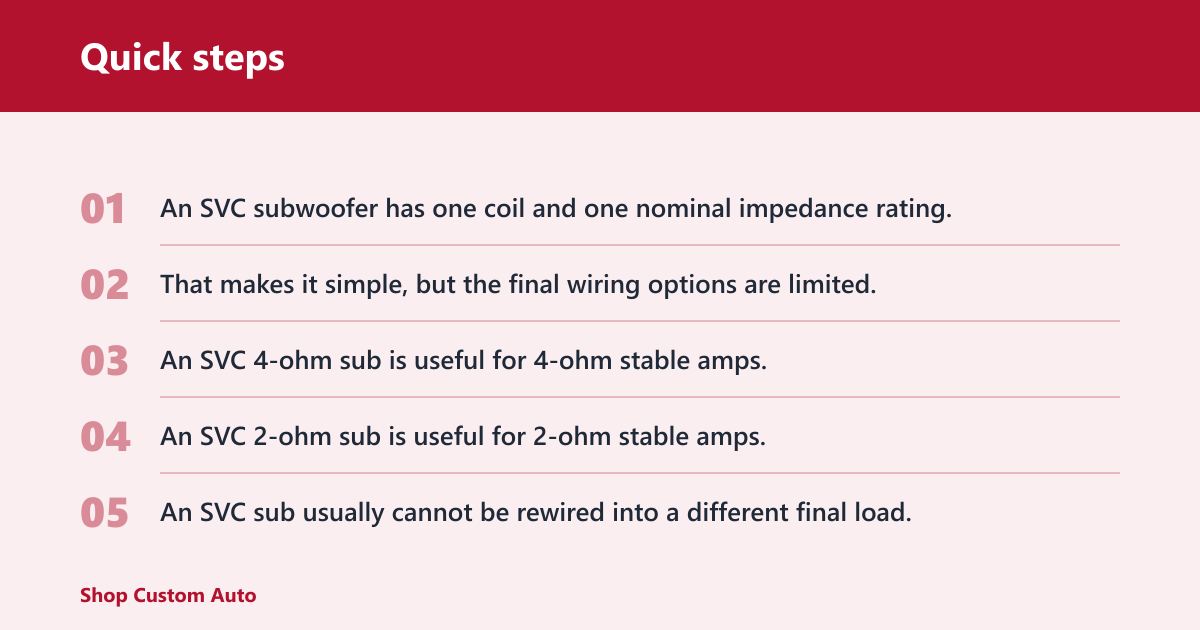
An SVC subwoofer has one coil and one nominal impedance rating. That makes it simple, but the final wiring options are limited. An SVC 4-ohm sub is useful for 4-ohm stable amps. An SVC 2-ohm sub is useful for 2-ohm stable amps. An SVC sub usually cannot be rewired into a different final load.
DVC 2-ohm subwoofers
A DVC 2-ohm sub has two 2-ohm coils. Wired in series, it typically ends up at about 4 ohms. Wired in parallel, it typically ends up at about 1 ohm. That gives you useful options for both 1-ohm stable and 4-ohm stable amplifiers, but it does not produce 2 ohms from a single DVC 2-ohm sub.
DVC 4-ohm subwoofers
A DVC 4-ohm sub has two 4-ohm coils. Wired in series, it typically ends up at about 8 ohms. Wired in parallel, it typically ends up at about 2 ohms. That makes it a common match for 2-ohm stable amps, and it can also work on 4-ohm stable amps if the amp allows a higher load.
How do you match subwoofer impedance to amplifier stability?
Start with the amp’s minimum stable load, then choose a subwoofer and coil configuration that can wire to that load without trapping you into the wrong final ohms. If you want a 2-ohm final load, buy a sub that can reach 2 ohms. If you want 1 ohm, buy a setup that can make 1 ohm safely.
Matching matrix for common amp loads
| Amplifier minimum stable load | Subwoofer type | Wiring result | Suitable? |
|---|---|---|---|
| 1 ohm | SVC 4 ohm | 4 ohm | No |
| 1 ohm | SVC 2 ohm | 2 ohm | No |
| 1 ohm | DVC 2 ohm | 1 ohm in parallel | Yes |
| 1 ohm | DVC 4 ohm | 2 ohm in parallel | No |
| 2 ohm | SVC 4 ohm | 4 ohm | Yes |
| 2 ohm | SVC 2 ohm | 2 ohm | Yes |
| 2 ohm | DVC 2 ohm | 1 ohm or 4 ohm | No for 1 ohm; Yes for 4 ohm |
| 2 ohm | DVC 4 ohm | 2 ohm in parallel | Yes |
| 4 ohm | SVC 4 ohm | 4 ohm | Yes |
| 4 ohm | SVC 2 ohm | 2 ohm | No |
| 4 ohm | DVC 2 ohm | 1 ohm or 4 ohm | No for 1 ohm; Yes for 4 ohm |
| 4 ohm | DVC 4 ohm | 2 ohm or 8 ohm | No for 2 ohm; Yes for 8 ohm |
Simple yes/no callouts for common combinations
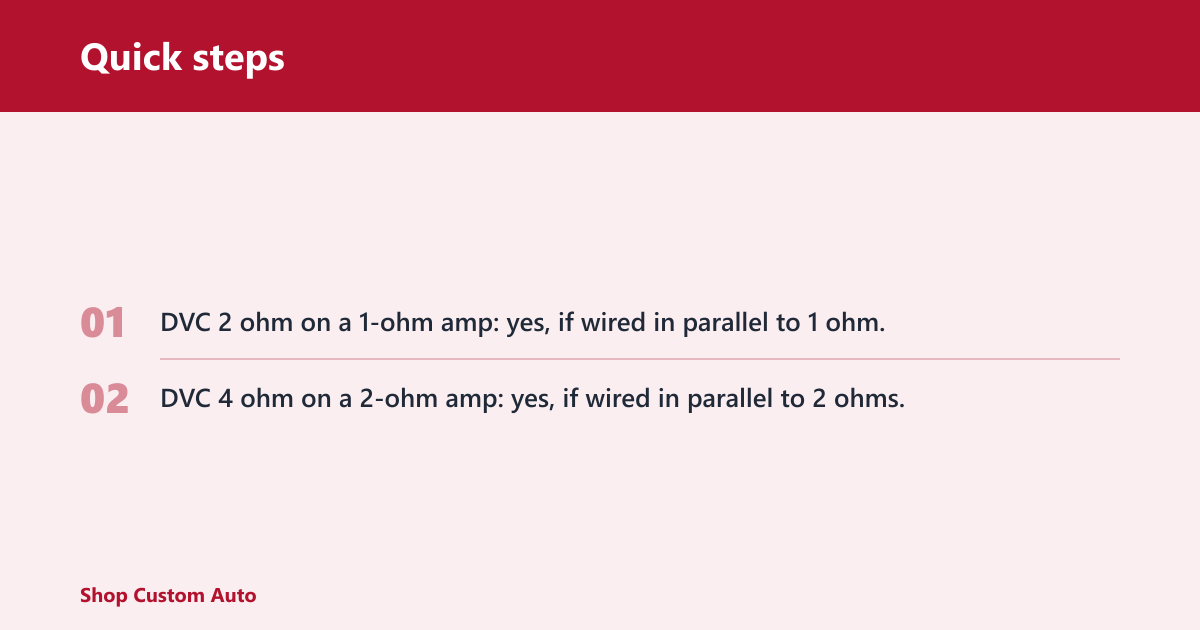
SVC 4 ohm on a 4-ohm amp: yes. SVC 2 ohm on a 4-ohm amp: no. DVC 2 ohm on a 1-ohm amp: yes, if wired in parallel to 1 ohm. DVC 4 ohm on a 2-ohm amp: yes, if wired in parallel to 2 ohms.
Is a 2 ohm or 4 ohm subwoofer better for my amplifier?
Neither is automatically better. The better choice is the one that lets your final wiring land on the amp’s safe minimum load. A 2-ohm sub often fits a 2-ohm stable amp directly. A 4-ohm sub often fits a 4-ohm stable amp directly and can also preserve safer headroom on some systems.
What the final load changes
Ohm’s law helps explain the tradeoff. With a fixed voltage, a lower resistance load draws more current. That can increase output if the amp is designed for it, but it also raises stress. A safe load is better than chasing the lowest number without checking the amp spec.
Suppose a 2-ohm stable amp gets paired with a DVC 4-ohm sub wired in parallel. The final load is 2 ohms, which matches the amp. If the same sub is wired in series, the load becomes 8 ohms, which is safe but may leave power on the table.
Will my amp run a dual 2 ohm or dual 4 ohm subwoofer?
Maybe, but only if the coil wiring can produce a final load at or above the amp’s minimum stable rating. A DVC 2-ohm sub can make 1 ohm in parallel or 4 ohms in series. A DVC 4-ohm sub can make 2 ohms in parallel or 8 ohms in series.
Choosing between DVC 2 ohm and DVC 4 ohm
- Choose DVC 2 ohm if you need 1 ohm on a 1-ohm stable amp or 4 ohms on a higher-load setup.
- Choose DVC 4 ohm if you need 2 ohms on a 2-ohm stable amp or 8 ohms for a higher-impedance application.
- Do not buy the coil type first if it cannot wire to the amp’s safe minimum load.
Can I wire my subwoofer to 1 ohm, 2 ohm, or 4 ohm?
Yes, but only if the coil configuration supports that final result and the amplifier is stable at that load. The wire pattern matters as much as the label on the box. Series adds impedance. Parallel lowers it. DVC subs create the widest set of final-load choices.
Series wiring examples
In series wiring, you add impedances. Two 2-ohm coils in series become 4 ohms. Two 4-ohm coils in series become 8 ohms. Series is the safer direction when you need a higher load than a parallel connection would produce.
Parallel wiring examples
In parallel wiring, the load drops. Two 2-ohm coils in parallel become 1 ohm. Two 4-ohm coils in parallel become 2 ohms. Parallel is useful only when the amplifier is stable at the lower final load you create.
Does lower ohm mean more bass?
No. Lower ohms do not automatically mean more bass. Lower impedance can let a compatible amp deliver more current and often more power, but only if the amp is stable at that load. Bass output depends on the full system, including enclosure, tuning, signal level, and amplifier limits.
Why power and load are linked
Current, voltage, and resistance are tied together by Ohm’s law. If resistance drops and voltage stays available, current demand rises. That can increase amplifier output in a design built for the load, but it can also cause clipping or shutdown if the amp is pushed past its stable range.
A common first-timer mistake is buying a “1-ohm capable” sub setup for a 2-ohm stable amp and then wiring it in parallel anyway. The result is not extra bass. It is usually a hot amp, protection mode, or a system that shuts off at higher volume.
What happens if the subwoofer impedance is too low for the amp?
If the load falls below the amp’s minimum stable rating, the amp may overheat, clip sooner, enter protection mode, or shut down. In some cases it can keep playing quietly, but that does not mean the setup is safe. Too-low impedance is a reliability problem, not a power upgrade.
Protection mode and overheating
Protection mode is the amp’s way of telling you the load, heat, or current demand is outside its safe operating window. Repeated shutdowns usually mean the wiring or sub choice is wrong. Heat buildup also shortens amplifier life, especially if ventilation is poor.
Clipping and shutdown risk
Clipping happens when the amp cannot cleanly provide the demanded signal. That can sound harsh and can damage speakers over time. A safe load keeps the amplifier operating where it was designed to work, which is better than squeezing out a risky extra bit of output.
How do you check subwoofer impedance with a multimeter?
Set the multimeter to ohms mode and measure across the subwoofer terminals as a quick sanity check. The reading will usually be lower than the nominal rating because the meter is reading DC resistance, not AC impedance. That difference is normal and expected.
Why the reading is below nominal
A “4-ohm” sub may read around 3 ohms on a meter, and a “2-ohm” sub may read below 2 ohms. The exact number varies by model, but the key point is simple: the meter is not proving the nominal AC load. It is only confirming the coil is not open or shorted.
What a meter cannot tell you about AC load
Electrical impedance is measured in ohms in AC circuits, but the operating load changes with frequency and enclosure behavior. That means the real load can rise above nominal during use. A meter cannot show that. It only shows the DC side of the story.
How do series and parallel wiring change the final load?
Series wiring adds coil resistance and raises the final load. Parallel wiring lowers the final load. For DVC subs, this is the whole reason coil choice matters: the same driver can become different final impedances depending on how the coils are connected to the amplifier.
How DVC subs create more final-load options
With a DVC 2-ohm sub, series wiring gives 4 ohms and parallel wiring gives 1 ohm. With a DVC 4-ohm sub, series wiring gives 8 ohms and parallel wiring gives 2 ohms. That flexibility is the main advantage of dual voice coils.
- Read the amplifier’s minimum stable load first.
- Choose a subwoofer voice-coil type that can reach that load.
- Check whether the sub needs series or parallel wiring.
- Confirm the final impedance before connecting the amp.
- Use the meter only as a sanity check, not as the final word on AC load.
Frequently asked questions
What ohm subwoofer should I get for my amp?
Get the subwoofer that can wire to your amplifier’s safe minimum load. If the amp is 1-ohm stable, choose a sub setup that can reach 1 ohm. If it is 2-ohm stable, choose a setup that can reach 2 ohms. The best choice is the one that matches the amp without forcing an unsafe load.
Is a 2 ohm or 4 ohm subwoofer better for my amplifier?
The better choice depends on the amp’s minimum stable load and the final wiring result. A 2-ohm sub is often better for a 2-ohm stable amp. A 4-ohm sub is often better for a 4-ohm rated amp. Neither is better in general if it cannot be wired safely to the amplifier.
Will my amp run a dual 2 ohm or dual 4 ohm subwoofer?
It can, if the final wired load stays at or above the amp’s minimum stable rating. A DVC 2-ohm sub can become 1 ohm or 4 ohms. A DVC 4-ohm sub can become 2 ohms or 8 ohms. Match the wiring result, not just the coil label.
What impedance does my amplifier want to see?
It wants to see the lowest load the manufacturer says it can handle safely. That is the minimum stable load. Many amps are rated at 1 ohm, 2 ohms, or 4 ohms. Use the rating that applies to the amp’s actual operating mode, especially if it is bridged.
Can I wire my subwoofer to 1 ohm, 2 ohm, or 4 ohm?
Yes, if the sub’s voice coils and the wiring method can produce that final load. Two 2-ohm coils in parallel make 1 ohm. Two 4-ohm coils in parallel make 2 ohms. Series wiring raises the load instead of lowering it, so check the final result carefully.
What happens if the subwoofer impedance is too low for the amp?
The amp may clip, overheat, enter protection mode, or shut down. Even if sound still comes out, the system is outside its safe operating window. Too-low impedance is a common cause of unstable performance, and it can shorten amplifier life if ignored.
How do I match subwoofer impedance to amplifier stability?
Start with the amp’s minimum stable load, then choose SVC or DVC subwoofers that can wire to that load using series or parallel connections. Verify the final impedance before installation. If the load can only be reached by going below the amp’s rating, pick a different coil configuration.