
Can you use parking mode without a hardwire kit safely?
Yes, parking mode can run without a hardwire kit if your dash cam can pull power from an always-on 12V outlet, an OBD-II power cable, or an external battery pack. Set it up poorly, and you can drain the starter battery or lose recording when you need it most. This guide compares those three options and helps you choose based on parking time, vehicle behavior, and battery-risk tolerance.
Can you use parking mode without a hardwire kit?

Yes, but only if the camera still has power after the ignition turns off. Parking mode keeps the camera monitoring the vehicle when the engine is off, and some systems switch to time-lapse or event recording after an impact. Hardwiring is common, but it is not required in every case.
What parking mode needs
Parking mode depends on a power source that stays available after ignition off. The camera also has to detect that the vehicle is parked, either through an ignition-off trigger or through firmware that changes modes when external power behavior changes. Some models react differently depending on the power method.
That is why “can it work?” and “will it work in your car?” are different questions. A dash cam can only stay on in parking mode if the vehicle or battery setup keeps supplying power in the right way.
Why hardwiring is common, but not required
Hardwire kits connect to the fuse box and may include low-voltage protection, which is one common reason people use them for parking mode. VIOFO says hardwire kits enable parking mode, and it also lists multiple hardwire kit models, including HK6 and HK4. Still, non-hardwired options exist for owners who want to avoid the fuse box.
Which non-hardwired parking-mode power options actually work?
The three main non-hardwired paths are an always-on 12V outlet, an OBD-II power adapter, and an external dash cam battery pack. Wolfbox lists the OBDII port, an external battery pack, and an always-on 12V outlet as non-hardwired options. Those paths differ in battery risk, install effort, and how long they can support parking mode.
- Always-on 12V outlet: simplest if the socket stays live after shutdown.
- OBD-II power adapter: plugs into the port under the dashboard and can keep the camera powered after the engine stops.
- External battery pack: charges while driving and powers the camera while parked.
How do you know which option your vehicle supports?
Start with two checks: whether the 12V socket stays live with the key off, and whether the OBD-II port remains powered after shutdown. If neither stays live, a battery pack or a hardwire kit becomes the practical path. Do not assume a port is live just because it powers accessories while driving.
- Turn the vehicle off and remove the key or shut down the ignition.
- Check whether the 12V outlet still powers a known accessory.
- Check whether an OBD-II adapter still has output after shutdown.
- Watch whether the dash cam enters parking mode automatically.
- If power disappears, treat that method as unsupported in that vehicle.
Say your sedan has a center-console socket that stays live for a short time after shutdown, then turns off. That may support short stops, but it is a poor fit for overnight street parking because the camera can stop before the risk period is over.
📊 VIOFO lists multiple hardwire kit models, including HK6 and HK4. Source: Viofo.
Which option is best for overnight parking, workday parking, or airport storage?
The best choice changes with how long the vehicle sits. Overnight street parking usually needs a method with low starter-battery risk. All-day work parking can work with more options if low-voltage cutoff is set correctly. Airport storage pushes many owners toward an external battery pack or a hardwire setup with careful protection.
Overnight street parking
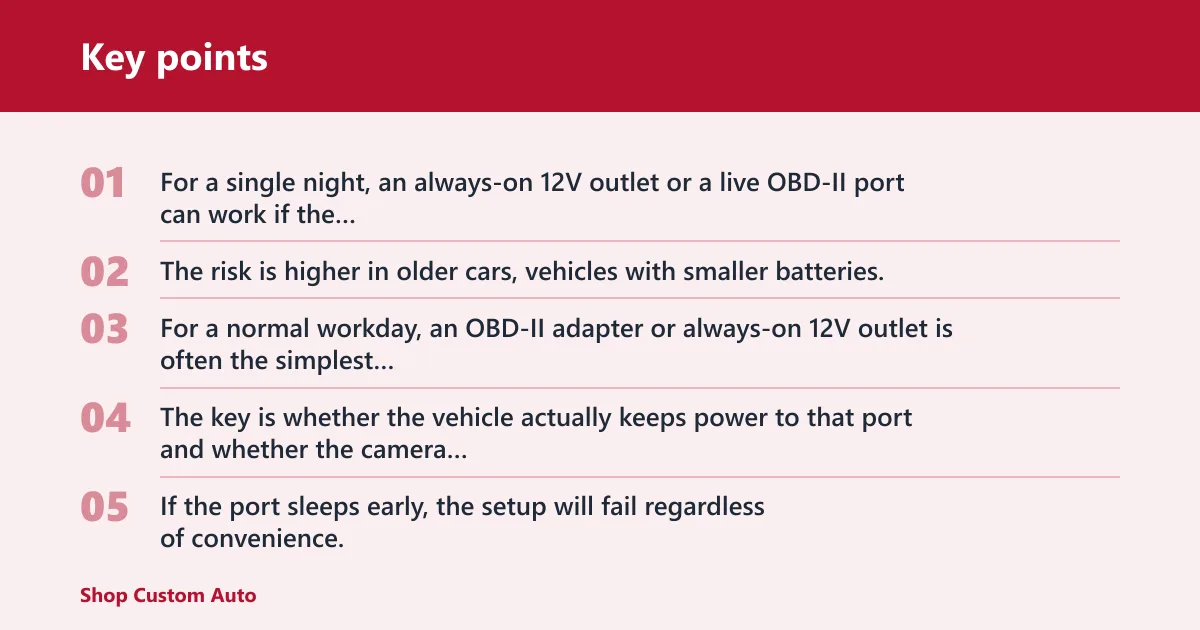
For a single night, an always-on 12V outlet or a live OBD-II port can work if the vehicle battery is healthy and the camera has low-voltage cutoff. The risk is higher in older cars, vehicles with smaller batteries, or cars that sit for long periods before the next drive.
All-day work parking
For a normal workday, an OBD-II adapter or always-on 12V outlet is often the simplest non-hardwired setup. The key is whether the vehicle actually keeps power to that port and whether the camera can limit drain. If the port sleeps early, the setup will fail regardless of convenience.
Long-term airport parking
For multi-day parking, an external battery pack is often a safer non-hardwired choice because it can reduce strain on the starter battery. A pack is still not magic. It must be sized and charged correctly, and it has to support the camera’s parking-mode draw for the length of the trip.
Suppose a compact SUV is left at an airport garage for five days. An always-on socket may seem easy, but the risk to the starter battery rises over time. A battery pack is the more cautious option because it separates parking-mode power from the vehicle battery.
Use this checklist to match vehicle power behavior to the right setup
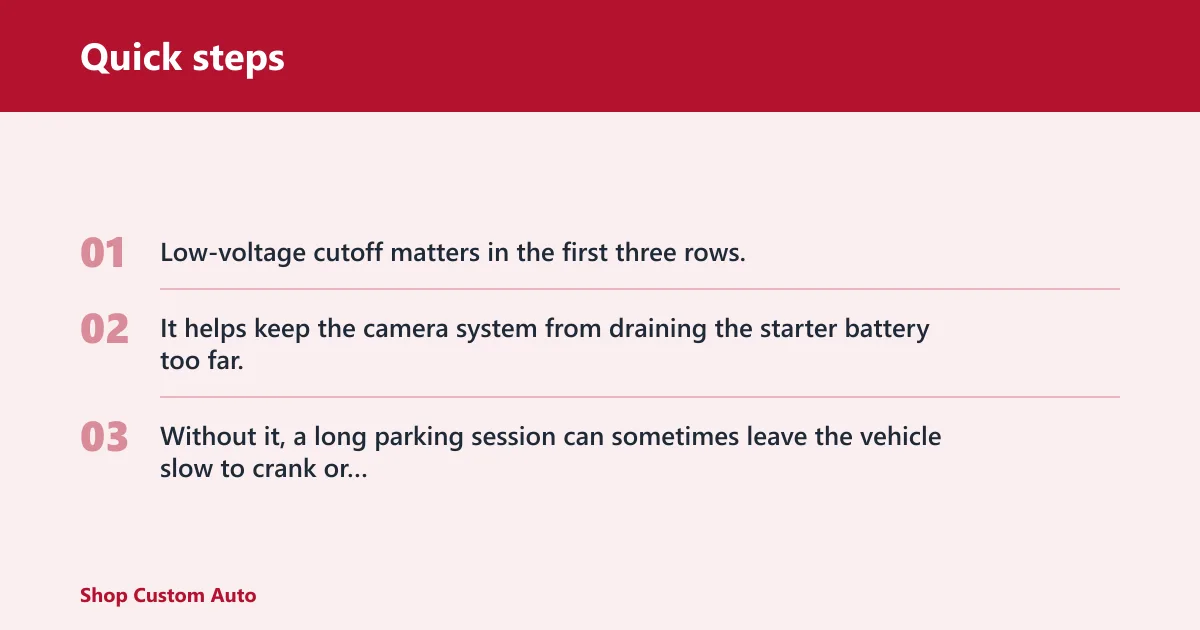
This table turns the decision into a vehicle check. It maps the power behavior you find, the best non-hardwired method, a simple yes/no test, and a risk rating for battery drain. If the vehicle does not pass the test, do not treat the method as reliable.
| Vehicle power behavior | Best method | Simple yes/no test | Battery-drain risk |
|---|---|---|---|
| Always-on 12V outlet | Use the 12V outlet, with low-voltage cutoff if the camera supports it | Yes if the socket still powers a device after ignition off; no if it shuts off immediately | Medium |
| Switched 12V outlet | External battery pack, or hardwire kit if parking mode is required | Yes if the socket stays on after shutdown; no if it loses power with the ignition | High for direct 12V use; Low to medium with battery pack |
| Live OBD-II port | OBD-II power adapter with battery protection | Yes if the adapter still has power after the car is off; no if the port sleeps or shuts down | Medium |
| None | External battery pack or hardwire kit | Yes only if the camera has a separate battery source; no if it relies on vehicle outlets alone | Low with battery pack; low to medium with hardwire kit and cutoff |
Low-voltage cutoff matters in the first three rows. It helps keep the camera system from draining the starter battery too far. Without it, a long parking session can sometimes leave the vehicle slow to crank or unable to start.
Will parking mode drain your car battery if you avoid hardwiring?
Yes, it can, because every non-hardwired option that draws from the vehicle still pulls from the starter battery unless an external pack sits in between. Low-voltage cutoff reduces the risk, but it does not make drain impossible. The longer the car sits, the more important battery protection becomes.
How low-voltage cutoff changes the risk
Low-voltage cutoff stops the camera or adapter from running the battery down too far. That is especially relevant for OBD-II adapters and always-on 12V outlets. It does not tell you how much parking time you have left, but it does create a guardrail that can prevent a no-start condition.
Why battery packs reduce starter-battery strain
An external dash cam battery pack charges while driving and powers the camera while parked. That setup isolates parking-mode use from the starter battery, which is why it is the safer choice for longer parking periods. Wolfbox lists an external battery pack as a non-hardwired option, and VIOFO lists battery packs as accessories for dash cams.
Warning signs that the setup is unsafe
If the vehicle struggles to crank after a parking session, the setup is too aggressive. If the camera drops offline early, the vehicle may be cutting power or the cutoff may be too conservative. If the OBD port is warm, the adapter is acting oddly, or the camera reboots repeatedly, stop and check the power source.
How do you set a dash cam to enter parking mode automatically?
Most dash cams enter parking mode when they detect ignition-off behavior or a change in external power. Some cameras switch automatically; others need a specific parking trigger in firmware. If the camera does not see the right power pattern, it may stay in normal recording mode or shut down.
Ignition-off detection and firmware behavior
Parking mode detection is not only about whether the port has power. The camera must also recognize that the car is off. Some models use voltage change, delayed shutdown, or accessory power loss to trigger the mode change. Others need a menu setting that tells them how to interpret the power source.
Common failure cases
A camera may never enter parking mode if the power source behaves like a live accessory line and never signals shutdown. It may also fail if the OBD port sleeps in a way the camera does not interpret correctly. Another common problem is intermittent power from an accessory socket, which can make the camera restart instead of staying in parking mode.
- The outlet turns off too quickly after shutdown.
- The OBD port sleeps after a delay.
- The camera firmware expects a different trigger.
- The power cable is loose or the adapter is incompatible.
What happens if my car turns off the 12V socket when the engine is off?
If the 12V socket loses power when the engine stops, that method will not support parking mode by itself. The camera will shut down unless it has its own battery source or another live power path. In that case, an OBD-II adapter, battery pack, or hardwire kit becomes the better choice.
Simple yes/no test for the socket
Turn the ignition off and confirm whether the socket still powers a device. Wolfbox notes that some cars keep the cigarette lighter active after shutdown, which means some cars do and some do not. If the answer is no, do not plan parking mode around that outlet.
Will an OBD-II adapter keep a dash cam on in parking mode?
Sometimes, yes. Wolfbox says its OBD-II method can power parking mode after the engine stops, and VIOFO lists a dedicated OBD-II power cable for dash cams. But the adapter only works if the vehicle keeps the OBD port live long enough and the camera supports that trigger behavior.
When OBD-II works well
An OBD-II adapter is a practical middle ground when the port stays live after shutdown and the camera can detect parked state properly. It is often simpler than opening the fuse box, and many adapters include battery-protection features. That said, it still draws from the vehicle battery.
When OBD-II fails
Some OBD-II ports sleep after shutdown or lose power quickly. Others remain live only for a short window, which is enough for diagnostics but not for parking mode. If the camera powers off, reboots, or never enters parking mode, the adapter is not a reliable fit for that vehicle.
Can you use an always-on 12V outlet for dash cam parking mode?
Yes, if the socket truly stays powered after the ignition turns off. That is the simplest non-hardwired option. Wolfbox lists an always-on 12V outlet as another option and says some cars keep the cigarette lighter active after shutdown, but many vehicles do not.
What to check before relying on it
Confirm that the socket is always-on, not delayed-off or accessory-only. A delayed-off socket may work for short stops but fail during longer parking periods. If the outlet stays live, make sure the dash cam has battery monitoring or low-voltage cutoff, because the vehicle battery still matters.
Is a battery pack better than hardwiring for parking mode?
For long parking periods, often yes, because it reduces risk to the starter battery. For short or moderate parking periods, hardwiring may be more direct and cheaper. The better choice depends on how long the car sits, how much install work you want to avoid, and whether you need the cleanest possible setup.
Practical cost comparison
Look at the total cost, not only the adapter price. A non-hardwired setup may include the adapter or battery pack, cable routing, and time spent confirming compatibility. Hardwiring adds fuse-box work but often gives more predictable parking-mode behavior. A battery pack costs more up front, but it separates parking use from the starter battery.
Choose by parking duration
For overnight use, an OBD-II adapter or always-on 12V outlet may be enough if the vehicle supports it. For all-day work parking, battery protection becomes more important. For airport storage or multi-day parking, an external battery pack is usually the safer non-hardwired answer.
How do you power a dash cam in parking mode without hardwiring?
You can power it through an always-on 12V outlet, a live OBD-II port, or an external battery pack. The right path depends on whether the vehicle keeps power after ignition off and how long you want parking mode to run. Start with the vehicle’s power behavior, then set battery protection accordingly.
- Check whether the 12V outlet stays live after shutdown.
- Check whether the OBD-II port stays live after shutdown.
- Confirm that the camera supports automatic parking-mode switching.
- Enable low-voltage cutoff if the setup draws from the starter battery.
- Use a battery pack for longer parking periods.
Common first-timer mistake: assuming the OBD port is always hot because the camera powers on in the driveway. A port that works during driving can still sleep after the engine stops, which means parking mode fails at the exact moment you need it.
Frequently asked questions
Will parking mode drain my car battery if I use the OBD port?
It can. An OBD-II adapter draws from the vehicle battery unless an external battery pack is in the middle. Low-voltage cutoff lowers the risk, but it does not remove it. If the vehicle sits for long periods, check how long the port stays live and how the camera manages cutoff.
Do dash cams switch to parking mode automatically when the ignition is off?
Many do, but not all. The camera needs a trigger it can recognize, such as ignition-off behavior or a change in power state. Some models need a specific menu setting, and some power methods confuse the camera enough that it never enters parking mode reliably.
How do you power a dash cam in parking mode without hardwiring?
Use an always-on 12V outlet, an OBD-II power adapter, or an external battery pack. Then confirm that the camera can enter parking mode automatically and that the vehicle power source stays live after shutdown. If the outlet or port turns off, that method will not hold parking mode.