Is It Better to Hardwire a Dash Cam? Pros and Trade-Offs
Hardwiring is the better fit if you want parking mode, cleaner cable routing, or a free 12V socket. Plug-in power works fine for driving-only recording. Using the wrong power setup can make parked-car footage unavailable, drain a battery you did not intend to use, or leave the cabin cluttered with loose cables. This guide compares hardwire kits and plug-in power by parking mode, battery protection, install effort, and socket use.
Hardwire vs plug-in power: the real trade-off
The choice is about use case, not a universal winner. Hardwiring connects the dash cam directly to the car’s electrical system, while a plug-in dash cam uses the car’s 12V socket. One method favors parked-car coverage and hidden wiring; the other favors speed, reversibility, and fewer electrical changes.
What hardwiring changes
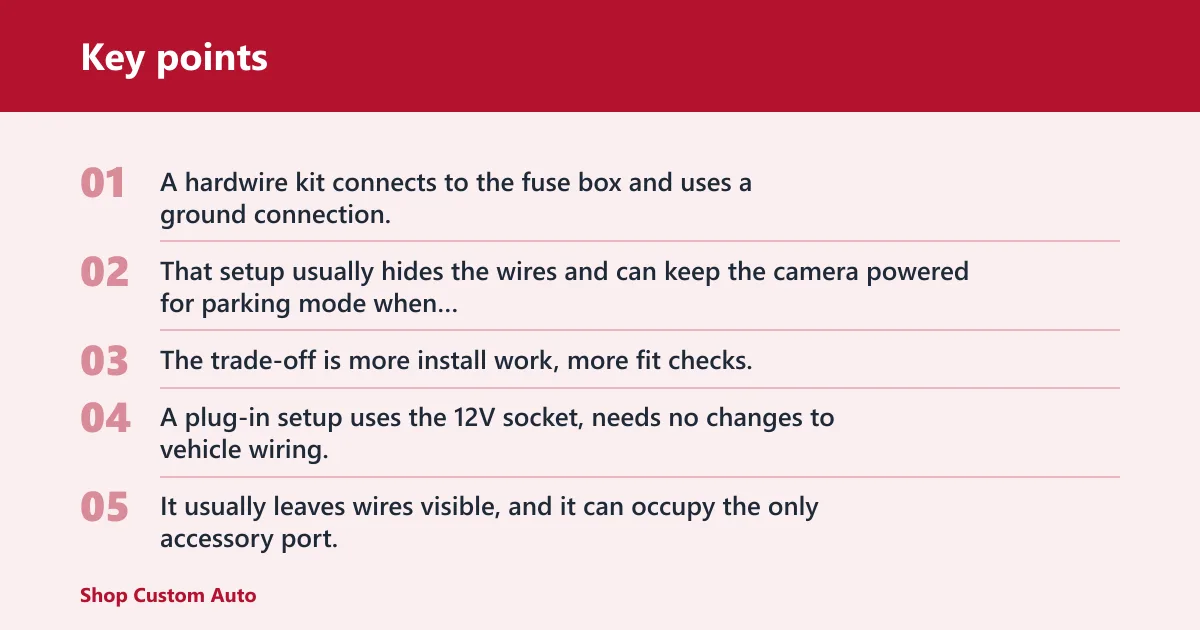
A hardwire kit connects to the fuse box and uses a ground connection. That setup usually hides the wires and can keep the camera powered for parking mode when the vehicle is off. The trade-off is more install work, more fit checks, and more risk if the wiring is done poorly.
What a 12V socket setup changes
A plug-in setup uses the 12V socket, needs no changes to vehicle wiring, and is usually quicker to remove later. It usually leaves wires visible, and it can occupy the only accessory port. That matters if you already use the socket for a phone charger, radar detector, tire inflator, or cooler.
Quick side-by-side comparison
| Criterion | Hardwire kit | 12V socket / cigarette lighter |
|---|---|---|
| Power source | Fuse box connection | Car’s 12V socket |
| Parking mode | Can support parking mode when the car is off | Usually for driving-only recording |
| Wiring appearance | Usually hides wires | Usually leaves wires visible |
| Install changes | Requires fuse tap/add-a-fuse and grounding | No changes to vehicle wiring |
| Port tradeoff | Keeps the 12V socket free | Occupies the socket while in use |
📊 A plug-in dash cam uses the car’s 12V socket. Source: Hardwired vs Plug-In Dash Cam: Which One Should You Choose?.
When hardwiring is worth it
Hardwiring is worth it when parking mode matters, when cable clutter is a problem, or when you need the 12V socket for something else. It is also the better fit if you want the camera to stay powered after shutdown and your vehicle supports the right fuse and grounding setup.
Parking mode is a real need
Parking mode records when the vehicle is off. That usually needs a constant-power source or a hardwire setup with low-voltage protection. If your car spends time on the street, in a shared lot, or in a garage with other vehicles nearby, parked-car recording can matter more than easy install.
You want hidden wiring
Hardwired setups usually hide the wires. That is useful if you care about a tidy cabin, if the dash cam sits far from the socket, or if the power cable would otherwise cross the dashboard and hang near the shifter. Hidden wiring is a comfort feature, not the main reason to hardwire.
You need to free the accessory port
If the 12V socket already powers another device, hardwiring can free that port. A common first-timer mistake is to plug the dash cam into the only socket and then discover there is nowhere to charge a phone on a long trip. Hardwiring avoids that tradeoff.
When a plug-in setup is the better choice
Plug-in power is the better choice when you want the simplest install, plan to remove the camera later, or do not need parked-car recording. It avoids vehicle wiring changes, which makes it the safer default for many lease holders, rental users, and drivers who only want recording while driving.
Simple install and easy removal
A plug-in setup is usually the fastest path to working footage. You run the cable to the 12V socket, power up the camera, and you are done. That matters if you do not want to route a fuse tap, choose a grounding point, or troubleshoot a fuse-slot fit issue.
You lease the car or want reversibility
If you lease, plan to sell soon, or want a setup that is easy to undo, plug-in power is the cleaner option. Hardwiring is still reversible, but it creates more steps and more chances to leave visible traces or fit issues if the install is rushed.
You do not need parking mode
If your dash cam is only for driving incidents, a plug-in setup is usually enough. You do not need to pay for a hardwire kit just to record while the engine is on. In that case, the added complexity buys little practical value.
How a hardwire kit works
A hardwire kit connects the camera to the fuse box, uses an add-a-fuse or fuse tap, and completes the circuit with a ground wire on bare metal. The kit also has to match the dash cam connector type. If the plug shape or voltage requirement is wrong, the camera may not work correctly.
Fuse box, add-a-fuse, and ground connection
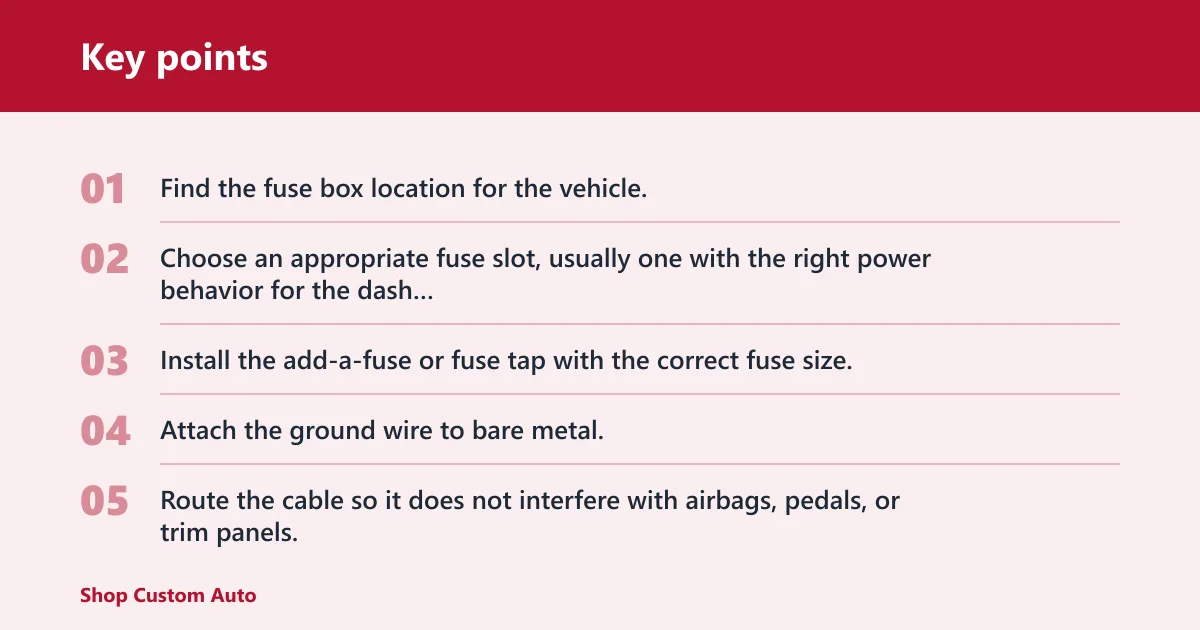
The fuse box is where hardwire kits connect power. An add-a-fuse or fuse tap lets you tap an existing slot without cutting factory wiring. You still need the correct fuse size for the vehicle’s fuse panel, and the ground wire should attach to a metal part of the car, often a grounding bolt.
- Find the fuse box location for the vehicle.
- Choose an appropriate fuse slot, usually one with the right power behavior for the dash cam.
- Install the add-a-fuse or fuse tap with the correct fuse size.
- Attach the ground wire to bare metal.
- Route the cable so it does not interfere with airbags, pedals, or trim panels.
Low-voltage cutoff and battery protection
Battery protection matters because parking mode can drain the battery if the camera runs too long. Competitor copy says low-voltage cutoff can stop discharge near 11.8V or 12.0V. That kind of cutoff helps reduce risk, but it does not make parking mode free; it only limits how far the battery can drop.
Connector type and voltage match
Do not assume every hardwire kit fits every dash cam. The connector type has to match, and the kit must suit the camera’s power requirements. If the hardware does not match, the result is failure to power on, unstable parking mode, or a setup that looks installed but does not function as intended.
Suppose a commuter leaves a car parked for many hours a day in a shared lot. A hardwire kit with cutoff protection can be sensible if parked-car coverage matters. Suppose a weekend driver only uses the car on Saturdays. Plug-in power is usually the simpler fit, since parked-car recording adds little value.
Which power option fits your use case?
The best choice depends on how the car is used, not on the dash cam itself. Daily commuters, street parkers, lease holders, and owners who need the socket free all face different tradeoffs. OBD-II is a valid alternative in some cases, but it is not the same as fuse-box hardwiring.
Daily commuter
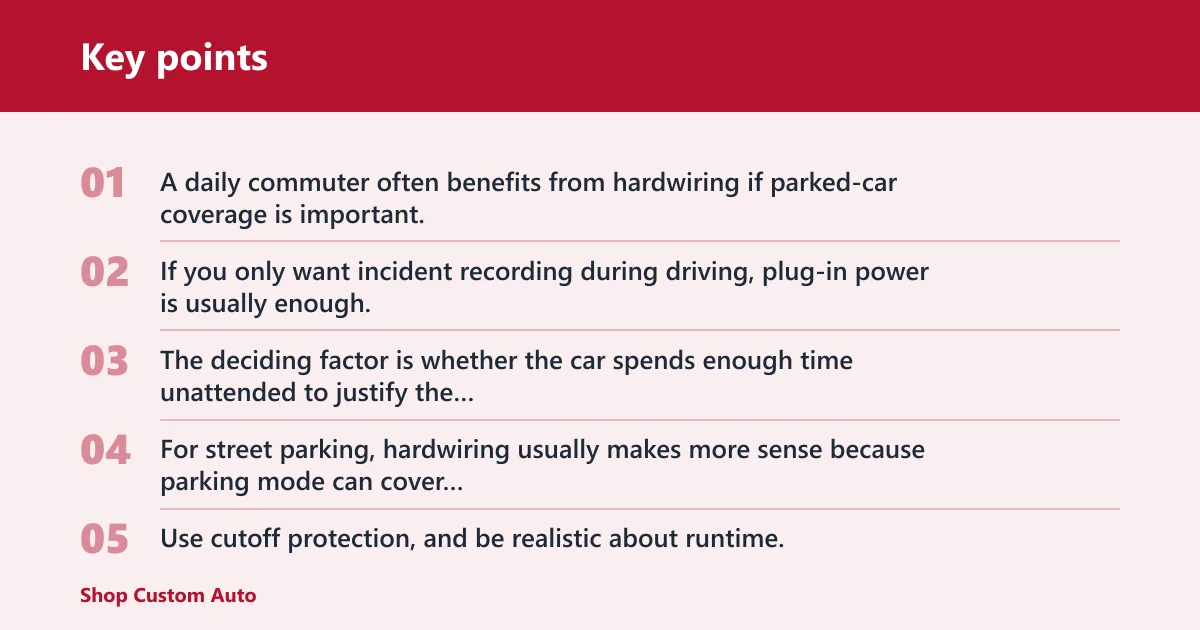
A daily commuter often benefits from hardwiring if parked-car coverage is important. If you only want incident recording during driving, plug-in power is usually enough. The deciding factor is whether the car spends enough time unattended to justify the added install work.
Street parker
For street parking, hardwiring usually makes more sense because parking mode can cover bumps, contact, or motion near the car after shutdown. Use cutoff protection, and be realistic about runtime. A cutoff near 11.8V or 12.0V is there to limit drain, not to provide all-night recording forever.
Weekend driver
A weekend driver usually gets more value from plug-in power. The car is on for fewer hours, parking risk is lower, and a simple setup keeps installation time down. If you only need footage while driving, plug-in is hard to beat on convenience.
Lease or rental user
Lease and rental users should lean toward plug-in power unless they have explicit permission for electrical modifications. Hardwiring may be reversible, but it still means touching the fuse box, choosing a fuse tap, and making a ground connection. That is more than many short-term users want to handle.
Driver who needs the 12V socket free
If the 12V socket already powers a charger or emergency inflator, hardwiring is often the better fit. You keep the port open and avoid cable conflicts. That can be more valuable than hidden wiring alone, especially on cars with only one accessory outlet.
Owner considering OBD-II power
OBD-II can be a fast alternative power route, especially when you want a quick plug-in method without using the 12V socket. It is not the same as fuse-box hardwiring, and it can block mechanic scan access if left in place. Choose it only when that tradeoff is acceptable.
Use the one-page decision matrix
Use this matrix as a shortcut. Match your real use case to the power method that fits parking mode needs, install tolerance, battery risk, cable visibility, and accessory-port use. If more than one row fits, choose the option that creates fewer long-term compromises.
Six common driver scenarios
| Scenario | Parking mode need | Install difficulty | Cable visibility | Battery risk | Port tradeoff | Best power option |
|---|---|---|---|---|---|---|
| Daily commuter who parks on the street | High | Medium | Lower with hardwire | Needs cutoff protection | Keep socket free if possible | Hardwire |
| Weekend driver with garage parking | Low | Low | Not a big issue | Low | Socket use is usually fine | Plug-in |
| Lease holder who wants reversibility | Low to medium | Low | Visible cable may be acceptable | Low | May need the socket later | Plug-in |
| Owner who needs the 12V socket for another device | Medium | Medium | Lower with hardwire | Needs cutoff protection | Socket must stay free | Hardwire |
| Driver who wants quick setup and no wiring changes | Low | Low | Usually visible | Very low | Uses the socket | Plug-in |
| Owner considering OBD-II instead of the fuse box | Medium | Low to medium | Usually moderate | Depends on the adapter | Does not use the 12V socket | OBD-II if acceptable, otherwise hardwire |
How to read the matrix
Start with parking mode. If you do not need it, plug-in power usually wins. Then check battery risk tolerance and port tradeoff. If the socket is already spoken for, or cable visibility matters a lot, hardwiring rises in value even if install takes longer.
Choose hardwire if… / choose plug-in if…
Choose hardwire if parking mode matters, if you want hidden wiring, or if the 12V socket needs to stay free. Choose plug-in if you want the fastest install, do not want to touch the fuse box, or only need recording while driving. The better answer is the one that fits the car’s use pattern.
Choose hardwire if…
- You want parking mode when the car is off.
- You can accept a more involved install with an add-a-fuse and a ground connection.
- You want hidden wiring.
- You need the accessory port free for another device.
Choose plug-in if…
- You want no changes to vehicle wiring.
- You do not need parking mode.
- You want the simplest removal for a lease, rental, or resale plan.
- You can live with visible cable routing and using the 12V socket.
Frequently asked questions
is it better to hardwire a dash cam or cigarette lighter
Hardwire is better if you need parking mode, hidden wiring, or a free 12V socket. Cigarette-lighter power is better if you want a fast install with no wiring changes. The right answer depends on whether the camera must work after shutdown or only while driving.
is it better to hardwire a dash cam
Hardwiring is better for drivers who want parking mode, cleaner cable routing, or a setup that does not use the 12V socket. It is not automatically better for everyone. If you only need drive-time recording, a plug-in setup is often the more practical choice.
is it worth hardwiring a dash cam
It is worth hardwiring when parked-car coverage, cable tidiness, or accessory-port access matters enough to justify the extra install steps. It is usually not worth it for a weekend driver who only wants basic recording. Value comes from use case, not from the wiring method itself.
does a dash cam have to be hardwired
No. A dash cam can run from the 12V socket, and plug-in power needs no changes to vehicle wiring. Hardwiring is mainly for parking mode and a cleaner cabin layout. Many drivers never need anything beyond the included socket cable.
can a dash cam be hard wired
Yes. Hardwiring connects the dash cam directly to the car’s electrical system through the fuse box. The install should use an add-a-fuse or fuse tap and a ground connection to bare metal. The kit must also match the camera’s connector type.
is it hard to hardwire a dash cam
It is harder than plugging into the 12V socket, because you must choose a fuse slot, install a fuse tap, and find a proper ground point. The work is manageable for many owners, but it is not a casual plug-and-play job. Vehicle layout also changes the difficulty.
is it bad to hardwire a dash cam
No, not when it is done correctly with the right kit and battery protection. It becomes a problem if you use the wrong fuse, ground poorly, or ignore voltage cutoff. The method itself is normal; the risk comes from bad setup, not from hardwiring as a concept.