
What Voltage Should an Amp Remote Turn On Wire Have?
An amp remote turn-on wire should read about 12 volts with the key or radio on, and you should see nearly the same voltage at the amp’s REM terminal; a noticeable voltage drop may point to a wiring problem or a weak trigger path. If that signal is missing or too weak, the amplifier may stay off, send you into parts-swapping, and hide the real fault. This guide shows where to probe with a multimeter, what numbers count as healthy, and how to tell voltage presence from enough trigger current to wake the amp.
What you’ll need
- Digital multimeter set to DC volts
- Test leads or backprobe pins
- Access to the head unit, fuse panel, and amplifier REM terminal
- Small pick or trim tool for reaching tight connectors
- Optional: relay and fuse holder if the trigger circuit must feed multiple devices
📊 The remote wire is typically a thin 18-gauge wire. Source: How to Wire an Amplifier Remote Turn-On Wire [2026 Guide].
What voltage should an amp remote turn on wire have?
A healthy remote turn-on wire typically reads about 12 volts when the stereo or ignition is on and 0 volts when it is off. That is the practical threshold to look for at both the source wire and the amplifier REM terminal. The wire is a low-current trigger, usually a thin 18-gauge wire, and it connects directly to the amplifier REM terminal.
Normal reading with the key or radio on
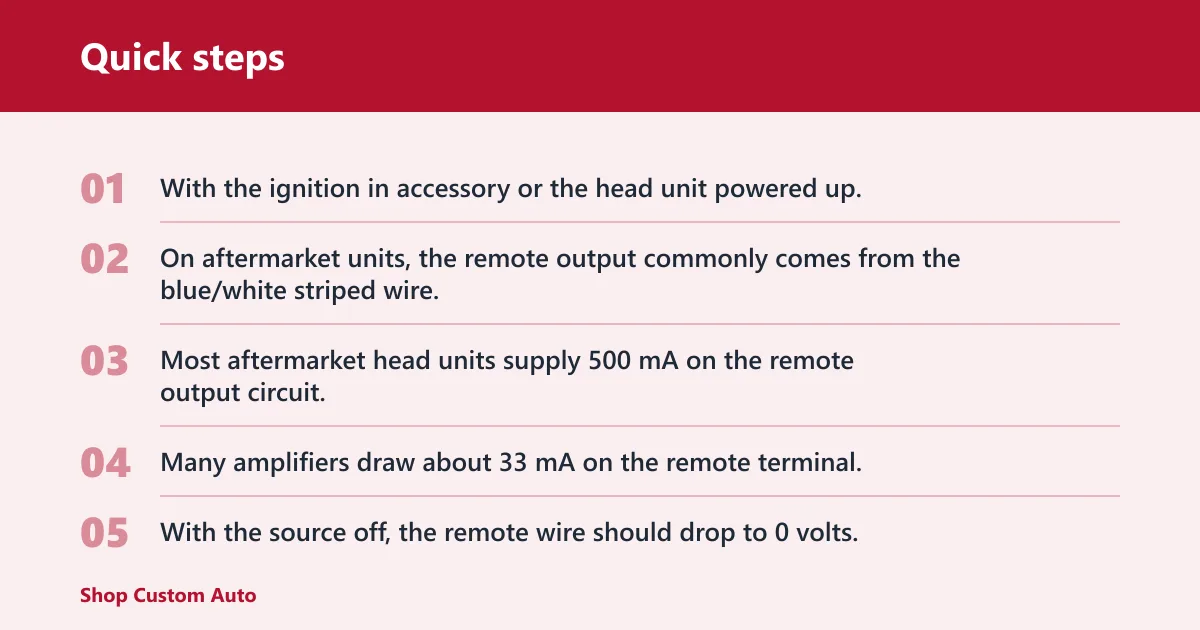
With the ignition in accessory or the head unit powered up, a good remote circuit should show near battery voltage. On aftermarket units, the remote output commonly comes from the blue/white striped wire, which wakes the amp rather than powers it.
Most aftermarket head units supply 500 mA on the remote output circuit, and some can supply up to 1 A. Many amplifiers draw about 33 mA on the remote terminal, so a single amp is usually a light load.
Normal reading with the key or radio off
With the source off, the remote wire should drop to 0 volts. If it stays at voltage all the time, the amplifier may never shut down, or the wire may be tied to a constant hot source by mistake.
Why 12 volts at the source is not always enough
Source-side voltage only proves the trigger exists at one point. The real test is whether that same voltage reaches the amp REM terminal. A bad splice, damaged run, weak crimp, or overloaded remote output can still leave the meter showing voltage where the amp needs it.
Say your head unit shows 12.4 volts on the blue/white wire, but the amp sits dead. That points away from the radio itself and toward the run between the radio and amplifier, or toward a trigger output that cannot supply enough current under load.
How do you test an amp remote wire with a multimeter?
Set the multimeter to DC volts, probe the source wire first, then probe the amplifier REM terminal with the system on. Repeat with the system off. The comparison tells you whether the issue is the trigger source, the wire run, or the amp side connection.
Measure at the source wire first
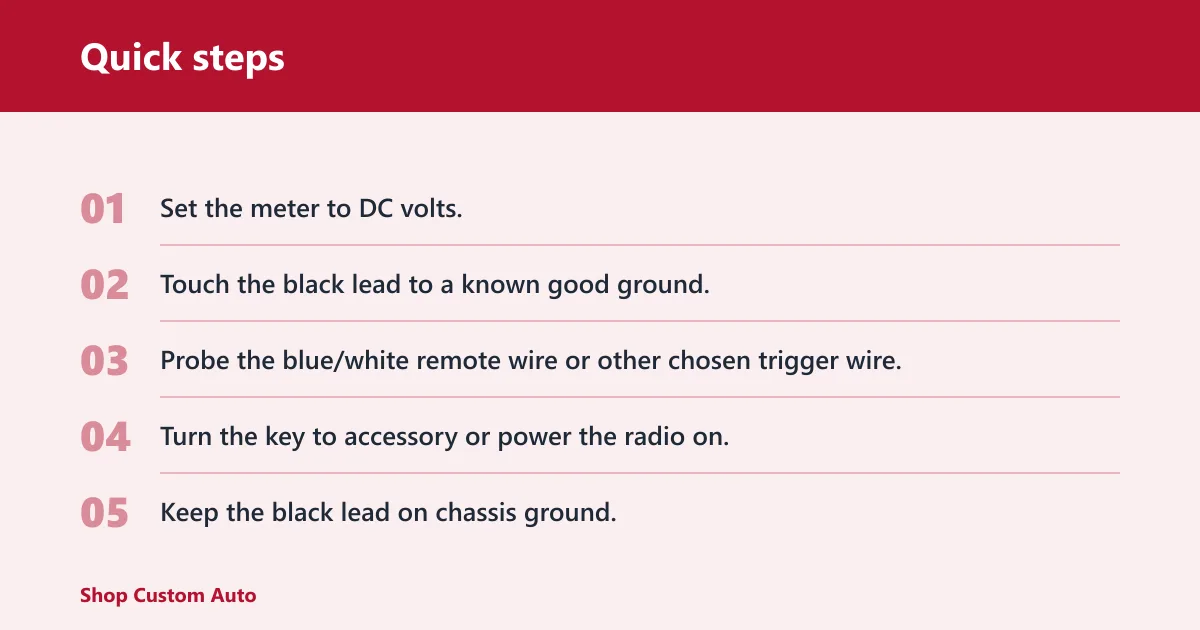
- Set the meter to DC volts.
- Touch the black lead to a known good ground.
- Probe the blue/white remote wire or other chosen trigger wire.
- Turn the key to accessory or power the radio on.
Check for 12V at the REM terminal with ignition accessory on, then turn the car off and confirm the remote drops to 0V. Those two readings give you a clean on/off picture.
Measure again at the amplifier REM terminal
- Keep the black lead on chassis ground.
- Probe the amplifier REM terminal directly.
- Compare the reading to the source wire with the system on.
- Check the same point again with the system off.
A healthy run should show nearly the same voltage at both ends. A noticeable difference means the trigger path is losing voltage before it reaches the amp.
Compare on and off readings to isolate the fault
If the source has voltage and the amp does not, the open is between those two points. If neither point has voltage, the problem is upstream: wrong wire, no switched feed, or no accessory output from the radio harness.
| Source-side reading | Amp-side reading | Key state | Likely fault |
|---|---|---|---|
| 12V | 12V | On | Normal turn-on path |
| 12V | 0V | On | Open splice, broken run, or bad connection |
| 0V | 0V | On | Wrong source, no switched feed, or dead trigger output |
| Any reading above 0V | Any reading above 0V | Off | Constant hot feed or backfeed from another circuit |
Suppose the source wire reads 12.1 volts, the amp end reads 11.9 volts, and the amp still stays off. That is not a wiring-loss problem first. It points to a trigger path that may have enough voltage for a meter, but not enough usable current for the load attached to it.
How do you identify the right turn-on wire?
Use the wire color and source behavior, not guesswork. On roughly 97% of aftermarket head units, the remote output is blue/white striped. The solid blue wire is the power antenna output, and it can shut off in Bluetooth or AUX mode. A factory setup usually needs a switched 12V source from the accessory circuit or fuse panel.
Aftermarket head unit: blue/white remote output
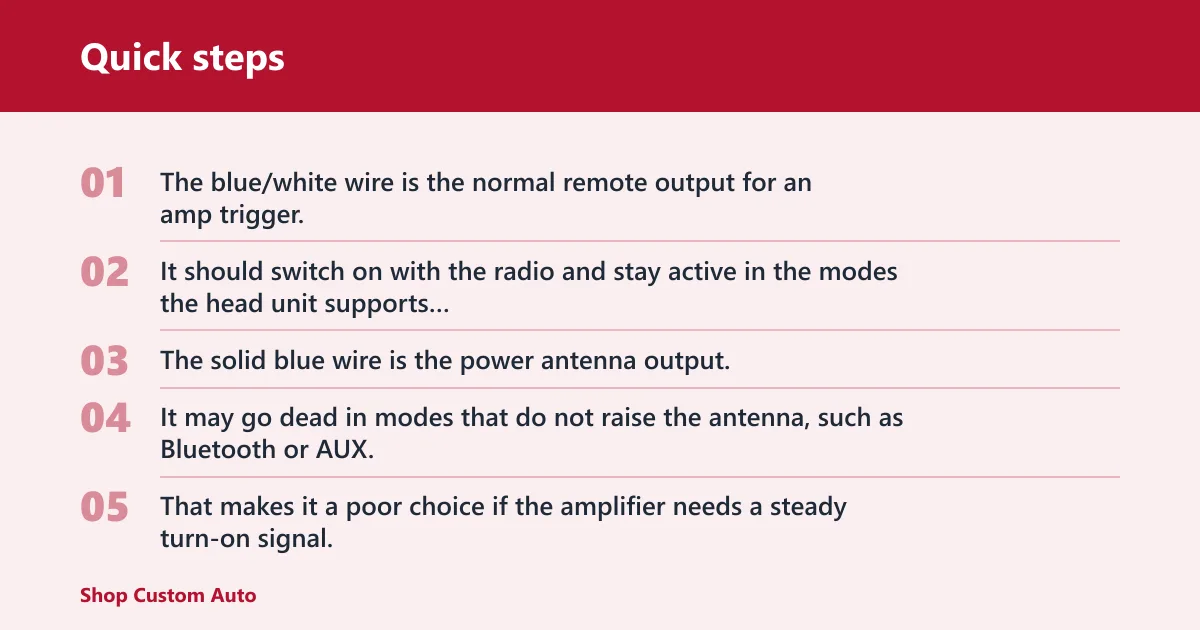
The blue/white wire is the normal remote output for an amp trigger. It should switch on with the radio and stay active in the modes the head unit supports as a remote feed.
Power antenna lead: solid blue and mode-dependent
The solid blue wire is the power antenna output. It may go dead in modes that do not raise the antenna, such as Bluetooth or AUX. That makes it a poor choice if the amplifier needs a steady turn-on signal.
Factory radio: switched 12V from an accessory or fuse-panel source
Factory radios often do not offer a dedicated remote output. In that case, use a switched 12V source that turns on with ACC or ignition. The fuse panel is a common place to find one, but the circuit must be switched, not constant hot.
When do you need a relay?
Use a relay when the head unit’s remote output has to feed too many devices or the circuit is not staying stable. A relay protects the head unit output transistor and gives the trigger line a cleaner path to multiple loads. It is generally recommended for higher-current loads, roughly a few amps or more.
Multiple amps on one remote circuit
If several amplifiers share one trigger wire, the combined load can exceed what the head unit remote output should carry. That is where a relay makes sense.
Adding a DSP, active crossover, or other trigger load
DSPs, active crossovers, and similar devices add more current draw to the turn-on line. If the remote output is already near its limit, the meter may still show voltage while the devices fail to wake reliably.
What if the remote wire has 12 volts but the amp still won’t turn on?
That usually means the amp is seeing voltage, but the trigger path cannot deliver enough usable current, the REM terminal connection is poor, or the amplifier has a separate power or ground problem. Start by comparing source-side and amp-side readings, then check the amp’s main power, ground, and fuse.
- Probe the amp REM terminal with the key on.
- Check the amplifier main power fuse and chassis ground.
- Inspect the splice at the remote wire.
- Use a relay if the circuit feeds several devices.
A common first-timer mistake is reading 12 volts at the radio and assuming the amp should wake up. The meter only proves voltage exists, not that the trigger circuit can support the load at the other end.
Common mistakes
Most remote problems come from a short list of wiring errors. The fix is usually simple once the bad point is isolated.
- Swapping the blue wire and blue/white wire: the solid blue wire is the power antenna lead, not the normal amp remote output.
- Using a constant 12V source: that keeps the amp on all the time and can mask the real issue.
- Trusting one meter reading: source-side voltage does not prove the amp terminal sees the same signal.
- Ignoring a weak splice or damaged run: a meter can show voltage through a poor connection that still fails under load.
Use a switched source at the fuse panel only if it truly turns on and off with ACC or ignition. A fuse tap can work for a remote trigger when the circuit is switched and properly fused, but it does not solve a bad source choice.
Label the remote lead at both ends before you close the dash, then test it again after all trim goes back in.
Frequently asked questions
How many volts should the remote wire on an amplifier read?
Most setups should show battery-like voltage, usually around 12 volts, at the amplifier REM terminal when the source is on. If the reading is much lower at the amp than at the source, inspect the splice, run length, and connection quality.
Should the remote wire have 12 volts all the time?
No. It should be live only when the radio or ignition circuit is on. A constant reading means the amp may stay on after shutdown, which usually points to a wrong source or a backfeed from another circuit.
Why does my amp remote wire only show voltage sometimes?
That often means the wire is tied to the wrong lead, such as a power antenna output that drops in certain modes. It can also point to an intermittent splice or a switched source that is not truly stable across accessory positions.
Can I use a fuse tap for an amp remote wire?
Yes, if the tapped circuit is switched with ACC or ignition and the tap is fused correctly. It should not be used on a constant hot circuit, and it should not be the first choice if the radio already has a proper remote output.
How do I know if I swapped the blue wire and blue/white wire?
If the amp turns off in Bluetooth or AUX mode, the solid blue power antenna lead is likely being used instead of the blue/white remote output. Recheck the harness and move the remote lead to the blue/white wire on the head unit.