Can You Use a Rear Dash Cam as a Reversing Camera?
Yes, but only as a helper: a rear dash cam can assist reversing if it offers instant live view and parking guidelines; it cannot replace a true reversing camera for tight maneuvering or dependable distance judgment. Miss that difference and you can back into curbs, posts, or people while trusting the wrong view. Here’s how rear dash cams differ from backup cameras, which features matter, and when a dedicated rear camera is still required.
Why a Rear Dash Cam Falls Short as a Backup Camera
A rear dash cam can record what happens behind the car, and some models can show that image on a screen. That still is not the same as a reversing camera. A true backup camera is linked to reverse gear, gives a live view for low-speed maneuvering, and usually includes guide lines or parking aid logic.
What a true reversing camera does that a dash cam does not
Reverse cameras usually turn on when you shift into reverse. That trigger matters because it gives you a live, immediate rear view exactly when you need it. Many rear dash cams do not switch on from reverse gear by themselves, so they may be a poor substitute for parking into tight spaces.
A reversing camera also belongs to the vehicle’s maneuvering system. It is commonly wired to the head unit or a mirror display, and many OEM and aftermarket units add parking lines that help judge angle and distance. A rear dash cam is built first for evidence capture.
📊 A wide-view front-facing dash cam may still miss up to 50% of surroundings. Source: Cobra.
Rear dash cam vs reversing camera: what is the difference?
A rear dash cam’s main job is rear-facing recording. It documents tailgaters, rear-end impacts, and parked-car incidents. A reversing camera’s main job is live low-speed guidance. Those are related jobs, but they are not interchangeable.
Rear dash cam roles in incident recording and parked-car coverage
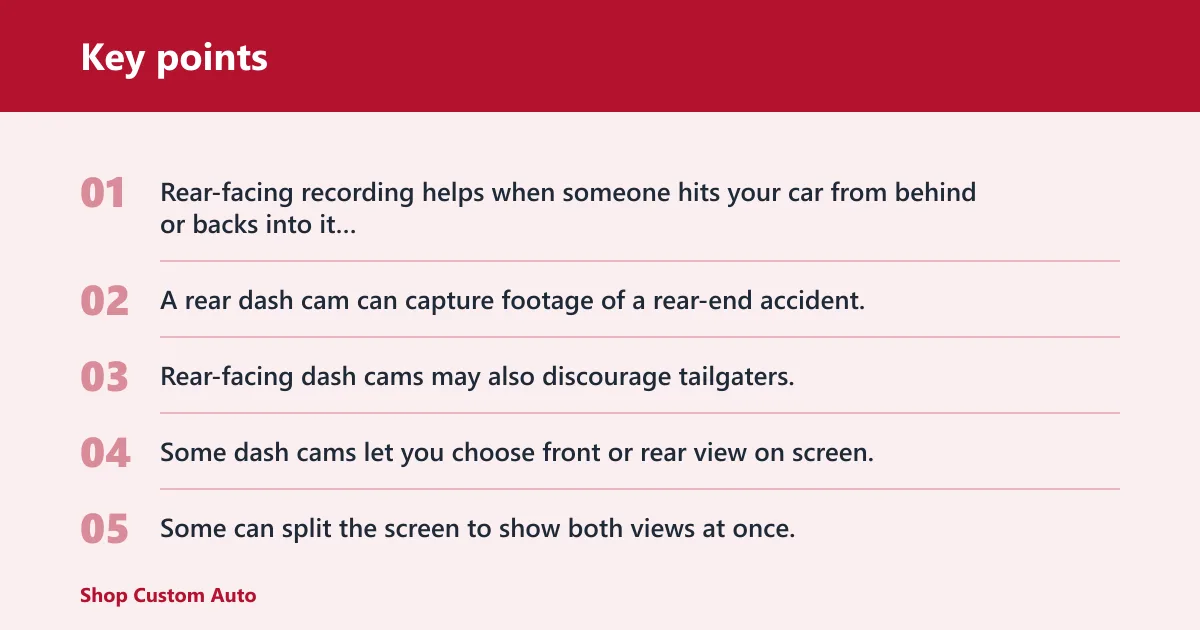
Rear-facing recording helps when someone hits your car from behind or backs into it while parked. A rear dash cam can capture footage of a rear-end accident, and it may catch a license plate during a hit and run. Rear-facing dash cams may also discourage tailgaters.
Some dash cams let you choose front or rear view on screen. Some can split the screen to show both views at once. That is useful for monitoring, but it still does not create the same parking aid behavior as a reverse camera.
Reversing camera roles in live low-speed guidance
A backup camera is designed to help you place the vehicle precisely at low speed. It uses reverse-gear activation, live display, and usually guide lines that match the vehicle’s path. Without those cues, judging bumper distance becomes much less reliable.
That difference matters more in larger vehicles. SUVs, trucks, vans, and cars with tinted rear windows often have harder rear visibility. In those cases, a rear dash cam may give you recording, but a reverse camera gives you maneuvering help.
OEM and aftermarket options
Factory reverse cameras often integrate with the dash or mirror screen and may be calibrated for the vehicle. Aftermarket systems can add the same basic function, but they still need the proper trigger, display, and wiring. A rear dash cam can sit beside that system, but it does not replace it in most setups.
When can a rear dash cam help while parking?
A rear dash cam can help while parking if it has a live rear view on a display, clear image orientation, and enough screen size to read the scene. Even then, it is a viewing aid, not a parking sensor. Wide-angle distortion and missing guide lines limit precision.
Live display support and split-screen setups
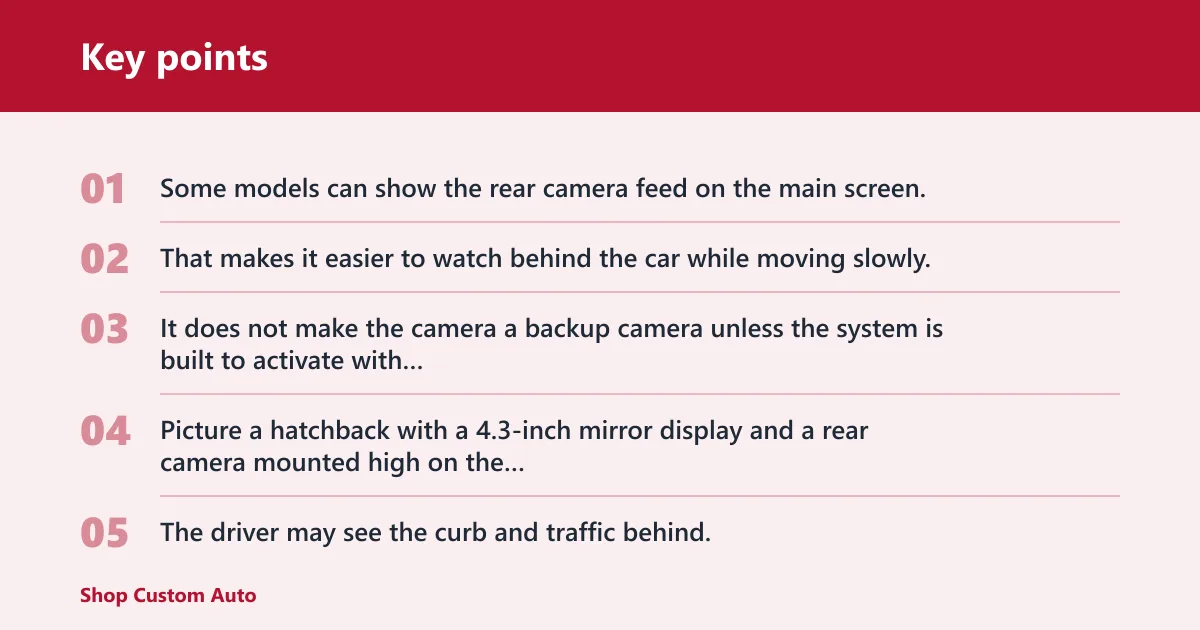
Some models can show the rear camera feed on the main screen, and some offer split-screen viewing. That makes it easier to watch behind the car while moving slowly. It does not make the camera a backup camera unless the system is built to activate with reverse gear.
Picture a hatchback with a 4.3-inch mirror display and a rear camera mounted high on the rear window. The driver may see the curb and traffic behind, but without reverse-triggered switching and parking lines, the view still lacks the guidance needed for tight alley parking.
Guide lines, image orientation, and parking precision limits
Guide lines matter because they give reference points for the vehicle path. A dash cam feed usually shows a camera image, not a calibrated parking overlay. That makes it harder to judge how close the bumper is to an obstacle, especially when the lens is wide-angle and distances look flatter than they are.
A wide-view front-facing dash cam may still miss up to 50% of surroundings, and the same general problem appears at the rear. Wide-angle distortion helps coverage but hurts depth judgment. That is why a rear dash cam can mislead you if you treat it like a reversing aid.
Why field of view matters at low speed
Field of view is useful for coverage and less useful for accuracy. A broader rear lens angle may catch more of the lane and both corners behind the car, but it can shrink objects and distort how near they are. Good for evidence. Weak for bumper-to-wall judgment.
One example dual dash cam offers 155-degree front and 126-degree rear coverage. Another example dual dash cam offers 170-degree front and 130-degree rear coverage. Those angles help with visibility, but angle alone does not create parking precision.
What setup do you need for a usable reversing view?
You need three things for a real reversing setup: reverse-gear trigger, a live display, and a camera mounted and wired for that job. Without all three, the rear image may be useful for recording but not dependable for maneuvering. Power source and cable routing also matter.
Reverse-gear trigger and display connection
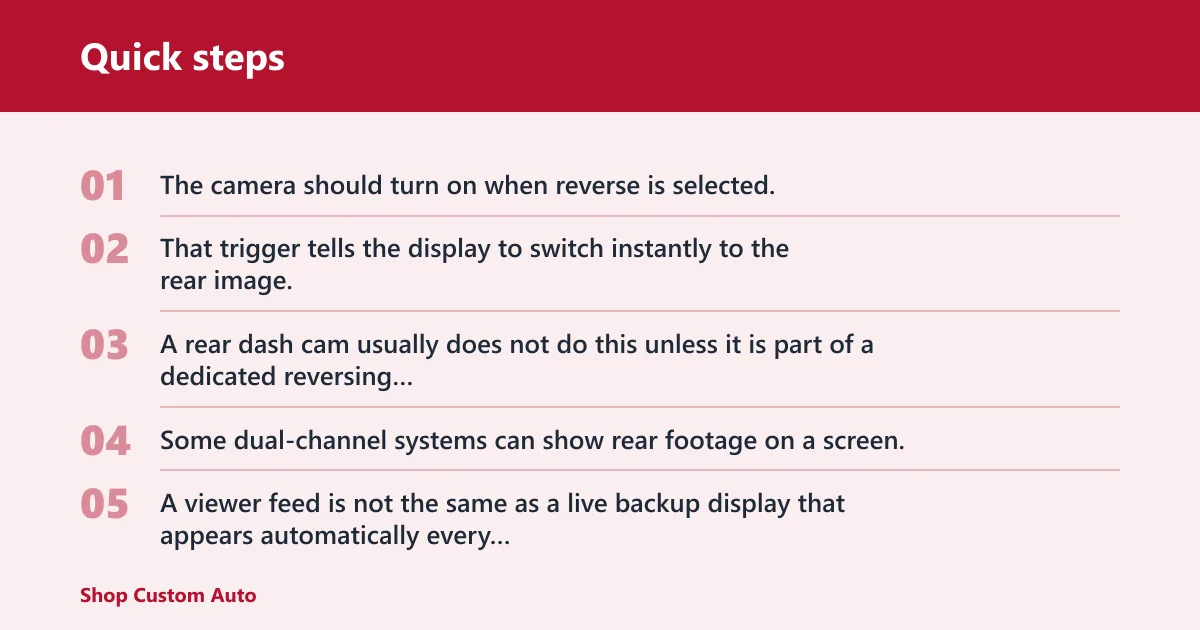
The camera should turn on when reverse is selected. That trigger tells the display to switch instantly to the rear image. A rear dash cam usually does not do this unless it is part of a dedicated reversing system or connected through special monitor hardware.
Some dual-channel systems can show rear footage on a screen, but the screen logic is still different from reverse-gear activation. A viewer feed is not the same as a live backup display that appears automatically every time you back up.
Hardwiring, accessory power, and cable routing
Hardwired dash cams may record while the car is parked. That helps evidence capture, but parking mode is not reversing assistance. Some units use vibration-trigger recording and can store short clips when something bumps the vehicle.
One featured model includes a 24-hour parking monitor that records 15-second clips when it senses vibrations. Another records 1080P at 30fps and has a waterproof rear camera. A featured model also supports up to 128 GB SD cards. Those details are about recording, not reverse-gear switching.
Mounting location, screen size, and rear-window visibility
Mounting location changes what the lens sees. Rear-window placement is common for dash cams, while license-plate-rear placement is more common for backup cameras. The higher the camera sits, the more it can see over a trunk or tailgate, but the image still needs the right display.
A small screen can show the feed, yet parking accuracy usually improves with a clearer, larger display or a mirror-style monitor. Tinted glass, cargo, and steep hatch angles can block part of the rear view, which is another reason a dash cam alone is often not enough.
Decision checklist: dash cam only, add monitor, or buy a reverse camera
Use this checklist to sort the job into recording, viewing, or maneuvering. If you need proof after an impact, a rear dash cam may be enough. If you need a usable rear view while reversing, the system has to behave like a backup camera. If you need both, you may need both.
| Factor | Dash cam only | Add monitor | Buy a reverse camera | Verdict |
|---|---|---|---|---|
| Reverse-gear trigger | No | Sometimes | Yes | buy a reverse camera |
| Live display | Optional | Yes | Yes | add monitor |
| Guide lines | Usually no | Sometimes | Usually yes | buy a reverse camera |
| Night visibility | Varies | Varies | Better when designed for reverse use | buy a reverse camera |
| Parking precision | Low | Medium | High | buy a reverse camera |
| Evidence capture | Yes | Yes | Limited | dash cam only |
- If your main goal is proof after a rear-end crash, choose the rear dash cam.
- If you want to watch the rear view on a screen while maneuvering, add a monitor only if the camera feed is easy to view live.
- If you need automatic reverse-gear activation and parking lines, buy a reverse camera.
- If you drive an SUV, van, truck, or a car with tinted rear glass, lean toward a dedicated reverse camera.
- If you park in tight spaces often, do not rely on recording coverage alone.
How rear dash cams help with evidence and parking mode
Rear dash cams are best when the problem is documenting events, not guiding a parking maneuver. They can capture a rear-end accident, a license plate in a hit and run, or a parked-car bump. That evidence can matter more than a live view if the incident happens while the car is unattended.
Rear-end collision and hit-and-run footage
A rear dash cam can help capture footage of a rear-end accident, and rear-facing footage may catch a license plate during a hit and run. That is especially useful in low-speed neighborhood collisions, shopping-center parking lots, and stop-and-go traffic where the rear plate is the best clue.
Low-light performance matters here. If the camera cannot resolve plate characters in dim light, its evidence value drops. A camera with a clear rear lens still may not read every plate, but it is more useful than a blank rear window.
Hardwired parking mode and engine-off recording
Hardwired dash cams may record while the car is parked. That lets the rear camera watch for vibration-triggered events and engine-off bumps. It is a recording feature, though, not a maneuvering feature.
A rear dash cam may record if someone backs into your car while parked. That is valuable after the fact. It does not help you avoid the impact in the first place the way a live reverse camera does.
Low-light performance and license plate readability
Night visibility is worth checking carefully. Rear cameras that look fine in daylight can struggle after dark, especially through tinted glass or in rain. If the goal is evidence, plate readability matters. If the goal is parking, live image clarity matters even more.
Say your sedan has a steep rear window and a black interior. A camera mounted high may see a wide area, but the view can still go soft at night and distort distance. That setup helps with recording. It does not make backing into a narrow spot easier.
Frequently asked questions
Can a dash cam be used as a reversing camera?
Sometimes, but only if the setup includes a live display and reverse-trigger behavior. Most dash cams are built for recording, not for automatic backup use. If you need reliable low-speed guidance, choose a camera system designed for reverse gear.
What is the difference between a rear dash cam and a backup camera?
A rear dash cam records incidents behind the vehicle and can help with parked-car evidence. A backup camera is made for live reversing assistance, usually with guide lines and reverse-gear activation. Recording and reversing are related, but they solve different problems.
Can a dash cam show a live rear view on a screen?
Yes. Some dash cams let you choose front or rear view on screen, and some can split the screen to show both views at once. That makes monitoring easier, but it still does not make the system a true reversing camera unless it is tied to reverse gear.
Will a rear dash cam work as well as a factory reverse camera?
Usually not. Factory reverse cameras are built around reverse-gear activation, live display, and parking aid behavior. A rear dash cam is better at recording evidence. It is weaker at distance judgment, image orientation, and precise maneuvering in tight spaces.
Can I install a reverse camera instead of a rear dash cam?
Yes, if your main goal is backing up rather than recording incidents. A reverse camera can replace the parking job of a dash cam, but it will not give you the same rear-end evidence coverage. Many drivers end up using both for different reasons.
Is a reversing camera worth it for my car?
If your car is hard to see out of, the answer is often yes. SUVs, trucks, vans, and cars with tinted rear windows benefit most because they are harder to place accurately without a live rear view. If you only want evidence capture, a rear dash cam may be enough.
can you use a dash cam as a reversing camera
Sometimes, but only with the right display and wiring. Most dash cams are designed to record, not to activate automatically in reverse. If the goal is safe parking, a dedicated reverse camera is the better fit.
can i put reverse camera in my car
Yes. Many cars can take an OEM or aftermarket reverse camera, though wiring and display compatibility matter. The camera must connect to a screen that can show the live image when reverse is selected, or it will not function as intended.
is a reversing camera worth it
For drivers who back into tight spaces, drive larger vehicles, or struggle with rear visibility, yes. A reversing camera is worth it when you need live low-speed guidance more than recorded evidence. If evidence is the priority, a rear dash cam is the better first buy.