Is a Tailgate Camera Better Than a License Plate Camera?
A tailgate camera usually fits trucks that tow or line up to a hitch. A license plate camera fits better when you want a lower, fixed view and the plate stays fully visible. Bad placement can hide the hitch, block the plate, or leave the lens open to spray and damage. This guide compares both mounts by towing, hitching, plate visibility, and weather exposure.
What each camera changes
The mount changes three things at once: viewing height, rear coverage, and fit on your truck. A tailgate camera sits higher on the tailgate or handle area, so it often sees over a bumper and gives more trailer-hitch context. A license plate camera sits lower at the plate frame or bracket, so it tends to show the ground and bumper area more directly.
Mount height and rear-view geometry
Higher mounting usually reduces the amount of bumper that fills the bottom of the image and can make hitch alignment easier. Lower mounting can give a more direct look at the area just behind the bumper, which helps when you care about curb edges, low obstacles, or a plate-centered install. Wide diagonal fields of view help parking coverage, but very wide angles can bend straight lines and make distance feel less exact.
Plate clearance and tag visibility
A license plate camera can fit cleanly if the bracket leaves full tag visibility and the lens does not cover registration stickers or state inspection items. A tailgate camera is less likely to block the plate, but some trucks place the plate on the tailgate itself or close to the handle area, so the housing can still create a legal problem if it overlaps the tag.
Truck body style and tailgate design
Fitment depends on the truck, not the label on the camera. A fixed tailgate handle mount often works best on full-size pickups with common factory handle shapes. A drop-down tailgate, a split tailgate, or an aftermarket bumper can change the angle enough to require a vehicle-specific bracket or a different camera body altogether.
Side-by-side comparison
The main trade-off is simple: tailgate mounts usually help with hitching and higher rear visibility, while license plate mounts usually make retrofit work easier when the plate area is clear. The best choice depends on your truck’s tailgate shape, how often you tow, and how strict local plate rules are where you register the vehicle.
| Factor | Tailgate camera | License plate camera |
|---|---|---|
| Plate visibility | Usually better, since it sits away from the tag | Can block the tag or frame if clearance is tight |
| Hitch alignment | Usually stronger for lining up a ball or receiver | Works, but the lower view can make depth feel tighter |
| Install difficulty | Often harder on retrofit trucks; may need model-specific trim work | Often easier with bracket or frame hardware |
| Night performance | Depends on sensor and glare control; higher mount can help light spread | Often good at close range, but plate lamps can glare into the lens |
| Weather sealing | Needs strong connector sealing and drip protection | More splash exposure near the road and license plate spray |
| OEM integration | Often better on trucks with factory tailgate camera provisions | Often easier with universal RCA units, but screen compatibility still matters |
| Tow/trailer use | Usually better for hitch ball and trailer tongue alignment | Can help with rear parking, less ideal for high hitch clearance |
| Legal risk | Lower if it never covers the plate or backup lights | Higher if it obscures the plate, frame, or inspection stickers |
Weather sealing and connector sealing
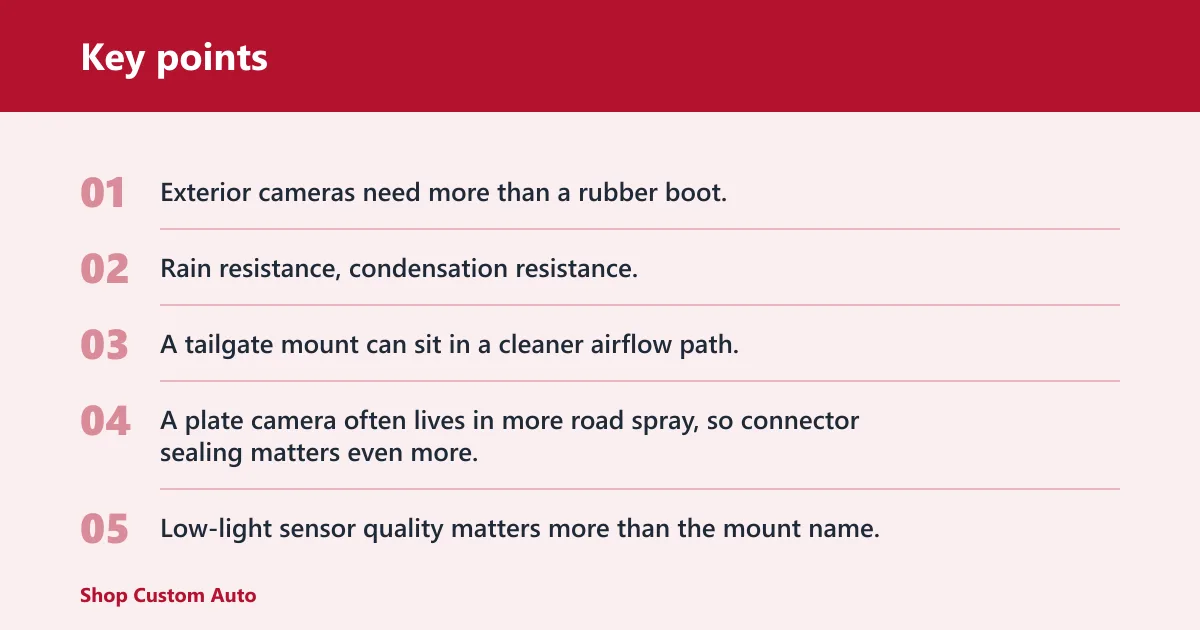
Exterior cameras need more than a rubber boot. Rain resistance, condensation resistance, and sealed connectors matter because water intrusion often starts at the plug, not the lens face. A tailgate mount can sit in a cleaner airflow path, but it still needs proper grommets or factory-style sealing. A plate camera often lives in more road spray, so connector sealing matters even more.
Night performance and glare control
Low-light sensor quality matters more than the mount name. IR LEDs can help when the area is dark, but they can also reflect off a plate, wet bumper, or trailer coupler and wash out the image. Good glare control and a clear reverse-light trigger matter on either style, especially under parking-lot lighting.
Camera decision matrix
Use this matrix as a practical filter, not a brand ranking. Scores run from 1 to 5, with 5 being the stronger fit for that factor. The right answer depends on whether your truck needs hitch help, clear plate visibility, or a retrofit path that matches the display and wiring already in the vehicle.
| Factor | Tailgate camera | License plate camera | Which wins |
|---|---|---|---|
| Plate visibility | 4 | 2 | Tailgate camera |
| Hitch alignment | 5 | 3 | Tailgate camera |
| Install difficulty | 2 | 4 | License plate camera |
| Night performance | 4 | 3 | Tailgate camera |
| Weather sealing | 4 | 3 | Tailgate camera |
| OEM integration | 4 | 3 | Tailgate camera |
| Tow/trailer use | 5 | 2 | Tailgate camera |
| Legal risk | 4 | 2 | Tailgate camera |
Short recommendation by vehicle type: full-size pickup with factory camera support: tailgate camera. Truck with a drop-down tailgate and tight plate space: license plate camera only if the plate stays fully readable. SUV or older truck with an aftermarket screen: license plate camera is often the easier retrofit, provided the bracket does not obscure the tag.
Which camera fits your truck?
Fit comes down to bed height, tailgate shape, and how much of the rear area you need to see. A taller tailgate mount can help on trucks with a high bumper or a long bed, while a lower plate mount can work better on a compact SUV or an older truck where the plate area is the cleanest access point.
Full-size pickup with factory tailgate handle mount
If your truck already has a handle-area opening or a factory camera path, a tailgate camera is usually the cleaner fit. It can preserve plate visibility, keep the lens higher above road spray, and aim more naturally toward the hitch. The main check is connector type and whether the screen accepts the camera signal format.
Truck with drop-down tailgate or tight plate space
A drop-down tailgate can change the camera angle enough that a universal bracket no longer points at the right target. If the plate sits low or near the tailgate edge, a license plate camera may be simpler, but only if the frame does not cover the tag. A common first-timer mistake is picking the mount before checking whether the plate and backup lights stay visible.
SUV or older truck with aftermarket screen
For an older vehicle with an added screen, a license plate camera often has the fewest parts to integrate. It usually uses a 12V power source, a reverse-light trigger, ground, and either RCA video input or an OEM-style adapter. That said, universal fit is not a guarantee; the bracket and tilt range still need to match the bumper shape.
Installation and wiring differences
Installation is less about the mount label and more about hardware and signal path. A no-drill kit may use a bracket, screws, or adhesive pads, while a drill-in setup may need a grommet and a sealed pass-through. The wiring usually includes reverse-light trigger power, ground, and a video cable that ends at RCA or a factory input.
No-drill and drill-in hardware
License plate cameras often use plate-frame hardware or a bracket that reuses the plate bolts, so the install can be reversible. Tailgate cameras more often need vehicle-specific trim pieces or a handle replacement. Either style can fail if the camera sits loose, because vibration leads to shaky video and aim drift.
Reverse-light trigger and 12V power
The reverse-light trigger tells the display when to switch to camera view. Most aftermarket units draw from a 12V source and need a solid ground, while OEM systems may use a factory connector or a harness adapter. If the trigger is wrong, the screen may stay blank, come on late, or switch at the wrong time.
RCA video input or OEM integration
RCA is common on universal cameras. OEM integration is more exacting because the display, connector type, and sometimes the image format must match the truck’s system. A mirrored feed may be correct for rear view, but an upside-down image or a non-compatible video signal will make the camera look faulty even when the lens is fine.
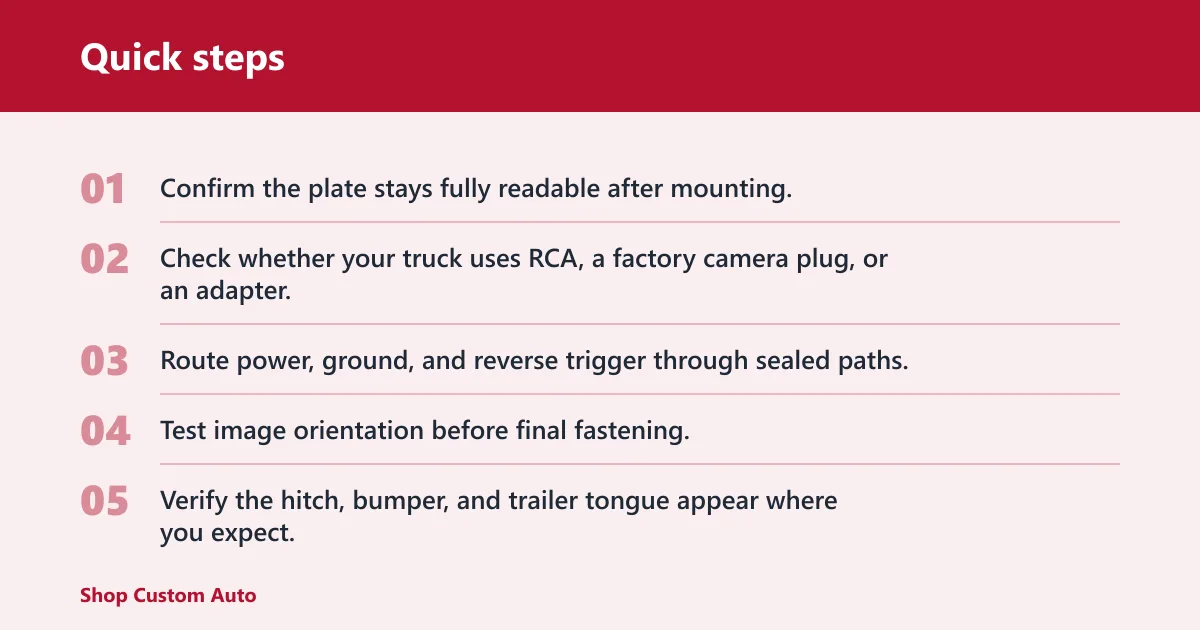
- Confirm the plate stays fully readable after mounting.
- Check whether your truck uses RCA, a factory camera plug, or an adapter.
- Route power, ground, and reverse trigger through sealed paths.
- Test image orientation before final fastening.
- Verify the hitch, bumper, and trailer tongue appear where you expect.
Choose tailgate camera if… / Choose license plate camera if…
Choose a tailgate camera if towing, hitch alignment, or a cleaner factory look matters more than a quick universal fit. Choose a license plate camera if your truck has clear plate space, you want easier retrofit hardware, and your wiring path is already built for an aftermarket display. The mount should match the truck, not the other way around.
Best fit for towing and hitching
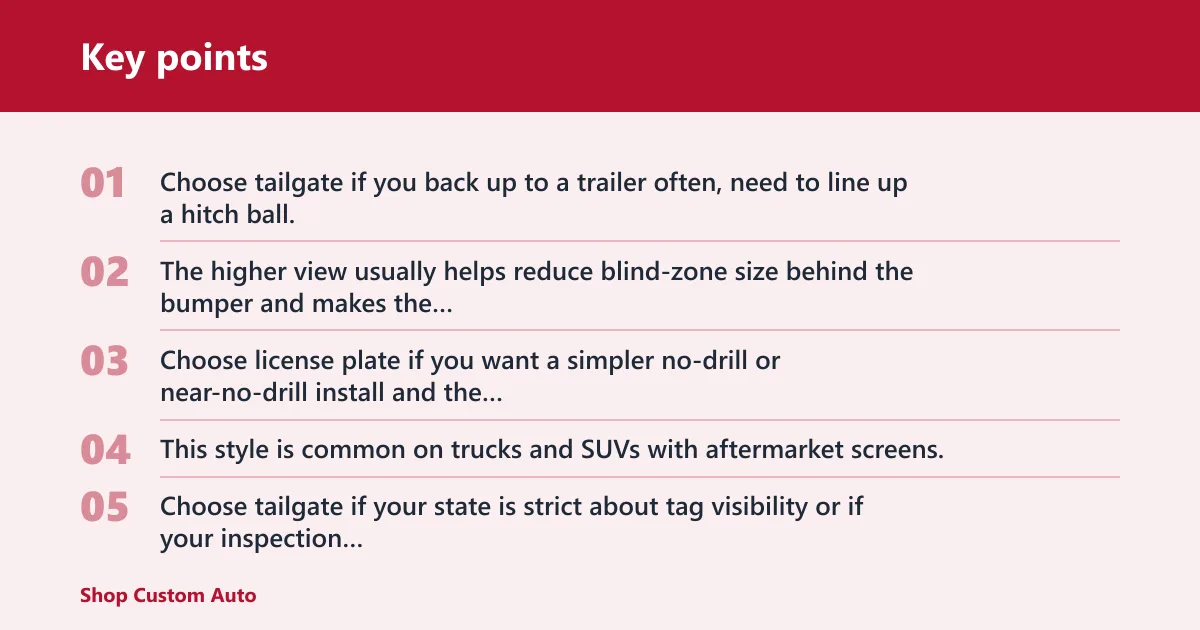
Choose tailgate if you back up to a trailer often, need to line up a hitch ball, or want more separation between the camera and road spray. The higher view usually helps reduce blind-zone size behind the bumper and makes the coupler easier to place in the frame.
Best fit for easy retrofit
Choose license plate if you want a simpler no-drill or near-no-drill install and the plate frame leaves enough room for the lens and wiring. This style is common on trucks and SUVs with aftermarket screens, but the plate must remain readable and the angle must not point too low.
Best fit for plate visibility and inspection risk
Choose tailgate if your state is strict about tag visibility or if your inspection station rejects frames that cover bolts, corners, or stickers. License plate cameras can work well, but the frame, housing, and tilt range must stay outside the area that must remain visible.
Say your half-ton pickup sits high enough that the bumper fills the lower third of the screen. A tailgate camera mounted above the handle can show the hitch zone with less bumper blockage, while a plate camera may give a lower view but leave the coupler harder to judge by depth. The choice changes with mount height, not badge size.
Suppose your SUV uses a plate bracket with only 1 inch of spare depth behind the tag. A license plate camera with a slim housing and adjustable tilt may fit cleanly, while a bulkier model could press against the plate and invite vibration or glare. That is a fitment issue, not a camera-quality issue.
Frequently asked questions
Is a tailgate camera better than a license plate camera?
Usually yes for trucks that tow, back to a hitch, or need a higher rear view. A license plate camera can still be the better fit when the plate area is clear and you want easier retrofit hardware. The better choice depends on plate visibility, truck design, and wiring compatibility.
What is the difference between a tailgate camera and a license plate camera?
A tailgate camera mounts on the tailgate or handle area and usually sits higher, while a license plate camera mounts to the plate frame or bracket and sits lower. That change in height affects hitch visibility, bumper coverage, blind-zone size, and how much the plate or frame is exposed.
Will a tailgate camera fit my truck without blocking the plate?
Often yes, especially on trucks with a separate plate location or a factory handle opening. On some tailgates, though, the camera body or trim ring can overlap the tag area. Check the plate clearance, bolt spacing, and whether state rules require the entire tag to remain readable.
Which camera gives a wider rear view when backing up?
Either style can use a wide diagonal field of view, but the higher tailgate mount often gives a better sense of the full rear area. A very wide lens can help parking coverage and blind-zone reduction, yet it may also create edge distortion that makes distance look less precise.
Are license plate cameras easier to install than tailgate cameras?
Usually yes. Many license plate cameras use bracket or frame hardware, basic screws, and a simpler wire route to reverse-light power, ground, and video input. Tailgate cameras more often need model-specific trim work, sealed pass-throughs, or OEM-style connectors, especially on newer trucks.
What are common problems with license plate backup cameras?
Common problems include blocked plate numbers, loose brackets, upside-down images, mirrored feeds set the wrong way, water intrusion at the connector, and poor low-light performance. Some units also point too low or too close, which makes the bumper dominate the image and reduces useful rear coverage.