What Is Subwoofer Impedance and What Do the Ohms Mean?
Subwoofer impedance is the electrical load the amp sees, measured in ohms. A lower-ohm load draws more current, so the amp must be rated for the sub’s final wired impedance, usually 2 or 4 ohms. Get it wrong and you can trigger shutdown, distortion, overheating, or weak output. This guide explains what the ohms rating means, how wiring changes the final load, and why a sub’s measured impedance varies with frequency.
Nominal ratings versus DC resistance and why they differ

Impedance is the load a subwoofer presents to an amplifier, measured in ohms (Ω). Think of it as the amp’s workload. Lower impedance lets more current flow, which can raise output if the amp is built for that load. Higher impedance eases the load and usually runs cooler.
The important detail is that the number printed on the sub is a nominal rating. It is the expected load category, not a fixed meter reading at every bass note. Real impedance shifts with the signal’s frequency, the enclosure, and the driver’s electrical behavior. That is why the label and the meter do not always match.
Impedance versus resistance
People often use “resistance” and “impedance” interchangeably, but they are not the same thing. A meter reading with no signal applied gives you DC resistance, not the sub’s full AC impedance in operation. That difference explains why a “4 ohm” sub can read lower on a multimeter.
A common first-timer mistake is to see a reading near 3 ohms and assume the sub is mislabeled. It usually is not. The label refers to nominal impedance, while the meter reads voice-coil resistance at rest.
Why the ohm rating is nominal
A subwoofer’s impedance changes with frequency because the voice coil, cone motion, and enclosure all affect the load seen by the amp. Around some frequencies, the driver may ask for more current; at others, less. That is normal behavior in car audio, not a defect.
For bass use, this matters because consumer subwoofers usually work in the 20–200 Hz range, while professional live sound subwoofers are typically below 100 Hz and THX-certified systems use subwoofers below 80 Hz. Different systems still rely on the same idea: the amp must be comfortable with the load the sub presents. (Wikipedia)
📊 Professional live sound subwoofers are typically below 100 Hz. Source: Subwoofer.
What do the ohms on a subwoofer mean?
The ohms printed on a subwoofer tell you how hard the amp must work to drive it. A 2 ohm speaker has lower resistance than a 4 ohm speaker, so more current can flow. That usually means a bigger power demand from the amplifier, along with more heat.
Lower-ohm loads are only useful when the amplifier is rated for them and can deliver power safely at that load. A 4 ohm sub gives the amp an easier job, which often suits standard systems. A 2 ohm sub can allow more output when the amp is built for that load.
Why a 4 ohm sub may read about 3 ohms
A multimeter measures DC resistance, not full operating impedance. Because voice coils have wire resistance and inductive behavior, a sub labeled 4 ohms may measure around 3 ohms at rest. That reading is normal and does not mean the sub is actually a 3 ohm nominal driver.
Use the meter reading as a sanity check, not as the final system target. The final load depends on how the coils are wired and whether you are measuring a single driver or several drivers together.
2 ohm vs 4 ohm subwoofer
A 2 ohm setup can often push more power than 4 ohm from the same amp, and dropping from 4 ohms to 2 ohms roughly doubles the power an amp can deliver. Doubling power translates to about a 3 dB increase in loudness. That gain only appears when the amp is stable at 2 ohms and can actually supply the extra current.
A 4 ohm sub is often the cleaner choice for many standard systems. It draws less current, puts less strain on the amplifier, and fits standard systems with fewer wiring complications. That does not make it quieter in every system; it makes it easier to integrate correctly.
When 2 ohm makes sense
Choose 2 ohm when the amplifier label says it is stable at 2 ohms and you want the amp to deliver more power into that load. That is common in systems built around a mono sub amp with a clear 2 ohm minimum rating.
Suppose a mono amp is rated for 2 ohms and the sub wiring lands there exactly. The amp can deliver its intended power range without being forced beyond its design limit. The result is stronger output potential, not automatic better bass.
When 4 ohm is the cleaner choice
Choose 4 ohm when you want an easier load for the amplifier, a simpler install, or a safer match for a factory-style or standard aftermarket setup. A 4 ohm load usually draws less current, so the amp runs cooler and has more breathing room.
Say your amplifier is a full-range model with a 4 ohm minimum on the sub channel. A single 4 ohm sub gives you a direct match with less risk of thermal shutdown or protect mode. The wiring is simpler too.
Output, heat, and amp strain
Lower impedance increases current draw and heat. Higher impedance reduces strain. That is the tradeoff behind the ohm rating. A lower load can make more power only if the amplifier can supply that power without clipping or overheating.
If the amp is undersized for the lower load, output can get worse rather than better. Distortion rises, protection circuits may activate, and the system may sound strained at higher volume.
Can your amplifier handle the load?
Check the amplifier’s minimum rated impedance before you wire the sub. That rating is the lowest safe load the amp is designed to drive. If the final wired load drops below that number, the amp may overheat, clip, shut down, or blow a fuse.
Do not guess from the sub label alone. The final load depends on voice-coil configuration, wiring method, and whether you have one sub or several. Match the finished load to the amp’s spec sheet, not to a rough rule of thumb.
What happens below the safe load
When an amp sees too low an impedance, it has to supply more current than it was built to handle. The most common warning signs are clipping, protect mode, thermal shutdown, and blown fuses. Sometimes the first symptom is simply weak output followed by distortion.
Clipping often sounds like rough, harsh bass at higher volume. Thermal shutdown means the amp gets hot enough to protect itself and stops playing until it cools. Blown fuses suggest the current demand has gone beyond what the circuit can support.
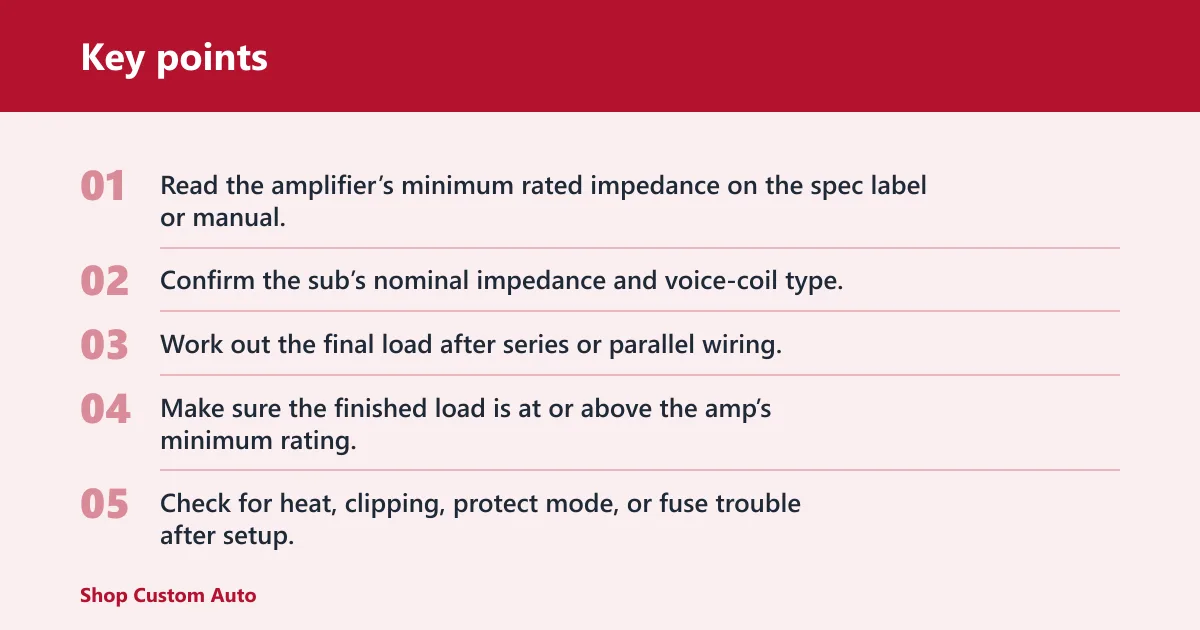
- Read the amplifier’s minimum rated impedance on the spec label or manual.
- Confirm the sub’s nominal impedance and voice-coil type.
- Work out the final load after series or parallel wiring.
- Make sure the finished load is at or above the amp’s minimum rating.
- Check for heat, clipping, protect mode, or fuse trouble after setup.
A common first-timer mistake is wiring a sub to “get more power” and then ignoring the amp label. If the load falls below the minimum, the amp may play louder for a short time and then start clipping or shutting down. That is not extra headroom. It is overload.
How do dual voice coil subwoofers change the final ohm load?
Dual voice coil subwoofers have two separate coils on the same driver. Each coil can be wired in series or parallel, which changes the final load the amplifier sees. That flexibility is useful when you need to hit a specific amp rating.
Series wiring raises total impedance. Parallel wiring lowers it. The correct choice depends on the amp’s minimum stable load and the number of coils and subs in the system.
Series wiring
Series wiring connects the coils end to end, so the impedances add. Use it when you need a higher final load. That can be the right move when the amp is not stable at the lower option your sub could otherwise create.
For example, dual 2 ohm coils wired in series total 4 ohms. Dual 4 ohm coils wired in series total 8 ohms. Both setups reduce current draw compared with their parallel equivalents.
Parallel wiring
Parallel wiring ties the coils together so the total impedance drops. Use it when the amp can handle the lower load and you want more current flow and more power potential. This is common with mono amps rated for low-impedance sub loads.
For example, dual 2 ohm coils wired in parallel total 1 ohm. Dual 4 ohm coils wired in parallel total 2 ohms. Those are useful only when the amplifier is designed for those loads.
Impedance decision table
| Setup | Final load | Series or parallel result | Amp-stability need | Current draw direction | Common failure symptoms if mismatched |
|---|---|---|---|---|---|
| Single 2 ohm sub | 2 ohms | Fixed nominal load | Amplifier must be stable at 2 ohms | Higher than 4 ohm | Clipping, thermal shutdown, blown fuse, protect mode |
| Single 4 ohm sub | 4 ohms | Fixed nominal load | Works with many standard amps rated for 4 ohms | Lower than 2 ohm | Usually fewer issues; overload symptoms if amp is underpowered |
| Dual 2 ohm coils, series | 4 ohms | 2 ohms + 2 ohms = 4 ohms | Fits amps that want a 4 ohm load | Lower than the parallel version | Weak output if the goal was higher power, but generally safe |
| Dual 2 ohm coils, parallel | 1 ohm | 2 ohms in parallel total 1 ohm | Only for amps stable at 1 ohm | Much higher than 4 ohm | Clipping, protect mode, thermal shutdown, blown fuse |
| Dual 4 ohm coils, series | 8 ohms | 4 ohms + 4 ohms = 8 ohms | Safe for almost any amp, but power falls | Lowest of the group | Low output, limited bass level, not usually damage from overload |
| Dual 4 ohm coils, parallel | 2 ohms | 4 ohms in parallel total 2 ohms | Amplifier must be stable at 2 ohms | Higher than 4 ohm | Clipping, protect mode, overheating, blown fuse if amp is not rated for it |
This table shows the main decision point: pick the wiring that lands on a load your amp can actually support. A safe 4 ohm match is often the simplest route. A lower load only makes sense when the amp label says it can handle it.
How do I know if my amplifier can handle a subwoofer’s ohms?
Start with the amplifier’s minimum rated impedance and compare it to the final wired load, not the sticker on the raw driver. If the amp says 2 ohms minimum, then a 2 ohm final load is acceptable. If the final load falls below that, it is not a safe match.
For single-sub systems, this is usually straightforward. For dual-sub or multi-amplifier setups, count every coil and every driver before you combine them. That is where most wiring mistakes happen.
Single-sub setups
With one sub, the main question is whether the driver is 2 ohm or 4 ohm nominal, or whether a DVC sub can be wired to one of those loads. If the amp is stable at 2 ohms, a 2 ohm final load can make sense. If not, 4 ohms is the safer path.
Dual-sub setups
With two subs, the final load can drop fast when you wire coils or drivers in parallel. Two 4 ohm single-coil subs in parallel do not equal 4 ohms. The finished load depends on the full circuit, so check the math before connecting the amp.
Multi-amplifier setups
When more than one amp is involved, each amplifier must be matched to the load on its own channel or output section. Do not assume one amp’s rating transfers to another. A mono sub amp and a separate midrange amp may have very different safe loads.
Frequently asked questions
What is subwoofer impedance in simple terms?
Subwoofer impedance is the electrical load the amplifier has to drive, measured in ohms. Lower impedance lets more current flow and asks more from the amp. Higher impedance is easier on the amp and usually reduces current demand. The number printed on the sub is a nominal rating.
Is a 2 ohm subwoofer louder than a 4 ohm subwoofer?
Not by itself. A 2 ohm setup can often push more power than 4 ohm from the same amp, and that can mean about a 3 dB increase in loudness if the amp delivers the extra power safely. If the amp is not designed for 2 ohms, output may worsen instead.
Does lower impedance mean better bass?
No. Lower impedance means more current draw, not automatically better bass quality. Bass depends on enclosure design, sub size, tuning, amplifier control, and correct gain setting. A well-matched 4 ohm setup can sound cleaner than a badly matched 2 ohm setup.
Why does a 4 ohm subwoofer sometimes measure about 3 ohms?
Because a meter measures DC resistance, not nominal AC impedance. A “4 ohm” sub can show around 3 ohms at rest because the voice coil wire has resistance and the full impedance changes with frequency. That reading is normal and does not change the label.
How do series and parallel wiring change subwoofer impedance?
Series wiring adds impedance and raises the final load. Parallel wiring lowers the final load and increases current draw. For dual 2 ohm coils, series gives 4 ohms and parallel gives 1 ohm. For dual 4 ohm coils, series gives 8 ohms and parallel gives 2 ohms.