How to Install Component Speakers Without an Amp
You can wire component speakers to a factory head unit without an amp if the speakers are 4-ohm and sensitive enough, but keep the setup only if volume is clean at normal listening levels and the high frequencies do not fade first. Done badly, the system can sound thin, clip early, and waste money on speakers that need more power than the radio can give. This guide shows the wiring steps, where the crossover goes, and the simple fit-and-power checks that tell you whether to keep the no-amp setup.
Can you install component speakers without an amp?
Yes, if the component set is efficient, the factory radio has enough clean output, and the crossover stays in the signal path. A factory head unit usually has less power than an external amplifier, so the result depends on speaker sensitivity, wiring quality, and how hard you listen. If the sound stays clear at moderate volume, the setup can stay.
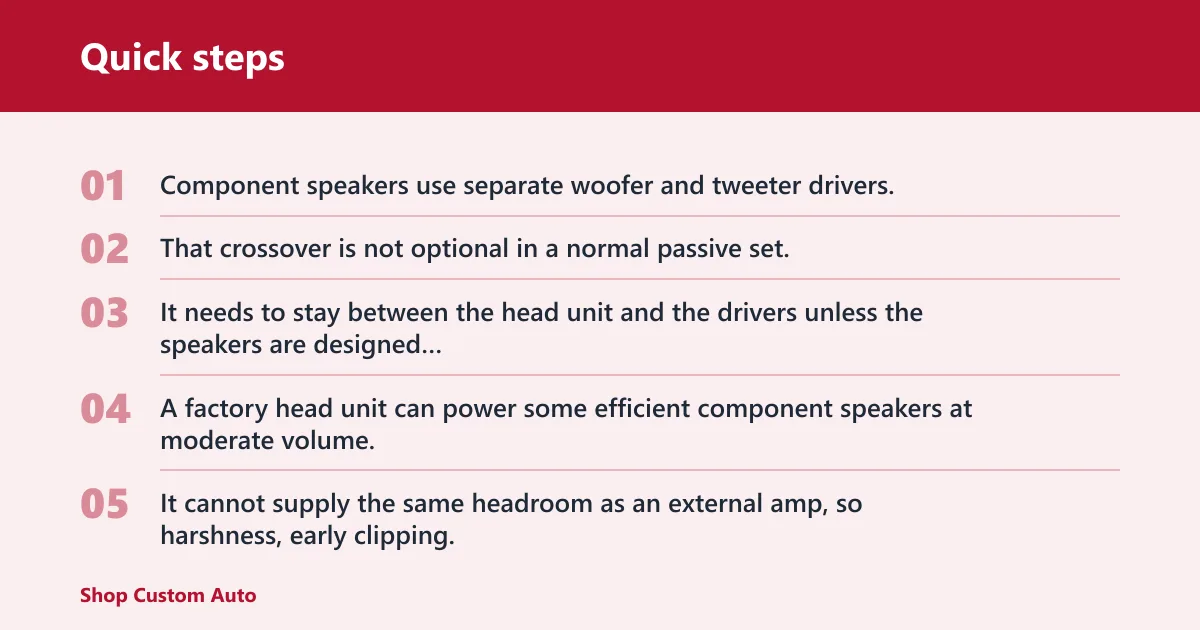
Component speakers use separate woofer and tweeter drivers, and many sets use a passive crossover to split the signal between them. That crossover is not optional in a normal passive set. It needs to stay between the head unit and the drivers unless the speakers are designed for active use.
What a factory head unit can and cannot do
A factory head unit can power some efficient component speakers at moderate volume, especially when the speakers are 4-ohm and not power-hungry. It cannot supply the same headroom as an external amp, so harshness, early clipping, or weak bass usually mean the radio is being pushed too hard.
Which component speakers are more likely to work well?
Look for higher sensitivity and modest RMS rating. For a no-amp install, the safest choice is a speaker that reaches useful output with modest power, not one built mainly for an amplifier. If the tweeter sounds bright but the woofer stays weak, the set may be a poor match for a stock radio.
When a no-amp install is worth trying
Try it when you want cleaner front-stage sound, the factory wiring is intact, and the speaker set is efficient enough to play loud and clean from the radio. A common first-timer mistake is buying a set for amplifier use, then expecting the head unit to make up the difference. It usually cannot.
What you’ll need
- Plastic pry tools for door cards and dash bezels
- Basic hand tools for screws, bolts, and clips
- Speaker wire, with 18 AWG common for head-unit-powered runs
- 16 AWG wire if the run is longer or the setup is higher power
- Factory harness adapters or speaker connectors, if the vehicle uses them
- A multimeter for continuity and polarity checks
- Foam gasket material for the woofer seal
- Electrical tape or heat-shrink for secure connections
- The crossover supplied with the component set
How to install component speakers without an amp
Start with the factory front speaker location, keep the crossover in line, and route the tweeter and woofer leads away from moving parts. The standard path is four stages: prep, panel removal, wiring, and testing. That order matters because hidden wire damage and cramped crossover placement are easier to catch before the door goes back together.
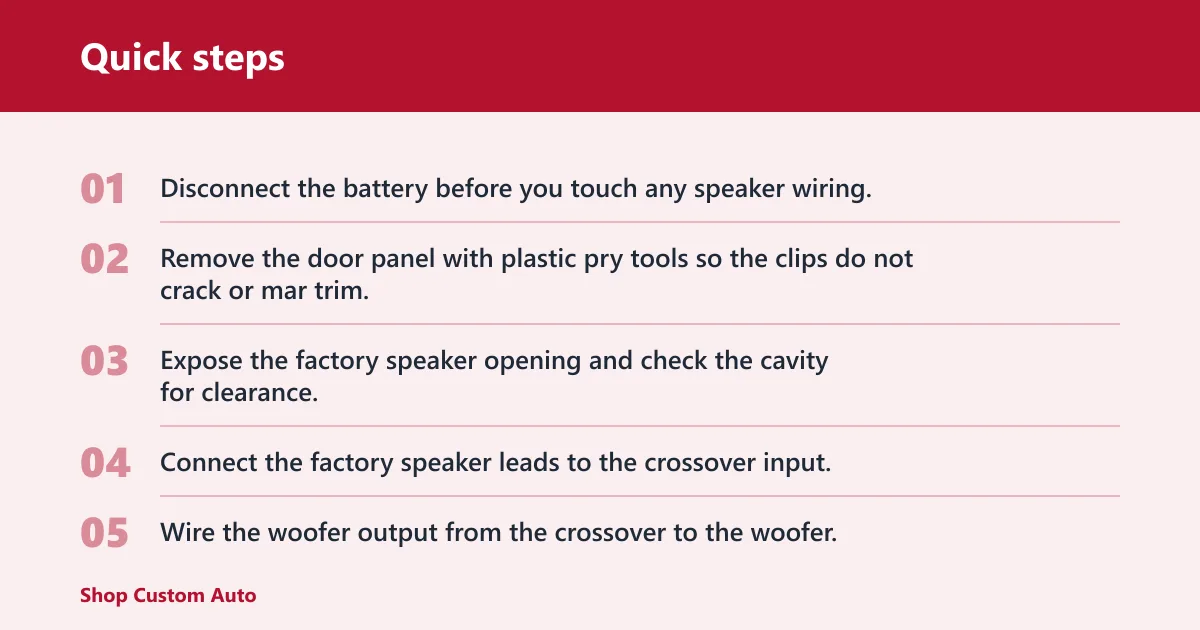
- Disconnect the battery before you touch any speaker wiring, so you do not short a lead or damage the radio output stage.
- Remove the door panel with plastic pry tools so the clips do not crack or mar trim.
- Expose the factory speaker opening and check the cavity for clearance, water barrier position, and wiring path.
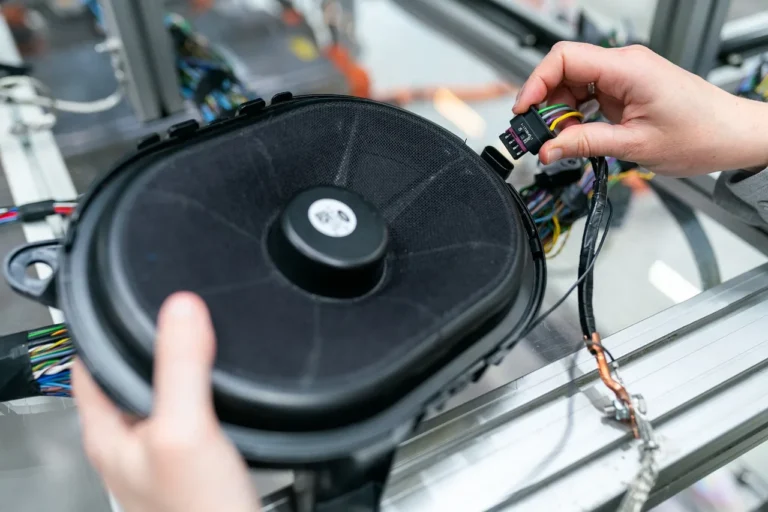
- Connect the factory speaker leads to the crossover input, keeping positive to positive and negative to negative.
- Wire the woofer output from the crossover to the woofer, then mount the woofer with a tight seal and a foam gasket.
- Route the tweeter lead to a high mounting point on the door or dash, away from the window track and any pinch point.
- Use the multimeter to confirm continuity and polarity before the panel goes back on.
- Play audio at low volume first, then raise it in about 5 W-equivalent steps if the radio settings allow level control, checking for distortion after each increase.
Remove the door panel without damage
Use plastic pry tools around the perimeter, then lift the panel straight off once the clips release. Start at the lower edge, where most panels give first, and work slowly around hidden fasteners behind handle surrounds and switch bezels. If the car uses a dash-mounted tweeter location, use the same careful removal process there. The goal is access, not speed, and broken clips take longer to fix than slow removal.
Wire the woofer and crossover
Keep the passive crossover in the signal path for a normal component set. Many external crossovers can mount inside the door behind the vapor barrier or inside the cabin under the dash, but only if they fit dry and secure. If the box is too bulky for the door cavity, move it under the dash instead of crushing it into place.
If the factory radio sends signal through thin, fragile leads in the door jamb, use the multimeter to identify the correct speaker pair before cutting anything. A clipped lead or reversed pair can make the woofer weak, cancel bass, or leave the tweeter sounding disconnected.
Mount the tweeter and finish the run
The tweeter works best higher on the door or on the dash area, away from moving window tracks and sharp bends in the wire path. Keep the lead secure where the door flexes. The woofer should mount tightly in the door or factory speaker opening, with the foam gasket compressed enough to limit air leaks and rattle.
Picture a tweeter mounted low in the door pocket next to the window regulator. The speaker may work, but the wire can rub or pinch every time the glass moves. Moving the tweeter higher and re-routing the lead often fixes that problem before it becomes an intermittent failure.
No-Amp fit check for component speakers
| Speaker sensitivity | RMS rating | Factory-radio suitability | Wire gauge | Crossover location | Likely outcome |
|---|---|---|---|---|---|
| 90 dB or higher | Up to 60 W RMS | Pass if the radio sounds clean at moderate volume | 18 AWG | Under dash or dry door pocket | Usually a good no-amp candidate |
| 88–89 dB | 60–75 W RMS | Borderline; check for early clipping | 18 AWG or 16 AWG if the run is long | Door or under dash, with room to spare | May work, but volume headroom can be limited |
| Below 88 dB | 75 W RMS or more | Usually poor for a stock radio | 16 AWG for the run | Any safe dry location | Fail for most factory head units; plan on an amp |
| Any sensitivity | Any rating | Fail if the radio distorts before normal listening level | Inspect the factory wire first | Too large for the door cavity | Fail until the crossover is relocated or replaced |
Will component speakers sound good on a stock radio?
They can sound good on a stock radio when the speakers are efficient, the crossover is installed correctly, and the front-stage placement is done well. The factory head unit can power some efficient speakers at moderate volume, but it is not a substitute for an amp when the speakers need more current or the listener wants higher output.
What good looks like at moderate volume
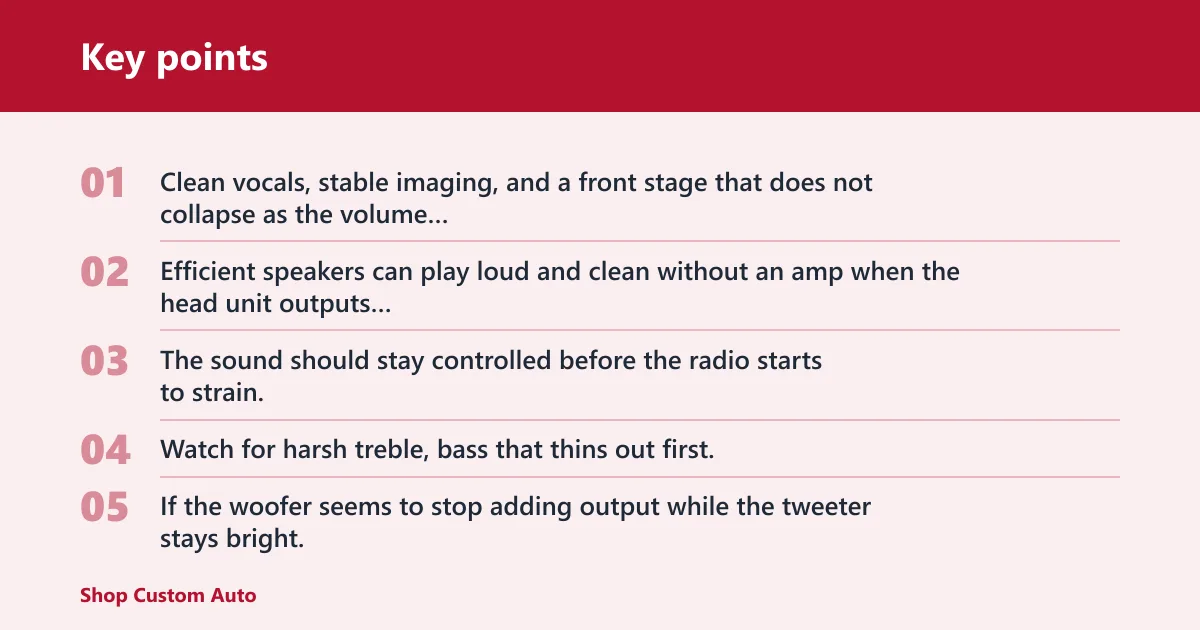
Clean vocals, stable imaging, and a front stage that does not collapse as the volume rises are the main signs. Efficient speakers can play loud and clean without an amp when the head unit outputs 20–25 W RMS per channel. The sound should stay controlled before the radio starts to strain.
Signs the head unit is running out of output
Watch for harsh treble, bass that thins out first, or a system that gets louder but less clear. If the woofer seems to stop adding output while the tweeter stays bright, the radio may be clipping or the speaker match is poor. Thin factory wiring can make the problem worse, especially on longer door runs.
When to stop and plan for an amp
If the set only sounds acceptable at low volume, or if the crossover and woofer are fine but the radio clips before normal listening level, stop there. That is the point to add amplification rather than forcing more gain from the head unit. A no-amp setup should be a decision, not a compromise you keep revisiting.
Common mistakes
Most no-amp failures come from a few avoidable errors. Reversed polarity can wipe out bass. A crossover jammed into a cramped cavity can overheat or rattle. Clipped speaker leads and thin factory wiring can break continuity after reassembly. Bad mounting location for the tweeter can also make the system sound harsh or uneven.
- Reversing polarity on the woofer or tweeter leads
- Mounting the tweeter where the window track can hit it
- Forcing the crossover into a space with no dry clearance
- Ignoring a damaged factory connector or pinched wire
- Skipping the foam gasket and leaving an air leak behind the woofer
If that didn’t work, try this next
- Use a multimeter in continuity mode to confirm the speaker pair from the radio to the crossover input.
- Check polarity at the woofer terminals, then swap the pair only if the phase test shows bass cancellation.
- Move the crossover to a drier, roomier spot under the dash if the door cavity is too tight.
- Replace the run with 18 AWG for normal head-unit power or 16 AWG if the run is longer and the factory wire looks thin.
Are component speakers worth it without an amp?
Yes, when the speakers are efficient, the factory radio stays clean, and the installation is done with proper polarity, sealing, and crossover placement. No, when the speaker set is built for high power, the crossover will not fit safely, or the radio clips before the system reaches normal listening level. The best no-amp build is the one you can keep.
Best-case no-amp setups
Efficient 4-ohm speakers, sensible RMS ratings, and a factory head unit that can deliver clean output make the best match. A tight woofer seal, a safe tweeter mount, and a crossover that fits dry and secure are the other pieces that keep the system usable without extra hardware.
Cases where the upgrade is short-lived
If the speakers are inefficient or the radio runs out of clean power quickly, the system often sounds good only until the volume goes up. That is the sign the no-amp plan will not last. At that point, the smarter move is to stop, keep the speakers if they are a good match, and add an amp later.
How to decide before buying more parts
Check sensitivity, RMS rating, crossover size, and the space behind the door card before you buy. If the set lands in the pass range on the fit table, it is worth trying on the factory radio. If it fails on sensitivity or space, spend the budget on an amp and proper wiring instead.
Frequently asked questions
How do you wire component speakers to the factory head unit?
Run the factory speaker pair into the crossover input, then connect the woofer and tweeter outputs to their matching drivers. Keep positive and negative aligned end to end. If the vehicle uses an adapter plug, use it instead of cutting the factory connector so future service stays cleaner.
Do component speakers need a crossover if there’s no amp?
Yes for a normal passive component set. The crossover keeps low frequencies out of the tweeter and high frequencies out of the woofer. Without it, the drivers can distort or fail. Coaxial speakers are different; they do not need separate crossovers because the network is built into the speaker assembly.
What wire gauge should I use for component speakers without an amp?
18 AWG is common for head-unit-powered door-speaker runs. Use 16 AWG if the run is longer or the setup will later see higher power from an amp. The key is to avoid routing the wire where the door hinge, window track, or trim clips can pinch it.
Where should tweeters be mounted for component speakers?
Mount them higher on the door or in the dash area so the sound stage rises toward the windshield. Keep them away from moving window tracks, sharp bends, and pinch points. Safe routing matters as much as placement, because a damaged tweeter lead can fail after the panel goes back on.