
4 Gauge vs 8 Gauge Amp Wiring Kit: Which Should You Use?

4 Gauge vs 8 Gauge Amp Wiring Kit: Which Should You Use?

Choose 4 gauge for higher-power amps, longer runs, or any copper-clad aluminum kit. 8 gauge fits smaller amps with short runs and true copper wire. Pick too small a kit and voltage drop can starve the amp, add heat, and cause protect-mode shutdowns. This guide gives a simple RMS, material, and length rule so you buy the smallest safe amp wiring kit.

Decision factor 4 gauge 8 gauge amp wiring kit Winner
Current headroom Higher current capacity and lower resistance Lower current capacity and higher resistance 4 gauge
Short-run small amps Works, but often more copper than needed Usually the better fit 8 gauge amp wiring kit
Long run to a trunk amp Better choice as resistance rises with length More likely to show voltage drop 4 gauge
OFC vs CCA flexibility Safer choice, especially with CCA kits or future upgrades Best kept for true OFC and lighter loads 4 gauge
Routing ease and cost Bulkier, harder to route, usually costs more Smaller, easier to route, usually costs less 8 gauge amp wiring kit

4 gauge vs 8 gauge amp wiring kit: the core trade-off

American Wire Gauge, or AWG, uses a smaller number to mean a thicker wire. Thicker wire has lower resistance, so it carries more current with less voltage drop. That matters more than peak watts, because amplifier RMS power and one-way cable length determine real wire demand.

Why wire thickness matters

4 gauge is physically thicker than 8 gauge, so it can move more current with less heat build-up. That gives it more margin when the amp pulls hard during bass peaks or when the cable run is long. 8 gauge is thinner, so it fits smaller systems better.

Why RMS power and run length matter more than peak watts

Use amplifier RMS power, not peak power, to size the kit. RMS reflects the output the amp can sustain, while peak power is a brief number and should not drive the wire choice. A short 8 gauge run may be fine for a modest amp, while a long 4 gauge run may be the safer move for a larger one.

Say your amp is a 300-watt RMS mono block under a front seat with a short power run. Eight gauge OFC is often enough there. Now picture a 1,000-watt RMS trunk install in an SUV; the longer path raises resistance, so 4 gauge becomes the safer choice.

How much power can 4 gauge and 8 gauge wire handle?

There is no single wattage number that fits every kit, because cable material, one-way length, amplifier efficiency, and vehicle voltage all change the result. A common rule of thumb is that 8 gauge fits smaller amplifiers, while 4 gauge suits higher-current systems. Check the amplifier manual and the fuse rating near the battery before you buy.
Quick steps: 4 gauge vs 8 gauge amp wiring kit: the core trade-off
American Wire Gauge, or AWG, uses a smaller number to mean a thicker wire. Thicker wire has lower resistance, so it carries more current with less voltage drop. That matters more than peak watts, because amplifier RMS power and one-way cable length determine real wire demand.

Why wire thickness matters
4 gauge is physically thicker than 8 gauge, so it can move more current with less heat build-up. That gives it more margin when the amp pulls hard during bass peaks or when the cable run is long. 8 gauge is thinner, so it fits smaller systems better.

Why RMS power and run length matter more than peak watts
Use amplifier RMS power, not peak power, to size the kit. RMS reflects the output the amp can sustain, while peak power is a brief number and should not drive the wire choice. A short 8 gauge run may be fine for a modest amp, while a long 4 gauge run may be the safer move for a larger one.

Say your amp is a 300-watt RMS mono block under a front seat with a short power run. Eight gauge OFC is often enough there. Now picture a 1,000-watt RMS trunk install in an SUV; the longer path raises resistance, so 4 gauge becomes the safer choice.

How much power can 4 gauge and 8 gauge wire handle?

Typical RMS bands for 8 gauge amp wiring kit

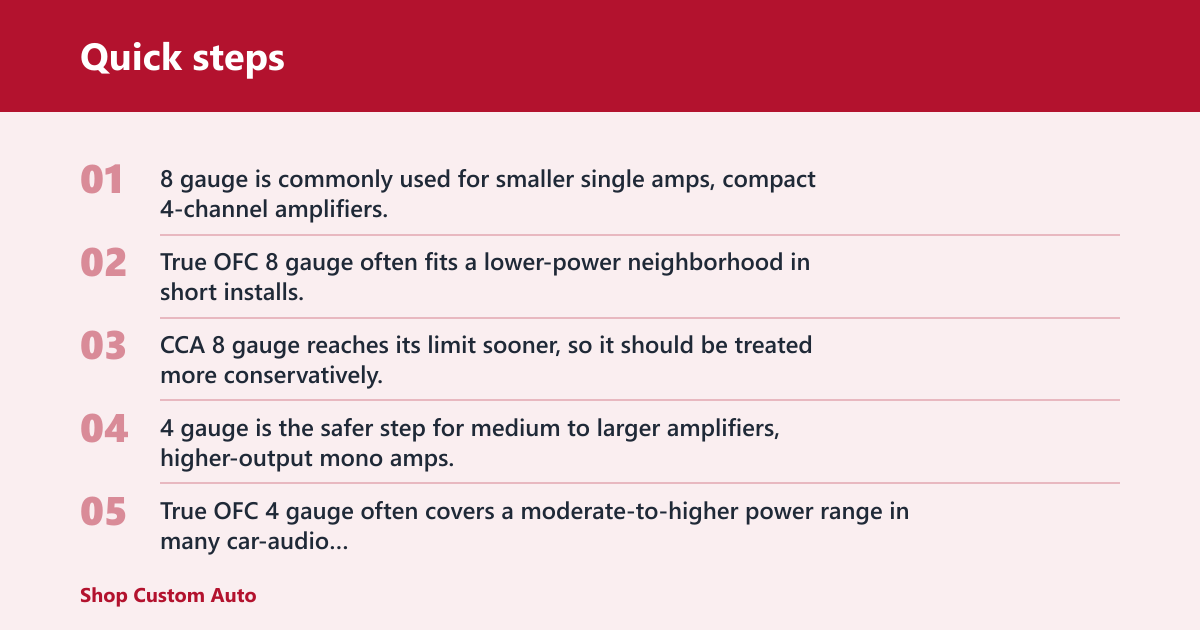
8 gauge is commonly used for smaller single amps, compact 4-channel amplifiers, and short power runs. True OFC 8 gauge often fits a lower-power neighborhood in short installs. CCA 8 gauge reaches its limit sooner, so it should be treated more conservatively.

Typical RMS bands for 4 gauge amp wiring kit

4 gauge is the safer step for medium to larger amplifiers, higher-output mono amps, and systems with more run length. True OFC 4 gauge often covers a moderate-to-higher power range in many car-audio installs, while CCA 4 gauge should be sized more cautiously. The farther the cable must travel, the more 4 gauge makes sense.

How amplifier manuals and fuse limits set the ceiling

The amplifier manual may list the minimum wire size and the recommended fuse size. That fuse should protect the wire near the battery, not the amp by itself. If the manual calls for a 40-amp fuse, an 8 gauge kit with a properly sized fuse holder may fit a small amp; if the amplifier needs more current, 4 gauge is often the better match.

Does OFC or CCA change the choice?

Yes. OFC, or oxygen-free copper, conducts better than CCA, copper-clad aluminum. Better conductivity means less resistance, less heat, and less voltage drop. For the same gauge number, OFC can safely serve a larger load or a longer run than CCA.

OFC vs CCA conductivity

OFC carries current more efficiently, so an OFC 8 gauge kit can often do what a CCA 8 gauge kit cannot. CCA uses aluminum under the copper coating, and aluminum has higher resistance. That means a CCA kit may need the next thicker gauge sooner.

How material changes safe power and heat

Heat is the warning sign. When resistance rises, current turns into heat inside the wire and at terminals. A CCA kit running near its limit can run hotter and drop more voltage, which can reduce amplifier output and stress the insulation over time.

Why CCA usually needs a larger wire size sooner

If the kit is CCA, move up a size earlier than you would with OFC. A 4 gauge CCA kit may be a better match than an 8 gauge OFC kit for the same amp if the run is fairly long or the current draw is higher. That is why material must be part of the decision rule.

How does wire length change the decision?

Longer one-way wire length adds resistance. That creates more voltage drop before the amp ever sees current, which can reduce output and trigger protect mode. Shorter runs can get away with smaller wire, especially when the amp is close to the battery or in a compact cabin layout.
Quick steps: 4 gauge vs 8 gauge amp wiring kit: the core trade-off
American Wire Gauge, or AWG, uses a smaller number to mean a thicker wire. Thicker wire has lower resistance, so it carries more current with less voltage drop. That matters more than peak watts, because amplifier RMS power and one-way cable length determine real wire demand.

Why wire thickness matters
4 gauge is physically thicker than 8 gauge, so it can move more current with less heat build-up. That gives it more margin when the amp pulls hard during bass peaks or when the cable run is long. 8 gauge is thinner, so it fits smaller systems better.

Why RMS power and run length matter more than peak watts
Use amplifier RMS power, not peak power, to size the kit. RMS reflects the output the amp can sustain, while peak power is a brief number and should not drive the wire choice. A short 8 gauge run may be fine for a modest amp, while a long 4 gauge run may be the safer move for a larger one.

Say your amp is a 300-watt RMS mono block under a front seat with a short power run. Eight gauge OFC is often enough there. Now picture a 1,000-watt RMS trunk install in an SUV; the longer path raises resistance, so 4 gauge becomes the safer choice.

How much power can 4 gauge and 8 gauge wire handle?
There is no single wattage number that fits every kit, because cable material, one-way length, amplifier efficiency, and vehicle voltage all change the result. A common rule of thumb is that 8 gauge fits smaller amplifiers, while 4 gauge suits higher-current systems. Check the amplifier manual and the fuse rating near the battery before you buy.


Typical RMS bands for 8 gauge amp wiring kit
8 gauge is commonly used for smaller single amps, compact 4-channel amplifiers, and short power runs. True OFC 8 gauge often fits a lower-power neighborhood in short installs. CCA 8 gauge reaches its limit sooner, so it should be treated more conservatively.

Typical RMS bands for 4 gauge amp wiring kit
4 gauge is the safer step for medium to larger amplifiers, higher-output mono amps, and systems with more run length. True OFC 4 gauge often covers a moderate-to-higher power range in many car-audio installs, while CCA 4 gauge should be sized more cautiously. The farther the cable must travel, the more 4 gauge makes sense.

How amplifier manuals and fuse limits set the ceiling
The amplifier manual may list the minimum wire size and the recommended fuse size. That fuse should protect the wire near the battery, not the amp by itself. If the manual calls for a 40-amp fuse, an 8 gauge kit with a properly sized fuse holder may fit a small amp; if the amplifier needs more current, 4 gauge is often the better match.

Does OFC or CCA change the choice?
Yes. OFC, or oxygen-free copper, conducts better than CCA, copper-clad aluminum. Better conductivity means less resistance, less heat, and less voltage drop. For the same gauge number, OFC can safely serve a larger load or a longer run than CCA.

OFC vs CCA conductivity
OFC carries current more efficiently, so an OFC 8 gauge kit can often do what a CCA 8 gauge kit cannot. CCA uses aluminum under the copper coating, and aluminum has higher resistance. That means a CCA kit may need the next thicker gauge sooner.

How material changes safe power and heat
Heat is the warning sign. When resistance rises, current turns into heat inside the wire and at terminals. A CCA kit running near its limit can run hotter and drop more voltage, which can reduce amplifier output and stress the insulation over time.

Why CCA usually needs a larger wire size sooner
If the kit is CCA, move up a size earlier than you would with OFC. A 4 gauge CCA kit may be a better match than an 8 gauge OFC kit for the same amp if the run is fairly long or the current draw is higher. That is why material must be part of the decision rule.

How does wire length change the decision?

Short runs where 8 gauge may be enough

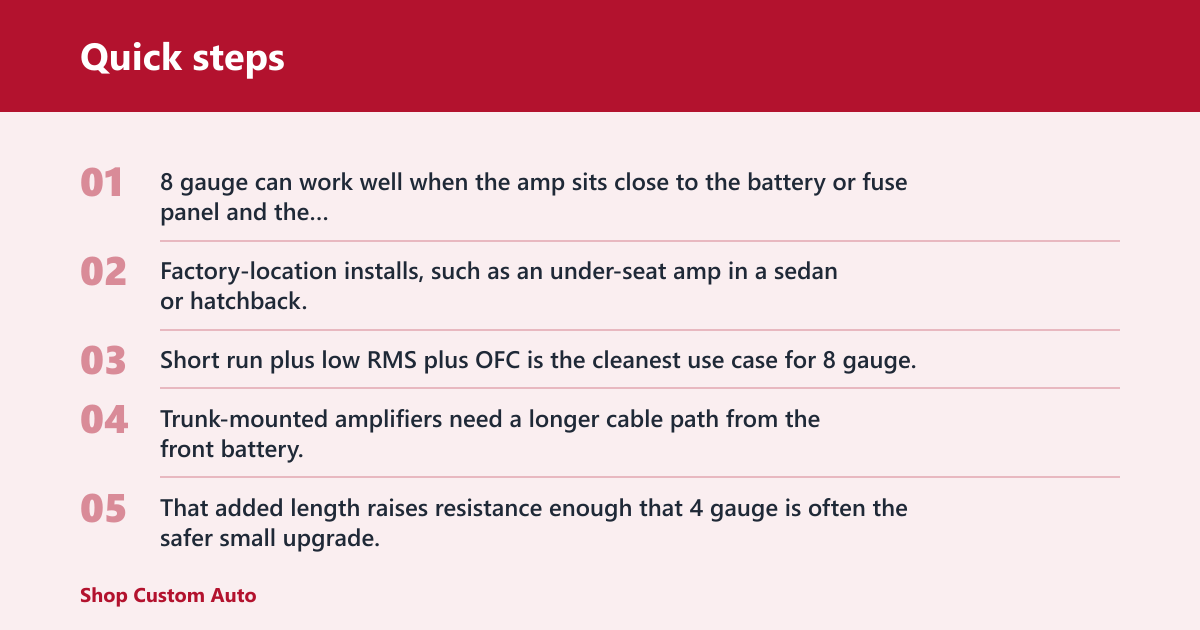
8 gauge can work well when the amp sits close to the battery or fuse panel and the amplifier is modest in RMS demand. Factory-location installs, such as an under-seat amp in a sedan or hatchback, often fit this pattern. Short run plus low RMS plus OFC is the cleanest use case for 8 gauge.

Long trunk-mounted runs that favor 4 gauge

Trunk-mounted amplifiers need a longer cable path from the front battery. That added length raises resistance enough that 4 gauge is often the safer small upgrade. If the amp is also feeding subwoofers hard, the extra headroom helps avoid weak bass and nuisance fuse blowing.

Factory-location installs vs trunk installs

A front-seat or under-seat amp often needs less wire because the path is short. A trunk install usually needs a longer power run, especially in sedans and SUVs. That change alone can move the answer from 8 gauge to 4 gauge even when the amplifier RMS stays the same.

Decision table: choose the smallest safe kit

Use the smallest kit that still covers RMS power, material, and length. The table below assumes a healthy charging system, a correctly sized near-battery fuse, and normal car-audio routing. If the vehicle voltage is already weak, move up one size.

Amplifier RMS band One-way cable length OFC recommendation CCA recommendation Future upgrade?
Up to 300 watts RMS Under 10 ft 8 gauge 4 gauge 8 gauge if the amp will stay small; 4 gauge if a larger amp is likely later
Up to 300 watts RMS 10 to 16 ft 8 gauge 4 gauge 4 gauge if upgrade room matters
300 to 600 watts RMS Under 10 ft 8 gauge or 4 gauge 4 gauge 4 gauge gives better upgrade headroom
300 to 600 watts RMS 10 to 16 ft 4 gauge 4 gauge 4 gauge
600 to 1,200 watts RMS Under 10 ft 4 gauge 4 gauge or larger 4 gauge only if the fuse and amp manual allow it
600 to 1,200 watts RMS 10 ft and up 4 gauge Larger than 4 gauge may be needed Yes, if a bigger amp is planned

What happens if amp wire is too small?

Undersized wire creates resistance, and resistance creates heat. That can soften insulation, stress terminals, and reduce the voltage the amp receives. The result is often weaker bass, protect-mode shutdowns, or a fuse that opens even though the amp itself is not defective.

Heat and insulation stress

When current demand exceeds what the wire can comfortably carry, the cable warms up. Over time, that can damage insulation and make connections unreliable. A hot wire near carpet, trim, or sharp edges is a safety problem, not just a performance problem.

Voltage drop and weak output

If voltage drops too far, the amplifier has less headroom to make power cleanly. Bass can sound flat or compressed, especially at higher volume. That is why many systems that “should” be loud are quiet when the wire is too small or too long.

Fuse blowing and system instability

A fuse is supposed to protect the wire, but an undersized kit can make the fuse do its job repeatedly. If the fuse holder is near the battery and the wire still trips under normal use, the wire size or material is likely wrong for the load. Random shutdowns are a clue, not a mystery.

Choose 4 gauge if… / Choose 8 gauge amp wiring kit if…

Choose 4 gauge if the amplifier RMS is medium to high, the cable run is long, the kit is CCA, or you want room for a future amp upgrade. Choose 8 gauge amp wiring kit if the amp is small, the run is short, and the kit is true OFC. Bigger is not always better, but too small is the fastest way to create noise, heat, and voltage loss.
Quick steps: 4 gauge vs 8 gauge amp wiring kit: the core trade-off
American Wire Gauge, or AWG, uses a smaller number to mean a thicker wire. Thicker wire has lower resistance, so it carries more current with less voltage drop. That matters more than peak watts, because amplifier RMS power and one-way cable length determine real wire demand.

Why wire thickness matters
4 gauge is physically thicker than 8 gauge, so it can move more current with less heat build-up. That gives it more margin when the amp pulls hard during bass peaks or when the cable run is long. 8 gauge is thinner, so it fits smaller systems better.

Why RMS power and run length matter more than peak watts
Use amplifier RMS power, not peak power, to size the kit. RMS reflects the output the amp can sustain, while peak power is a brief number and should not drive the wire choice. A short 8 gauge run may be fine for a modest amp, while a long 4 gauge run may be the safer move for a larger one.

Say your amp is a 300-watt RMS mono block under a front seat with a short power run. Eight gauge OFC is often enough there. Now picture a 1,000-watt RMS trunk install in an SUV; the longer path raises resistance, so 4 gauge becomes the safer choice.

How much power can 4 gauge and 8 gauge wire handle?
There is no single wattage number that fits every kit, because cable material, one-way length, amplifier efficiency, and vehicle voltage all change the result. A common rule of thumb is that 8 gauge fits smaller amplifiers, while 4 gauge suits higher-current systems. Check the amplifier manual and the fuse rating near the battery before you buy.


Typical RMS bands for 8 gauge amp wiring kit
8 gauge is commonly used for smaller single amps, compact 4-channel amplifiers, and short power runs. True OFC 8 gauge often fits a lower-power neighborhood in short installs. CCA 8 gauge reaches its limit sooner, so it should be treated more conservatively.

Typical RMS bands for 4 gauge amp wiring kit
4 gauge is the safer step for medium to larger amplifiers, higher-output mono amps, and systems with more run length. True OFC 4 gauge often covers a moderate-to-higher power range in many car-audio installs, while CCA 4 gauge should be sized more cautiously. The farther the cable must travel, the more 4 gauge makes sense.

How amplifier manuals and fuse limits set the ceiling
The amplifier manual may list the minimum wire size and the recommended fuse size. That fuse should protect the wire near the battery, not the amp by itself. If the manual calls for a 40-amp fuse, an 8 gauge kit with a properly sized fuse holder may fit a small amp; if the amplifier needs more current, 4 gauge is often the better match.

Does OFC or CCA change the choice?
Yes. OFC, or oxygen-free copper, conducts better than CCA, copper-clad aluminum. Better conductivity means less resistance, less heat, and less voltage drop. For the same gauge number, OFC can safely serve a larger load or a longer run than CCA.

OFC vs CCA conductivity
OFC carries current more efficiently, so an OFC 8 gauge kit can often do what a CCA 8 gauge kit cannot. CCA uses aluminum under the copper coating, and aluminum has higher resistance. That means a CCA kit may need the next thicker gauge sooner.

How material changes safe power and heat
Heat is the warning sign. When resistance rises, current turns into heat inside the wire and at terminals. A CCA kit running near its limit can run hotter and drop more voltage, which can reduce amplifier output and stress the insulation over time.

Why CCA usually needs a larger wire size sooner
If the kit is CCA, move up a size earlier than you would with OFC. A 4 gauge CCA kit may be a better match than an 8 gauge OFC kit for the same amp if the run is fairly long or the current draw is higher. That is why material must be part of the decision rule.

How does wire length change the decision?
Longer one-way wire length adds resistance. That creates more voltage drop before the amp ever sees current, which can reduce output and trigger protect mode. Shorter runs can get away with smaller wire, especially when the amp is close to the battery or in a compact cabin layout.


Short runs where 8 gauge may be enough
8 gauge can work well when the amp sits close to the battery or fuse panel and the amplifier is modest in RMS demand. Factory-location installs, such as an under-seat amp in a sedan or hatchback, often fit this pattern. Short run plus low RMS plus OFC is the cleanest use case for 8 gauge.

Long trunk-mounted runs that favor 4 gauge
Trunk-mounted amplifiers need a longer cable path from the front battery. That added length raises resistance enough that 4 gauge is often the safer small upgrade. If the amp is also feeding subwoofers hard, the extra headroom helps avoid weak bass and nuisance fuse blowing.

Factory-location installs vs trunk installs
A front-seat or under-seat amp often needs less wire because the path is short. A trunk install usually needs a longer power run, especially in sedans and SUVs. That change alone can move the answer from 8 gauge to 4 gauge even when the amplifier RMS stays the same.

Decision table: choose the smallest safe kit
Use the smallest kit that still covers RMS power, material, and length. The table below assumes a healthy charging system, a correctly sized near-battery fuse, and normal car-audio routing. If the vehicle voltage is already weak, move up one size.


      Amplifier RMS band
      One-way cable length
      OFC recommendation
      CCA recommendation
      Future upgrade?


      Up to 300 watts RMS
      Under 10 ft
      8 gauge
      4 gauge
      8 gauge if the amp will stay small; 4 gauge if a larger amp is likely later
    
    
      Up to 300 watts RMS
      10 to 16 ft
      8 gauge
      4 gauge
      4 gauge if upgrade room matters
    
    
      300 to 600 watts RMS
      Under 10 ft
      8 gauge or 4 gauge
      4 gauge
      4 gauge gives better upgrade headroom
    
    
      300 to 600 watts RMS
      10 to 16 ft
      4 gauge
      4 gauge
      4 gauge
    
    
      600 to 1,200 watts RMS
      Under 10 ft
      4 gauge
      4 gauge or larger
      4 gauge only if the fuse and amp manual allow it
    
    
      600 to 1,200 watts RMS
      10 ft and up
      4 gauge
      Larger than 4 gauge may be needed
      Yes, if a bigger amp is planned


What happens if amp wire is too small?
Undersized wire creates resistance, and resistance creates heat. That can soften insulation, stress terminals, and reduce the voltage the amp receives. The result is often weaker bass, protect-mode shutdowns, or a fuse that opens even though the amp itself is not defective.

Heat and insulation stress
When current demand exceeds what the wire can comfortably carry, the cable warms up. Over time, that can damage insulation and make connections unreliable. A hot wire near carpet, trim, or sharp edges is a safety problem, not just a performance problem.

Voltage drop and weak output
If voltage drops too far, the amplifier has less headroom to make power cleanly. Bass can sound flat or compressed, especially at higher volume. That is why many systems that “should” be loud are quiet when the wire is too small or too long.

Fuse blowing and system instability
A fuse is supposed to protect the wire, but an undersized kit can make the fuse do its job repeatedly. If the fuse holder is near the battery and the wire still trips under normal use, the wire size or material is likely wrong for the load. Random shutdowns are a clue, not a mystery.

Choose 4 gauge if… / Choose 8 gauge amp wiring kit if…

Choose 4 gauge if…

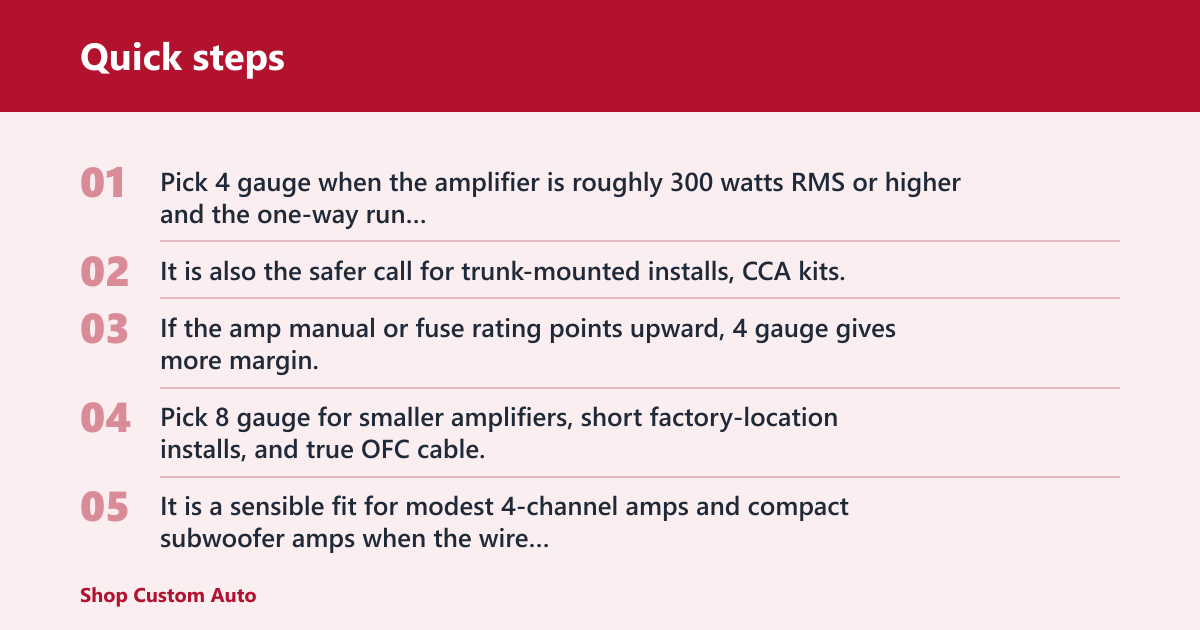
Pick 4 gauge when the amplifier is roughly 300 watts RMS or higher and the one-way run starts to get long. It is also the safer call for trunk-mounted installs, CCA kits, and systems that may grow later. If the amp manual or fuse rating points upward, 4 gauge gives more margin.

Choose 8 gauge amp wiring kit if…

Pick 8 gauge for smaller amplifiers, short factory-location installs, and true OFC cable. It is a sensible fit for modest 4-channel amps and compact subwoofer amps when the wire path is short. If the install is simple and the power level is low, 8 gauge avoids extra cost and routing bulk.

A common first-timer mistake is buying 8 gauge CCA for a trunk sub amp because the box says “800 watts.” That peak number does not equal RMS demand, and the long run can turn the smaller kit into a voltage-drop problem fast. A properly sized 4 gauge OFC kit would have been the better buy.

Frequently asked questions

Is 4 gauge better than 8 gauge for an amp wiring kit?

4 gauge is better when the system needs more current, the cable run is long, or the kit is CCA. 8 gauge is better when the amp is smaller and the run is short. The right answer is not the bigger wire every time; it is the smallest safe wire for the actual RMS load.

What size amp wiring kit do I need for my amplifier?

Start with the amplifier’s RMS power, then check one-way cable length and wire material. A small OFC amp with a short run may fit 8 gauge, while a medium or large amp, especially in a trunk, usually needs 4 gauge. The fuse rating near the battery should match the wire and the manual.

How many watts can 4 gauge amp wire handle?

A common car-audio rule of thumb puts true OFC 4 gauge in a moderate-to-higher power range, depending on run length and vehicle voltage. CCA 4 gauge should be treated more conservatively. Longer runs and hot underhood conditions push the safe limit downward.

How many watts can 8 gauge amp wire handle?

In short installs, true OFC 8 gauge is often used in a lower-power range, roughly around a few hundred watts RMS. CCA 8 gauge should be sized lower because it has higher resistance and more voltage drop. If the amplifier is near the upper end of that range, 4 gauge gives more safety margin.

Can I run 4 gauge wire to a small amplifier?

Yes. 4 gauge can power a small amplifier, and the amp will not be harmed by having extra wire capacity. The trade-off is cost, routing space, and less flexibility in tight areas. If the amp is small and the run is short, 8 gauge may be the cleaner choice.

Will 8 gauge wire be enough for a 4-channel amp?

Often yes, if the 4-channel amp is modest in RMS output and the run is short. Many smaller 4-channel amps fit well on 8 gauge OFC in factory-location installs. If the amp is high-output, the run is long, or the wire is CCA, 4 gauge is the safer choice.

Does wire length change whether I should choose 4 gauge or 8 gauge?

Yes. Longer wire adds resistance, which increases voltage drop and heat. Short runs can make 8 gauge acceptable for smaller amps, while long trunk runs push the choice toward 4 gauge. If the amp is far from the battery, length matters almost as much as RMS power.

Should I choose the bigger wire for future upgrades?

If an amp swap is likely, yes, choosing 4 gauge now can save a second wiring job later. That is especially true when the route is long or the kit is CCA. If the system will stay small and close to the battery, 8 gauge is usually the more sensible purchase.

Similar Posts