
Should You Ground an Amp to the Battery? Usually No
No, an amp should usually ground to bare chassis metal near the amplifier rather than straight to the battery. A poor ground can cause alternator whine, voltage drop, protect-mode shutdowns, and hot wiring. This guide shows when a battery ground is acceptable, when it is redundant, and how to tell whether it is fixing the problem or hiding a wiring fault.
Should you ground an amp to the battery?
Usually no. In most installs, the best choice is a short amp ground wire to clean, bare chassis metal near the amplifier. A connection to the negative battery terminal only makes sense when that terminal is already bonded to the chassis with a short, low-resistance path and you are not relying on it to compensate for a weak ground point.
The distinction matters because “battery ground” can mean two different things. It can mean the negative battery terminal, which is already tied to chassis ground in a normal vehicle, or it can mean a long run back to the battery because the local chassis point is poor. Those are not the same choice.
Why the distinction matters
A near-amp chassis ground keeps the return path short. That cuts resistance, makes troubleshooting easier, and avoids extra cable length that can add failure points. If the amp ground is long, loose, or routed awkwardly, voltage drop and noise become harder to isolate.
A battery connection also changes serviceability. If the amp ground shares a main battery terminal with factory cables, later work can become crowded and messy. A proper chassis point is often simpler to inspect, tighten, and clean.
Why chassis ground is the default choice
Chassis ground is the default because the vehicle body is already part of the electrical return path. A good ground point is close to the amplifier, on bare metal, and secured tightly with the correct ring terminal or lug. That setup is usually shorter and cleaner than running a wire all the way to the battery.
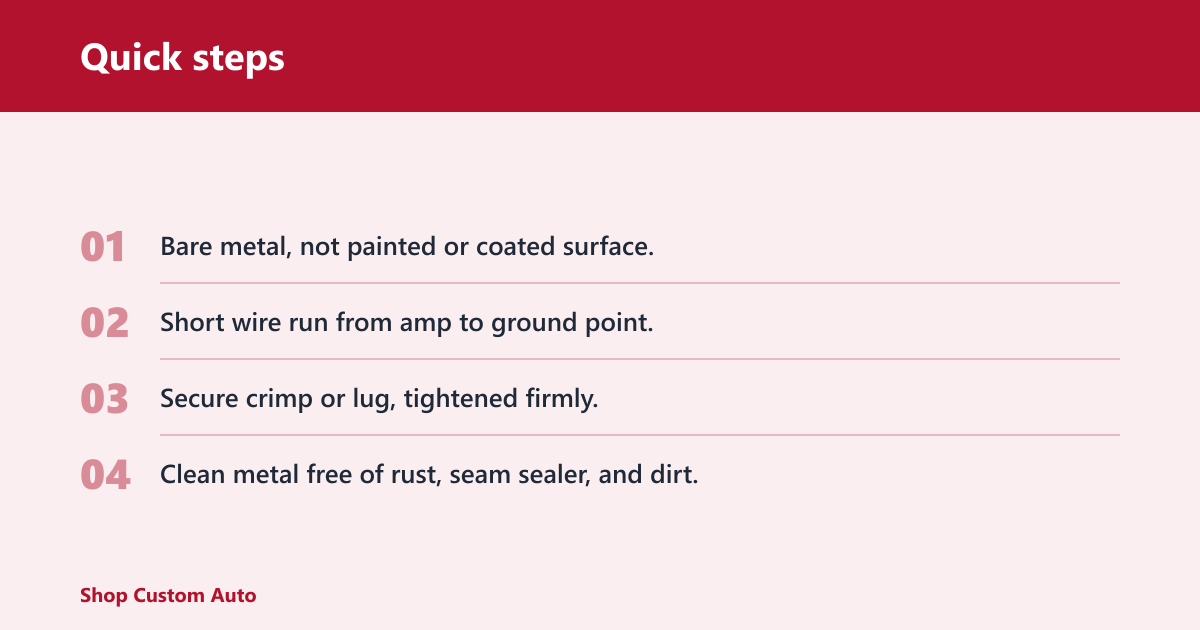
Short ground runs matter. The ground wire should be as short as practical, and in many installs it should match the power wire gauge. Most amp manuals call for a solid, low-resistance connection rather than a long detour to a distant terminal.
What a proper chassis ground looks like
- Bare metal, not painted or coated surface.
- Short wire run from amp to ground point.
- Secure crimp or lug, tightened firmly.
- Clean metal free of rust, seam sealer, and dirt.
Painted or dirty metal raises resistance. That can make a ground appear “good enough” at low volume while failing under load. You need to scrape to clean metal before fastening the ground.
When battery grounding is acceptable
A battery-terminal connection is acceptable only when it is effectively the same ground point as the chassis. In many vehicles, the negative battery terminal is bonded to the body and frame with a short cable, so using that terminal can work in special cases such as a rear battery setup or a bench test. It is not a fix for a bad local ground.
Suppose an amplifier is mounted beside a rear battery in a trunk build. If the negative terminal is already tied to the vehicle body with a short, heavy cable, grounding the amp there may be reasonable. The key question is still the quality of the bond to chassis, not the fact that the cable ends at a battery post.
When the negative terminal is close enough to count
The negative battery terminal is electrically tied to chassis ground in most cars. That means the terminal itself can function as a ground reference. The connection still needs to be short and low resistance, and it should not be used as a shortcut around a poor body ground elsewhere.
A rear-mounted auxiliary battery changes the picture only if its negative side is tied into the vehicle body with a proper ground strap. In that case, the battery terminal and chassis point are part of the same ground network.
When battery grounding is the wrong choice
Battery grounding is the wrong choice when it is used to hide a bad chassis point. If the local metal is painted, rusty, or thin, running a long cable to the battery may seem to help, but it leaves the real problem untouched. It also adds length, clutter, and another place for resistance to develop.
Another failure mode is confusion during troubleshooting. A long battery run can mask a weak body bond, while a noisy amp may still have a ground loop or power-cable issue. Fix the local ground first unless you have a specific reason to tie into the battery terminal.
Common failure modes to watch for
- Added cable length with extra resistance.
- Poor access for service and inspection.
- Noise that looks like a ground issue but comes from elsewhere.
- Masked chassis problems that return later.
What a bad amp ground looks like
A bad amp ground can cause voltage drop, protect mode behavior, weak output, and sometimes alternator whine or other noise. The symptoms often change with volume, bass hits, or engine speed. That pattern usually points to a current-path problem, not just a speaker problem.
Ground loop noise is also possible when grounding choices are poor. It can sound like a whistle or whine that rises with engine RPM. That noise is often blamed on the amp itself, but the actual issue may be a difference in ground potential between components.
Symptoms that point to grounding trouble
- Amplifier shuts down on bass notes.
- Wiring or terminals feel warm.
- Output drops when volume rises.
- Whine changes with engine speed.
Picture a sub amp in a hatchback that powers up fine at low volume, then flips into protect mode when the bass line hits. If the ground point is on painted sheet metal or the wire is too long, the amp may be starved for current even though the battery is healthy.
How to test the ground with a multimeter

Use a multimeter to compare voltage at the battery and at the amplifier under load. Continuity alone is not enough, because a ground path can pass a simple beep test and still drop too much voltage when current flows. Under-load testing matters.
Set the meter to DC volts for voltage-drop checks. Then compare the voltage between the amp ground and battery negative while the system is playing at a normal working level. A healthy ground path should show very little difference. If the reading rises under load, the ground path deserves attention.
Simple multimeter test flow
- Turn the system on and play audio at a moderate level.
- Measure DC voltage at the battery positive and negative terminals.
- Measure DC voltage at the amplifier’s power and ground terminals.
- Compare battery voltage to amp voltage while the system is loaded.
- Check resistance or continuity only after the vehicle is off.
- Inspect the ground point if the amp side shows extra drop.
| Check | What to measure | What it can tell you | What to do next |
|---|---|---|---|
| Battery vs. amp voltage | DC volts under load | Voltage drop in power or ground path | Inspect ground, power wire, and connections |
| Ground continuity | Resistance with power off | Basic path present, but not full quality | Do not stop here; test under load too |
| Ground point condition | Bare metal, tight hardware | Whether resistance is being added by contact surfaces | Clean to bare metal and retighten |
| Noise while driving | Whine or interference with engine RPM | Possible ground loop or routing issue | Recheck ground location and cable routing |
How to fix an amp ground the right way
Start by moving the ground to a clean chassis point close to the amp. Remove paint, rust, and coating until you reach bare metal, then fasten a short ground wire with a proper crimp or lug. Tight contact matters more than force alone.
If the ground wire is undersized or excessively long, replace it with a run that matches the power wire in many installs. If the amp still sees voltage drop after the ground is corrected, inspect the power cable, battery connections, and charging system.
When to look beyond the ground wire
If the vehicle has a high-current system, the Big 3 upgrade may help: battery-to-chassis ground, engine-to-chassis ground, and alternator-positive-to-battery-positive. That is most useful when the audio system stresses the charging path and the wiring needs better current flow.
A bad chassis connection can look like a battery problem. A weak alternator, corroded battery terminals, or poor factory grounding can all show up as amp shutdowns or dimming. Do not assume the battery terminal is the answer before checking the whole path.
Decision checklist: battery ground, chassis ground, or neither
Use this checklist to decide quickly. The first branch is the default in most installs. The second is acceptable only when the battery negative is already the same ground point as chassis. The third means stop and repair the actual problem instead of working around it.
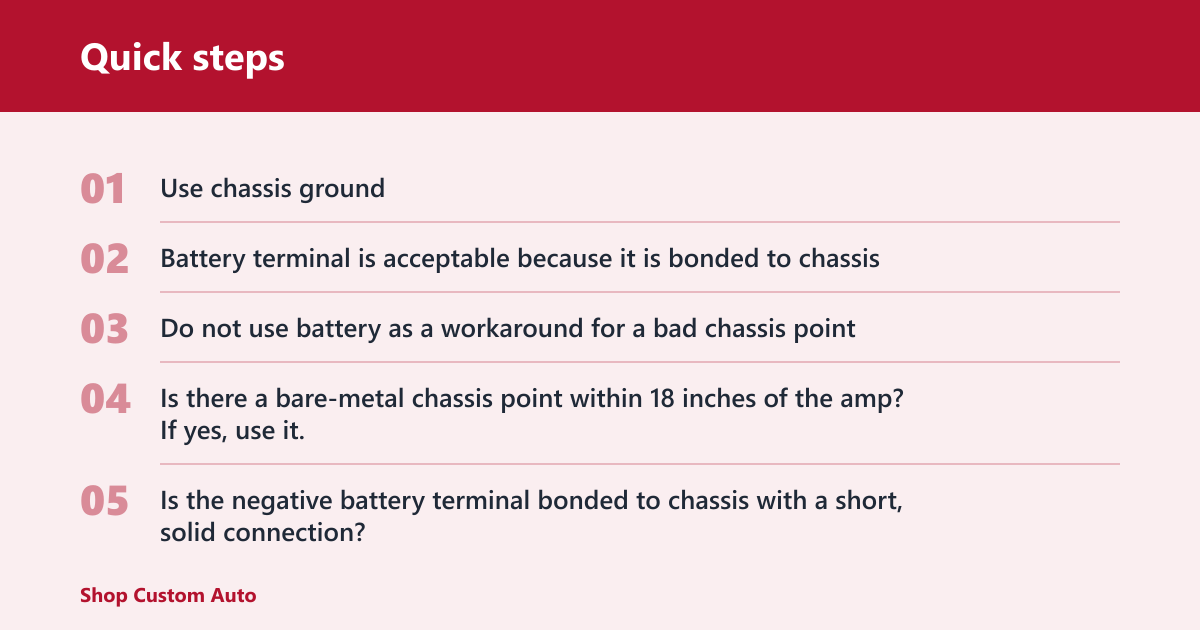
- Use chassis ground if the amp is near a clean body point, the metal can be scraped to bare contact, and the ground wire can stay short.
- Battery terminal is acceptable because it is bonded to chassis if the terminal is the same electrical ground point, the bond is short and low resistance, and the setup is for a special case such as a rear battery or temporary test.
- Do not use battery as a workaround for a bad chassis point if the local body metal is painted, rusty, or inconvenient and the battery run is only hiding a poor ground that should be fixed.
One-page decision flow
- Is there a bare-metal chassis point within 18 inches of the amp? If yes, use it.
- Is the negative battery terminal bonded to chassis with a short, solid connection? If yes, it may be acceptable in a special case.
- Is the battery run being used because the chassis point is dirty, painted, or weak? If yes, stop and fix the chassis ground.
- Still seeing voltage drop or noise? Test under load with a multimeter and check the power cable, battery terminals, and charging path.
Frequently asked questions
can you ground an amp to the battery
Usually no. A battery ground is only acceptable when the negative battery terminal is already bonded to chassis with a short, low-resistance path, or in special setups where that terminal is effectively the same ground point. For most installs, bare chassis metal near the amp is the better choice.
can you ground an amp to the negative battery terminal
Sometimes. The negative terminal is tied to the vehicle’s chassis ground in most cars, so it can work when that bond is solid and short. It should not be used as a workaround for a bad local chassis point, because that hides the real fault.
can you ground an amp directly to the battery
Only in limited cases, and usually only to the negative side. Directly grounding to a battery terminal is acceptable when the battery’s negative is effectively the same ground point as the chassis, such as with a rear battery setup or a temporary troubleshooting test.
should you ground amp to battery
Usually no. A short chassis ground near the amplifier is the standard choice because it is cleaner, shorter, and easier to inspect. Battery grounding should be reserved for special situations where the terminal is already part of the same ground network.
Will grounding an amp to the battery cause noise or charging problems?
It can, especially if the battery connection is being used to mask a poor chassis point or if the wiring creates a long, awkward return path. That can add resistance, noise, and troubleshooting confusion. A correct chassis ground avoids most of those issues.
Is the negative battery terminal a safe ground point for an amp?
It can be safe if the terminal is tightly bonded to chassis with a short, low-resistance connection and the installation needs that tie-in for a good reason. It is not automatically the best choice, and it should not replace a proper local chassis ground when one is available.