License Plate Frame Camera vs Bracket Camera: Which Fits Better?
A license plate frame camera works best on vehicles with a flat, centered plate recess and enough clearance for a thicker frame; a bracket camera is usually better when the plate sits on a curved bumper, low tailgate, or tight mounting surface. Pick the wrong mount and you can block plate characters, fight glare, or build a camera that loosens and fails service checks. This guide compares fitment, plate visibility, install effort, and long-term serviceability so you can choose the right mount by vehicle layout.
| Factor | frame camera | bracket camera | Winner |
|---|---|---|---|
| Plate visibility | Higher obstruction risk if the frame overlaps characters, state stickers, or the plate edge | Usually easier to offset around the plate, with more freedom to keep text clear | bracket camera |
| Install difficulty | Often simpler on flat, standard plate mounts because the camera and frame are one assembly | More setup steps, since you position the bracket and then mount the camera separately | frame camera |
| Angle adjustability | Limited by the frame’s fixed geometry | Better tilt and offset control for parking view and bumper coverage | bracket camera |
| Clearance and service access | Thicker frame bodies can conflict with hatch handles, tow gear, or tight recess depth | Usually easier to place away from moving parts and remove later for service | bracket camera |
| Best-fit vehicle layout | Flat trunk or hatch plate pocket with standard spacing | Curved bumper, recessed plate pocket, tailgate, or mixed-height rear end | tie |
Physical fit and mounting differences
The trade-off is direct: the frame camera favors fast, centered mounting on a flat plate area, while the bracket camera gives you more room to work around odd bodywork and clearance limits. The better choice depends less on camera features and more on how the rear plate sits on the vehicle.
What each mount style changes first
A license plate frame camera combines the camera with the plate surround, so the install depends on the plate opening, screw-hole spacing, and enough depth behind the plate for the frame body. A license plate bracket camera separates the camera from the plate surround, which makes it easier to shift the camera position when the plate sits in a recess or on a curved surface.
That difference shows up before image quality does. If the mount does not sit flat, the camera can tilt, the plate can sit crooked, or the frame can press against the hatch handle and create vibration.
Why fitment drives the choice
Standard US plates are 12 by 6 inches, but rear bodywork is not standardized. Some vehicles have a shallow pocket with good screw access; others have a deep recess, a contoured tailgate, or a plate area that shares space with a handle or trim bezel.
Because of that, fitment is the first filter. If the camera body or frame thickness crowds the plate opening, the better mount is the one that leaves more clearance, even if its install takes longer.
Where the trade-off shows up first
The trade-off usually appears in three places: plate visibility, clearance, and later service. A frame camera can be tidy on a flat sedan trunk lid, but the same frame may block a registration sticker or press into a hatch release. A bracket camera often solves those problems, but it adds hardware and adjustment points that need tightening.
License plate camera decision matrix
The matrix below uses the factors that matter most for mount choice, not marketing claims. It compares how each style fits the vehicle, not how bright the image looks on a spec sheet.
| Decision factor | frame camera | bracket camera | Winner |
|---|---|---|---|
| Plate visibility | Can cover plate edges or tag stickers if the frame is thick | Usually easier to position clear of characters and stickers | bracket camera |
| Install difficulty | Fewer separate parts on a flat mounting area | More setup and alignment steps | frame camera |
| Angle adjustability | Fixed by frame geometry | More freedom to aim the lens down and outward | bracket camera |
| Vibration resistance | Good when the frame seats flush and the hardware is tight | Depends on bracket stiffness and fastener quality | tie |
| Water exposure | Frame edges can trap spray if the fit is poor | Usually easier to drain and clean around the camera body | bracket camera |
| Tailgate clearance | Thicker frame depth can interfere with handles or trim | Can be offset away from moving parts more easily | bracket camera |
| Serviceability | Simple if the frame stays accessible; harder if the plate recess is tight | Usually easier to remove, re-aim, or replace later | bracket camera |
| Best-fit vehicle type | Flat trunk or hatch with standard plate recess | Curved bumper, recessed pocket, tailgate, or tight rear layout | bracket camera |
Plate visibility
The frame camera loses ground when the frame overlaps the plate border, registration tag, or any state-required marking. Some states are stricter than others about legibility and obstruction, so the safest mount is the one that keeps every character and sticker easy to read from normal viewing angles.
The bracket camera gives more room to move the lens without crowding the plate. That matters on plates with top or corner stickers, or on vehicles where the camera must sit lower to clear trim.
Install difficulty and hardware
A frame camera usually uses the plate screws and spacer hardware already available on the vehicle, so it can be the easier drill-free path on a standard mount. A bracket camera may need extra screws, spacers, or a separate bracket, which adds steps but also gives more flexibility.
Do not confuse fewer steps with a better end result. If the frame must be forced into a recess, the quick install can become the poor choice because the mount sits crooked or loosens over time.
Angle adjustability and coverage
Bracket cameras usually win on angle control because the lens can be offset relative to the plate and aimed toward the bumper edge or parking zone. That helps with blind-spot coverage near the bumper, especially when the rear surface slopes or the plate sits high.
Frame cameras can still provide a useful rear-view picture, but the viewing angle is more constrained. Wide-angle coverage can also bring distortion, so the better mount is the one that lets the lens point where the driver actually needs it.
Vibration, water, clearance, and serviceability
Mounts that sit flush and tight resist vibration better than mounts that flex or hang off a shallow edge. That said, a rigid bracket with good hardware can be very stable, while a thick frame can shake if it bridges an uneven recess.
Weather exposure is a separate issue. Salt, snow, and car washes punish any outside mount, so a design that sheds water and allows easy cleaning usually ages better. Service access matters too, because a camera that is simple to remove is easier to replace when wiring or the module fails.
Will it fit your vehicle?
Fit should start with the plate opening, not the camera spec sheet. A mount that matches the vehicle’s plate recess, screw-hole spacing, and contour clearance will sit more securely and is less likely to obstruct the plate or rub against nearby trim.
Standard plate size and screw-hole spacing
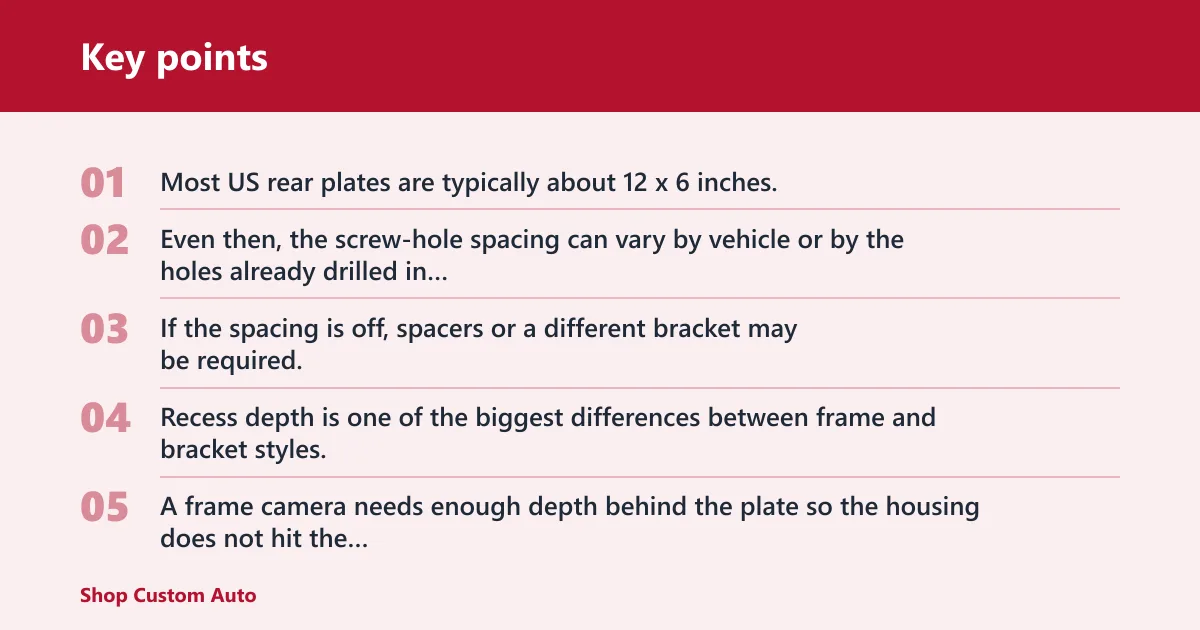
Most US rear plates are typically about 12 x 6 inches, and many mounts are built around that format. Even then, the screw-hole spacing can vary by vehicle or by the holes already drilled in the plate bracket, so you should confirm that the camera mount matches the existing attachment points before buying.
If the spacing is off, spacers or a different bracket may be required. That is a fit problem, not a camera problem.
Recessed plates and contour clearance
Recess depth is one of the biggest differences between frame and bracket styles. A frame camera needs enough depth behind the plate so the housing does not hit the bumper, trim, or gate skin; a bracket camera can usually stand off from the surface and bridge a difficult pocket more easily.
Picture a compact SUV with a deep plate recess and a narrow trim lip. A thick frame may sit proud of the surface and rock under load, while a bracket can be offset and tightened flat.
Hatch handles, tailgate gaps, and tow gear
Tailgates and hatches add moving parts. If the plate area shares space with a release handle, camera wiring pass-through, or tow accessory, the mount has to clear those pieces through every open and close cycle.
A bracket camera is often the safer option in those cases because it can be shifted away from the moving edge. A frame camera can still work, but only when the frame thickness leaves room for the hatch handle and any nearby trim.
Checklist: common fitment problems
| Check | Yes | No | Why it matters |
|---|---|---|---|
| Recessed plate pocket | ☐ | ☐ | Deep pockets can block a thick frame camera |
| Hatch handle or release nearby | ☐ | ☐ | Moving parts can hit the mount or wiring |
| Tag sticker could be covered | ☐ | ☐ | Obstruction risk is higher with thick frame edges |
| Tight contour or curved bumper | ☐ | ☐ | Curvature often favors a bracket-style offset |
Which mount is easier to install?
A frame camera is often easier to install without drilling when the vehicle already has a flat plate area and usable screw holes. A bracket camera usually takes more setup, but it can solve fit issues that a simple frame cannot, especially on curved or recessed rear panels.
Drill-free and drilled installs
Drill-free mounting is simplest when the camera uses the existing plate screws and the surface is flat enough to support the mount. If the plate pocket is odd-shaped or the wiring needs a new path, drilling may be required for either style.
Do not assume drill-free means universal. A frame camera can still need spacers or modified hardware, and a bracket camera may need a drilled pass-through for the cable to stay hidden and protected.
Wiring pass-through and cable routing
Routing matters as much as the mount. A clean pass-through keeps the cable away from sharp edges, latch mechanisms, and water entry points, and it reduces strain when the hatch or tailgate opens and closes.
Bracket cameras often offer more routing freedom because the camera body does not have to sit inside the frame perimeter. That can make the final install cleaner on vehicles with limited space behind the plate.
Torque, spacers, and vibration control
Fasteners need enough torque to hold the mount, but not so much that they distort the frame or strip a plastic bracket. Spacers can help when the body surface is uneven, and they can also reduce wobble if the plate sits in a shallow recess.
A common first-timer mistake is tightening the mount until the plate bows. That can create a slow tilt over time, especially after road vibration and repeated wash cycles.
Will it block your plate or sticker?
Yes, either style can block part of the plate if the geometry is wrong. The risk is higher with a thick frame camera because the frame itself can cover characters, trim the plate edge, or hide a registration sticker that local law expects to remain visible.
Plate-legibility rules and obstruction risk
License plate visibility rules vary by state, but the general requirement is the same: the plate must remain legible and unobstructed. If the camera or frame blocks a character, a registration tag, or a security feature, the mount can create compliance risk even if the camera works perfectly.
Bracket cameras usually make it easier to keep the plate open and readable because the camera can sit beside or above the plate instead of wrapping around it.
Tag-sticker placement and frame thickness
Sticker placement matters. If the state tag sits in a corner or along the top edge, a thick frame lip can hide part of it and create a problem that does not show up in a basic product photo.
Frame thickness also affects depth clearance. A mount that looks slim from the side may still project enough to clip the sticker area or push the plate toward the bumper surface.
When a bracket gives better clearance
Use the bracket when the plate needs space from the surrounding bodywork. It can preserve the full plate face while still giving the camera a direct rear view, which is useful on vehicles with tight hatch openings or narrow tailgate frames.
Weather, vibration, and night use
Both styles sit outside, so weather sealing matters. Rain, snow, wash spray, salt, and dirt can all affect camera clarity and the long-term condition of the hardware, especially where fasteners and seams stay wet.
Weather sealing and exterior exposure
Many exterior cameras are sold with water resistance claims or an IP rating, but the mount itself still has to keep water from pooling around the lens or wiring entry. A frame with poor drainage can trap grime; a bracket with a cleaner edge can be easier to rinse.
That does not make one style waterproof by itself. The better choice is the one that leaves fewer hidden pockets for moisture to sit in.
Salt, corrosion, and wash durability
Road salt attacks screws, brackets, and any unprotected metal surface. Plastic frame bodies avoid rust, but they can still crack or loosen; metal frames can be stronger, but only if the finish and fasteners resist corrosion.
If winter use is common, check the hardware path, not only the camera housing. The mount that is easier to inspect and clean later usually holds up better over time.
Low-light image support and field of view
A license plate backup camera needs enough low-light visibility to show the bumper, lane edges, and nearby obstacles after dark. Field of view helps, but extreme wide-angle lenses can stretch the image and make distance judgment harder.
The mount should support the lens angle the camera needs. If the frame forces the lens too high, the picture may miss the parking zone; if the bracket lets the lens point too low, the image can overfill with bumper and pavement.
Choose frame camera if… / Choose bracket camera if…
Choose a frame camera if the vehicle has a flat, centered plate recess, standard screw access, and enough depth behind the plate for the frame body. Choose a bracket camera if the plate sits on a curved bumper, a tight tailgate, or a layout that risks blocking the plate or hitting a hatch handle.
Best fit for a frame camera
A frame camera is the better pick on a sedan trunk lid, a flat SUV hatch panel, or any rear end where the plate area is square and centered. It is also a good fit when you want the simplest drill-free install and the fewest separate parts around the plate.
Best fit for a bracket camera
A bracket camera is the better pick for a pickup tailgate, a recessed bumper pocket, or a hatchback with limited clearance around the plate opening. It is also the safer choice when you need more room for tag visibility, adjustment, or future service.
Vehicle layout summary
Cars with flat rear bodywork tend to favor the frame camera. Trucks, SUVs with deep recesses, and hatchbacks with tight clearances usually favor the bracket camera because the extra adjustability matters more than the simpler form.
Suppose a crossover has a 12 x 6 plate pocket with a top sticker and a shallow hatch handle above it. A frame camera may crowd the sticker and sit too close to the handle; a bracket camera can shift the lens lower and keep the plate clear.
Frequently asked questions
Is a license plate frame camera better than a bracket camera?
Neither is always better. A frame camera is usually easier on flat, centered plate mounts, while a bracket camera is usually better when the rear body is curved, recessed, or crowded. The right pick comes from the vehicle layout, plate visibility, and available clearance.
Will a license plate camera block my tag?
It can. Thick frame edges are the main risk because they can cover part of the plate, a registration sticker, or another required marking. A bracket camera usually gives more room to keep the full plate face visible, but the final fit still has to be checked on the vehicle.
Which mount is easier to install without drilling?
A frame camera is often easier to install without drilling when the plate area is flat and the screw holes line up. A bracket camera may still be drill-free in some cases, but it usually needs more alignment work and more hardware to sit correctly.
Which style works better on my car or truck?
Flat sedan trunks and simple hatch panels usually favor the frame camera. Trucks, tailgates, curved bumpers, and recessed plate pockets usually favor the bracket camera. If the rear opening has moving parts or tight contour clearance, the bracket often gives you more room to work.
Can I still open my tailgate with a bracket camera installed?
Usually yes, if the bracket is placed with enough clearance and the wiring is routed so it does not snag. That said, tailgate clearance is a key fit check. If the camera or bracket sits too close to the handle or latch path, it can interfere with opening or closing.
What should I check before buying a license plate camera mount?
Check the plate size, screw-hole spacing, recess depth, tag-sticker position, and whether the rear surface is flat or curved. Also check the path for wiring pass-through, the chance of hatch or tailgate interference, and whether the mount leaves the plate fully legible under local rules.