Is a Bigger Subwoofer Box Better for Deep Bass?
A bigger subwoofer box can improve deep bass only if the driver is built for it and the box’s net volume matches the target tuning; otherwise bass gets looser, louder at the wrong notes, or bottoms out sooner. Get the sizing wrong, and you can lose output, waste trunk space, or stress the sub below its safe range. This guide covers when larger boxes help, when they hurt, and how cabin gain, tuning, and driver specs change the answer.
What counts as deep bass in a car?
Deep bass is low-frequency extension, not just volume. In a car, it usually means strong output in the lower bass region without a sharp peak that makes one note stand out. Loud bass can be easy to get. Deep bass takes the right enclosure, tuning, and vehicle response working together.
Deep bass versus loud bass
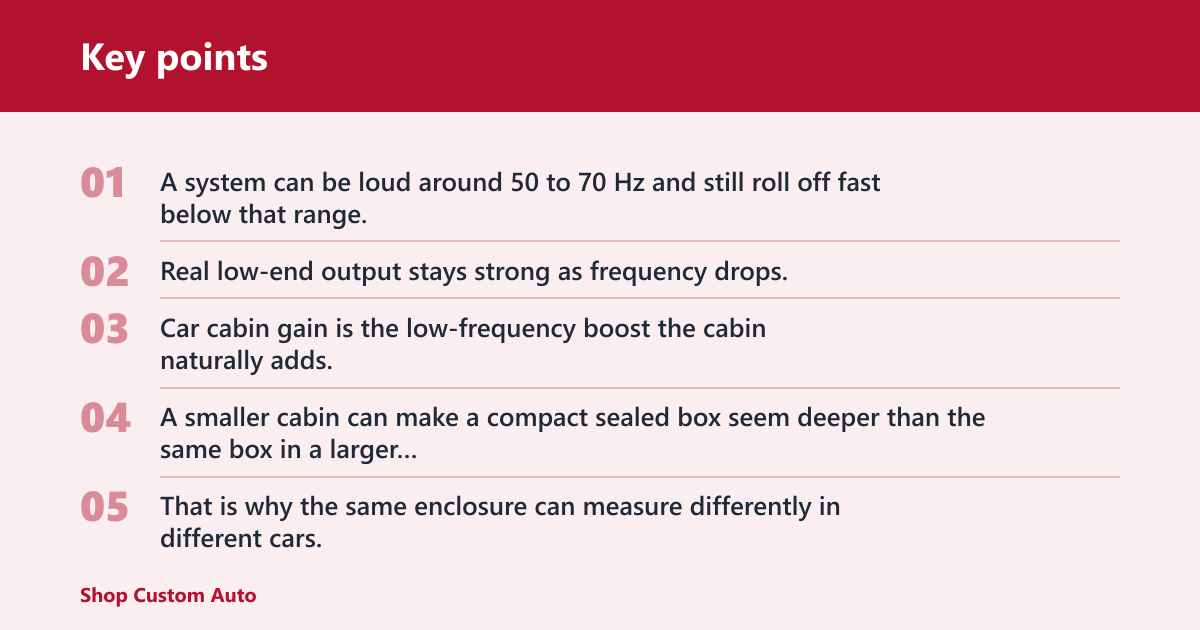
A system can be loud around 50 to 70 Hz and still roll off fast below that range. That sounds punchy, but not deep. Real low-end output stays strong as frequency drops, while keeping cone motion under control so the sound stays clean instead of muddy.
Why vehicle cabin gain changes what you hear
Car cabin gain is the low-frequency boost the cabin naturally adds, and it varies by vehicle size and layout. A smaller cabin can make a compact sealed box seem deeper than the same box in a larger vehicle. That is why the same enclosure can measure differently in different cars.
Why bass depth depends on the whole system
Driver design, enclosure type, net volume, tuning frequency, and cabin response all change the result. A box that looks oversized on paper may work well with one subwoofer and fail with another. Subwoofer model specific enclosure range matters more than a generic size rule.
Does a bigger subwoofer box always mean deeper bass?
No. A larger box can move the response lower in some designs, but only within the driver’s recommended range. Past that point, cone control often gets worse, excursion rises, and the bass can sound looser rather than deeper. Bigger is a tool, not a guarantee.
When larger volume helps low-end output
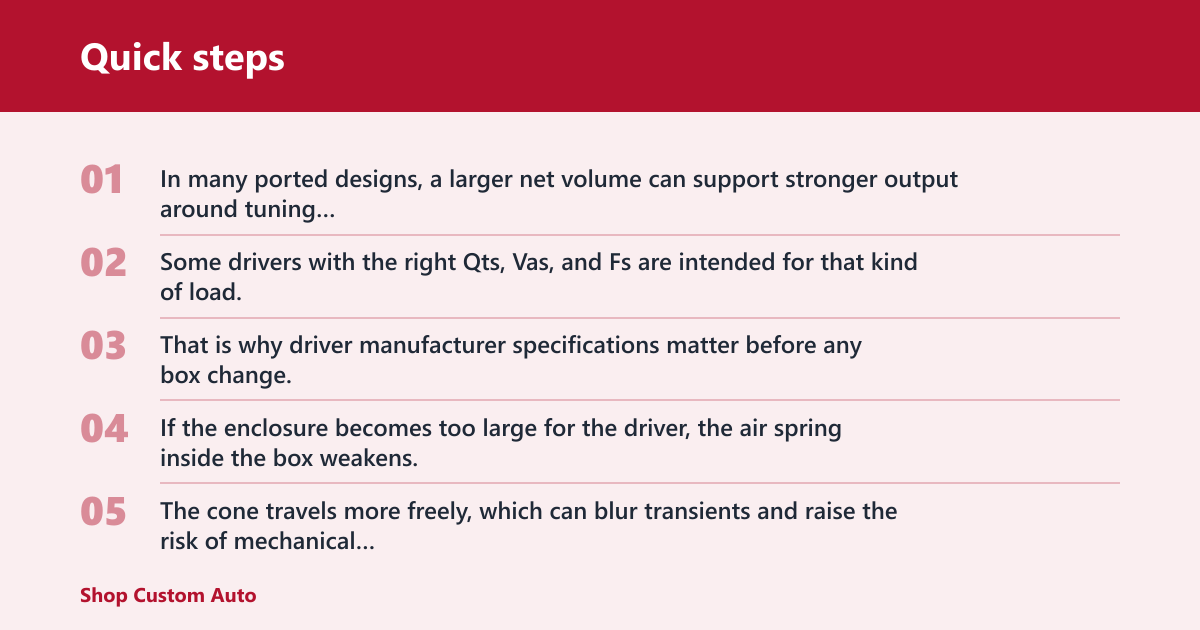
In many ported designs, a larger net volume can support stronger output around tuning and a deeper perceived bottom end. Some drivers with the right Qts, Vas, and Fs are intended for that kind of load. That is why driver manufacturer specifications matter before any box change.
When larger volume hurts cone control
If the enclosure becomes too large for the driver, the air spring inside the box weakens. The cone travels more freely, which can blur transients and raise the risk of mechanical damage. The result may be more movement, not better bass.
Why “bigger” is not the same as “better”
Deep bass depends on control, not just displacement. A huge box can sound impressive on a quick demo, then fall apart on music with long, low notes. The better question is whether the net volume fits the subwoofer model specific enclosure range and your listening goal.
How sealed and ported boxes change bass depth
Sealed subwoofer box designs usually give smaller internal volume, tighter bass response, and better transient control, but less deep-extension than ported designs. Ported subwoofer box designs use a tuned enclosure, can play deeper and louder near tuning, and depend heavily on correct box volume and tuning frequency.
Sealed subwoofer box behavior
A sealed box uses trapped air as a spring. That spring helps control cone motion, which often gives cleaner response and easier daily-use tuning. It usually gives up some deep-extension compared with a properly built ported design, especially at the lowest frequencies.
Ported subwoofer box behavior
A ported box adds output around its tuning frequency. That can make deep bass more efficient, but only if the enclosure volume and port dimensions are correct. If the tuning is off, the response shifts and excursion can rise below tuning very quickly.
How tuning frequency changes the bass curve
Box tuning frequency, measured in Hz, is where the port does much of its work. Lower tuning can reach deeper, but too-low tuning can reduce efficiency and demand more cone travel below the port’s support range. Deep tuning without enough control is a common mistake.
Why internal net volume matters more than outside box size
Internal net volume is the air space inside the finished enclosure, usually measured in cubic feet after subtracting driver displacement, bracing, and port displacement. Gross outside size does not tell you the real working volume. If the net volume misses the target, the box will not behave as intended.
How to measure net volume in cubic feet
- Measure the internal length, width, and height of the empty box in inches.
- Multiply those numbers to get cubic inches.
- To convert cubic inches to cubic feet, divide by about 1,728.
- Subtract driver displacement, brace displacement, and port displacement.
- Compare the final net figure with the subwoofer’s published range.
Why manufacturer volume ranges must come first
Many manufacturers list recommended sealed and ported ranges, plus minimum and maximum enclosure volumes. Those figures exist because each driver behaves differently. Qts, Vas, Fs, excursion limits, and power handling all help determine the right box size. Follow those numbers before chasing a bigger enclosure.
What damping and stuffing can and cannot do
Polyfill or other damping material can make a sealed box behave as if it is slightly larger, and it can smooth response. It is not a fix for the wrong enclosure size. It cannot rescue an oversized or badly tuned box, and it does not replace correct net volume.
Can a subwoofer box be too big?
Yes. A box can be too big when the air spring becomes too weak for the driver. That usually increases excursion, softens control, and can make bass sound boomy or loose. In severe cases, the sub can reach its mechanical limits earlier than intended.
What oversizing does to excursion
More internal volume often means less cone restraint. The driver can travel farther for the same input power, especially near and below tuning in a ported design. That extra travel can push the sub toward its excursion limits and shorten its safe operating window.
How oversized boxes can sound boomy or loose
Oversized sealed boxes may lose damping and sound less precise. Oversized ported boxes can create a strong peak that hangs around too long. A common first-timer mistake is chasing “more bass” by adding air space without checking the driver’s published limits.
Why power handling can become less forgiving
Power handling is not only about heat. Mechanical control matters too. If the cone unloads too much in a large or badly tuned box, the driver can bottom out before the coil gets near its thermal limit. That is a real failure mode, not a theory.
What happens if my subwoofer box is too large?
If the box is too large, the subwoofer may lose control, sound less accurate, and use more excursion for the same bass note. In a ported design, things can get worse below tuning, where output may drop quickly and cone travel may rise. That combination can damage the driver.
Real-world symptoms of too much volume
Common signs include a thick midbass hump, weak notes below the port peak, audible bottoming on hard hits, and bass that changes character at higher volume. Say your 12-inch sub is meant for 1.75 cubic feet sealed, but you build 2.75 cubic feet. The result may be looser bass and more cone travel, not better depth.
How to spot the risk before you build
Look at the manufacturer’s minimum and maximum volumes, then compare them with the finished net box size. If the design exceeds the recommended range, stop and recalculate. That check matters more than any outside dimension on a sketch.
Box-size decision matrix: sealed vs ported, small vs recommended vs oversized
This matrix uses practical outcome ranges, not one universal size. The best choice depends on the driver’s published enclosure range, your bass goal, and daily-use needs. Internal net volume still has to match the subwoofer model specific enclosure range.
| Enclosure type | Small volume | Recommended volume | Oversized volume |
|---|---|---|---|
| Sealed | Very tight control, less depth, safer excursion, good for compact daily use | Balanced depth and control, usually the best all-around sealed result | Looser response, more excursion, less damping, higher risk of bottoming |
| Ported | Can sound punchy, but may lose deep output and raise port noise risk if the port is not sized well | Strong low-end output, deeper bass potential, best fit when tuning matches the driver | Can get boomy, less controlled below tuning, higher excursion and mechanical risk |
| Daily-use fit | Best for tight space and smooth response | Best for most builds | Usually the wrong choice unless the driver is designed for it |
Best fit for tight bass and daily use
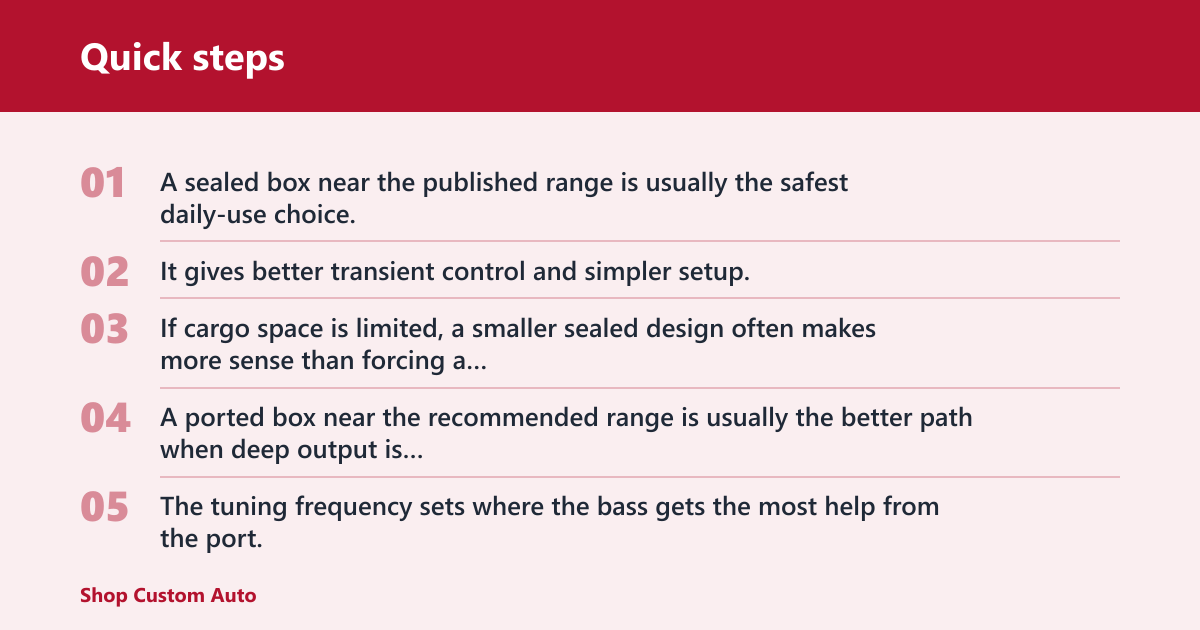
A sealed box near the published range is usually the safest daily-use choice. It gives better transient control and simpler setup. If cargo space is limited, a smaller sealed design often makes more sense than forcing a ported box into the wrong volume.
Best fit for deeper bass and higher output
A ported box near the recommended range is usually the better path when deep output is the main goal. The tuning frequency sets where the bass gets the most help from the port. Too much volume, though, can still wreck control and raise risk.
Risk level by box size and enclosure type
Small sealed boxes are often the safest, though not the deepest. Recommended-volume ported boxes can deliver the most depth when built correctly. Oversized ported boxes usually carry the highest risk because they can sound loud while exposing the driver to more excursion stress.
How do you choose the right box size for your subwoofer?
Start with the driver’s published sealed and ported ranges, then choose the enclosure type that matches your goal. Match net volume to the spec sheet, account for displacement, and use cabin gain as the last check. That order keeps the build focused on the actual output you want.
Start with the driver’s published enclosure range
Check the minimum and maximum volumes first. If the driver is meant for a smaller sealed box, do not force it into a large ported design unless the manufacturer says so. Qts, Vas, and Fs are there for a reason.
Match the goal to the enclosure type
If you want tighter bass and easier integration, sealed is usually the safer choice. If you want deeper low-end output and the driver is rated for it, ported is often the better path. The goal should drive the design, not the other way around.
Use cabin gain and tuning as final checks
Vehicle cabin gain can make a smaller box feel deeper in the cabin than it would on paper. In a ported design, tuning frequency should line up with the music and the driver’s excursion limits. Picture a compact hatchback with strong cabin gain: a properly sized sealed box may already reach deep enough without going oversized.
Frequently asked questions
Is a bigger subwoofer box better for deep bass?
Not by itself. A bigger box can help deep bass only when the driver is designed for that volume and the enclosure type supports the target response. If the box is too large, control drops, excursion rises, and the bass can get looser instead of deeper.
How does subwoofer box size affect bass depth?
Box size changes how strongly the driver is loaded by the air inside the enclosure. Smaller sealed boxes usually tighten response and limit extension. Larger ported boxes can push lower output when tuning and driver specs align, but the wrong size can shift the curve in the wrong direction.
Can a subwoofer box be too big?
Yes. Too much volume weakens cone control and can raise excursion, especially below tuning in a ported box. That can make bass sound boomy or loose and can push the driver toward mechanical limits sooner than expected. Manufacturer volume limits matter for a reason.
What happens if my subwoofer box is too large?
You may get less damping, more cone travel, and a response that sounds louder on some notes but weaker on others. In a ported box, output below tuning can fall off fast while excursion climbs. That combination can hurt sound quality and reduce safe power headroom.
Is a ported box better than a sealed box for deep bass?
Not always, but it often has more deep-bass potential when built to spec. Ported designs can play lower and louder near tuning, while sealed boxes usually give tighter control and easier daily use. The better choice depends on the subwoofer’s enclosure range and your goal.
How do I know the right box size for my subwoofer?
Use the manufacturer’s sealed and ported ranges as the starting point, then calculate net internal volume after subtracting driver, brace, and port displacement. Match the result to the goal and verify tuning frequency if the box is ported. If the numbers do not line up, revise the design.