
Why Is Your Amp Wiring Kit Power Wire Getting Hot?
A power wire that gets hot usually means the wire is too small for the current, a connection has high resistance, or the amp is pulling more current than the circuit can carry. If the insulation is too hot to hold, shut it down and inspect it. Heat like that can melt insulation, damage terminals, and create a fire risk. This guide shows how to tell wire-size problems from bad connections and from amp overdraw, then isolate the exact fault point.
What hot power wire means
A power wire should stay close to room temperature in normal use. Slight warmth can happen on a long, heavily loaded run, but noticeable heat at one spot is a warning sign, especially near the battery, fuse holder, ground, or amp terminal.
Normal warmth versus unsafe heat
Normal warmth is spread out and modest. Unsafe heat is concentrated, gets worse under load, or shows up with dimming lights, a soft fuse holder, or a terminal that is hot enough to discolor plastic. If the wire span feels fine but one connection is hot, the problem is usually resistance at that joint, not the full wire length.
Say your 4 gauge OFC power wire feels slightly warm after a long bass-heavy drive, but the fuse holder and terminals stay cool. That can be within normal limits. If the same system has one terminal that gets too hot to touch, the fault is at that connection, not the entire run.
Why is your amp power wire hot?
The main causes are wire that is too small, a high-resistance connection, or an amp that pulls more current than the kit can carry. The heating pattern matters. A hot span points toward wire size or length. A hot end points toward a terminal, fuse holder, or ground problem. A system-wide heat problem with dimming lights can point to current draw that exceeds the charging and wiring path.
Undersized wire for the load
If the amp RMS demand is above what the wire can carry over the run length, the wire heats from normal electrical loss. An 8 gauge kit can be fine for a modest 4-channel amp, but it is often too small for a high-current subwoofer amp. Four gauge covers more installs, and 0 gauge is common when current draw and length are both high.
High-resistance connection points
Loose set screws, weak crimps, corroded lugs, and dirty contact surfaces create heat at the joint. That heat can be more dangerous than a warm wire span because it concentrates in a small area. A fuse holder, battery terminal, chassis ground, or amp terminal can get hot even when the cable itself is the correct size.
Amp current draw above the kit
Even a properly installed cable can overheat if the amp is asking for more current than the wiring path can support. Subwoofer amps often draw more current than 4-channel amplifiers because they are asked to deliver lower-impedance, higher-power output. If the fuse keeps opening or the lights dim hard on bass hits, current demand deserves a close look.
Amp wiring kit wire gauge and material
Wire gauge, material, and run length work together. A short 8 gauge run may be fine for a small amp. A long 4 gauge run may be marginal for a high-output monoblock. A 0 gauge run is often used when current demand and cable length both climb, especially when the system will pull hard for long periods.
8 gauge, 4 gauge, and 0 gauge basics
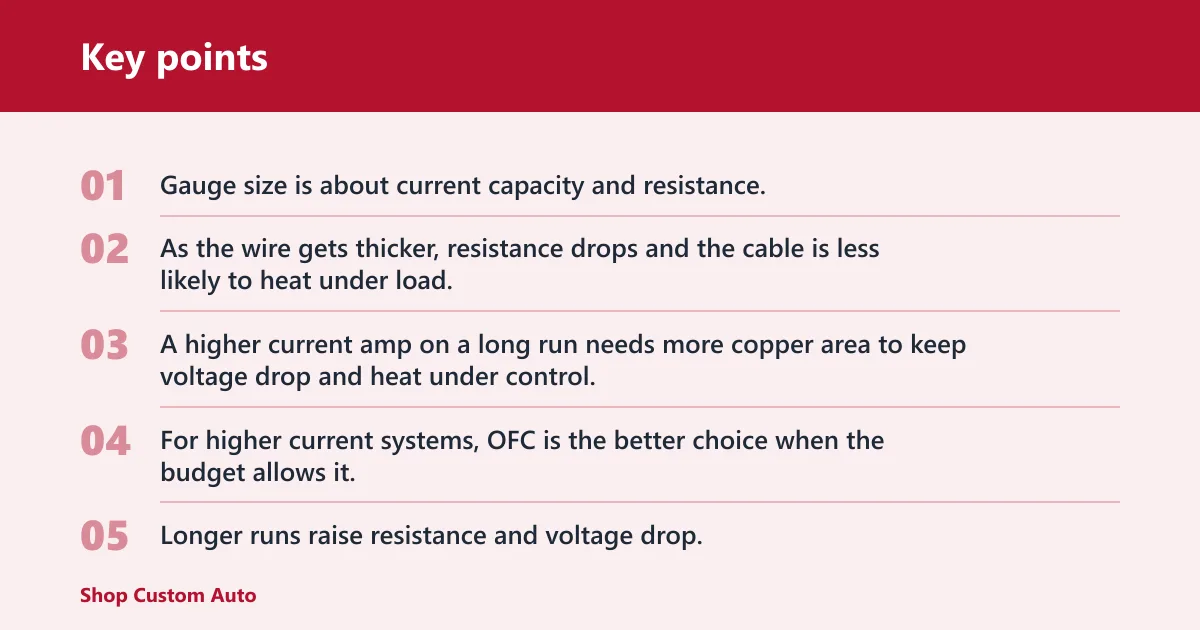
Gauge size is about current capacity and resistance. Smaller gauge numbers mean thicker wire. As the wire gets thicker, resistance drops and the cable is less likely to heat under load. A higher current amp on a long run needs more copper area to keep voltage drop and heat under control.
OFC copper wire versus CCA wire
OFC copper wire is generally lower resistance than CCA wire, so it can carry current better and may stay cooler under the same load. CCA is often used as a lower-cost option and can work in lighter installs, but it has higher resistance and may run hotter under load. For higher current systems, OFC is the better choice when the budget allows it.
Length, resistance, and voltage drop
Longer runs raise resistance and voltage drop. That means a kit that looks adequate on paper can still run hot if the amp is far from the battery. Check the battery-to-amp path under load, not just the wire size printed on the package. Heat plus voltage drop usually means the circuit is working too hard.
| Wire type | Typical use | Heat behavior | Best fit |
|---|---|---|---|
| 8 gauge OFC | Small to moderate amp loads on shorter runs | Lower heat than CCA at the same load | Compact 4-channel or light sub amp installs |
| 4 gauge OFC | Common mid-power installs | Better current handling with less voltage drop | Most moderate subwoofer and multi-channel systems |
| 0 gauge OFC | Higher current systems and longer runs | Least likely of these three to heat under heavy load | Large monoblocks or systems with long battery-to-amp runs |
| CCA wire | Budget kits and lighter loads | Runs hotter than OFC under the same current | Shorter, lower-demand installs where cost matters more |
Heat at the fuse holder, terminals, and ground
The hot spot often starts at a connection, not in the middle of the cable. That matters because the fix may be tightening hardware, cleaning corrosion, or remaking a crimp rather than replacing the whole run.
Battery terminal and fuse holder checks
The inline fuse should protect the wire, be mounted close to the battery, and match the wire’s safe current capacity. It is not a cure for an undersized cable. If the fuse holder is hot, look for loose hardware, corrosion, a cracked body, or a bad crimp at the fuse lead.
Amp terminal checks
Heat at the amp terminal usually means the conductor is not making solid contact. Check that the wire is fully seated and that the set screw is tight enough for the cable type. A stranded wire that is partly cut, loose, or poorly crimped can create a small resistance point that gets hot fast.
Chassis ground checks
The ground wire should be the same gauge as the power wire or a proper match for the load, and the mounting point should be bare metal with no paint, seam sealer, or rust between the lug and chassis. A weak ground can force the amp to pull harder through the rest of the circuit, which raises stress and heat.
- Inspect every connection. Check the battery terminal, fuse holder, amp terminal, and ground lug for looseness, corrosion, discoloration, or softened plastic. Heat at one point is a clue that the failure is local.
- Clean contact surfaces. Remove corrosion and expose clean metal where the ground lug meets the chassis. A shiny bare-metal contact patch reduces resistance and gives the current a solid return path.
- Retighten with care. Tighten terminals so the cable cannot move, but do not strip hardware or crush the conductor. A secure clamp helps prevent hot spots from vibration and repeat current load.
How do you diagnose the hot spot?
Use a multimeter to separate voltage drop from plain wire warmth, then compare the amp’s RMS demand with the wire kit’s rating. A hot fuse holder, hot battery terminal, and hot amp terminal can point to a connection issue or resistance. Heat along the full wire path points more toward gauge or length.
- Measure under load. Set the multimeter to DC volts and measure battery positive to amp positive while the system is playing at normal volume. A meaningful drop on a healthy system points to resistance or an undersized run.
- Check the ground side. Measure amp ground to battery negative under the same load. If the drop is high here, the chassis ground or ground cable is part of the problem.
- Compare current demand. Match the amp’s RMS output need against the wire gauge, material, and length. If the amp is a high-current subwoofer model on 8 gauge or budget CCA, the cable may be too small even if the fuse is intact.
- Match the hot spot. If only one end is hot, focus on that terminal or holder. If the whole run is hot and voltage drop is high, treat the wire size or run length as the main issue.
Suppose a monoblock amp on 4 gauge CCA wire plays fine at low volume, then the voltage at the amp sags hard on bass hits and the fuse holder warms up. That pattern points to resistance plus current demand, not a random wire defect.
Amp wiring kit troubleshooting matrix
This matrix helps you separate symptoms by location and likely cause. Start with the row that matches what you feel, then move to the fastest test. If the wire, holder, or terminal is too hot to touch, stop using the system until the cause is fixed.
| Symptom | Likely cause | Quick test | Fix | Next action |
|---|---|---|---|---|
| Warm wire | Normal load on a long run, or wire near its limit | Check whether the warmth is spread out or localized | Compare gauge, material, and amp RMS demand | Measure voltage drop under load |
| Hot fuse holder | Loose hardware, corrosion, poor fuse contact | Inspect for discoloration or softened plastic | Clean contacts, tighten, replace damaged holder | Retest with the amp running |
| Hot battery terminal | Poor clamp contact or corrosion at the battery end | Check for movement, oxidation, or loose ring lugs | Clean and retighten; replace damaged terminal | Verify the fuse is sized for the wire |
| Hot amp terminal | Loose set screw, partial strand contact, bad crimp | Gently tug the cable and inspect conductor seating | Re-terminate the wire and secure the clamp | Check amp current draw and load |
| Dimming lights | High current draw, weak ground, or charging stress | Watch for dimming on bass hits while measuring voltage | Improve ground, check wire gauge, confirm alternator health | Measure battery-to-amp voltage drop |
| Blown fuses | Short, overcurrent, or fuse too small for the wire and load | Inspect for pinched wire or repeated fuse failure under load | Fix short, then size fuse to protect the wire | Confirm amp RMS draw and cable size |
| Voltage drop | Resistance in wire, ground, or connection points | Measure positive and ground drop under load | Shorten run, upgrade gauge, or repair connections | Retest after each change |
How to wire amp safely
Safe wiring starts with matching the cable to the amp’s RMS demand and the run length. Use OFC for higher load installs when possible. Mount the inline fuse close to the battery, size it to protect the wire, and build solid ground and terminal connections. A good install keeps heat low before the system ever sees full volume.
- Choose the right gauge. Start with the amp’s RMS demand, then factor in wire length and material. Use 8 gauge only for lighter loads, 4 gauge for many mid-power systems, and 0 gauge when current draw and run length justify it.
- Use the right fuse. Place the inline fuse close to the battery and size it for the wire, not as a fix for an undersized kit. The fuse should protect the cable if the wire shorts or fails.
- Build the ground correctly. Match the ground wire to the power wire or the kit’s intended size, then bolt it to bare metal. A weak ground creates resistance, heat, and voltage drop on the return path.
- Finish every termination. Crimp or clamp each terminal so the conductor is fully seated and cannot move. Loose ends heat first, and a hot terminal often becomes the first visible warning.
When should you stop using the system?
Stop using the system immediately if insulation softens, plastic near a terminal melts, a fuse holder or battery terminal stays hot, or fuses keep failing after you inspect for obvious shorts. Persistent dimming lights, a strong burning smell, or a terminal that is too hot to touch all point to a fault that needs correction before more use.
A common first-timer mistake is replacing a blown fuse with a larger one. That can hide the problem and let the wire overheat further. The correct fix is to find the cause first: short, poor ground, bad terminal, or a wire that is too small for the amp and run length.
Frequently asked questions
Why is my amp wiring kit power wire getting hot?
Heat usually comes from too much current, a wire that is too small for the load, or a high-resistance connection at a terminal or fuse holder. If the heat is localized, start at the hot spot. If the whole run is warm and voltage drop is high, focus on gauge, material, and length.
Is a warm amp power wire normal or dangerous?
A slight, even warmth can happen on a loaded system, but noticeable heat is a warning sign. If the wire is hot to the touch, the fuse holder warms up, or the insulation softens, treat it as unsafe. Heat that is easy to feel usually means resistance or overcurrent needs attention.
Does a hot power wire mean the gauge is too small?
Often, yes, but not always. A hot wire can mean the gauge is too small for the amp RMS demand and length, especially with CCA. It can also mean the connections are loose or corroded. Check the full circuit before replacing the cable.
Can a loose fuse holder or terminal make the wire heat up?
Yes. Loose hardware, corrosion, poor crimps, and weak contact surfaces create resistance, and resistance turns into heat right at the joint. A hot fuse holder, battery terminal, or amp terminal often points to a connection fault rather than a full-wire sizing problem.
How do I check if my ground wire is causing the problem?
Measure voltage drop from the amp ground to battery negative under load, then inspect the mounting point for bare metal and solid contact. A bad ground can force current stress through the rest of the circuit and raise heat. Use the same gauge as the power lead or the kit’s matched ground size.
Will CCA wire run hotter than OFC wire?
Yes. CCA has higher resistance than OFC, so it drops more voltage and tends to run hotter under the same load. That difference matters most on longer runs and higher current amps. OFC is the better choice when the system pulls more power and cable temperature matters.