How to Choose an Amp Wiring Kit for a 4-Channel Amp
Choose an amp wiring kit by matching wire size to the amp’s total fuse rating and the run length. For many 4-channel amps, 8 AWG OFC is often enough. Use 4 AWG for higher current or longer routes, as a common rule of thumb. Under-sized wire can create voltage drop, heat, noise, and nuisance fuse blows. This guide covers gauge, OFC vs CCA, fuse size, kit contents, and install length.
What you’ll need
- Power wire long enough for the battery-to-amp route
- Ground wire long enough for a short chassis run
- Inline fuse holder with the correct fuse style for the kit
- RCA interconnects, usually a 2-channel pair for a 4-channel amp input
- Remote turn-on wire is often 18 AWG or 16 AWG
- Speaker wire is often 16 AWG for full-range channels and 12 AWG for heavier loads
- Ring terminals, grommet, zip ties, and a trim tool for routing
- Wire stripper, crimp tool, and a multimeter for checks
Should you choose 4 gauge or 8 gauge?
Start with the amp’s actual current demand, then check cable length and whether the channels will ever be bridged. For many 4-channel full-range systems, 8 AWG is enough. Use 4 AWG when the amp draws more current, the run is long, or you want room for future expansion.
Match gauge to real power draw
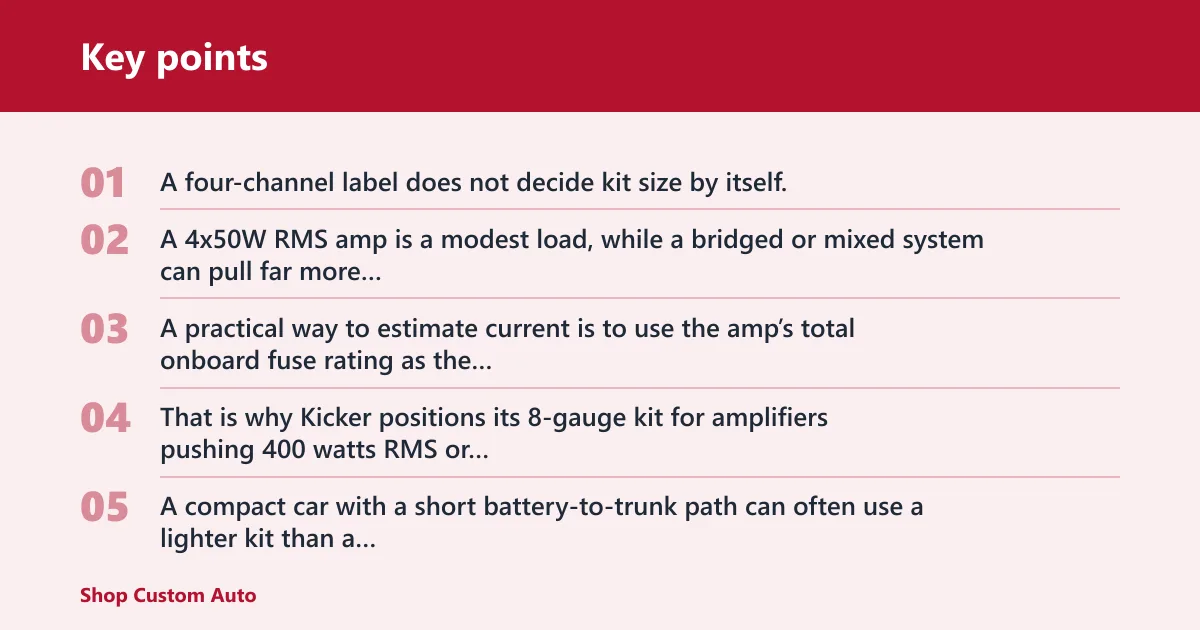
A four-channel label does not decide kit size by itself. A 4x50W RMS amp is a modest load, while a bridged or mixed system can pull far more current than a basic speakers-only install. A practical way to estimate current is to use the amp’s total onboard fuse rating as the current demand, then choose wire that safely supports that total for the planned run length. That is why Kicker positions its 8-gauge kit for amplifiers pushing 400 watts RMS or less, and its 4-gauge kit for mid-to-high-power single amplifiers around 600 to 1000 watts RMS.
Use vehicle size and cable length as checks
Longer routes raise resistance. A compact car with a short battery-to-trunk path can often use a lighter kit than a large SUV or van. The KnuKonceptz Kolossus AK4 and Kicker 46CK4 include 17 ft of power cable and 3 ft of ground cable, which is a common fit pattern for sedan and SUV installs. Under-seat amps, battery-in-trunk vehicles, and other nonstandard mounting locations may need shorter or longer leads than that pattern.
Watch for true-gauge wire claims
Some budget kits advertise 4 AWG but measure closer to 6 or 8 AWG. That matters because undersized wire can heat up and drop voltage before the amp reaches rated output. If the listing does not state true gauge, do not rely on jacket thickness or vague photos alone.
Is OFC or CCA better?
OFC is the safer pick for most 4-channel amp installs because it conducts better and drops less voltage over the same length. CCA can work for lighter loads and tighter budgets, but it leaves less margin as power, distance, or current demand rises. For higher output, OFC is the cleaner choice.
Choose OFC for lower voltage drop
The Kicker 46CK4 uses true 4 AWG OFC wire. That cable fits better when you want stable voltage at the amp, especially on longer runs or near the 600 to 1000 watt RMS range. OFC also gives more room if the system grows later.
Use CCA only for lighter loads
The RECOIL RCK44 is a value CCA option under 800W. That is a fair zone for a light-to-mid setup, but CCA is not the first pick for heavy bridged use or long cable runs. If the kit is CCA, check gauge honestly and keep the install path short.
Check insulation and flexibility for routing
A stiff cable is harder to route through firewalls, sill panels, and seat folds. More flexible insulation helps when the run turns tight or needs to pass through a small grommet. That does not replace proper gauge or copper quality, but it can decide whether the kit installs cleanly.
What should a complete kit include?
A complete amp wiring kit should include power cable, ground cable, an inline fuse holder, remote turn-on wire, and RCA interconnects. Some kits also include speaker wire, but many legitimate amp wiring kits do not. If any of those pieces are missing, the kit may still work, but you may need to source the weak link separately to avoid noise, heat, or poor fit.
Power and ground cable lengths
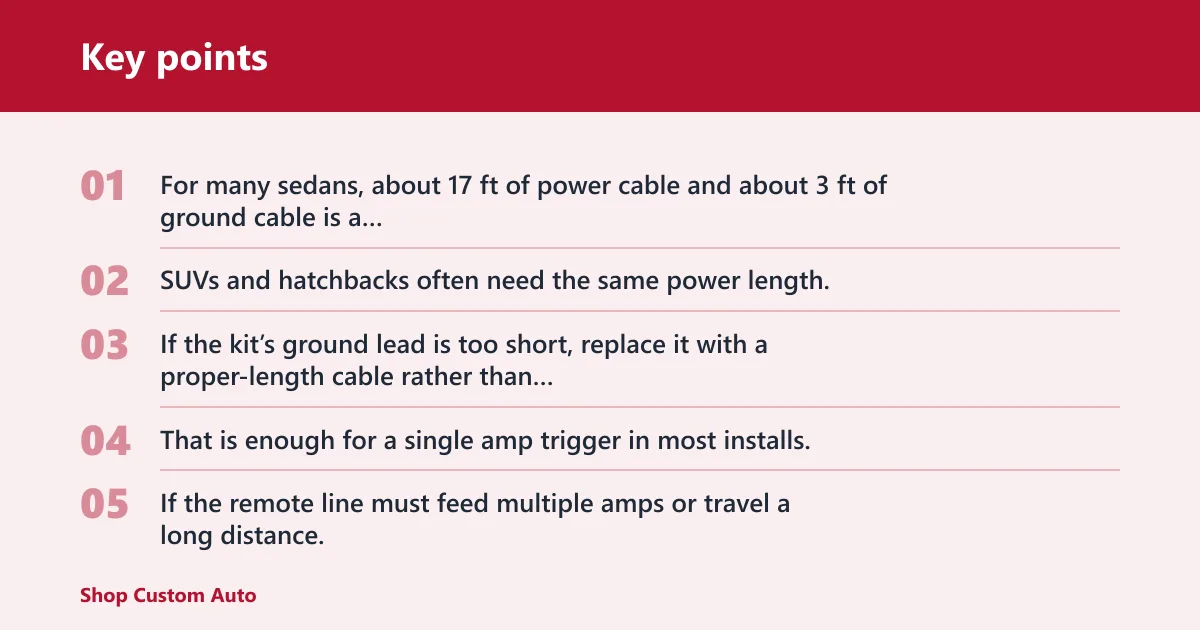
For many sedans, about 17 ft of power cable and about 3 ft of ground cable is a practical pattern. SUVs and hatchbacks often need the same power length, while the ground lead still works if the amp is mounted near bare metal. If the kit’s ground lead is too short, replace it with a proper-length cable rather than stretching it.
Remote turn-on wire size
Remote wire is usually 18 AWG or 16 AWG. That is enough for a single amp trigger in most installs. If the remote line must feed multiple amps or travel a long distance, step up to heavier wire or split the trigger through a relay so the head unit is not carrying extra load.
RCA and speaker wire basics
Two-channel RCA cables are enough for many 4-channel amps because the amp can split left and right inputs internally. Some 4-channel amps, however, need 4-channel input to preserve front/rear fade or to match the amp’s input design. Better shielding matters when the RCA run passes near power wire, because it helps resist alternator whine and hiss. For speaker wire, 16 AWG works for most full-range channels; 12 AWG is a better pick for heavier current or bridged duty.
Amp kit decision table
| Use case | Power range | Vehicle size | Preferred gauge | OFC or CCA | Fuse style | RCA needs | Must-upgrade parts |
|---|---|---|---|---|---|---|---|
| Speakers-only full-range install | Sub-500W RMS | Small sedan or hatchback | 8 AWG | OFC preferred; CCA can fit a light build | AFS or mini-ANL, matched to wire and amp | 2-channel RCA cable is usually enough | Upgrade speaker wire if the kit includes very light cable |
| Higher-output four-channel or longer route | 600 to 1000W RMS | Sedan, SUV, or longer trunk run | 4 AWG | OFC | 120A class holder such as AFS or mini-ANL | Shielded 2-channel RCA cable | Replace any undersized ground lead or true-gauge question mark |
| Bridged or mixed speaker-plus-sub system | Above 1000W RMS, or heavy current peaks | Mid-size SUV or large vehicle | 4 AWG, sometimes larger if the system demands it | OFC only | Heavy-duty holder, fused close to battery | Well-shielded RCA cable, routed away from power | Heavier speaker wire, stronger ground point, and possibly a fuller kit |
| Very high-current build | Over 1500W RMS | Large vehicle or complex routing | 4 AWG may be borderline; size by load, not channel count | OFC only | Heavy-duty fuse holder is non-negotiable | Noise-resistant RCA set | Consider a kit beyond the basic all-in-one package |
How do you match the kit to your install path?
Build the kit around the route, then confirm the load. Sedan runs are usually simpler than SUV runs, but a short car with a bridged amp can still need the stronger kit. If the system is mixed or may grow later, choose the higher tier now instead of replacing the wiring twice. Bridged channels also require the amp and speaker load to be bridge-compatible.
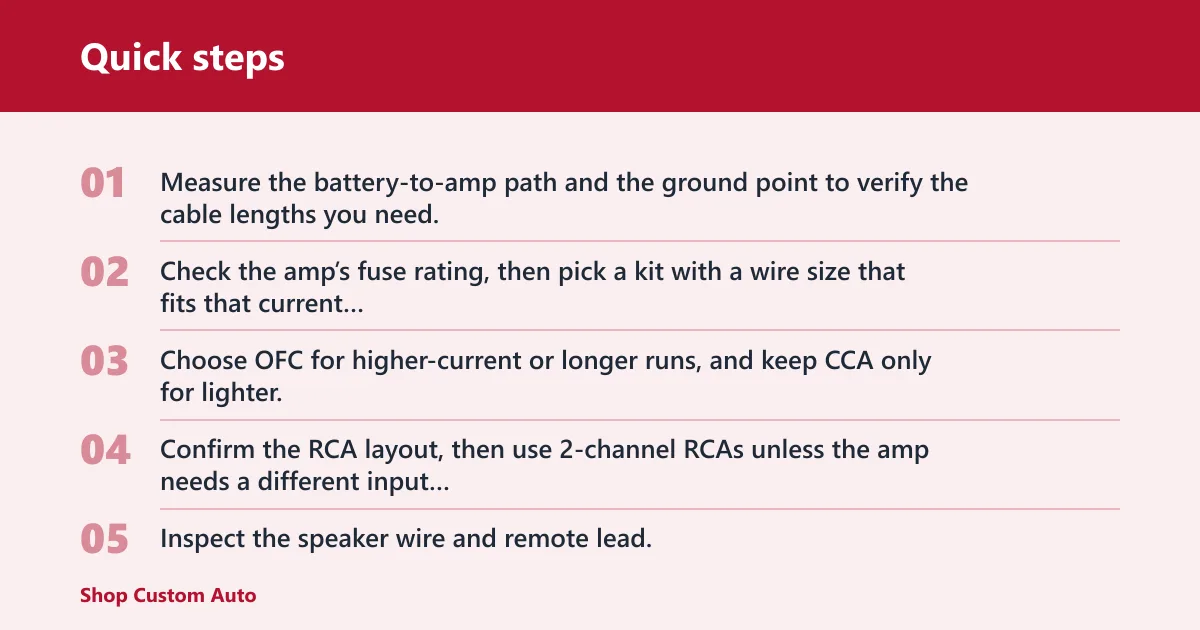
- Measure the battery-to-amp path and the ground point to verify the cable lengths you need.
- Check the amp’s fuse rating, then pick a kit with a wire size that fits that current demand.
- Choose OFC for higher-current or longer runs, and keep CCA only for lighter, short installs.
- Confirm the RCA layout, then use 2-channel RCAs unless the amp needs a different input path.
- Inspect the speaker wire and remote lead, then upgrade any part that looks light for bridged use or a long run.
Suppose a 4-channel amp runs 4x50W RMS in a compact sedan with short routing. An 8 AWG OFC kit with a proper inline fuse and 2-channel RCAs is usually the clean fit. If the same amp is bridged for a mixed setup, the safer choice is 4 AWG with heavier speaker wire and better shielding.
A common first-timer mistake is buying a subwoofer-focused kit that looks complete but has a thin ground lead, weak RCAs, or speaker wire that is too light for bridged channels. That kit may still power a 4-channel amp, but only after you replace the weak parts.
How much power can a 4-gauge amp wiring kit handle?
A 4-gauge kit is commonly used for mid-to-high-power single amps. The real limit still depends on wire quality, route length, and fuse match. If the kit is true 4 AWG OFC, it has more usable headroom than a thin or false-marked kit.
Can I use a subwoofer amp wiring kit for a 4-channel amp?
Yes, if the sub kit has the right gauge, proper fuse holder, and enough cable length. A sub-focused kit is acceptable for a 4-channel amp when the load is modest and the parts are truly sized. Skip it if the RCAs, remote lead, or speaker wire are too light for your layout.
What fuse size should I use with a 4-channel amp wiring kit?
Use the fuse size that matches the wire and the amp’s current demand, not a random value from the package. The fuse belongs as close to the battery as the kit allows, and the holder style should fit the kit and the build.
Common mistakes
- Picking gauge by channel count alone instead of by current draw and run length.
- Buying 4 AWG that is not true 4 AWG.
- Using CCA for a load that really wants OFC.
- Mounting the fuse too far from the battery.
- Accepting a kit with a ground lead that is too short.
- Skipping shielded RCAs on a noisy route.
- Using speaker wire that is too light for bridged channels.
Prevention is simple: measure the route before you order, then buy the first kit that covers the real path, current, and expansion plan.
Frequently asked questions
What amp wiring kit do I need for a 4-channel amp?
Choose the kit from the amp’s current demand, not the number of channels. For a light full-range build, 8 AWG OFC can be enough. For a higher-current or bridged setup, 4 AWG OFC is the better fit, especially if the run is long or the kit must support future upgrades.
Should I choose 4 gauge or 8 gauge for a 4-channel amp?
Use 8 gauge for modest loads, short routes, and simple speakers-only installs. Use 4 gauge when the amp draws more current, the route is longer, or the system includes bridged channels or expansion plans. If the wire is not true gauge, size up rather than trust the label.
Is OFC or CCA better for a 4-channel amplifier kit?
OFC is the better choice for lower voltage drop and more stable delivery to the amp. CCA can work for light builds, but it gives up margin as current rises. For 600 to 1000 watts RMS or any longer run, OFC is the safer pick.
What should be included in a complete amp wiring kit?
Look for power wire, ground wire, an inline fuse holder, remote turn-on wire, and RCA interconnects. Some kits also include speaker wire, but not all do. The kit should also include the right cable lengths for your vehicle. If one part is weak or missing, plan to replace it before the install starts.
Do I need RCA cables in an amp wiring kit?
Yes, if your head unit or signal source feeds the amp through line-level input. A 2-channel RCA cable is enough for many 4-channel amps because the amp can distribute the signal internally. Choose better shielding if the cable will run near power wire or through a noisy path.
What wire length do I need for a sedan or SUV install?
A common fit is 17 ft of power cable and about 3 ft of ground cable. That works for many sedans and SUVs when the amp mounts in the trunk or cargo area. If the ground point is farther away, buy a longer ground lead rather than stretching a short one.