OFC vs CCA Amp Wiring Kit: What Is the Difference?
OFC carries more current with less voltage drop than CCA, so for most amp installs choose OFC unless the run is short, the power is low, and the kit is sized correctly for the wire’s ampacity. Using CCA where OFC is needed can raise heat and leave the amp short on headroom. This guide covers current delivery, fuse sizing, run length, and when CCA is acceptable.
| Factor | OFC | CCA amp wiring kit | Winner |
|---|---|---|---|
| Current delivery on a 17-foot power run | Lower resistance and less voltage drop at the same gauge | Higher resistance, so the same gauge carries less current | OFC |
| Cost | Higher upfront price | Lower upfront price | CCA amp wiring kit |
| Heat and headroom under load | More margin before the wire heats up or the amp sags | Less margin, especially on long runs or near the limit | OFC |
| Best fit for future upgrades | Better choice when the next amp may draw more current | Best only when the system will stay modest | OFC |
OFC vs CCA: the real trade-off
What changes in resistance and current delivery
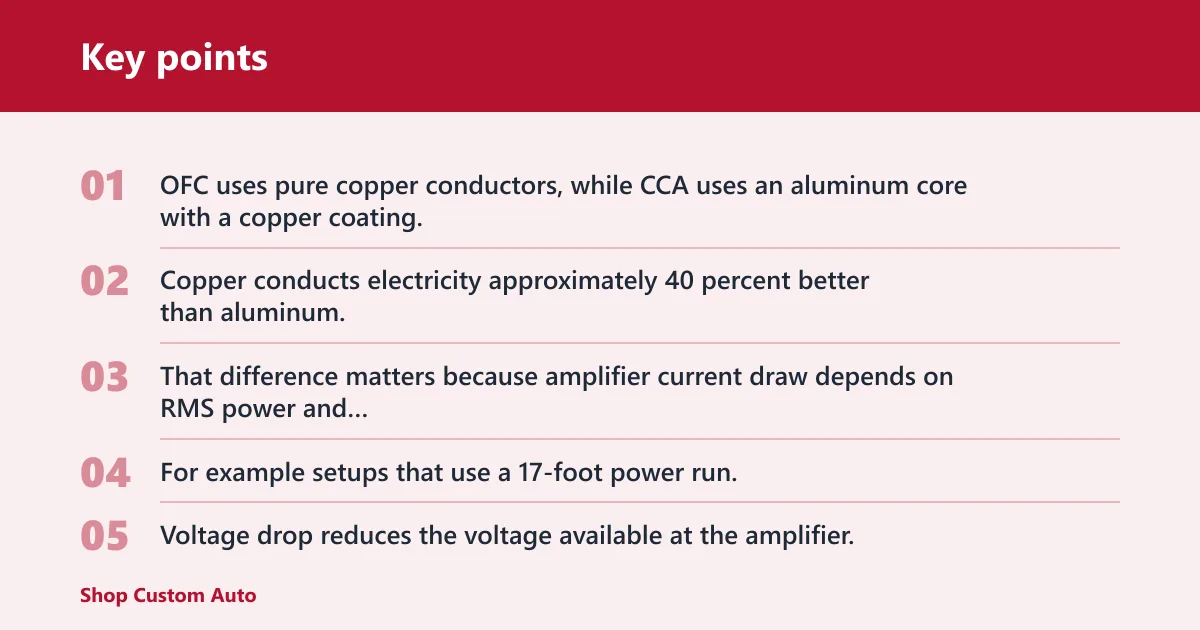
OFC uses pure copper conductors, while CCA uses an aluminum core with a copper coating. Copper conducts electricity approximately 40 percent better than aluminum, so OFC has lower resistance and loses less voltage across the same run.
That difference matters because amplifier current draw depends on RMS power and efficiency, not peak watt claims. For example setups that use a 17-foot power run, a kit that looks acceptable on paper can still sag under load if the conductor is CCA.
Why heat and voltage drop matter in a car audio install
Voltage drop reduces the voltage available at the amplifier, which can reduce output and trigger protection behavior in some amps. Heat rises when the wire is undersized or made from higher-resistance material, and heat is where the cheap kit stops being cheap.
A common first-timer mistake is buying a kit by the wattage printed on the box and ignoring the actual conductor material. That is how a system ends up with dimming lights, warm power wire, or an amp that shuts down at moderate volume.
Why the cheaper kit is not always the better buy
BestCarAudio.com says OFC wire typically costs two to three times more than CCA alternatives, with a true 4-gauge OFC kit often priced at $80 to $150 and CCA versions at $30 to $50. The lower price is real, but so is the lower current headroom.
For a temporary, low-demand install, CCA can be a budget choice. For a system that needs more current, the savings can disappear fast if you need to replace the kit, move up a gauge, or fix voltage drop later.
OFC and CCA side by side
Oxygen-free copper: what it is and why it costs more
OFC stands for oxygen-free copper. In car audio, it is preferred for higher-power installs because it offers lower resistance and better long-term reliability than CCA, which helps keep current delivery steadier over time.
That is why OFC usually costs more. It buys more headroom, especially when the run is long, the amp draws current heavily, or the system may grow later.
Copper-clad aluminum: what it is and where it falls short
CCA stands for copper-clad aluminum. It is cheaper because it uses an aluminum core with a copper coating, but the core material has higher resistance than copper and needs a larger gauge for the same current.
BestCarAudio.com says a 4-gauge CCA wire performs closer to 6-gauge or even 8-gauge OFC wire. That is the practical problem: the label can say one thing, while the current delivery looks like something smaller.
How corrosion resistance and flexibility differ
OFC is the safer long-term choice where heat, vibration, and corrosion matter. In practice, termination quality and plating matter a great deal, and both OFC and CCA need clean, well-made connections to stay reliable.
Flexibility also matters during installation. Either type can be routed cleanly, but the better conductor gives you more margin if the route is longer than planned or the amp later draws more current.
How wire gauge changes the answer
AWG basics: 8, 4, 2, and 1/0 gauge
American Wire Gauge, or AWG, is a commonly used size standard for car audio wiring. Smaller numbers mean thicker wire, so 4 AWG is thicker than 8 AWG, and 1/0 AWG is thicker than 4 AWG.
Thicker wire lowers resistance and cuts voltage drop. That is why the right gauge depends on current draw and run length, not just the headline power rating on the amp box.
Why thicker wire lowers voltage drop
Thicker conductors create less resistance over a given distance, so more of the battery voltage reaches the amplifier. Less drop means less wasted power as heat in the wire and a steadier supply at the amp.
That matters more as current rises. A wire that seems fine for a small amp can become the weak point once the system is pushed hard or the amp demands more current on bass hits.
How a 17-foot power run changes the choice
Many kit tables assume a 17-foot power run, and that assumption matters. BestCarAudio.com notes that a 1,000-watt amplifier through 20 feet of 4-gauge CCA can see voltage drops exceeding 1.5 volts.
That is why a short run in a small car and a longer run in a larger vehicle should not get the same recommendation. The longer the run, the more CCA falls behind OFC at the same advertised gauge.
What size wire do you need?
Start with RMS power and estimate the amplifier’s current draw from that, then match the wire to the current, run length, and upgrade room you want. Peak watts do not tell the whole story. Efficiency changes the current demand, and the wire must support that demand without excessive drop or heat.
WooferGuy estimates 8 AWG OFC at up to about 475 W RMS, 4 AWG OFC for most single-amp systems up to about 1,200 W RMS on a 17-foot run, and 1/0 AWG OFC for bigger systems up to about 3,000 W RMS. WooferGuy also lists 4 AWG CCA at up to about 750 W RMS.
WooferGuy says CCA needs one to two sizes thicker wire for the same job. That fits the way real installs behave: a kit that looks “big enough” on a chart may still run hot or sag once it is loaded.
Amp wiring matrix
| Install scenario | OFC | CCA amp wiring kit | Recommended pick |
|---|---|---|---|
| Small budget system | 8 AWG OFC if the amp stays near 475 W RMS or below | 8 AWG CCA only for very modest demand and short runs | CCA amp wiring kit if the system stays light; OFC if you want margin |
| Typical sub amp | 4 AWG OFC for many single-amp installs up to about 1,200 W RMS on a 17-foot run | 4 AWG CCA is closer to a lighter-duty wire size and suits lower current | OFC |
| 4-channel or full-range amp | 4 AWG OFC when current draw is moderate and the run is not short enough to hide a weak kit | CCA can work only if the amp is modest and the wire is upsized | OFC |
| Future-upgrade build | 1/0 AWG OFC for larger systems up to about 3,000 W RMS | CCA is a poor choice when the next amp may be larger | OFC |
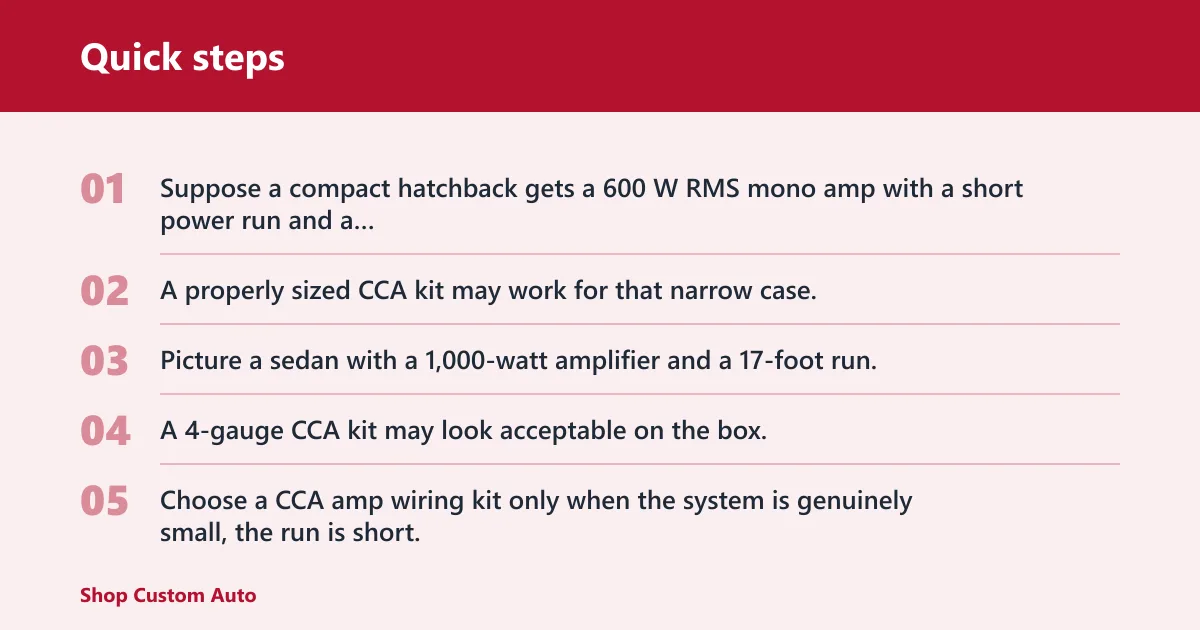
Suppose a compact hatchback gets a 600 W RMS mono amp with a short power run and a modest fuse. A properly sized CCA kit may work for that narrow case, but the same kit becomes poor value if a larger amplifier is likely next season.
Picture a sedan with a 1,000-watt amplifier and a 17-foot run. A 4-gauge CCA kit may look acceptable on the box, yet the system can still suffer voltage drop and protection behavior under load, while a true OFC kit gives more room to breathe.
Small budget system
Choose a CCA amp wiring kit only when the system is genuinely small, the run is short, and the amp will stay modest. Keep the fuse near the battery and verify the kit includes a proper fuse holder, not just wire and ring terminals.
If the label is vague, size up. A bargain kit that is undersized on the conductor side can cost more than OFC once you replace it.
Typical sub amp
A mono sub amp is where OFC starts to make the most sense. WooferGuy’s estimate of 4 AWG OFC up to about 1,200 W RMS on a 17-foot run fits the kind of current draw that can punish CCA.
At this level, a CCA kit can become a false economy. Heat, reduced output, or protection behavior are common failure modes when the wire is near its limit.
4-channel or full-range amp
For a 4-channel or full-range amp, the current draw is often lower than a comparable sub amp, but the same rules still apply. If the amplifier is efficient and the run is short, a well-built kit can work; if the vehicle is larger or the amp is asked to do more, OFC gives more headroom.
Do not choose by peak watts. Use RMS power and the amp’s likely current draw, then account for the length from battery to amp and the actual chassis-ground path used by the install.
Future-upgrade build
If the system will grow later, OFC is the smarter buy now. 1/0 AWG OFC gives a larger margin for a bigger amplifier, and that can prevent a second wiring job when the next upgrade arrives.
CCA usually makes the least sense in this scenario. It may look fine today and fail the upgrade plan tomorrow.
Can you use CCA for a sub amp?
Yes, but only for light demand, short runs, and a system that is unlikely to grow. A low-power sub amp on a short route can run on CCA if the gauge is sized with care and the fuse and fuse holder are correct.
Once the sub amp draws more current, CCA becomes a weaker choice. BestCarAudio.com says a 1,000-watt amplifier through 20 feet of 4-gauge CCA can see voltage drops exceeding 1.5 volts, which is enough to hurt output and stability.
When CCA is acceptable for light demand
CCA is reasonable when the install is temporary, the amp is small, and the buyer wants the lowest entry price. It should still be treated as a lower-headroom option, not a full substitute for OFC.
When CCA becomes a false economy
If the amp is large, the run is long, or a future upgrade is likely, CCA can cost more in the long run. The cheap kit may force a replacement, a larger gauge, or a troubleshooting session that would have been avoided with OFC.
Common failure modes: heat, dimming, and protection mode
Undersized or higher-resistance wire can heat up, make headlights dim at heavy load, or push the amp into protection mode. Those are not random failures. They are signs that current delivery is weak somewhere in the power path.
Choose OFC if… / Choose CCA amp wiring kit if…
Choose OFC if you want lower voltage drop, more current headroom, or a path to a larger amplifier later. Choose CCA amp wiring kit if the system is modest, the run is short, the budget is tight, and you understand that the kit needs more gauge for the same current.
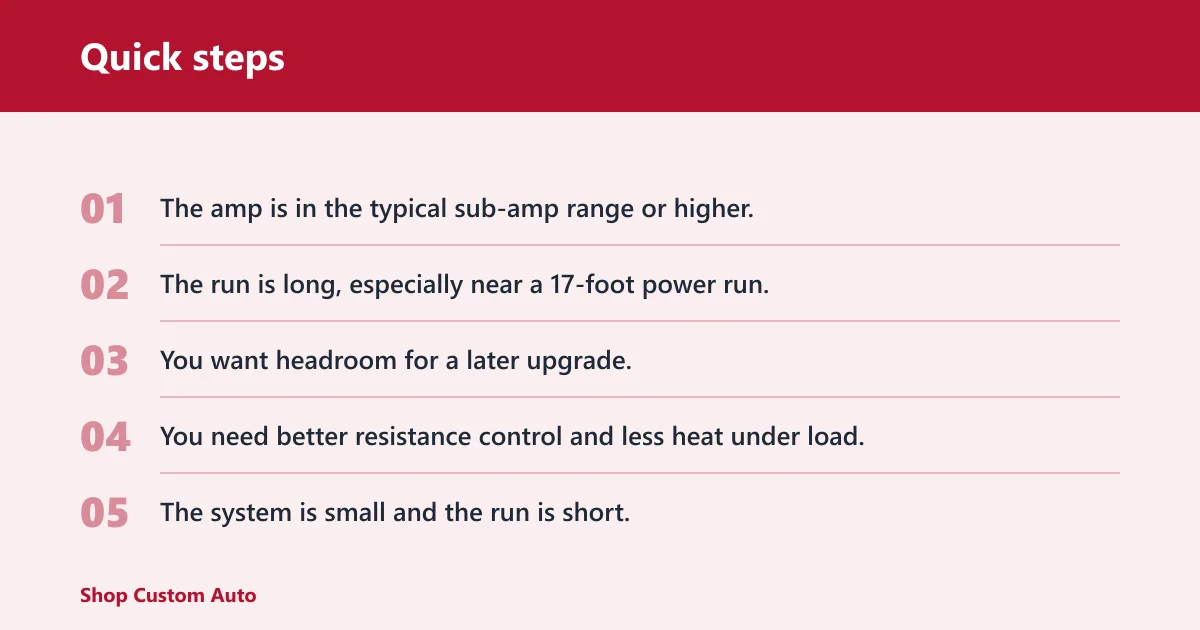
Both choices depend on the same checks: RMS power, efficiency, run length, and the fuse near the battery. The label should match the conductor, not just the marketing copy.
Choose OFC if…
- The amp is in the typical sub-amp range or higher.
- The run is long, especially near a 17-foot power run.
- You want headroom for a later upgrade.
- You need better resistance control and less heat under load.
Choose CCA amp wiring kit if…
- The system is small and the run is short.
- You are building on a tight budget.
- The amp will not be upgraded soon.
- You verify the gauge, fuse holder, and conductor label before buying.
What to inspect on the kit label before you buy
- Look for OFC or 100% copper labeling if you want copper conductor material.
- Check whether the listed gauge is true AWG or just marketing copy.
- Confirm the kit includes a fuse holder and the fuse goes near the battery, within 18 inches.
- Read the RMS power range, not just peak watts.
- Compare the kit’s stated gauge against the actual conductor material and the amp’s current draw.
Frequently asked questions
What is the difference between OFC and CCA amp wiring kit?
OFC uses pure copper conductors and carries current with less resistance, while CCA uses an aluminum core with a copper coating. That makes OFC the better choice for current delivery, voltage drop, and heat control. CCA is cheaper, but it needs more gauge for the same job.
Is OFC wire really better than CCA for car audio?
Yes, when the system draws meaningful current or the run is long. OFC offers lower resistance and more reliable long-term performance, so it gives more headroom before the wire becomes the weak point. For a very small, short-run install, CCA can be acceptable, but it is still the lower-margin option.
How much bigger does CCA wire need to be than OFC?
The same source says CCA needs one to two sizes thicker wire for the same job. BestCarAudio.com also says a 4-gauge CCA wire performs closer to 6-gauge or even 8-gauge OFC wire. That is why label size alone is not enough.
Can I use a CCA amp wiring kit for a subwoofer amp?
Sometimes, but only for a light-demand sub amp with a short run and no real upgrade plan. Once current rises, CCA’s higher resistance can create voltage drop, heat, and protection mode. For a typical sub amp, OFC is the safer long-term pick.
Is CCA wire safe for high-power car audio systems?
It is a poor choice for high-power systems unless the wire is upsized enough to handle the actual current. The risk is not just sound quality; it is heat, voltage drop, and protection behavior. For high-power builds, OFC is the better fit.
How do I know if an amp wiring kit is OFC or CCA?
Read the product label and packaging for OFC, 100% copper, or CCA wording. Also check whether the listed gauge seems realistic for the claimed wattage, and inspect the fuse holder and included terminals. If the description is vague, assume nothing and verify before purchase.
What gauge OFC wire do I need for my amp?
Use RMS power, amplifier efficiency, and run length to set the gauge, then leave some headroom.
Why do cheaper amp kits claim the same wattage as OFC kits?
Because wattage claims are often marketing claims, not proof of conductor quality. Some CCA kits are labeled with the same wattage range as OFC kits even though their real current handling is lower. That is why conductor material, gauge, and run length matter more than the wattage printed on the box.