Do Dash Cams Need to Be Hardwired?
Many dash cams can record from a 12V socket. Hardwiring can help if parking mode, cleaner wiring, or constant power is needed. Skip that choice, and you can lose parking coverage, leave cables hanging, or drain the battery with a poor install. This guide explains when hardwiring matters, what it adds, and when a plug-in setup is enough.
Plug-and-play vs. hardwiring: what you actually need
No. A dash cam can record from a 12V accessory socket, and many models are built for that simple setup. Hardwiring becomes useful when you want the camera to keep working after ignition-off, support parking mode, or cut visible cabling. For crash evidence, even a basic setup can still help prove what happened in a crash.
What a dash cam needs to record
A dash cam usually needs stable vehicle power and a memory card. Many units record in HD, Full HD, or 4K, and they may be forward-facing, rear-facing, or front-and-rear. GPS tracking and motion detection are common extras, but none of those features means the camera must be hardwired.
The power source is the real decision. If you plug the camera into the socket and that socket powers only with ignition on, the camera records while driving and shuts off with the car. That is enough for everyday recording.
Why many models work from a 12V socket
Most dash cams ship with a cigarette-lighter style cable or USB power lead for plug-and-play use. That approach is simple, removable, and usually friendlier for lease vehicles or temporary installs. It also avoids fuse-box work, which matters if you are not comfortable tracing circuits.
There is one catch. Some vehicles keep the accessory socket live all the time, while others shut it off with ignition. If your socket is always on, the camera may stay powered when parked, which can help or hurt depending on whether the model has parking-mode controls and battery protection.
When hardwiring is worth it
Hardwiring is worth it when you need parking mode, a less visible install, or reliable always-on power from the vehicle. It is also the better choice if you want motion or impact detection while parked and do not want to depend on a socket that may shut off with the ignition.
Parking mode and always-on coverage
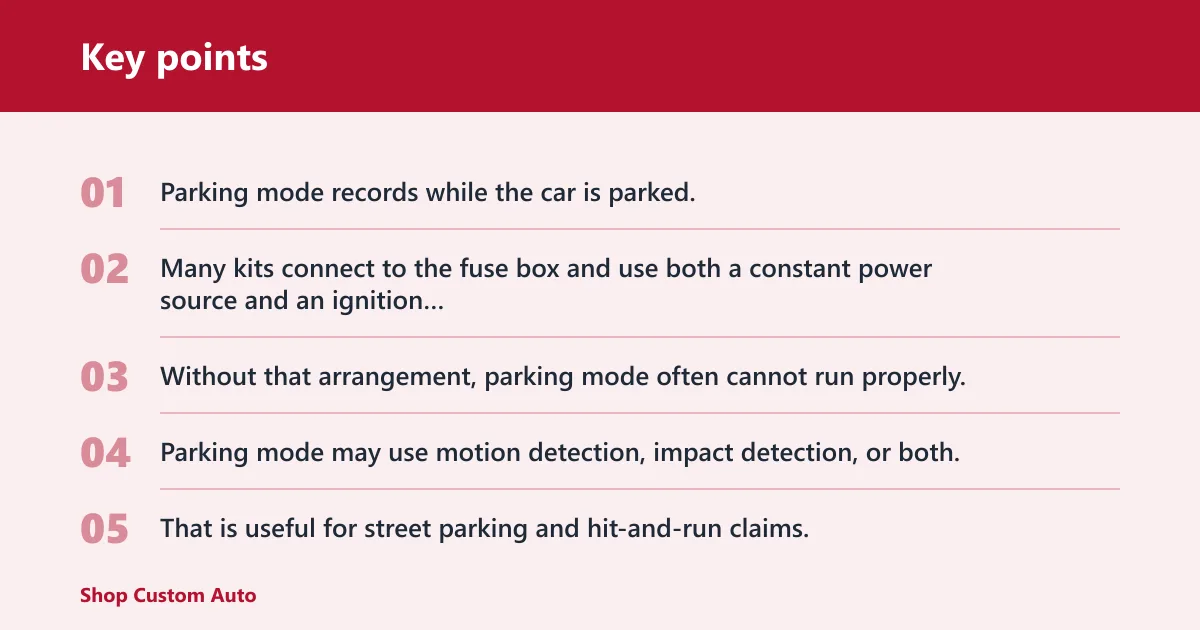
Parking mode records while the car is parked, and it usually needs hardwiring or another always-on power source. Many kits connect to the fuse box and use both a constant power source and an ignition source so the camera knows when the vehicle is parked. Without that arrangement, parking mode often cannot run properly.
Parking mode may use motion detection, impact detection, or both. That is useful for street parking and hit-and-run claims, but the feature is only as good as the power setup behind it. If battery protection settings are too cautious, parking mode may stop early.
Cleaner wiring and fewer cable runs
Hardwiring can leave the cabin tidier because the cable does not have to drape across the dash or hang from the console. That matters if you want a more discreet front-and-rear install or need to keep the windshield area clear. The benefit is practical, not cosmetic.
Say your front-and-rear dash cam has a rear cable and a power lead all crossing the cabin. Hardwiring can route power through the fuse box and trim panels, so only the camera heads remain visible. That reduces clutter and makes it less obvious that the car carries a camera.
Which drivers benefit most?
Commuters who park in a private garage may do fine with a socket-powered camera. Drivers who park on the street, leave a car at an airport lot, or want evidence after door dings usually benefit more from hardwiring. Lease drivers often prefer plug-in power unless they get permission for a hidden install.
Fleet vehicles and shared cars also benefit from a cleaner, more fixed setup when the goal is continuous coverage. In those cases, the better question is not whether hardwiring is required, but whether parking mode and always-on recording are worth the added complexity.
Dash cam checklist decision table
| User scenario | Recommended power method | Parking mode need | Battery-risk level | Worth hardwiring? |
|---|---|---|---|---|
| Daily commuter | 12V accessory socket | Low | Low | Usually no |
| Parked-on-street driver | Hardwire kit with fuse tap | High | Medium | Yes |
| Lease driver | Accessory socket or rearview mirror power | Low to medium | Low | Usually not unless allowed |
| Occasional road-tripper | Accessory socket, plus battery pack if needed | Low | Low | Sometimes, only for parking coverage |
What if you do not hardwire?
If you do not hardwire, you can still use a dash cam normally for driving video. A socket-powered setup is usually the easiest choice, and many drivers stop there. The main tradeoff is that parking mode may not work, or may work only if your vehicle keeps the socket live when the ignition is off.
Accessory socket power
Accessory socket power is the simplest path. Plug the camera in, mount it, and route the cable with clips or trim tuck. In most cars, that socket powers the dash cam only when the ignition is on, which is fine for road use but not for parked surveillance.
A common first-timer mistake is assuming every socket acts the same. Some vehicles keep the outlet alive after shutdown, and some shut it off immediately. If you do not check that behavior, you may think your parking mode failed when the car simply removed power.
Rearview mirror power options
Some dash cams can draw power from a rearview mirror adapter or an overhead power source instead of the 12V socket. This can shorten cable runs and keep the install neater. It still depends on the vehicle’s wiring, so the camera may behave like an ignition-only setup unless the adapter is tied to constant power.
Battery pack alternatives
If you cannot hardwire, an external battery pack is the main alternative for parking mode. It charges while driving and supplies the camera after shutdown. That option can be useful for lease vehicles, but it adds cost and another component to mount or charge.
Suppose a driver wants overnight parking recording but lease rules block fuse-box work. A battery pack or an always-on accessory-power adapter can fill the gap, though each has limits. The key is to match the power method to the parking risk, not to force a hardwire kit into every car.
Can hardwiring drain the battery?
Yes, but the risk depends on the kit, the cutoff settings, the battery’s condition, temperature, and how often you drive. A proper hardwire kit with low-voltage cutoff helps protect the starter battery. A poor setup, an old 12V vehicle battery, or long parking periods can cause problems.
Low-voltage cutoff and battery protection
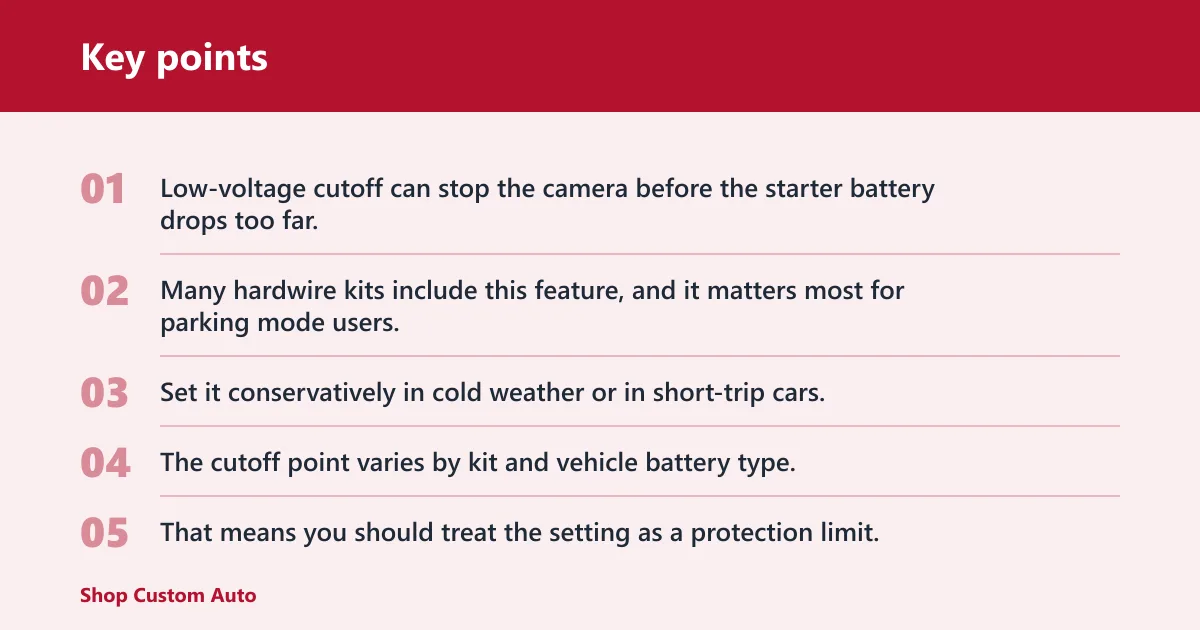
Low-voltage cutoff can stop the camera before the starter battery drops too far. Many hardwire kits include this feature, and it matters most for parking mode users. Set it conservatively in cold weather or in short-trip cars, because both conditions reduce battery reserve and make recovery less reliable.
The cutoff point varies by kit and vehicle battery type. That means you should treat the setting as a protection limit, not a guarantee that the battery will always be fine. If the car sits for days, even a good cutoff cannot create charge that is not there.
Starter battery wear and cold weather
Older batteries lose usable capacity, and cold weather makes that worse. If you run parking mode on a battery that already struggles to start the engine, the camera can push it closer to failure. The risk is higher on cars that do many short trips because the alternator has less time to refill the 12V battery.
Does hardwiring drain the car battery? It can, if parking mode runs too long or protection is set too low. It does not have to. A conservative cutoff, healthy battery, and regular driving usually keep the risk manageable.
Start-stop and infrequent-use vehicles
Start-stop vehicles and infrequently driven cars need extra care. Their battery management systems can be more sensitive, and some are not happy with aftermarket power draws left on for long periods. EVs and hybrids can also have different accessory-power behavior, so the vehicle manual matters before installation.
Use the vehicle fuse layout, the dash cam manual, and any lease or warranty rules before choosing a power path. That matters more than whether the camera itself is front-only or front-and-rear.
Is it easy to hardwire a dash cam?
Hardwiring is manageable for a confident do-it-yourself installer, but it is not as simple as plugging into a socket. You need the right fuse tap, the correct fuse type, and a safe choice of constant and ignition circuits. Some cars are straightforward. Others are better left to a professional.
Fuse tap basics
A fuse tap adapts an existing fuse slot for dash cam power. It is often used in an add-a-fuse installation and must match the fuse type in the vehicle. The hardwire kit usually needs a correctly sized fuse for the camera and a valid circuit choice so the camera gets the behavior you want.
Hardwire kits are sold for USB-C, micro USB, and mini USB dash cams. Most kits connect to the fuse box and may include low-voltage cutoff, but not every kit is set up the same way. Check the dash cam manual before buying parts.
Constant vs ignition circuits
The constant circuit supplies power even when the key is off. The ignition circuit only has power when the vehicle is on. Parking mode kits often use both, because the camera can watch for parked-car activity and still know when to stop drawing power if the battery gets low.
Choosing the wrong fuse can cause parking mode to fail, turn the camera off with the wrong trigger, or leave it drawing power when it should not. That is why fuse selection is not a guess. It should match the vehicle diagram and the function each circuit actually serves.
When to use a professional
Use a professional if the fuse box is hard to access, the vehicle has complex electronics, or you do not want to trace circuits yourself. That can be the better route for newer EVs, tight fuse panels, or cars with sensitive battery management. Professional installation is not required for everyone, but it can prevent avoidable mistakes.
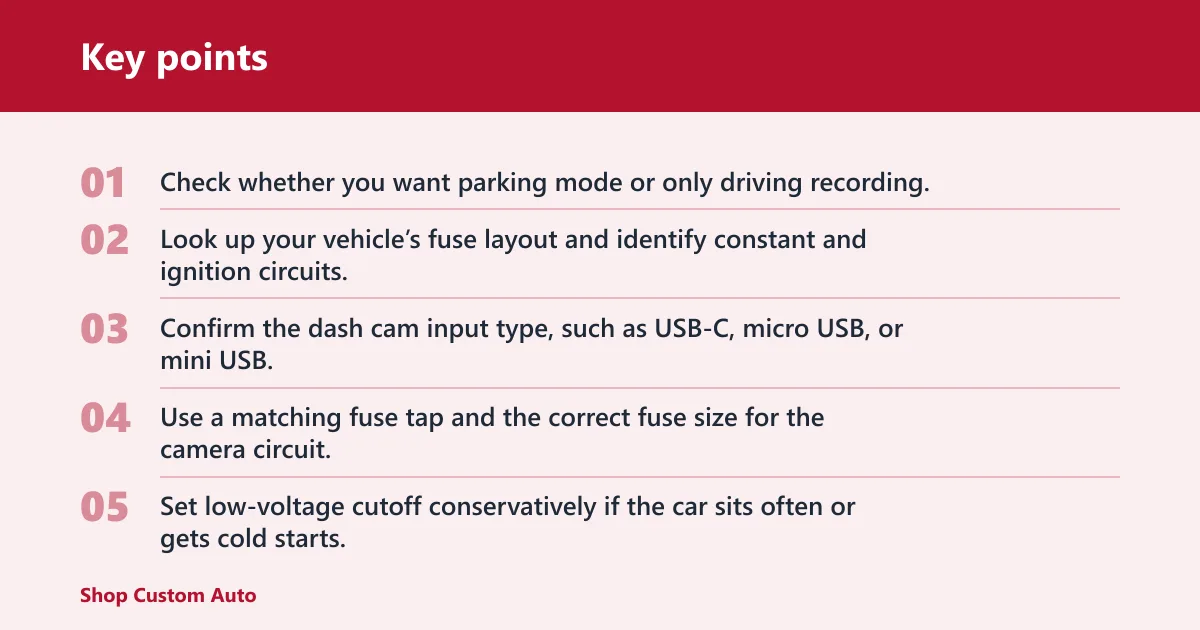
- Check whether you want parking mode or only driving recording.
- Look up your vehicle’s fuse layout and identify constant and ignition circuits.
- Confirm the dash cam input type, such as USB-C, micro USB, or mini USB.
- Use a matching fuse tap and the correct fuse size for the camera circuit.
- Set low-voltage cutoff conservatively if the car sits often or gets cold starts.
- Test that the camera powers off, enters parking mode, and resumes correctly.
Frequently asked questions
Do all dashcams need to be hardwired?
No. Most dash cams can run from a 12V accessory socket and record without any hardwire kit. Hardwiring is mainly for parking mode, cleaner wiring, or a constant power source. If your goal is only recording while driving, a plug-in setup is usually enough.
Does a dash cam have to be hardwired?
No. A dash cam does not have to be hardwired to work in normal driving. Many models plug into the accessory socket and switch on with ignition. Hardwiring becomes useful when you want the camera to keep monitoring while parked or want a less visible install.
Can a dash cam be hard wired?
Yes. Many dash cams can be hardwired with a fuse tap and the correct hardwire kit. Kits are commonly sold for USB-C, micro USB, and mini USB cameras. The important part is matching the vehicle’s fuse type and choosing the right constant and ignition circuits.
Is it easy to hardwire a dashcam?
It can be straightforward for a simple vehicle and an installer who is comfortable working around the fuse box. It is less easy if the panel is cramped, the fuse map is unclear, or the car has sensitive electronics. If any of that applies, a professional is a sensible choice.
Who can hardwire my dashcam?
Auto electronics shops, many accessory installers, and some mobile car-audio installers can do it. A dealership may also help, though that is not always the lowest-cost route. Ask whether they use a fuse tap, set low-voltage cutoff, and verify constant versus ignition circuits before leaving the car.
What happens if I don’t hardwire a dash cam?
Usually, nothing bad for normal driving. The camera records from the accessory socket and turns off with the ignition if the socket is switched. The main thing you lose is parking mode, so the camera may not capture events after you leave the car unless another power source is used.
Can I use a dash cam without parking mode and still be fine?
Yes. For many drivers, a dash cam that records only while driving is enough. It can still help show what happened in a crash or during a road incident. Parking mode is useful, but it is not required for the camera to be worthwhile.