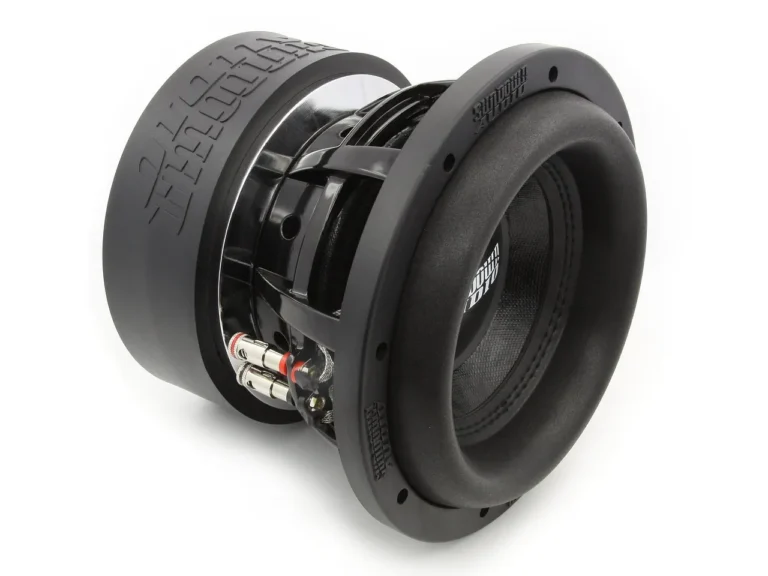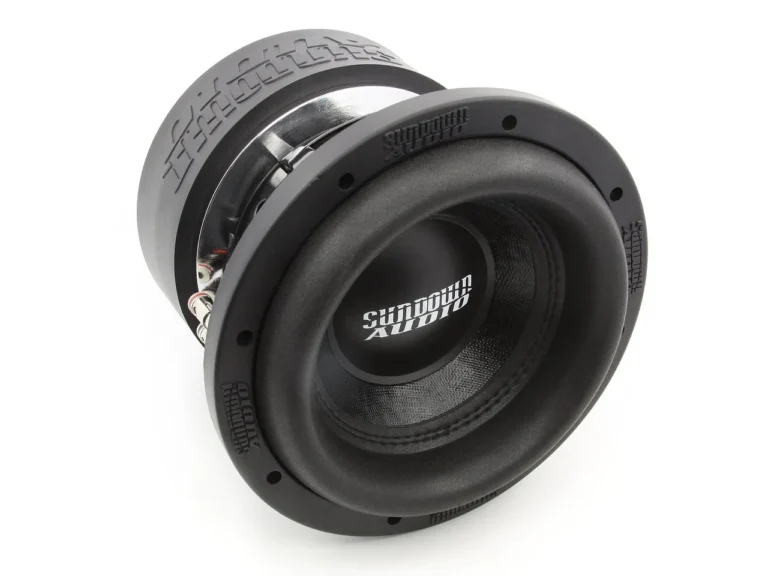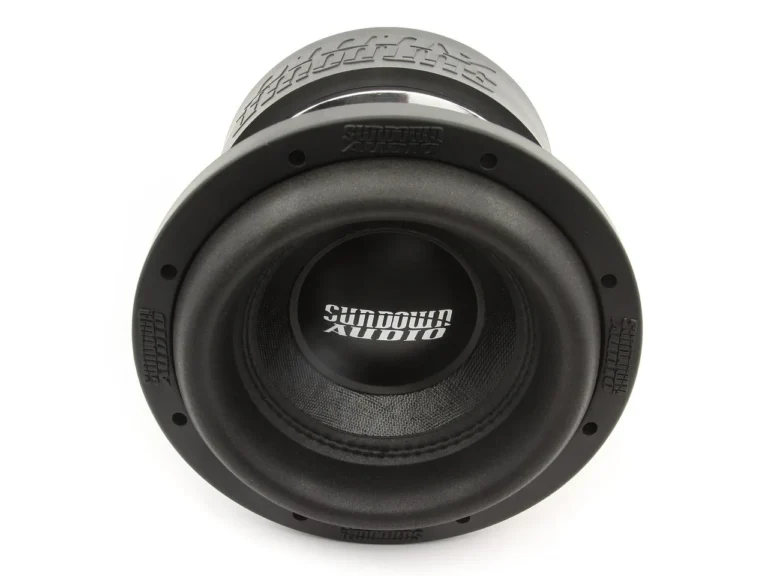
How to Determine Subwoofer Box Size for Your Sub
Determine subwoofer box size by calculating the enclosure’s net internal volume in cubic feet, then subtract the sub, port, and brace displacement; the finished number should generally fall within the driver’s recommended range before cutting wood. Get it wrong and you waste material, hurt bass output, or risk damaging the driver. This guide shows the measurements, math, and final sanity check.
Why box size matters
A subwoofer box matters as much as the subwoofer itself. The enclosure volume changes bass output, cone control, and how low the system can play cleanly. A proper box can literally double or cut your bass output in half, so the target is not “big enough” in a general sense. It is the right net volume for one specific subwoofer model.
Sealed and ported enclosures react differently. A sealed box is smaller, more forgiving if it misses the spec by a little, and usually gives tighter cone control. A ported box is larger, uses a tuned vent, and can provide up to about 2x perceived loudness versus sealed, but it is less tolerant of volume and tuning mistakes.
That is why the published volume range matters more than the outer cabinet size. Two boxes with the same outside dimensions can end up with different net volumes once wall thickness, driver displacement, port displacement, and bracing are included.
What volume changes in the bass response
As internal volume increases, the sub can usually play lower and louder around the tuning point in a ported design, but control can soften if the box gets too large for the driver. A smaller sealed box usually tightens response and raises system stiffness. The right answer depends on the subwoofer model, not on a universal size rule.
Why cone control depends on enclosure volume
Inside the box, air acts like a spring. Too much or too little air changes how strongly that spring pushes back on the cone. That affects excursion, transient response, and how the driver behaves near its limits. For that reason, the manufacturer’s range is the first number to trust, not the outer shell dimensions.
What measurements you need first
Before you calculate anything, gather the outside dimensions, the material thickness, and the displacement figures for every object that takes up space inside the cabinet. You need length, width, and height for the outside shell, plus the subwoofer model’s published displacement and, for ported builds, the port’s displacement and tuning target.
External dimensions and panel layout
Measure the box outside length, width, and height in inches. Then note the panel layout so you know which dimensions lose two wall thicknesses and which lose one. A cabinet built from 3/4-inch MDF or plywood does not use its outside size as internal volume; each panel reduces the internal space a bit.
Material thickness and displacement items
Material thickness changes the inside dimensions, so it changes the final cubic feet. Driver displacement is the volume taken up by the subwoofer itself, including basket and magnet. Port displacement applies only to vented boxes. Brace displacement is the space taken by internal bracing.
Say your outside dimensions look large enough for a 2.0 cu ft ported box, but the port and brace occupy a surprising amount of space. The box can still end up too small on net volume even though the cabinet itself looks generous from the outside.
| Box type | Published reference volume | Notes |
|---|---|---|
| Sealed | 1.25 cu ft | Used here as the sealed baseline |
| Ported | 2.0 cu ft tuned to 34 Hz | Used here as the vented baseline |
How to calculate gross volume
Gross volume starts with the outside shell. Convert the external dimensions to cubic inches by multiplying length × width × height, then divide by 1,728 to convert cubic inches to cubic feet. After that, subtract the space lost to wall thickness to get the internal shell volume before displacement deductions.
- Measure outside length, width, and height in inches.
- Multiply those three numbers to get gross external cubic inches.
- Convert cubic inches to cubic feet by dividing by 1,728.
- Subtract wall thickness from the dimensions that are reduced by two panels.
- Recalculate the internal shell volume in cubic feet.
How to measure internal box volume correctly
Internal box volume is the number that matters, because it reflects the air the sub actually sees. If the box has a removable front baffle, double-check whether the manufacturer measured from the outer shell or the net internal cavity. Most sizing mistakes happen when outside dimensions are treated as the answer.
A common mistake is to use the outside dimensions and assume the box is big enough; suppose a cabinet measures 24 inches by 16 inches by 13 inches externally, but thick bracing, terminal cup hardware, and the woofer’s displacement all reduce the usable volume inside. The net volume can fall far below the target even though the shell seems adequate.
How to get net box volume
Net box volume is the internal cavity after every occupied space is removed. Start with the internal shell volume, then subtract driver displacement, port displacement, and brace displacement. The final number should be compared with the subwoofer manufacturer recommended volume range from the owner manual or spec sheet.
Subtract driver displacement
Driver displacement is the space the subwoofer body takes up inside the cabinet. Larger motors and baskets take more space, and shallow-mount, single, dual, and free-air variants do not all displace the same amount. Use the published figure for the exact subwoofer model.
Subtract port and brace displacement
Port displacement matters only in ported boxes, but it can be significant. Long vents, wide flares, and slot ports reduce the air volume the driver sees. Internal bracing also consumes volume, and it should be counted before you call the box finished.
Subtract each of those volumes separately. Do not roll them into one guess. That is how a physically large box ends up with the wrong net volume and the wrong tuning behavior.
Check the final number against the target range
Now compare the net result to the recommended range for your exact subwoofer model. Many manufacturers publish separate sealed and ported ranges. Some also list different targets for shallow-mount or free-air variants. Use the range that matches the build, not the most convenient one.
Subwoofer box worksheet
This worksheet turns outside measurements into a pass or fail result. Keep the math in order: gross external volume, internal volume after wall thickness, then net volume after every displacement deduction. Use the subwoofer’s published range as the final check.
| Step | Formula | Example input | Result |
|---|---|---|---|
| Gross external volume | L × W × H ÷ 1,728 | 18 × 14 × 14 in | 2.06 cu ft |
| Internal shell volume | Adjust for wall thickness first | 3/4-inch MDF panels | Lower than gross |
| Subtract driver displacement | Internal shell volume – driver displacement | 0.12 cu ft driver | Net drops further |
| Subtract port and brace displacement | Net before ports/braces – port – brace | 0.18 cu ft total | Final net volume |
| Range check | Compare to spec sheet | Sealed or ported target | Pass or fail |
Pass or fail checks for sealed boxes
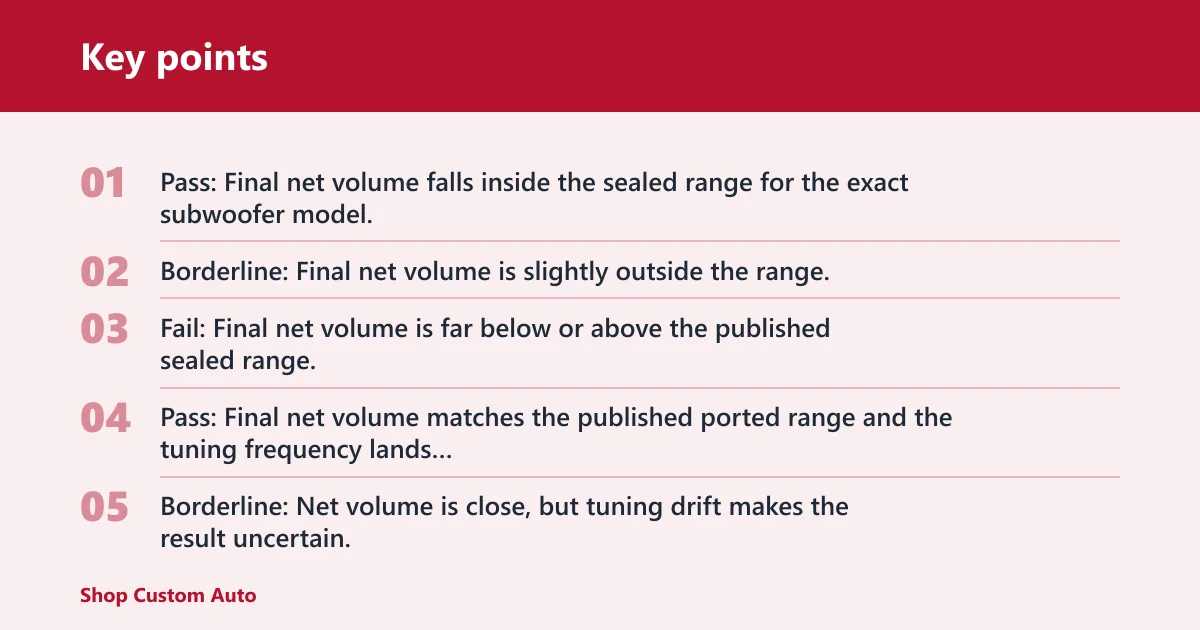
- Pass: Final net volume falls inside the sealed range for the exact subwoofer model.
- Borderline: Final net volume is slightly outside the range, but the box is still close enough to be a reasonable match for many sealed designs.
- Fail: Final net volume is far below or above the published sealed range.
Pass or fail checks for ported boxes
- Pass: Final net volume matches the published ported range and the tuning frequency lands in the recommended zone.
- Borderline: Net volume is close, but tuning drift makes the result uncertain.
- Fail: Volume is off and the box tuning frequency is outside the intended range.
How to determine the right box size for your subwoofer
Start with the subwoofer model’s published sealed and ported ranges, then work backward from the dimensions that fit your vehicle and build material. The right box size is the one that lands in the spec sheet range after all deductions, not the one that looks best on paper before displacement is counted.
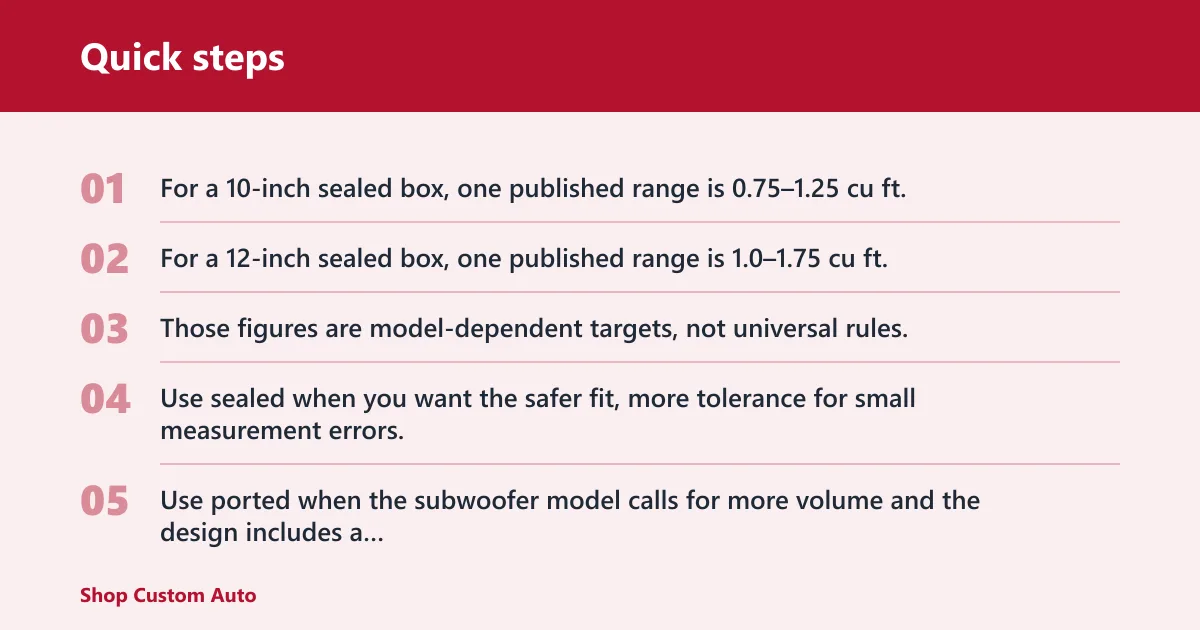
For a 10-inch sealed box, one published range is 0.75–1.25 cu ft. For a 12-inch sealed box, one published range is 1.0–1.75 cu ft. Those figures are model-dependent targets, not universal rules, but they show why the driver size alone does not tell you the full story.
Sealed or ported box volume?
Use sealed when you want the safer fit, more tolerance for small measurement errors, and simpler layout. Use ported when the subwoofer model calls for more volume and the design includes a properly sized vent and a specific tuning frequency. Ported boxes usually need more space than sealed boxes and are less forgiving if the net volume is off.
Suppose a sub’s spec sheet lists 1.25 cu ft sealed and 2.0 cu ft ported tuned to 34 Hz. A sealed box that lands at 1.18 cu ft may still be workable. A ported box that lands at 1.18 cu ft is not a near miss, it is the wrong enclosure.
Why tuning frequency changes the decision
Tuning frequency matters only for ported boxes. The vent and the box volume work together, and the common vented range shown on many sheets is around 30–36 Hz. If the tuning is wrong, the response shifts even if the net volume looks close on paper. That is why a calculator must include both volume and tuning inputs.
Use a subwoofer box calculator that accepts internal dimensions and displacement inputs. If it only asks for outside dimensions, it is skipping the part that usually causes the mistake. A correct calculator should let you enter wall thickness, driver displacement, and, for ported boxes, port displacement and tuning frequency.
What if my subwoofer needs a different size than the box I already have?
If the existing box misses the published range, treat it as a fitment problem, not a guess-and-hope problem. You can rebuild the enclosure, change the internal volume with spacers or new panels, or choose a different subwoofer model whose recommended range fits the box better. Do not ignore a large mismatch just because the cabinet physically fits in the vehicle.
Box style matters here too. A sealed enclosure that is slightly off-spec is usually easier to live with than a ported box that misses both volume and tuning. If the current box is close, measure the net volume first; the outside shell may still be salvageable with a new baffle or internal changes.
How do I know if a box is too small for my sub?
A box is too small when the net internal volume falls below the subwoofer’s published range and the system no longer behaves as intended. In a sealed box, that often means stiffer response and less low-end extension. In a ported box, too little volume can shift tuning and upset the whole design.
The final check is simple: if the net number does not fall inside the recommended range for that exact model, the box is wrong. The outer cabinet can still be large enough to mount in the car and still be too small after displacement is deducted.
Frequently asked questions
What size subwoofer should I get?
Choose the subwoofer model that matches the enclosure space you can actually build, not the largest driver that fits by diameter alone. Start with the box volume you can support, then check each candidate model’s sealed or ported range. That keeps the final system in spec before you buy wood or hardware.
How do I determine the right box size for my subwoofer?
Use the model’s spec sheet, calculate the net internal volume from your planned dimensions, and compare the result to the published sealed or ported range. The right size is the one that lands in that range after wall thickness, driver displacement, and any port or brace volume are removed.
How do I measure internal box volume correctly?
Measure the outside shell, subtract wall thickness to get internal dimensions, then multiply the internal length, width, and height. After that, subtract the space used by the subwoofer, port, and bracing. That final figure is the internal volume you should compare to the manufacturer’s recommendation.
Should I use sealed or ported box volume recommendations?
Use the recommendation that matches the enclosure type you plan to build. Sealed boxes use smaller net volumes and are usually more forgiving. Ported boxes need more room and a tuning frequency check, so the ported recommendation applies only when the design includes a vent and a correct tune.
How much does driver displacement affect box size?
Driver displacement can move the final net volume far enough to change the result from pass to fail, especially in smaller sealed boxes. Always subtract the published displacement for the exact model, since basket and magnet size vary. A box that looks correct outside can still be undersized inside.