0 Gauge vs 4 Gauge Amp Wiring Kit: Which Wins?
Use 4 gauge for a single amp at roughly up to 1,000 watts RMS, with a short run and OFC cable. Choose 0 gauge when power, cable length, or a second amp pushes current demand higher. Wrong wire size can cause voltage drop, weak bass, hot cables, and nuisance amp shutdowns. This guide breaks the choice into power, cable length, and material so you can size the kit correctly.
| Factor | 0 gauge | 4 gauge | Winner |
|---|---|---|---|
| Current headroom | Best for high-current runs, big mono amps, and multi-amp systems | Best for most single-amp installs in the mid-power range | 0 gauge |
| Install effort | Bulkier cable, larger terminals, more planning | Easier to route and terminate | 4 gauge |
| Borderline builds with long runs | Safer choice when cable length and current draw rise together | Works only when the run is short and the current demand is lower | 0 gauge |
| Cost pressure | Usually higher because the kit uses more copper and larger hardware | Usually lower | 4 gauge |
| Moderate single-amp systems | Safe, but often unnecessary | Usually the practical pick | 4 gauge |
4 gauge vs 0 gauge at a glance
The basic trade-off is clear. 0 gauge gives more current capacity and more margin on long or demanding power runs, while 4 gauge is easier to route and often enough for a single amplifier. Lower AWG numbers mean thicker wire, so 1/0 AWG is thicker than 4 gauge, and 4 gauge is thicker than 8 gauge.
Current draw and power
Use RMS power for wire sizing because it tracks continuous demand, not short marketing claims. A common guide puts 4 gauge in the mid-power zone, while 1/0 gauge fits big mono amps and multi-amp builds.
Cable run length
Longer runs raise voltage drop because resistance adds up with distance. The farther the battery feed travels, the more likely a borderline 4 gauge setup is to sag under load.
Wire material
OFC copper carries current better than CCA because it has lower resistance and runs cooler at the same size label. CCA costs less and weighs less, but it can behave like a smaller cable in borderline systems, so the same printed gauge number does not deliver the same performance.
Cable gauge decision table
Use this table as a practical boundary, not a sticker check. It combines RMS power, total battery-to-amp run length, and wire material so you can choose the larger kit when one factor starts pushing the system into a higher-current, higher-drop zone.
| Amplifier RMS range | Total cable run length | Wire material | Recommended gauge |
|---|---|---|---|
| Under 500W RMS | Short run | OFC | 4 gauge |
| 500W to 1,000W RMS | Short run | OFC | 4 gauge |
| 500W to 1,000W RMS | Moderate to long run | CCA | 0 gauge |
| 1,000W to 1,500W RMS | Short run | OFC | 4 gauge or 0 gauge, depending on the amplifier’s current draw |
| 1,000W to 1,500W RMS | Moderate to long run | OFC | 0 gauge |
| Above 1,500W RMS | Any run that is not very short | OFC | 0 gauge |
| Any borderline build | Long run | CCA | 0 gauge |
Which factors decide the wire size?
RMS power, current draw, and cable length decide the wire size. If the amplifier’s continuous demand is low and the run is short, 4 gauge often fits cleanly. If the system pulls more current, the run is long, or the kit uses CCA, 0 gauge gives more margin.
Why RMS matters more than peak ratings
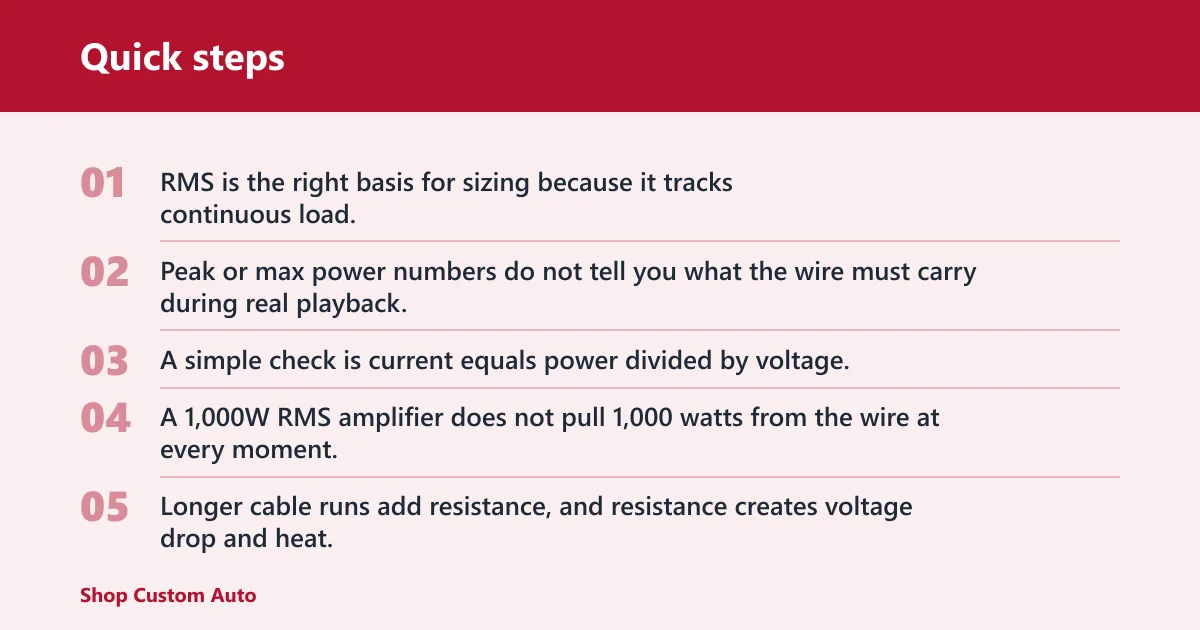
RMS is the right basis for sizing because it tracks continuous load. Peak or max power numbers do not tell you what the wire must carry during real playback, so they are the wrong starting point for a wiring decision.
How to estimate current from power and voltage
A simple check is current equals power divided by voltage, then adjusted for amplifier efficiency. A 1,000W RMS amplifier does not pull 1,000 watts from the wire at every moment, but the current demand still rises enough that wire choice should follow continuous draw, not the box label.
Why long runs push borderline systems up a size
Longer cable runs add resistance, and resistance creates voltage drop and heat. A setup that is fine on a short run can start dimming lights or shutting down when the same wire has to travel farther across the vehicle.
How run length changes the choice
Run length matters because every extra foot adds resistance. That does not change the amp’s load, but it does change how much voltage reaches the amplifier, which can reduce output and stability.
Short battery-to-amp runs
Short runs are where 4 gauge is most comfortable. A single amplifier with OFC wire and modest RMS demand usually does not need the bulk of 0 gauge if the battery-to-amp path is short.
Typical trunk installs
Trunk-mounted amps often sit in the middle zone. If the wire has to cross the cabin and continue into the rear cargo area, 4 gauge can still work for moderate power, but the margin shrinks as current demand rises.
Long vehicle runs and voltage drop
Long SUV, truck, or full-size sedan runs are where 0 gauge starts earning its cost. The extra copper helps keep voltage drop lower under load, which matters more when the amplifier is pulling sustained current.
OFC vs CCA in borderline builds
OFC is the better conductor. CCA is the budget choice, but it has higher resistance, so a CCA kit can act like a smaller wire in a borderline build even when the label says the same gauge.
Why OFC carries current better
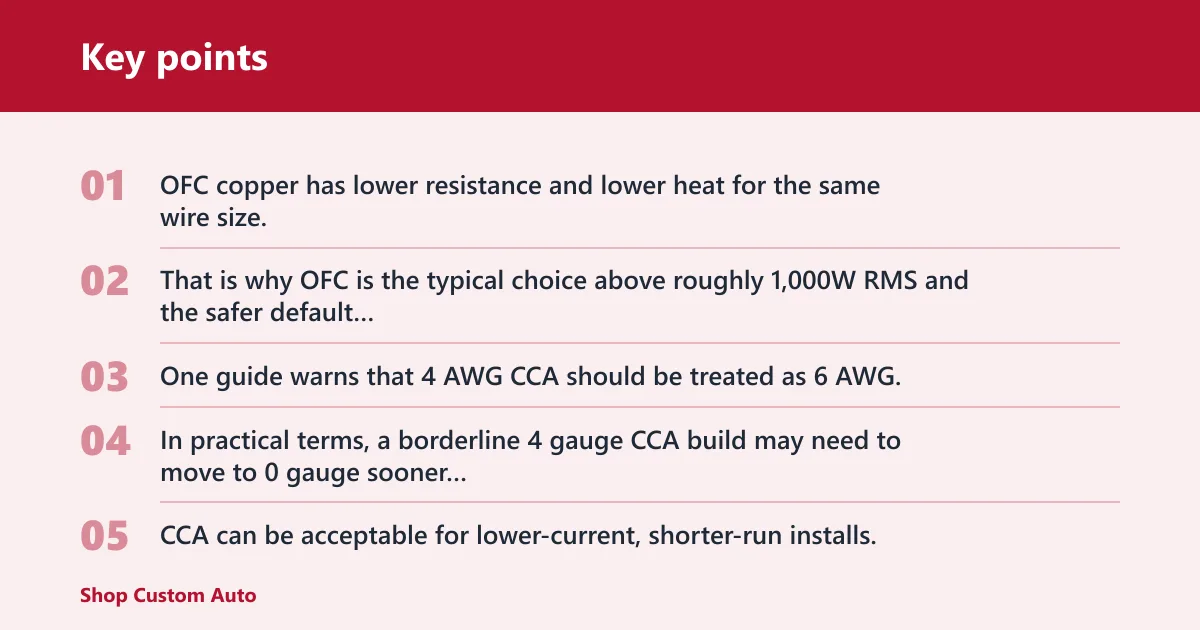
OFC copper has lower resistance and lower heat for the same wire size, which helps keep voltage loss down. That is why OFC is the typical choice above roughly 1,000W RMS and the safer default when the system is already close to the edge.
Why CCA can require a larger size sooner
4 AWG CCA should be treated as 6 AWG, which is a useful reminder that CCA does not perform like copper at the same printed gauge. In practical terms, a borderline 4 gauge CCA build may need to move to 0 gauge sooner than an OFC build.
When CCA is acceptable and when it is not
CCA can be acceptable for lower-current, shorter-run installs. It is a weaker choice for sustained high current, long runs, or any system that already shows voltage sag, warm wiring, or repeated fuse issues.
Say your single amp is rated at 900W RMS, the battery-to-amp run is short, and the kit is OFC. That is a case where 4 gauge is usually the clean choice. Change only one variable to a long rear-cargo run, and 0 gauge becomes much more attractive.
If the system uses a roughly 1,200W RMS monoblock and CCA cable. The label may look similar to an OFC 4 gauge kit, but the higher resistance means the safer answer shifts upward faster than many buyers expect.
When 4 gauge is enough
4 gauge is enough for most single-amp installs that stay in the mid-power range and keep the run short. It is also easier to route, fit through factory grommets, and terminate with smaller hardware than 0 gauge.
Single amplifier installs
A single amplifier is the most common 4 gauge use case. If the amp is modest in RMS output and the cable run is not unusually long, 4 gauge keeps the install simpler without giving up needed safety margin.
Moderate RMS systems
Guides commonly place 4 gauge around 500 to 1,200W systems, and some place a single amplifier up to 1,200W on 4 gauge. That range is a practical starting point, but the final call still depends on run length and wire material.
Shorter runs with OFC
Short OFC runs are where 4 gauge performs best. Lower resistance plus shorter distance means less voltage drop, less heat, and less chance that the wire becomes the bottleneck.
Choose 4 gauge if… / Choose 0 gauge if…
Choose 4 gauge when the system is a single amplifier, the RMS demand sits in the moderate range, and the battery-to-amp run is short enough that voltage drop stays under control. Choose 0 gauge when current demand climbs, the run is longer, or you want extra headroom for future expansion.
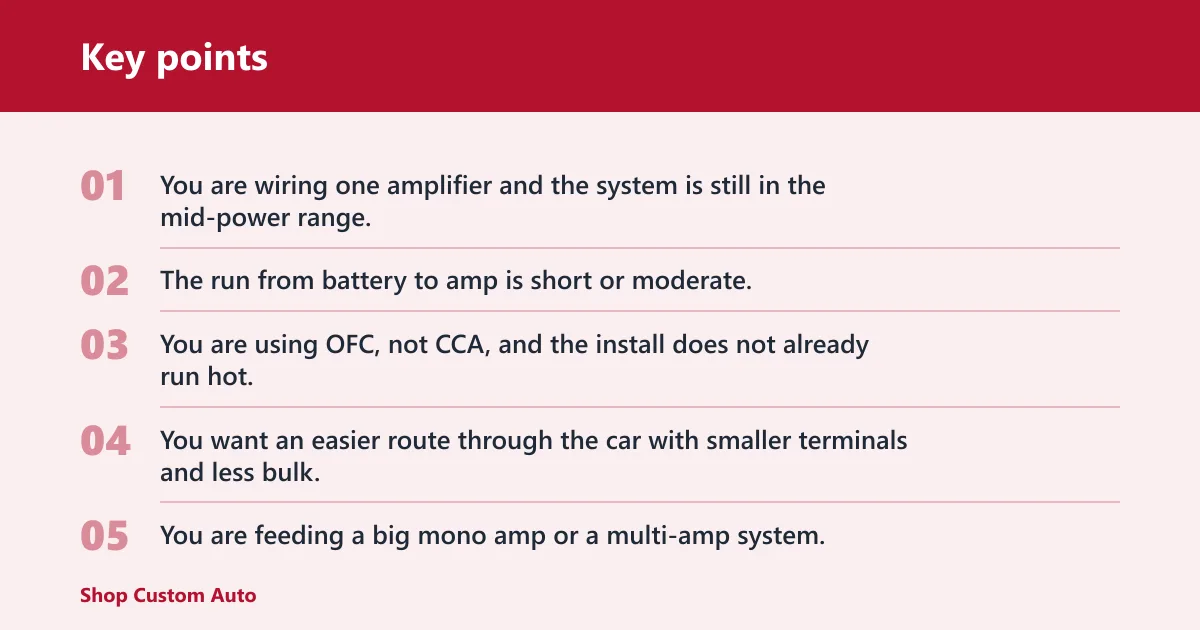
Choose 4 gauge if…
- You are wiring one amplifier and the system is still in the mid-power range.
- The run from battery to amp is short or moderate.
- You are using OFC, not CCA, and the install does not already run hot.
- You want an easier route through the car with smaller terminals and less bulk.
Choose 0 gauge if…
- You are feeding a big mono amp or a multi-amp system.
- The total current draw is climbing toward a high-current setup.
- The cable run is long enough that 4 gauge is close to its limit.
- You are using CCA in a borderline build and need the extra margin.
0 gauge is safe on a moderate-power system if the rest of the kit is matched properly. It is just often unnecessary there, which means the buyer pays more, deals with larger terminals, and may need more room around the fuse holder and distribution hardware than the system really needs.
- Check the amplifier’s RMS rating, not the peak number.
- Measure the total battery-to-amp cable path, not just the trunk distance.
- Confirm whether the kit is OFC or CCA.
- If the build is borderline on any one of those three factors, step up to 0 gauge.
- Size the fuse to protect the wire and place it near the battery in an ANL fuse holder.
Frequently asked questions
Do I actually need 0 gauge wiring for my amp?
Only if the amplifier’s continuous demand, cable length, or wire material pushes the system past what 4 gauge can support cleanly. For a single amp under about 1,000 watts RMS with a short OFC run, 4 gauge is usually enough. Move to 0 gauge when the install is high-current or long.
What wattage range is 4 gauge good for?
That range is not a free pass by itself. A long run or CCA cable can make 4 gauge marginal much sooner.
When does 0 gauge become necessary instead of 4 gauge?
0 gauge becomes the better pick when current draw gets high, the cable run is long, or the system uses multiple amplifiers. One source places 0 gauge above about 2,000W RMS, while another says it becomes relevant when total current draw exceeds about 225 A.
Is 0 gauge overkill for a single amplifier?
Sometimes, yes. A single moderate-power amplifier with a short OFC run usually does not need 0 gauge, even though it is safe to use. It becomes sensible only if the amp is large, the run is long, or you are planning to add another amp soon.
How does OFC compare to CCA in 0 gauge kits?
OFC has lower resistance and handles sustained current better, so it is the preferred choice for higher-power car audio runs. CCA is cheaper and lighter, but it loses more voltage and heat at the same size label. In borderline builds, CCA may need the next size up sooner.
What happens if I use wire that is too small for my amp?
Undersized wire raises voltage drop and heat. The usual warning signs are weak bass, dimming lights, hot cable, nuisance fuse trips, or the amplifier shutting down under load. Those symptoms point to a wiring bottleneck, not a bigger amp setting.
What fuse size should a 0 gauge kit use?
The fuse should match the wire’s ampacity, not the amplifier’s marketing number, and it should sit near the battery in an ANL fuse holder. The exact fuse value depends on the wire kit and the install design, so the safe rule is to size for wire protection first.
Can a 0 gauge kit be used on a moderate-power system safely?
Yes. It is safe if the terminals, fuse holder, and routing are all sized correctly. The downside is mostly cost, bulk, and installation effort. For a moderate single-amp system, 0 gauge is often more than the build needs, but it is not automatically a problem.
A common first-timer mistake is buying by peak wattage and then pairing a long trunk run with CCA. That combination often looks fine on paper and then shows up as voltage drop, hot wiring, and weak output once the system is loaded.