5.25 vs 6.5 Speakers: What Changes in Sound and Fit
A 6.5-inch door speaker usually gives more midbass and output than a 5.25-inch model, but only if the door, window track, and mounting depth can clear it. Ignore fitment and you get rattles, blocked glass travel, adapter hassle, or a speaker that sounds worse because the install is compromised. This guide compares sound, power needs, and fit so you can choose by use case.
| Factor | 5.25 | 6.5 speakers | Winner |
|---|---|---|---|
| Midbass and output | Less cone area, so less lower-frequency punch from the door | More cone area, so stronger midbass and more output potential | 6.5 speakers |
| Midrange clarity | Often sounds tighter at the top of the midrange and vocals | Can sound fuller, but not automatically cleaner | 5.25 |
| Fit risk | Usually easier in compact doors and tight factory openings | More likely to need adapter brackets, spacer work, or trimming | 5.25 |
| Factory head unit power | Works well when sensitivity is a better match than high RMS rating | Can be fine, but output depends more on sensitivity than on rated power alone | Tie |
| Amplifier-based system | Can sound good, but midbass limits appear sooner | Usually takes better advantage of added power and larger cone area | 6.5 speakers |
5.25 vs 6.5 speakers: the core tradeoff
The core tradeoff is simple: 6.5 speakers give you more cone area and usually more midbass, while 5.25 speakers are easier to place in tight doors and factory openings. The size stamp alone does not tell you if the speaker will fit, because the cutout, frame shape, and mounting depth can differ from the nominal diameter.
What changes with cone area and frame size
A 5.25-inch nominal driver has a circular area of about 21.6 square inches, while a 6.5-inch nominal driver is about 33.2 square inches. That is roughly 53% more area before you account for the surround, basket, and magnet structure. Real-world output still depends on driver design, excursion, door sealing, and crossover settings—not size alone.
Frame size matters too. A larger frame can run into the door panel, speaker grille, or inner metal before the cone size itself becomes the problem.
Why nominal size does not equal exact fit
Nominal size is only a label. The actual speaker cutout or mounting hole in the door can be smaller, larger, or shaped differently from the replacement speaker’s basket. That is why some vehicles need adapter brackets, some need light trimming, and some accept 6.5 speakers in an opening that was not listed as 6.5 from the factory.
Some automobiles need 6.5-inch woofers while others require 5.25-inch, depending on model and manufacture. The right answer starts with the door, not the number on the box.
How sound changes between 5.25 and 6.5 speakers
6.5 speakers usually bring more midbass and higher output potential, while 5.25 speakers often sound tighter in the upper midrange and vocals. The difference is most obvious in the door speaker’s lower range, where cone area and door installation quality affect how much punch you hear.
Midbass: what you gain with 6.5 speakers
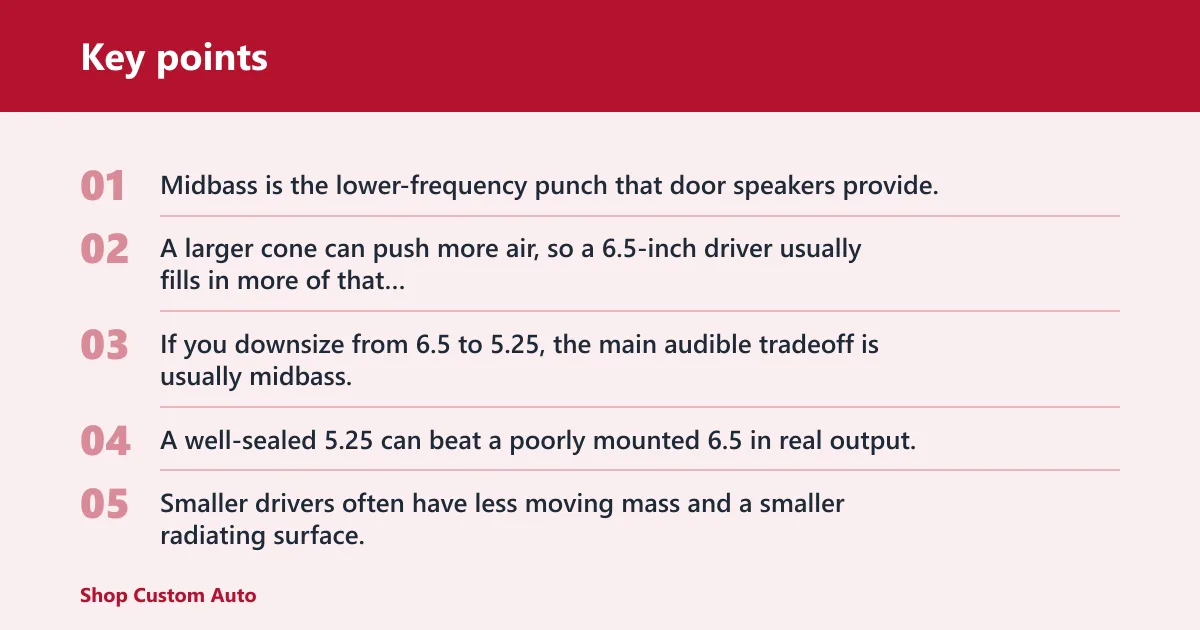
Midbass is the lower-frequency punch that door speakers provide. A larger cone can push more air, so a 6.5-inch driver usually fills in more of that region than a 5.25-inch driver. If you downsize from 6.5 to 5.25, the main audible tradeoff is usually midbass, not overall “clarity.”
That said, door install quality can shrink or widen the gap. A well-sealed 5.25 can beat a poorly mounted 6.5 in real output, especially if the larger speaker leaks air, hits the door card, or vibrates against a loose adapter.
Midrange clarity: where 5.25 speakers can sound tighter
Smaller drivers often have less moving mass and a smaller radiating surface, so they can sound cleaner in the upper midrange when the rest of the setup is matched well. For vocals and instrument detail, a 5.25-inch speaker can be the better fit when you do not need strong door bass.
Say your hatchback still uses the stock head unit and only has slim front-door speaker mounts. A 5.25-inch front speaker may keep voice lines clearer than a forced 6.5-inch swap that barely clears the glass and ends up sitting too shallow or too loose.
RMS power handling and sensitivity in plain terms
Published manufacturer specs are the safest way to compare power handling and sensitivity, because those values vary widely by model and design. RMS tells you how much continuous power a speaker can handle; it does not tell you whether the speaker will sound better by itself or fit the vehicle well.
Sensitivity matters for loudness with limited power. When comparing models, check the published dB rating on the manufacturer spec sheet and remember that cabinetless car-door installs, crossover choice, and door sealing all change the result. On factory power, a more sensitive speaker often sounds louder than a less sensitive one with a bigger wattage number.
What changes in fitment?
Fitment is usually decided by three separate checks: mounting depth, window clearance, and the shape of the cutout. A speaker can match the nominal size and still fail in the door if the magnet hits the glass track or the basket collides with hardware behind the panel.
Mounting depth and window clearance
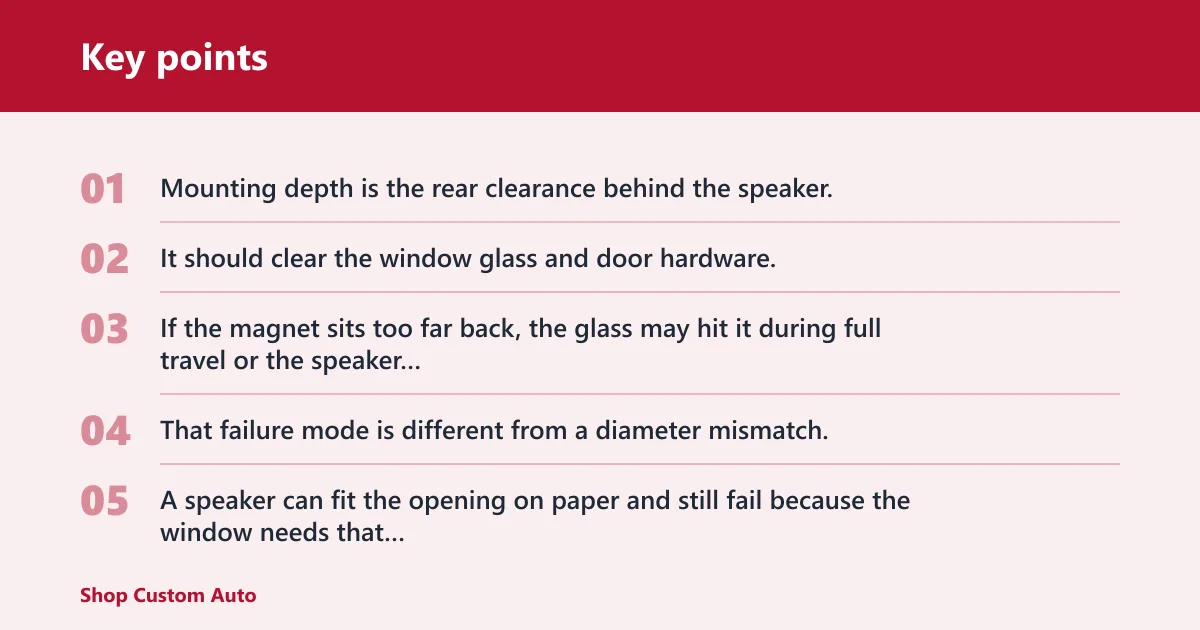
Mounting depth is the rear clearance behind the speaker. It should clear the window glass and door hardware, and it can matter as much as diameter for fit. If the magnet sits too far back, the glass may hit it during full travel or the speaker may force the window to stop early.
That failure mode is different from a diameter mismatch. A speaker can fit the opening on paper and still fail because the window needs that exact space behind the panel. Manufacturer fitment notes and installer guides consistently treat depth and glass path as separate checks.
Speaker cutout and mounting hole shape
The opening in the door or panel may not match the replacement speaker’s basket. Some vehicles use a round cutout, some use a keyed shape, and some use factory tabs that do not line up with an aftermarket frame. In those cases, adapter brackets help bridge the shape difference.
Do 5.25 speakers fit in 6.5 speaker openings? Sometimes, but not automatically. The answer depends on the adapter, screw pattern, and whether the smaller speaker leaves gaps that need sealing for proper midbass.
When adapter brackets or trimming come into play
Do you need an adapter bracket to switch from 5.25 to 6.5 speakers? Often, yes, if the door opening or bolt pattern does not line up. Light trimming can also be needed when the 6.5 frame is larger than the factory hole or when the grille sits too close to the cone.
Will a 5.25 speaker fit without modifying the door panel? It is more likely than with a larger driver, but you still need to check depth and the cutout shape. Smaller diameter does not guarantee a no-mod install.
5.25 vs 6.5 speaker decision table
| Speaker size | Expected sound change | Fit risk | Common vehicle situations | What to measure first |
|---|---|---|---|---|
| 5.25 | Tighter upper midrange, less midbass than 6.5 speakers | Lower in compact doors and tight factory openings | Compact cars, shallow doors, factory openings that already match 5.25, vehicles where the grille is close to the cone | Cutout size, then mounting depth and window clearance |
| 6.5 speakers | More midbass and higher output potential | Higher if the door is shallow or the opening is not truly 6.5 | Front doors, larger doors, trucks, systems that want stronger door punch, installs with room for an adapter ring | Mounting depth, then cutout shape and window clearance |
Use the table as a filter, not a guess. Start with depth because a speaker that hits the glass fails no matter how good the spec sheet looks. Then check the cutout shape so you know whether you need an adapter or a trim ring.
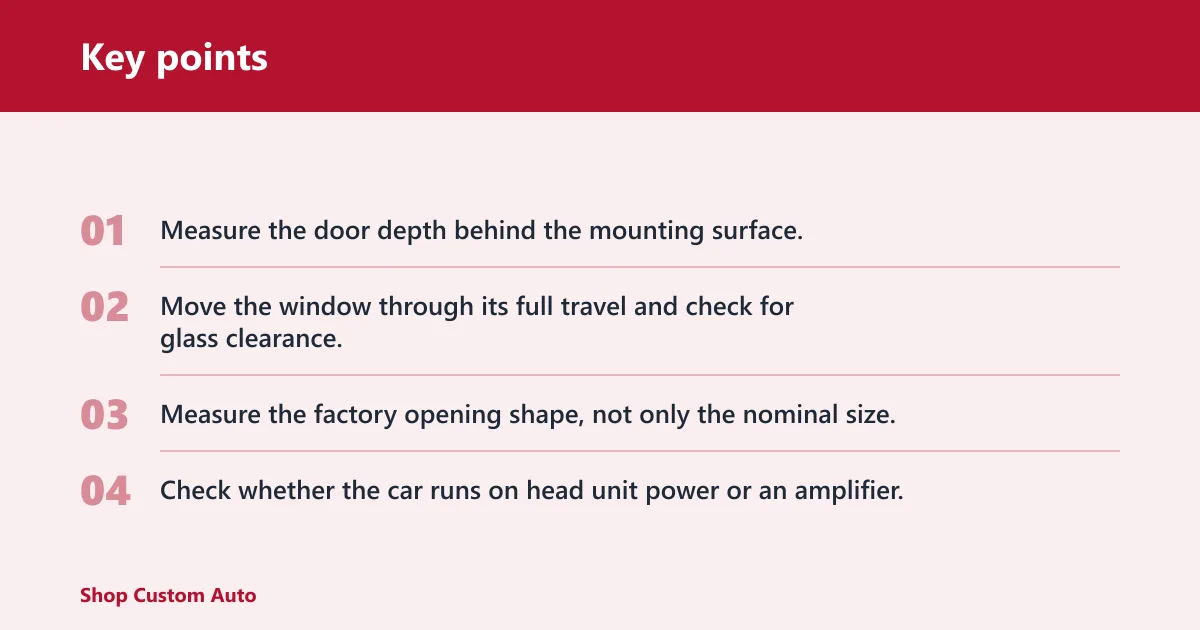
- Measure the door depth behind the mounting surface.
- Move the window through its full travel and check for glass clearance.
- Measure the factory opening shape, not only the nominal size.
- Check whether the car runs on head unit power or an amplifier.
Mini fit checklist: confirm door depth, verify full window travel, note the factory opening shape, check grille and panel clearance, identify the power source, and decide whether sealing foam or gasket material is needed. If any one of those steps fails, the “right” size on paper may still be the wrong choice in the car.
Do factory power and amps change the result?
Yes. Factory head unit power usually favors speaker sensitivity more than a high RMS rating, while an amplifier makes RMS rating more relevant. A speaker that is easy to drive can sound louder and fuller on the stock radio than a larger speaker that needs more power than the head unit can deliver cleanly.
Which size works better with factory head unit power?
With factory power, 6.5 speakers can have an edge if their sensitivity is higher and the door fit is solid. But the rating sheet alone does not decide it. A well-matched 5.25 with decent sensitivity can sound more balanced than a 6.5 that is underpowered or poorly mounted.
Which speaker size works better with factory head unit power? The answer is whichever has the better sensitivity-to-fit balance in your door. If the car is staying on stock power and the opening is tight, 5.25 is often the safer path.
How amplifier output changes RMS and sensitivity priorities
Once an amplifier is in the system, RMS rating matters more because the speaker can actually use the available power. That is where 6.5 speakers often pull ahead in front doors, since they can take more power and move more air without sounding strained as early.
Sensitivity still matters, but it stops being the only loudness lever. A strong amp can help both sizes; it does not erase a bad fit or a poor seal.
Choose 5.25 if… / Choose 6.5 speakers if…
Choose 5.25 if your door is shallow, your factory opening is already small, or you want a safer replacement with less risk of glass contact. Choose 6.5 speakers if your door has the depth and opening shape to accept them, and you want more midbass and stronger front-door output.
Choose 5.25 if…
- Your car has a compact door or a tight factory opening.
- Window clearance is limited and depth is the main concern.
- You are running on factory head unit power and want an easier fit.
- You care more about midrange clarity than door bass.
Choose 6.5 speakers if…
- You want more midbass from the front doors.
- The door has enough depth for the magnet and basket.
- You can accept an adapter bracket or minor trimming if needed.
- You have an amplifier or plan to add one.
A common first-timer mistake is assuming a 6.5 swap will always improve sound. If the speaker sits too close to the window track, the door can lose clearance, the cone can rattle, and the result can be worse than a smaller speaker that fits correctly.
Suppose a hatchback came with 5.25 speakers and the owner wants more bass from the doors. A 6.5 upgrade makes sense only if the opening, depth, and window path all check out; otherwise, the cleaner move is to keep the 5.25 size and add output through system matching elsewhere.
Frequently asked questions
What is the difference between 5.25 and 6.5 speakers?
The main difference is size, which changes cone area, frame size, and fit. A 6.5 speaker usually moves more air and gives more midbass, while a 5.25 speaker is often easier to fit and can sound tighter in the upper midrange. Exact fit still depends on the door opening and depth.
Will 6.5 speakers sound better than 5.25 speakers in my car?
Not automatically. 6.5 speakers usually sound stronger in midbass and can play louder, but a poor install, shallow door, or bad adapter can erase that benefit. If the car has limited space or stock power only, a well-fitted 5.25 can be the better match.
How much midbass do you lose going from 6.5 to 5.25 speakers?
You usually lose some lower-frequency punch, because the smaller cone has less surface area to move air. The exact loss depends on the door, the seal, and the rest of the system, so there is no honest fixed dB number to quote without measurements. The biggest change is usually the punch below the vocal range.
Do 5.25 speakers fit in 6.5 speaker openings?
Sometimes, but the opening still has to line up with the basket and mounting points. A smaller speaker may need an adapter bracket or spacer to sit correctly and seal the opening. If the gap is left open, you can lose bass and invite rattles.
Can I install 6.5 speakers in a car that came with 5.25 speakers?
Often yes, but only if the door has enough depth and the cutout can accept the larger frame. Some installs need adapter brackets or minor trimming, and some do not fit cleanly at all. Measure the mounting depth and the window path before buying.
What matters more for fit: speaker diameter or mounting depth?
Both matter, but mounting depth can be the hidden failure point. Diameter tells you whether the opening is close enough, while depth tells you whether the magnet clears the glass and hardware. A speaker can match the nominal size and still fail if the depth is wrong.