Parking Mode Dash Cam with Built-In Battery: Worth It?
A parking mode dash cam with a built-in battery is usually suitable only for short parking gaps, often under about 30–60 minutes. For overnight or multi-day parking, it is usually the wrong power choice. If you miss that limit, footage can die right when a hit-and-run or door-ding happens. This guide explains what built-in battery models can really cover, how climate changes that, and when to choose hardwire or another power source instead.
Verdict
Use a built-in battery dash cam if you want simple installation and only need brief parked capture. Do not buy one expecting true overnight surveillance, because the battery is a short power buffer, not long-stay parking support.
Built-in battery models often trade convenience for shorter parking time. Built-in battery models are easy to live with, but they age faster in heat, lose capacity over time, and usually need constant 12V power for parking mode to do meaningful work.
Pros and cons of built-in battery
Pros
- Simple setup when you want to avoid a hardwire kit.
- Useful for brief parked events and emergency file saving.
- Can be a decent fit for garage parking or short stops.
Cons
- Built-in lithium-ion battery degrades faster in high heat and can swell or lose capacity in summer dashboard temperatures.
- Runtime is usually short, so overnight or multi-day parking is a weak fit.
- Value drops fast if you pay extra for a feature that still cannot cover your actual parking routine.
Who it’s for?
This suits a driver who parks in a garage, returns within an hour or so, or mainly wants a camera that can keep recording briefly after shutdown. It does not suit apartment street parking, airport parking, or anyone who expects multi-day coverage without extra power hardware.
Suppose you park in a covered garage for 40 minutes while shopping and want the camera to catch a door slam or a backing bump. That is a use case where a built-in battery can make sense. Suppose your car sits curbside for two nights near passing traffic. That is where the same design falls short.
Parking mode decision matrix
| Scenario | Expected runtime class | Heat-risk level | Installation effort | Hardwire kit still needed? | Better alternative if no |
|---|---|---|---|---|---|
| Overnight street parking | Short event capture only | Medium to high | Low | Yes | Hardwire kit with low-voltage cutoff or an external dash cam battery pack |
| Apartment parking | Short event capture only | Medium to high | Low | Yes | Hardwire kit with 12.0V cutoff, or a battery pack if parking is long and repeated |
| Garage parking | Short stop to overnight limit | Low | Low | Sometimes | Built-in battery is acceptable if you only need brief parked clips |
| Airport parking | Not suitable for multi-day coverage | Medium | Low | Yes | External dash cam battery pack |
| Hot-climate parking | Short event capture only, if any | High | Low | Yes | Supercapacitor dash cam with hardwire kit, or external battery pack kept out of heat |
| Multi-day parking | Not suitable | Medium to high | Low | Yes | External dash cam battery pack rated for 24-72 hours of parking mode |
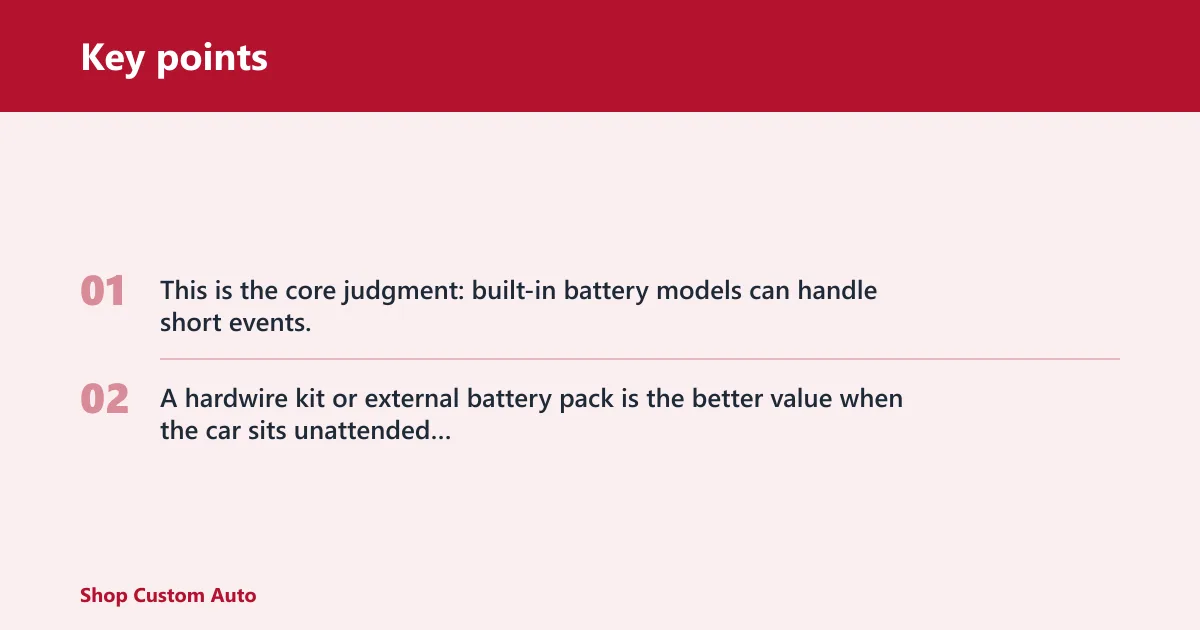
This is the core judgment: built-in battery models can handle short events, but they are a poor match for true parked surveillance over long stretches. A hardwire kit or external battery pack is the better value when the car sits unattended for long periods.
What parking mode actually does
Parking mode records while the car is parked and unattended. It can catch hit-and-run damage, theft attempts, vandalism, and parking disputes with another driver. Drive-Insight says parking mode requires three components: a dash cam, constant 12V power, and a detection trigger.
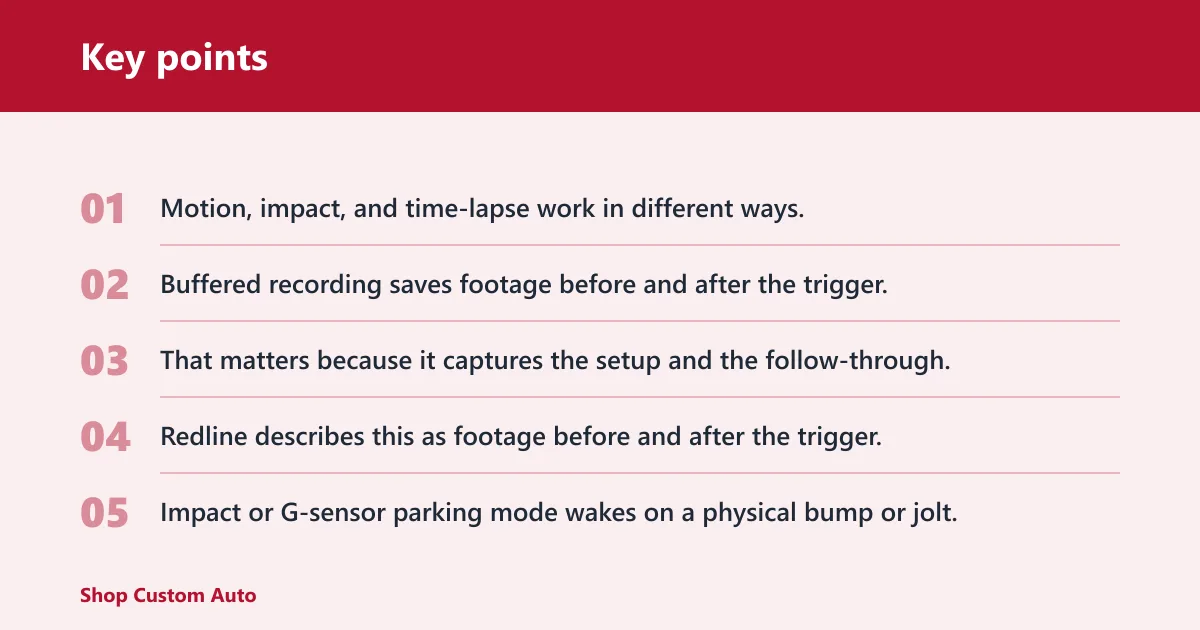
That last part matters. Parking mode is not one thing. Motion, impact, and time-lapse work in different ways, and the wrong mode can save the wrong clip or miss the event entirely.
Buffered recording
Buffered recording saves footage before and after the trigger. That matters because it captures the setup and the follow-through, not only the bump itself. Redline describes this as footage before and after the trigger, and that is usually the better choice for hit-and-run coverage.
Impact and G-sensor parking mode
Impact or G-sensor parking mode wakes on a physical bump or jolt. It is good for a hit-and-run, door contact, or a nearby impact. The weak point is the run-up: it can miss the seconds before contact if nothing disturbs the sensor first.
Motion detection parking mode
Motion detection triggers on visible movement. That can help if someone walks into frame or leans near the car, but it can also false-trigger on traffic and pedestrians. On a busy street, it can chew through storage while still missing the moment you care about.
Time-lapse parking mode
Time-lapse records at a low frame rate, usually 1-5 fps. Dashboard Camera Reviews lists time-lapse mode at 1fps, and that fits the idea: smaller files, longer coverage, less detail per second. It is better for longer parked periods than for a fast incident at the bumper.
Do you need a hardwire kit?
Yes, for meaningful parking surveillance you usually do. Parking mode needs constant 12V power, and a switched cigarette-lighter socket does not provide that after ignition off. If the socket shuts down with the key, the camera may only keep running on its built-in battery for a short window.
Low-voltage cutoff protects the car battery from going too low to start the engine. The same source gives example cutoffs of 11.8V, 12.0V, and 12.2V, and says 12.0V is the standard cutoff balance point. That is why a hardwire kit is the normal safe route for parked recording.
Will parking mode drain your car battery if you use a built-in battery dash cam? It can, if the camera is left on parked surveillance from the vehicle battery without a cutoff or separate pack. A built-in battery does not change that power path; it only gives the camera a short reserve of its own.
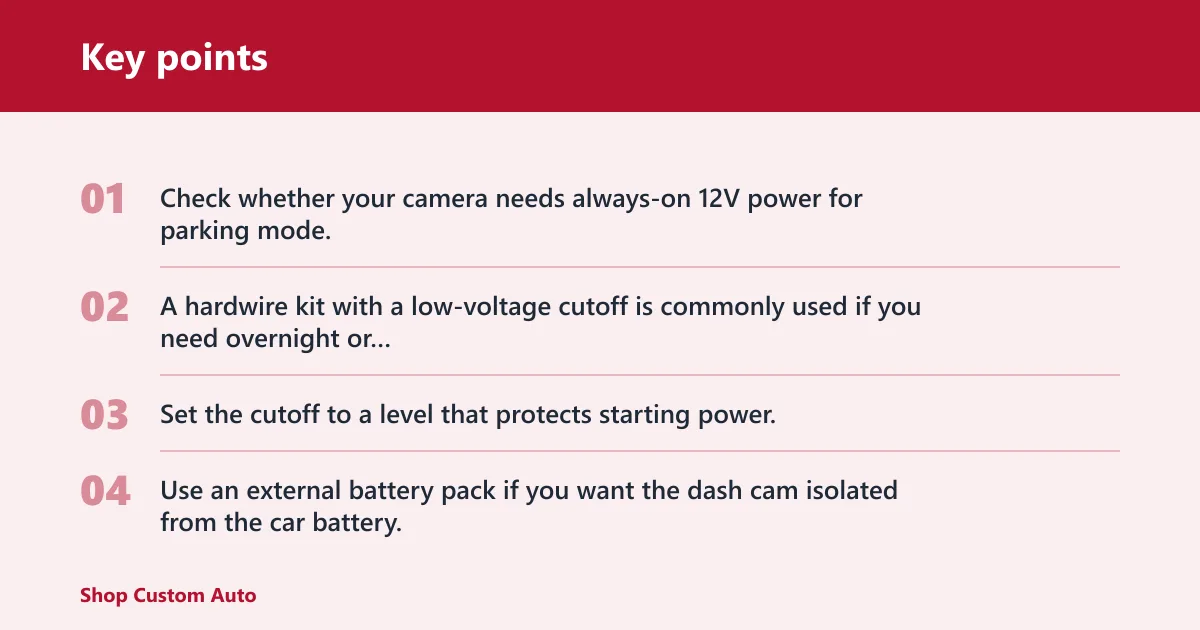
- Check whether your camera needs always-on 12V power for parking mode.
- A hardwire kit with a low-voltage cutoff is commonly used if you need overnight or longer coverage.
- Set the cutoff to a level that protects starting power, with 12.0V as the common balance point.
- Use an external battery pack if you want the dash cam isolated from the car battery.
Built-in battery vs supercapacitor
A built-in lithium-ion battery stores more energy per gram, so it can support short parked clips without extra hardware. The trade-off is aging: it degrades faster in high heat, and summer dashboard temperatures can cause swelling or loss of capacity over time.
A supercapacitor tolerates extreme heat far better and usually lasts for years. The cost is runtime. It usually only saves the last file and a short trigger loop, so it is better for shock survival than for long parked recording.
Picture a car sitting in direct sun at noon. A lithium-ion battery model may seem appealing because it sounds like more backup power. But in that heat, the chemistry is the weak point. A supercapacitor model is usually the safer long-term choice, especially if a hardwire kit already supplies constant 12V power.
Which parking mode is best?
The best mode depends on the parking situation, not on one universal setting. Buffered recording is strongest for hit-and-run coverage. Impact mode is good for jolts. Motion detection is useful when the area is quiet. Time-lapse is better when you need a long parked span in smaller files.
For street parking, buffered or impact-based parking mode usually makes more sense than motion alone. For garage parking, motion and impact can work well because the area is quieter. For long stays, time-lapse can be the most practical if your power setup can support it.
Solar charging integration
Solar charging can extend standby without hardwiring, but only as a supplement. It trickle-charges from sunlight and works best in direct sun. In shade, garages, or poor panel orientation, the help drops fast.
WellFizz says some built-in battery models advertise up to 14 days of standby with solar assist. Treat that as a best-case claim, not a normal outcome. For most drivers, solar is a partial extender, not a substitute for constant 12V power or a battery pack.
Frequently asked questions
Is a dash cam with a built-in battery worth it for parking mode?
It is worth it only if your parking gaps are short and your goal is brief event capture, not true overnight surveillance. The value drops fast when you need the camera to stay active for many hours, because built-in battery models are not built for long parked duty.
How long does a built-in battery dash cam last in parking mode?
The practical answer is a short-event window, not a full work shift or a long trip away. Runtime depends on camera draw, temperature, and age, but a built-in battery is generally for brief parked coverage rather than all-night recording. Heat and battery wear shorten that window further.
Can a dash cam with a built-in battery record overnight?
Usually no, not in the way most drivers mean it. Overnight parking needs constant 12V power or a separate battery source, because the built-in battery is typically there for short reserve power, not all-night surveillance. A hardwire kit or external battery pack is the safer match.
What is the difference between built-in battery and supercapacitor dash cams?
A built-in battery stores more usable energy for short parked clips, but it ages faster in heat and can lose capacity over time. A supercapacitor holds up much better in hot weather and lasts longer, but it usually only saves the last file and a brief trigger loop.
Do built-in battery dash cams need a hardwire kit?
For true parking mode, yes in most cases. Parking surveillance usually needs constant 12V power, and a hardwire kit is the standard way to get it safely with low-voltage cutoff. Without that, a built-in battery model can only cover a short parked interval.
What are the best parking mode options for street parking vs garage parking?
Street parking usually favors buffered or impact-based parking mode, plus a hardwire kit or external battery pack. Garage parking is less demanding, so a built-in battery can be acceptable if you only need brief clip capture. Motion detection is less reliable on busy streets because of false triggers.