2-wire vs 3-wire Dash Cam Hardwire Kit: What Changes?
A 2-wire hardwire kit gives the dash cam constant power and ground only; a 3-wire kit adds ACC detection, so the camera can tell when the car is on and switch parking behavior with more control. Wire it wrong, and parking mode may fail to start, shut off too early, or keep drawing from the battery longer than intended. This guide compares what each kit lets the camera detect, how it changes modes, and which parking features you gain or lose.
| Decision factor | 2-wire | 3-wire dash cam hardwire kit | Winner |
|---|---|---|---|
| Mode switching at runtime | Camera stays on whatever logic the model supports without an ignition signal. | Camera can detect ACC and change from driving to parking automatically. | 3-wire dash cam hardwire kit |
| Parking workflow control | Basic parking support, depending on the camera. | Better control over parking entry, shutdown behavior, and battery management. | 3-wire dash cam hardwire kit |
| Install simplicity | Fewer connections; usually easier to route and terminate. | Extra ACC fuse connection adds one more circuit to identify and tap. | 2-wire |
| Battery protection potential | Depends more on the camera’s own low-voltage logic. | Can add better battery control because the camera knows when ignition is on or off. | 3-wire dash cam hardwire kit |
| Best-fit use case | Basic recording or simple parked surveillance. | Smart parking mode, buffered parking, or vehicles that need tighter power control. | Tie, by use case |
Ignition detection differences and shared features
A 2-wire hardwire kit gives the camera constant power and ground only. A 3-wire dash cam hardwire kit adds ACC, so the camera can tell when the ignition is live and when the car has shut down. That extra signal changes the runtime workflow, not just the wiring count.
In practical terms, the camera gets a clearer trigger for when to leave driving mode and enter parking behavior. Mzuri Auto says 2-wire kits are easier to install than 3-wire kits, and that 3-wire kits support ignition detection while 2-wire kits do not. DashCamTalk also frames the three wires as 12v, ground, and ACC.
What the camera can detect
With a 3-wire dash cam hardwire kit, the dash cam can detect an ACC fuse, which is an ignition-switched circuit that signals when the car is on. That lets the unit change modes automatically instead of guessing from voltage alone. A 2-wire kit gives no dedicated ignition signal, so the camera must rely on its own power logic.
What stays the same in both kits
Both kits still depend on a constant power fuse for parked-time recording and a ground connection to complete the circuit. Both can power a dash cam from the fuse box instead of the cigarette lighter socket. Both often use a fuse tap, or add-a-fuse adapter, to avoid splicing factory wiring.
Wiring differences at a glance
The key split is plain: 2-wire means constant power plus ground, while 3-wire means constant power, ACC, and ground. That extra ACC line turns a basic powered install into a system that can notice ignition state. If the camera supports it, that notice becomes a cleaner driving-to-parking handoff.
2-wire kit
A 2-wire dash cam hardwire kit usually includes BATT/constant power and ground only. It powers the camera all the time, so parking support depends on the dash cam’s own firmware and power logic. DashCamTalk states that a 2-wire kit will work, but without parking mode options.
3-wire kit
A 3-wire dash cam hardwire kit adds an ACC/Ignition wire plus constant power and ground. Redtiger says hardwire kits can support parking mode and use constant power and ACC power. Cardashboardcameras also notes that these setups typically use three wires: red, yellow, and black.
Where each wire usually goes
The constant power wire goes to a constant power fuse that stays live with the ignition off. The ACC wire goes to an ACC fuse, which is live only when the ignition is on. The ground wire should attach to a bare metal chassis point so the circuit completes cleanly and the dash cam avoids resets or erratic behavior.
Which hardwire kit fits your use case?
| Dash cam feature need | Wire count required | ACC needed | Parking mode behavior | Battery risk | Recommendation |
|---|---|---|---|---|---|
| Basic recording | 2-wire | No | Simple power retention; parking support depends on the camera | Lower install complexity, but still needs cutoff protection | 2-wire |
| Motion-only parking | 2-wire | No | Works only if the camera can stay awake on constant power | Moderate if the camera runs too long without cutoff | 2-wire |
| Buffered parking | 3-wire dash cam hardwire kit | Yes | Cleaner switch from driving to parked recording with better trigger logic | Lower than a poorly managed constant-power setup | 3-wire dash cam hardwire kit |
| Battery-sensitive vehicles | 3-wire dash cam hardwire kit | Yes | Can support smarter shutdown timing and voltage control | Better managed, but not risk-free | 3-wire dash cam hardwire kit |
Basic recording
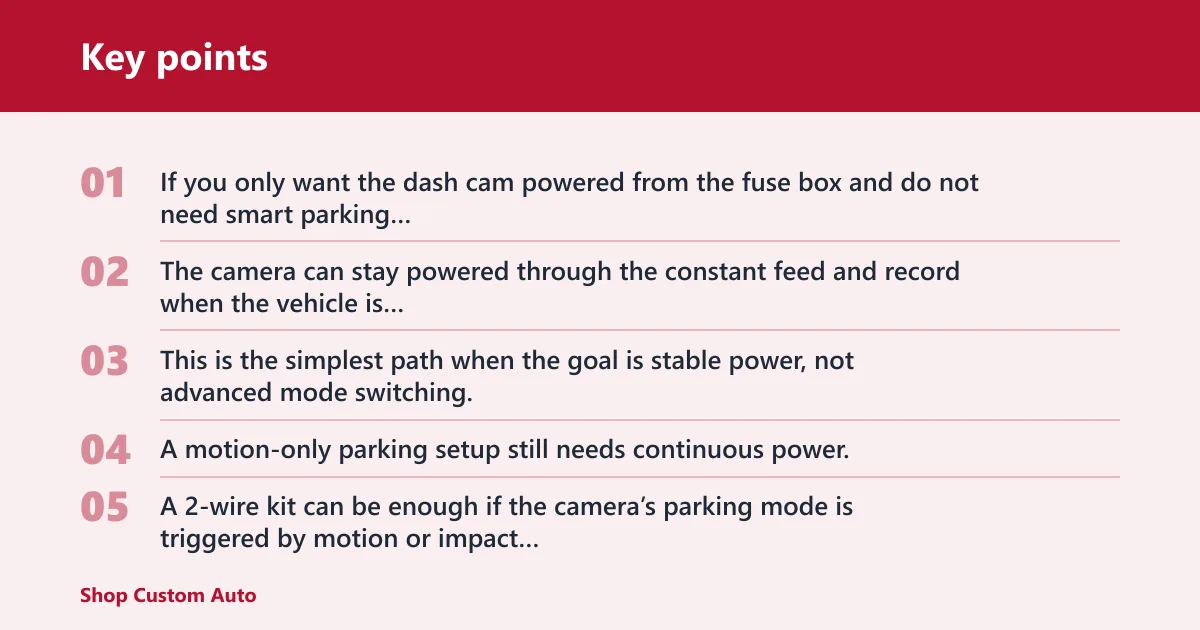
If you only want the dash cam powered from the fuse box and do not need smart parking logic, 2-wire is enough in many cases. The camera can stay powered through the constant feed and record when the vehicle is parked if its model supports that behavior. This is the simplest path when the goal is stable power, not advanced mode switching.
Motion-only parking
A motion-only parking setup still needs continuous power, but it does not always need ACC detection. A 2-wire kit can be enough if the camera’s parking mode is triggered by motion or impact and the model handles parked-state logic internally. Cardashboardcameras says these setups can support motion-triggered recording and impact detection.
Buffered parking
Buffered parking is where the 3-wire dash cam hardwire kit pulls ahead. The ACC line tells the camera when driving has ended, so buffered recording can start or arm more cleanly after shutdown. That matters when you want the camera to capture a few seconds before and after an event without guessing whether the car is on.
Battery-sensitive vehicles
If the vehicle battery is sensitive, a 3-wire setup usually gives better control over when parked recording should stop. The same source says 3-wire kits provide better battery control than 2-wire kits. That does not make them battery-safe by default, but it gives the camera more information to manage parked-time behavior.
Does your dash cam need ACC wiring?
You need ACC wiring if the dash cam must switch modes on its own when the ignition turns off. You may not need it if the camera only needs constant power for a simple parked-state record loop. The deciding factor is the camera’s parking logic, not the fuse box itself.
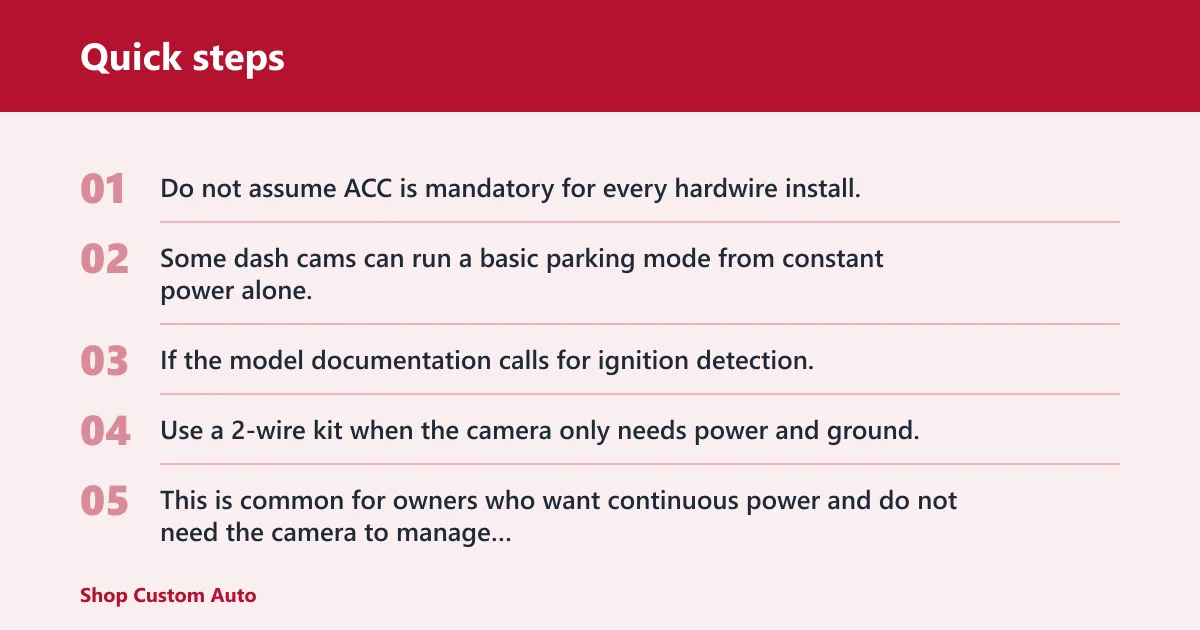
Do not assume ACC is mandatory for every hardwire install. Some dash cams can run a basic parking mode from constant power alone, while others need the ACC signal for automatic switching or buffered parking behavior. If the model documentation calls for ignition detection, a 2-wire kit leaves that feature unavailable.
When a 2-wire kit is enough
Use a 2-wire kit when the camera only needs power and ground, and when its parking mode is simple enough to work without ignition sensing. This is common for owners who want continuous power and do not need the camera to manage a more complex parked workflow. It is also the cleaner choice when the fuse box is awkward to access.
When ACC wiring matters
ACC wiring matters when the camera needs to know the exact moment the car switches from driving to parked. That signal improves mode switching and can support better battery management. If you want a smarter parking workflow, ACC is the line that makes the difference.
Suppose a sedan has a deep fuse box under the steering column and a camera that supports buffered parking. A 3-wire kit lets the camera detect shutdown through ACC, then continue on constant power for parking surveillance. With a 2-wire kit, the same camera may still have power, but it may not enter the intended workflow cleanly.
How parking mode changes by kit
Parking mode depends on continuous power in both setups. The difference is how the camera decides that it should enter that mode and what features it can use once parked. A 2-wire kit may support parking recording, but a 3-wire dash cam hardwire kit is better suited to automatic switching and feature-specific parking workflows.
Motion-only parking recording
Motion-only parking recording wakes the camera when movement or impact is detected. The same source says hardwire kits can enable motion-triggered recording and impact detection. A 2-wire kit can work here if the camera can stay powered and the model does not require ACC to arm parking mode.
Buffered parking recording
Buffered parking recording is more demanding. The camera needs enough information to know that the vehicle has shut down, then continue monitoring with uninterrupted power. That is where the ACC wire is useful, because it marks the transition from driving to parking more reliably than constant power alone.
Why continuous power still matters
Neither kit helps if the camera loses constant power during parking. The constant power fuse keeps the dash cam alive when the engine is off. Low-voltage protection then acts as the backstop that decides when parked recording should stop before the battery gets too low.
Battery protection and drain risk
Battery protection is not just about whether a kit has two wires or three. It is about whether the dash cam gets a clear ignition signal, how the cutoff is set, and how long the vehicle can sit parked. A 3-wire dash cam hardwire kit often manages that workflow better, but the cutoff setting still matters.
Low-voltage protection and common cutoff settings
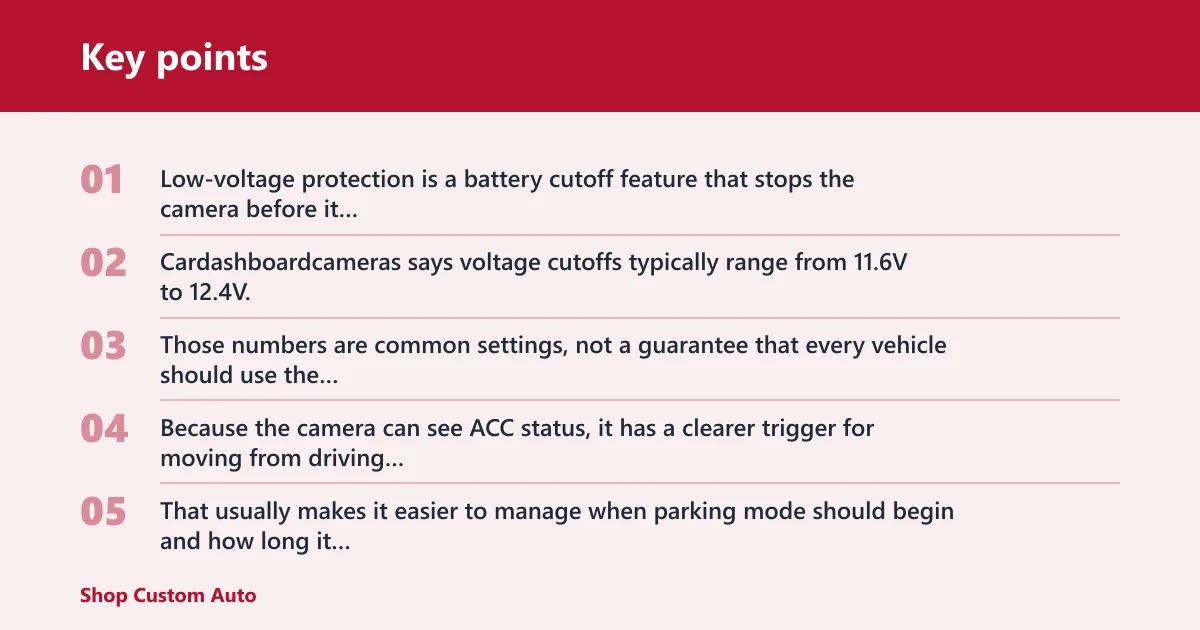
Low-voltage protection is a battery cutoff feature that stops the camera before it drains the car battery too far. The same source says voltage cutoffs typically range from 11.6V to 12.4V, and Redtiger lists low-voltage protection as usually 11.8V on its kit. Those numbers are common settings, not a guarantee that every vehicle should use the same one.
Why a 3-wire kit can manage parked-time behavior better
Because the camera can see ACC status, it has a clearer trigger for moving from driving behavior to parking behavior. That usually makes it easier to manage when parking mode should begin and how long it should stay active. The same source says 3-wire kits provide better battery control than 2-wire kits.
What can go wrong if cutoff is set too low?
If the cutoff is too low, the dash cam may run longer than the battery can comfortably support. If it is too high, parking time shrinks and the camera may quit before you want it to. A common first-timer mistake is assuming a lower cutoff is always better, when the real target depends on battery health and how long the car sits.
Picture an SUV parked for three days at an airport lot with a cutoff set at the low end. The camera may keep recording longer, but the vehicle battery may not appreciate it. The safer move is to set cutoff with the vehicle’s battery condition and parking duration in mind, not by chasing maximum runtime.
To hardwire the dash cam to your fuse box, identify the right circuits first. You need a constant power fuse, an ACC fuse if the kit uses one, and a solid ground connection. A fuse tap is the common method because it avoids splicing factory wiring.
- Find a constant power fuse that remains live with the ignition off.
- Find an ACC fuse that only powers on when the ignition is on, if you are using a 3-wire dash cam hardwire kit.
- Choose a bare metal chassis point for ground.
- Insert the fuse tap into the correct fuse slot and connect the wire lead.
- Set the low-voltage cutoff before leaving the vehicle unattended.
If the fuse box is cramped or the vehicle uses tightly packed micro fuses, the extra ACC circuit on a 3-wire kit adds time and room for error. That is the main install tradeoff. The wiring is still straightforward, but it is no longer the simplest possible route.
Choose 2-wire if… / Choose 3-wire dash cam hardwire kit if…
Choose 2-wire if you want the simplest install, only need constant power and ground, and are fine with basic recording or parking support that depends on the camera. Choose 3-wire dash cam hardwire kit if you want automatic driving/parking switching, buffered parking, or tighter battery management from the dash cam’s own power logic.
Choose 2-wire if the vehicle’s fuse box is hard to access and you do not want to find an ACC fuse. Choose 3-wire dash cam hardwire kit if the dash cam’s parking features depend on ignition detection or if the car will sit parked long enough that battery control matters.
Choose 2-wire if your dash cam only needs power for basic parked surveillance. Choose 3-wire dash cam hardwire kit if the camera supports motion-triggered, impact-aware, or buffered parking and you want those features to start and stop with less guesswork.
Frequently asked questions
What is the difference between a 2-wire and 3-wire dash cam hardwire kit?
A 2-wire hardwire kit usually includes BATT/constant power and ground only, while a 3-wire kit adds an ACC/Ignition wire. That ACC line lets the camera detect when the vehicle is on or off, which changes how parking mode starts, stops, and manages battery use.
Will a 2-wire hardwire kit still give me parking mode?
Sometimes, yes, but only if the dash cam supports parking behavior from constant power alone. The same source says a 2-wire kit will work, but without parking mode options. So basic parked recording may work, but smarter parking workflows usually need the 3-wire dash cam hardwire kit.
Do I need ACC wiring for my dash cam?
You need ACC wiring if your camera must know when the ignition turns off to switch modes automatically. If the dash cam supports only simple parked recording, a 2-wire kit may be enough. If the camera has buffered parking or ignition-based switching, ACC is the safer choice.
Can I use a 3-wire kit if my dash cam only has two power wires?
Not automatically. The hardwire kit has to match the dash cam’s power logic and the connections the camera can actually use. Some dash cams only need constant power and ground, so a 3-wire kit may add an unused ACC lead rather than a benefit.
Which hardwire kit is better for battery protection?
A 3-wire dash cam hardwire kit is usually better for battery control because it can use ignition detection to manage parked-time behavior more intelligently. Even then, low-voltage protection still matters. The same source notes cutoff ranges around 11.6V to 12.4V, so the setting needs to fit the vehicle.
How do I know which hardwire kit my dash cam needs?
Check whether the camera’s parking features require ACC detection or only constant power. If the model supports motion-triggered or buffered parking and calls for ignition sensing, use a 3-wire dash cam hardwire kit. If it only needs power and ground, a 2-wire kit may be enough.