
What Gauge Wire Should You Use for an Amp Turn on Wire?
Use 18 AWG for most amp turn-on leads in many common installs. Move to 16 AWG for longer runs, tight factory-style looms, or when the remote wire needs to travel alongside heavier signal cables. A wire that is too small can cause voltage drop, delayed turn-on, or relay chatter. This guide explains why remote turn-on wire differs from amplifier power cable and gives a simple size rule by length and install type.
Remote turn-on wire basics
A remote turn-on wire is a low-current trigger wire. It tells the amplifier to switch on and off. It does not carry the amp’s load current, so size it for trigger needs and run length, not for the amplifier’s main power demand.
American Wire Gauge, or AWG, is the wire sizing standard used in North America. Lower AWG numbers mean thicker wire, and higher numbers mean thinner wire. AWG charts list diameter, cross-section, and ampacity, but remote leads usually need only modest size because the circuit is a control path, not a power feed. (Wikipedia)
Aftermarket head unit remote outputs often use a blue or blue-and-white lead labeled REM, Remote, or Amp Control. That output often sits near 12 volts when the stereo is on. The amplifier remote input expects a low-voltage trigger, activates internal circuitry, and helps prevent constant-on battery drain.
What gauge wire should you use for an amp remote turn-on wire?
For many installs, 18 AWG is a common answer. It is usually enough for a short run from an aftermarket head unit to a single amplifier remote input. Move up to 16 AWG when the run is long, the wire must pass through a tight loom, or the trigger path has extra connectors, adapters, or a relay coil in the circuit.
Use 14 AWG only when the trigger run is unusually long or the remote lead does more than a simple head-unit-to-amp job, such as feeding a relay-trigger setup or crossing a larger vehicle with several splice points. Bigger wire is not the default answer. For a low-current trigger, thicker than needed is often harder to route and unnecessary.
A common first-timer mistake is treating the remote lead like a power cable. Suppose the amp sits in the trunk and the head unit is in the dash. If you use the same heavy gauge as the main power cable, you get more bulk, not better operation. Size should follow run length and the trigger source.
Remote wire decision table
| Install type | Recommended AWG range | When to upsize | Diagnostic note |
|---|---|---|---|
| Short aftermarket head unit to amp | 18 AWG | Move to 16 AWG if the lead must cross the cabin, pass through a dense loom, or pick up multiple splice points | Check for a clean 12-volt trigger at the REM output before blaming the amp |
| Long dash-to-trunk run | 16 AWG to 14 AWG | Upsize if the run is very long, the path shares routing with other cables, or the amp turns on late | Longer runs add resistance, so a weak trigger can fall below what the amp wants to see |
| Factory-radio or LOC trigger | 16 AWG | Move to 14 AWG if the trigger source is weak, the LOC output is noisy, or the path includes several adapters | A bad ground at the LOC can look like a wire-size problem |
| Relay-trigger setup | 16 AWG to 14 AWG | Upsize if the relay is mounted far from the trigger source or the coil feed is part of a long route | False turn-on and chattering often point to weak voltage or poor grounding, not just wire size |
Does the remote wire need to be thick?
No. The remote wire does not need to match the main power wire gauge. Power wire must handle high current and protect the amp’s supply path. The remote lead only has to carry a signal voltage that tells the amp when to wake up. Thick wire helps only when the run is long enough for resistance to matter or the install uses a relay.
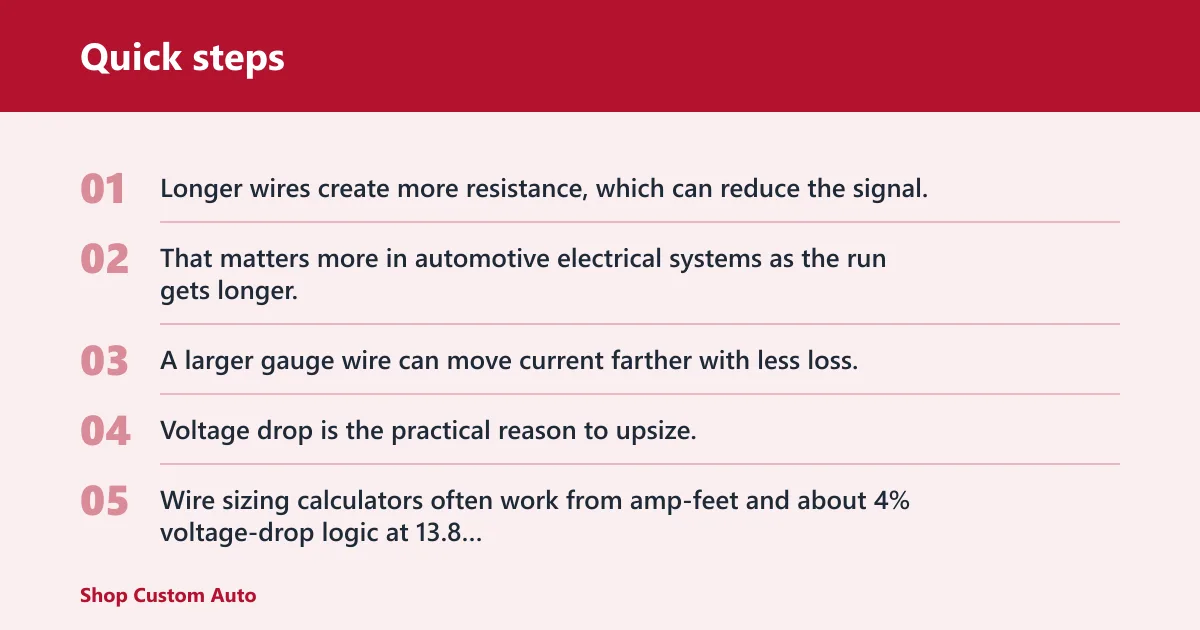
Longer wires create more resistance, which can reduce the signal. That matters more in automotive electrical systems as the run gets longer, even on a low-current circuit. A larger gauge wire can move current farther with less loss, but the remote lead usually needs that help only in unusual layouts.
Voltage drop is the practical reason to upsize. Wire sizing calculators often work from amp-feet and about 4% voltage-drop logic at 13.8 volts. For a remote wire, that is a sizing check, not a reason to overbuild every lead.
Say your head unit’s REM wire is 18 AWG and the amp is mounted just behind the rear seat. That is usually fine. Suppose the same trigger has to run from the dash to the trunk, with several factory connectors in the path. That longer route is where 16 AWG, and sometimes 14 AWG, makes more sense.
How long can an amp remote wire be before voltage drop matters?
Voltage drop starts to matter when the run is long enough that the remote signal arrives weak at the amp or relay. There is no single magic length, because routing, splice quality, and grounding all change the result. In practice, longer trigger runs make 18 AWG less attractive, and 16 AWG, sometimes 14 AWG, the better choice.
Use the run length and the install type together. A short head-unit lead can stay small. A long dash-to-trunk path, especially one that passes through noisy factory harnesses, needs more attention because the trigger may arrive with less voltage than expected.
Can you use speaker wire for trigger leads?
Yes, speaker wire can work for a remote turn-on lead if the gauge is right and the insulation fits the route. The wire still needs to survive vibration, abrasion, and heat, and it should be routed away from pinch points and moving parts. The issue is not the name on the spool; it is whether the conductor and jacket fit the job.
Choose a proper remote lead when you want a clean, easy-to-identify trigger wire with the right jacket for automotive routing. Speaker wire is more acceptable for short, simple runs than for a long harness through a crowded dash or trunk. Keep the wire protected and secure either way.
If the remote lead shares space with power and signal cables, insulation quality matters as much as conductor size. A wire that is too thin or poorly jacketed can nick, open, or create an intermittent trigger. That can look like an amp problem when the real issue is the lead itself.
Troubleshooting no turn-on issues
Use a multimeter before changing wire size. A remote output should show trigger voltage when the source is on. If the voltage is missing or unstable, the problem may be the head unit, LOC, ground, or connection point rather than the gauge alone. A bad ground can also create false turn-on or intermittent behavior.
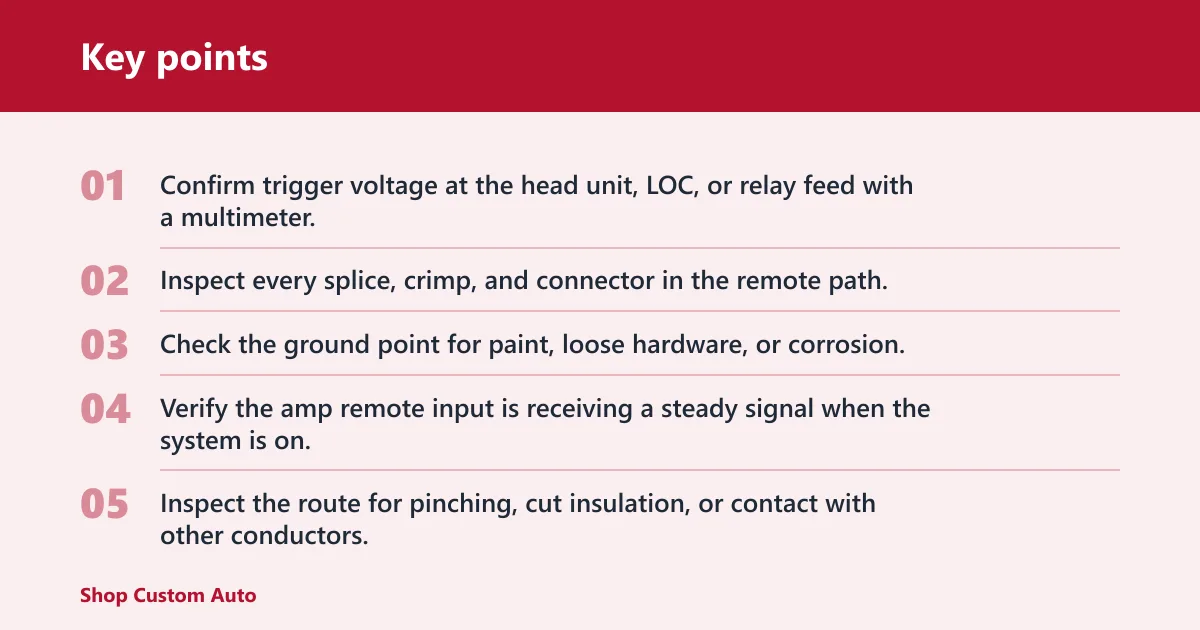
Start with the source, then follow the wire path. Check the head unit REM lead, any splice, any relay, and the amplifier remote input. If the amp turns on late, chatters, or shuts off when you hit a bump, the fault is often a weak connection, corrosion, or a poor ground at the trigger source.
- Confirm trigger voltage at the head unit, LOC, or relay feed with a multimeter.
- Inspect every splice, crimp, and connector in the remote path.
- Check the ground point for paint, loose hardware, or corrosion.
- Verify the amp remote input is receiving a steady signal when the system is on.
- Inspect the route for pinching, cut insulation, or contact with other conductors.
Picture a factory-radio install where the LOC trigger is weak and the amp only wakes up sometimes. Upsizing from 18 AWG to 16 AWG may help, but the better fix may be a solid ground for the LOC and a cleaner trigger source. Wire size cannot cure a bad reference point.
A false turn-on complaint can also point to the remote lead touching a constant-power source or to a relay wired with an unstable trigger. That is why voltage checks matter before replacing more wire.
Do you need a fuse on an amp remote turn-on wire?
Usually no. The inline fuse belongs on the main power wire near the battery, and it protects that power wire, not the amp itself. The remote turn-on lead is a low-current trigger circuit, so it normally does not get its own fuse unless a specific relay or accessory circuit requires one by design.
Keep the fuse sizing tied to the power wire and the amp’s current draw, not to the remote lead. If a remote wire is shorted, the symptom is usually a control failure, not the same fault path as the battery feed.
Frequently asked questions
Can I use 18 gauge wire for an amp remote wire?
Yes, 18 AWG is usually fine for a short aftermarket head unit to amp run. It is the common choice because the remote lead carries a trigger signal, not amplifier load current. Move up only when the route is long or the install adds resistance points.
Does the amp remote wire need to be thick?
No, not for a normal trigger circuit. The remote lead does not need to match the power wire gauge. It only needs enough size to avoid excessive resistance over the actual route, which is why 18 AWG works in many installs and 16 AWG helps on longer ones.
Can I use speaker wire for an amp turn on wire?
Yes, if the gauge and jacket are suitable for automotive routing. Speaker wire can work for a remote lead, but a proper trigger wire is usually easier to route and identify. For long runs or crowded harnesses, use wire that is meant for the installation environment.
Should the remote wire be the same gauge as power wire?
No. The remote lead is a low-current control wire, while the power wire feeds the amplifier’s load. Power wire size follows current draw and fuse sizing. Remote wire size follows trigger voltage, run length, and install type, so the gauges are usually very different.