Does Subwoofer Box Size Matter for Sound Quality?
Yes. Subwoofer box size matters because enclosure volume changes low-end output, cone control, and bass extension; too small usually tightens bass and raises resonance, while too large can make the sub loose or bottom out. A poor match wastes power and can distort, and this guide explains how box size changes sound quality, what symptoms point to the enclosure, and how to judge whether size is the real problem.
Net volume shapes bass extension, output, and cabin fit
Yes. Subwoofer enclosure volume changes how the driver loads the air inside the box, which changes bass extension, output, and control. The same sub can sound different in two enclosures because the air spring and tuning shift the resonant frequency, cone excursion, and the way bass notes line up with the cabin.
What changes when net volume changes
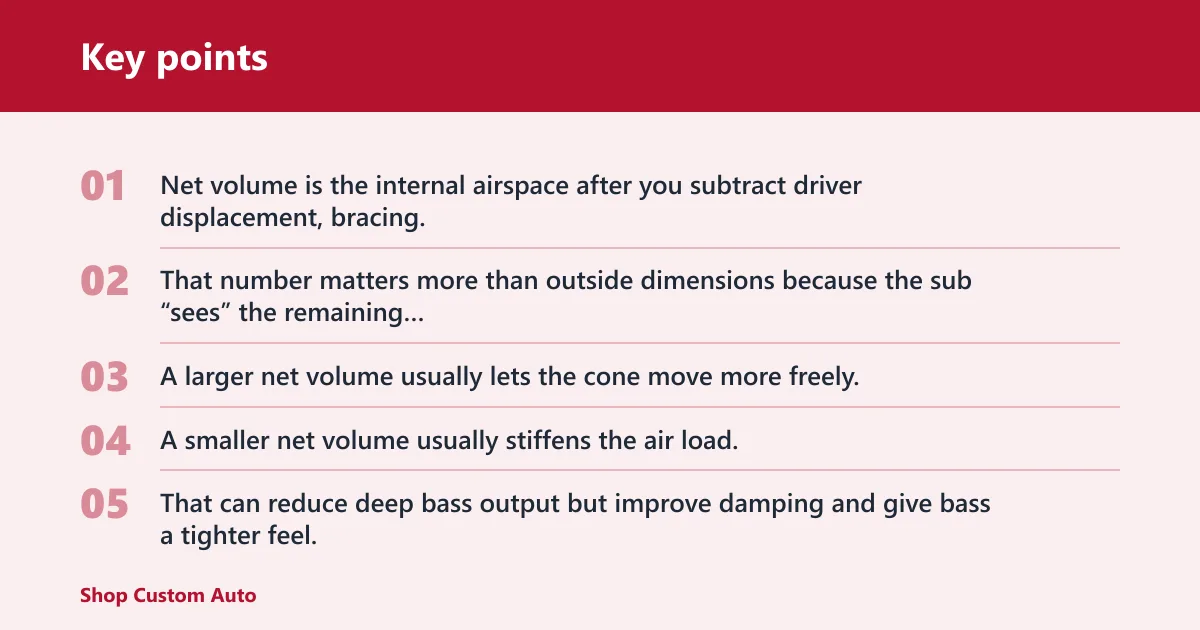
Net volume is the internal airspace after you subtract driver displacement, bracing, and any port volume. That number matters more than outside dimensions because the sub “sees” the remaining air, not the wood around it. A larger net volume usually lets the cone move more freely, which can add low-end output but reduce control if the alignment is wrong.
A smaller net volume usually stiffens the air load. That can reduce deep bass output but improve damping and give bass a tighter feel. The result depends on the driver and box type. A sealed enclosure usually tolerates smaller space better than a ported enclosure, while a ported design needs its tuning to match the available airspace.
Why output and sound quality move together only sometimes
More output does not automatically mean better sound quality. Sound pressure level, frequency response, and bass extension pull against one another. A box that plays louder around one band can still sound uneven if the response peaks hard and falls off early below tuning.
That is why the same sub can sound “better” in one box and “worse” in another even when both boxes are built correctly. The difference may be intentional tuning. It may also be a mismatch between the enclosure and the driver’s Thiele-Small targets, especially Vas, Qts, and Fs.
How box size changes bass response
Box size changes how low the system plays, how flat it sounds, and how much the cone moves at different frequencies. In a properly matched enclosure, the bass can extend lower without sounding muddy. In an off-spec enclosure, you can get a hump in one range and weak output in another.
| Enclosure size tendency | Typical sound character | Common risk if mismatched |
|---|---|---|
| Smaller sealed box | Tighter, punchier bass | Less deep extension, higher resonance |
| Larger sealed box | More low-end output | Looser control, more excursion |
| Smaller ported box | Can sound restrained and less efficient | Weak output below tuning |
| Larger ported box | Deeper bass and louder output | Boomy response if tuning is off |
How box size affects bass
Box size affects bass by changing resonant frequency, damping, and the amount of air spring behind the cone. Smaller net volume usually raises system resonance and can make the bass sound tighter. Larger net volume usually lowers resonance and can extend bass deeper, but it can also make the response peakier if the driver is undercontrolled.
Bass extension and low-end rolloff
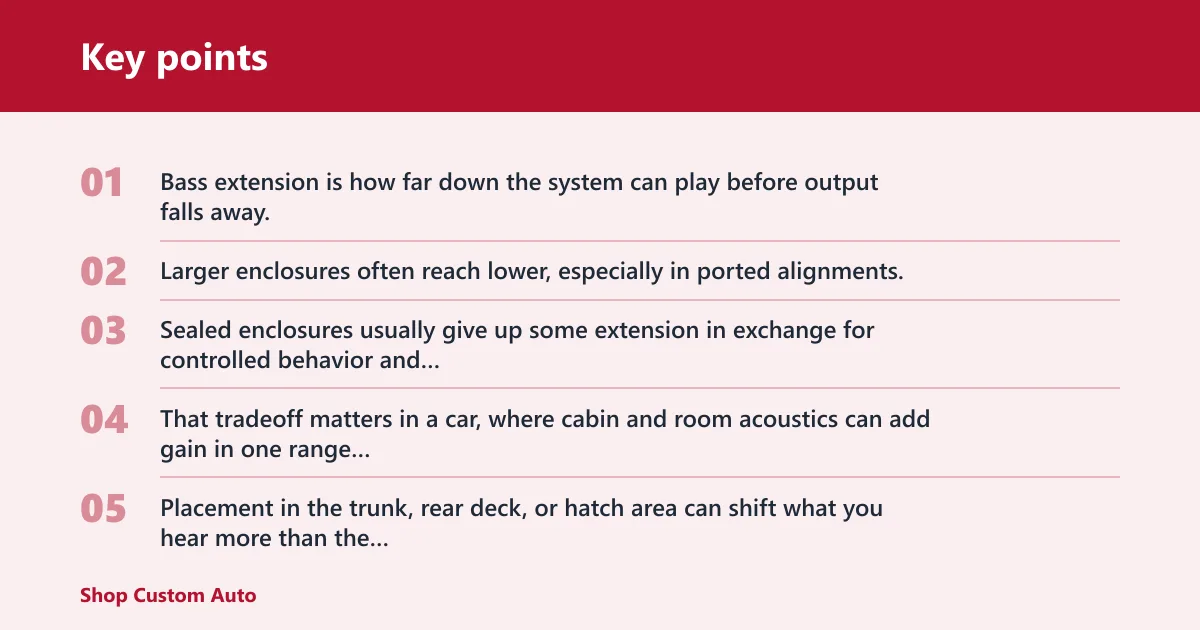
Bass extension is how far down the system can play before output falls away. Larger enclosures often reach lower, especially in ported alignments, because the driver has less resistance from the trapped air. Sealed enclosures usually give up some extension in exchange for controlled behavior and smaller space requirements.
That tradeoff matters in a car, where cabin and room acoustics can add gain in one range and cancel another. Placement in the trunk, rear deck, or hatch area can shift what you hear more than the box shape alone. For that reason, enclosure size should be judged with the car installed, not on paper alone.
Control, damping, and peakier response
Higher damping usually means the cone stops and starts more cleanly. A smaller sealed box typically increases that control. A larger box, especially one that is too large for the driver, can reduce damping and create a more boomy or loose character because the cone is less restrained.
Suppose a 12-inch sub is placed in a sealed box that is much larger than the recommended net volume. The bass may seem louder around one note, but other notes can blur together. That is a classic sign of a resonance shift, not simply “more bass.”
What happens to cone excursion
Cone excursion is the amount the driver moves in and out. As box size changes, excursion changes too. In the wrong alignment, especially with too much airspace or poor port tuning, the cone can move farther than intended at certain frequencies. That raises distortion and can stress the driver.
A ported box adds another layer: below tuning, the driver can lose the air support that normally helps control movement. That is one reason a poorly designed ported enclosure can sound loud but not clean. The woofer may be working harder, not better.
Can a subwoofer box be too big?
Yes. A subwoofer box can be too big when the net airspace moves the driver outside its intended operating range. The result is often looser bass, a higher risk of boom, and more cone travel than the driver can comfortably control. In ported designs, an oversized box can be especially unforgiving if the port is not tuned correctly.
Signs of an oversized sealed box
An oversized sealed box often sounds fuller at first, then less controlled as volume rises. Bass notes can smear together, and the woofer may seem to “hang” on certain notes. If the box is far above the target net volume, the system may also sound louder in the upper bass while losing grip in the lowest notes.
Signs of an oversized ported box
An oversized ported box can be deeper and louder, but it can also go boomier if the port size and length do not match the new airspace. If the tuning frequency drops too far or the alignment is off, output may swell in a narrow band and fall apart below it. That is not clean low bass.
Boomy bass, poor control, and overexcursion
Boomy bass usually means the system is emphasizing a narrow range instead of playing evenly. Poor control often shows up as slow, heavy notes rather than quick ones. Overexcursion is the failure mode that matters most because it can distort badly and damage the driver if the box is letting the cone move too freely.
A common first-timer mistake is building a large ported box for “extra bass” and then leaving the amplifier low-pass and subsonic settings unchanged. The box may be fine on paper, but the total system is not. The symptoms look like box trouble, yet the real issue is alignment.
What happens if the box is too small?
A box that is too small usually sounds tighter, but it can lose deep extension and low-end output. The smaller airspace raises system resonance and increases the air spring behind the cone. That can help control movement, but it can also make the bass feel lean if the driver was meant for more volume.
Tighter but less extended bass
Small boxes often give bass a punchier character. That can suit daily listening when you want clean notes instead of a lot of boom. The downside is that the bottom octave may fade early, especially if the box is much smaller than the driver’s recommended range.
F1 and F2 matter here: box shape can affect sound quality and performance, and different shapes can produce different types of sound. But shape does not cancel volume. A compact box with the wrong net airspace can still sound off, even if the build looks neat.
Higher system resonance and reduced low-end output
When the box is too small, resonant frequency shifts upward. That can make bass sound one-note or thin below the peak. In a sealed design, this often means tighter control with less depth. In a ported design, it can mean the system is no longer tuned where the driver and cabin need it.
When a small box makes the driver work harder
Small is not always safer. If the enclosure is too small for the driver and the system is pushed hard, the sub may need more amplifier power to reach the same output. That can increase heat and distortion while still failing to deliver the low notes you want.
Picture a 10-inch driver in a sealed box built far below the recommended net volume. It may sound controlled at moderate volume, but the lowest notes will disappear sooner, and the amplifier may be turned up to compensate. That is a tuning mismatch, not a speaker upgrade problem.
Sealed, ported, and bandpass boxes
Different enclosure types behave differently at the same nominal size. Sealed enclosures usually provide tight bass and are ideal for smaller spaces. Ported enclosures usually provide better bass extension and are suited to larger spaces. Bandpass enclosures emphasize a specific frequency range and need the most careful design.
Which type usually sounds tightest?
Sealed usually sounds tightest because the trapped air acts like a spring and helps control cone motion. That controlled sound output is the reason many daily-driven systems start there. The tradeoff is lower efficiency and less output than a well-tuned ported box.
Which type usually gets loudest?
Ported and bandpass boxes usually get louder for a given amount of power, especially near their tuning range. That extra sound pressure level can be useful for SPL goals or deep-bass preference. The cost is sensitivity to design errors, especially port size, port length, and net volume.
Why bandpass designs need the most care
Bandpass enclosures can be efficient, but they work over a narrower usable bandwidth. That means they can sound strong in one zone and weak outside it. Small design errors can produce a response that is too narrow, too peaky, or too dependent on cabin placement.
Thiele-Small parameters are the starting point for choosing the right enclosure volume. Vas, Qts, and Fs tell you how the driver tends to behave in a given airspace. Manufacturer recommendations usually reflect those targets, but the final result still depends on driver displacement, bracing, port volume, and the exact alignment you build.
How do I know the right box size for my subwoofer?
The right box size comes from matching the driver’s target net volume to your listening goal, then verifying the build math. Start with the manufacturer’s sealed or ported range, subtract displacement, and check whether the resulting airspace still fits your goals for extension, control, and output. If it does not, the goal needs to change or the alignment does.
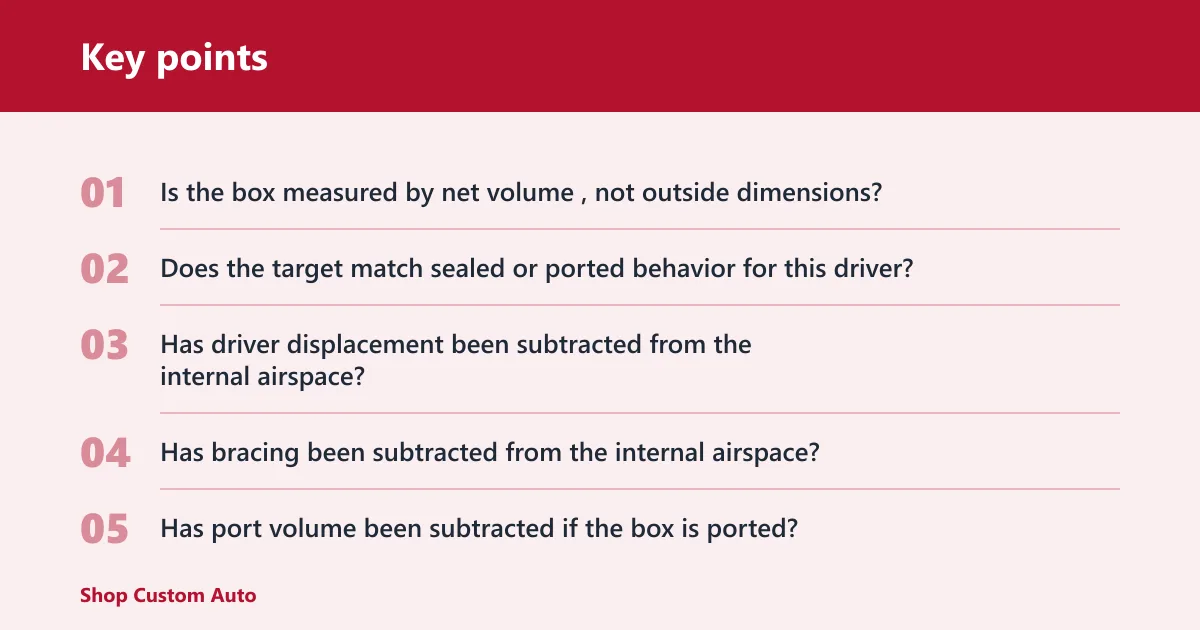
Box size checklist
Use this checklist to decide whether the enclosure is the real problem.
- Is the box measured by net volume, not outside dimensions?
- Does the target match sealed or ported behavior for this driver?
- Has driver displacement been subtracted from the internal airspace?
- Has bracing been subtracted from the internal airspace?
- Has port volume been subtracted if the box is ported?
- Is the port tuned to the intended frequency and length?
- Are there air leaks around the terminal cup, seams, or driver gasket?
- Are amplifier settings, including gain and subsonic filter, matched to the box?
- Is the box placed where cabin and trunk acoustics support the target response?
- Do the symptoms match the cause: boomier bass suggests too much volume or bad tuning, while weak deep bass suggests too little volume or a bad cabin/placement interaction?
Check net volume against the target
Most sizing problems start with the wrong number. A box can look correct on the outside and still miss the target once the driver, bracing, and port are counted. If the finished net volume misses the recommendation by a wide margin, that is the first place to look.
Check driver displacement, bracing, and port volume
These are not small details. A large subwoofer driver can displace enough air to matter. Bracing also takes up space. In a ported box, the port itself occupies volume that must be included in the final math or the tuning will shift away from the intended point.
Check leaks, amplifier settings, and cabin placement
Leaks can make a good box sound thin or noisy. Amplifier settings can make a correct box sound wrong. Cabin placement can alter the response at the listening position enough to mimic a box problem. Before rebuilding, confirm that the enclosure is sealed, the tuning is correct, and the placement works with the vehicle.
Frequently asked questions
Does subwoofer box size matter for sound quality?
Yes. Box size changes net airspace, which changes resonance, cone control, bass extension, and output. A proper match gives you the sound the driver was designed to make. An off-size box can sound boomier, thinner, or less controlled even when the speaker itself is fine.
How does box size affect bass?
Box size changes how the driver loads the air inside the enclosure. Smaller volume generally gives tighter bass with less extension. Larger volume usually gives deeper bass and more output in part of the range, but it can also create boominess or poor control if the alignment is off.
Which sounds tighter, a small box or a big box?
A smaller box usually sounds tighter because it increases damping and controls cone motion more firmly. That does not mean it is always better. If the box is too small for the driver, the low bass can disappear and the system may sound thin instead of accurate.
Should I follow manufacturer box recommendations?
Yes, start there. The listed range usually reflects the driver’s Vas, Qts, and Fs, so it is the safest baseline. Use those recommendations as a starting point, then adjust only if you understand how the change will affect net volume, tuning, excursion, and the type of bass you want.