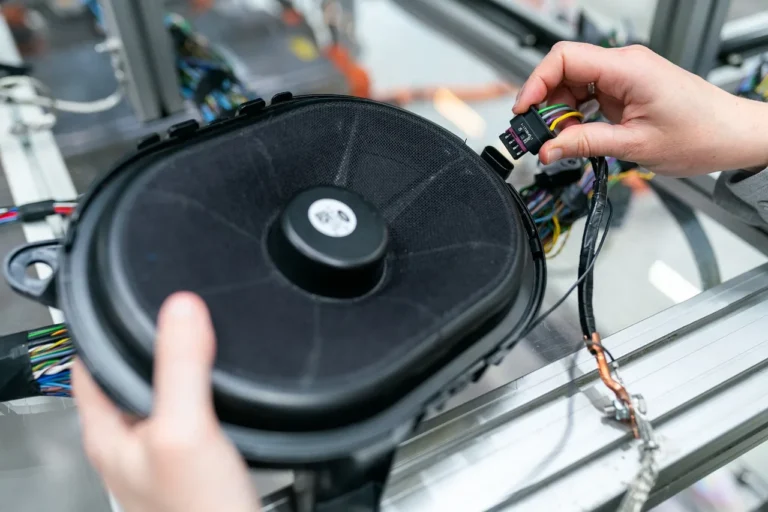
What Happens If One Car Speaker Is Wired Backwards?
If one car speaker is wired backwards, it plays out of phase with the others, so the stereo image can sound thin, bass can drop, and one side may seem hollow; the exact speaker is usually the one that flips those symptoms in mono or balance tests. Ignoring it can waste time on the wrong wire and mask a simple fix. Use the sound clues and a quick check to find and correct the reversed speaker.
What one reversed speaker sounds like
One reversed speaker can show up as weaker bass, a hollow or papery midrange, and a center image that may drift or split. The car may still play loudly. It just sounds less anchored, especially when both front speakers carry the same low-frequency content.
Weak bass and a hollow midrange
The bass drop happens because the reversed driver is pushing when the others are pulling. At low frequencies, that can cancel part of the shared wavefront before it reaches your ears. Mids can sound hollow for the same reason, though the effect is usually less dramatic than the bass loss.
Highs may seem less affected, since many tweeters and upper mids carry more directional, less shared content. That is why one reversed door speaker can leave the system sounding oddly light in the bottom end while vocals still seem present.
Stereo image shifts off center
A single reversed speaker often pulls the stereo image away from the center, or makes it spread without a solid middle. In a front-seat test, a centered vocal may sound blurred or float toward one side. That is a clue, not proof, because balance settings and cabin layout can also shift the image.
Picture a sedan with a left dash speaker and left door speaker wired opposite of the right side. The bass may drop most when both fronts play the same kick drum hit. Then the image tightens again when one side is muted, which points to a polarity mismatch rather than a dead speaker.
Why the symptom changes with music content
The symptom is frequency-dependent because cancellation is strongest when both speakers reproduce the same low-frequency content. Bass notes are longer and more similar across channels, so the reversal is easier to hear there. Separate mids and highs are often less perfectly matched, so the damage to clarity can seem smaller.
That is why some songs expose the problem and others hide it. A track with centered kick drum and bass guitar will make the issue obvious. A wide, effect-heavy mix may mask it until you compare the left and right sides directly.
Speaker polarity basics
Speaker polarity means the positive and negative terminals on each driver are connected in the same direction relative to the signal. Matching polarity across the car helps the cones move together on shared notes, which supports in-phase bass reinforcement and a stable stereo image. Some systems intentionally reverse a driver in the crossover or DSP path, so the goal is matching the intended design, not forcing every driver to look identical at the terminals.
Positive and negative terminals
Each speaker has two leads, usually marked + and -. If one speaker’s leads are swapped while the others are correct, that speaker moves opposite the others on the same signal. That is a polarity reversal, not automatically a broken speaker.
Keep the terms separate. Phase is a broader timing relationship between signals. Polarity is the wiring direction of a driver. A car can have a polarity error at one speaker without having a global phase problem in the amplifier or DSP.
Why matched polarity matters across the car
When front speakers move in the same direction, their low-frequency output adds instead of subtracting. That is the in-phase bass reinforcement people expect from a healthy stereo image. If one side is reversed, shared bass content can cancel right where the cabin should feel strongest.
A common first-timer mistake is to judge by wire color alone on an older connector that has been repaired before. Always verify the actual conductors at the speaker or plug, especially in a door where past repairs, adapters, or aftermarket connectors may not match factory color conventions.
When a system may intentionally invert a driver
Some factory and aftermarket systems may invert one driver on purpose to align acoustic output through the crossover or DSP. That does not mean random reversal is acceptable. It means you should confirm the intended wiring at the specific speaker path before changing anything.
If you are dealing with a premium factory system, look for a service manual, wiring diagram, or labeled adapter before swapping leads. A driver can be wired opposite another driver by design and still be correct at the system level.
Speaker polarity troubleshooting table
| Symptom | Likely cause | Quickest confirmation test |
|---|---|---|
| Weak bass, hollow center image, sound improves when one side is muted | One speaker wired backwards | Use balance or fade to isolate each speaker, then confirm cone motion with a 1.5V battery pop test |
| Buzzing, scraping, or very low output from one speaker only | Blown speaker | Check the speaker with a low-level signal and inspect for voice-coil rub or open continuity with a multimeter |
| Sound cuts in and out when the door moves, or one channel returns after tapping the connector | Loose connector | Wiggle the cable gently and run a continuity check through the speaker leads |
| Both sides lose bass even though the wiring at each speaker looks correct | Amp phase issue or DSP polarity setting | Check amplifier settings, DSP output polarity, and compare left/right outputs with a polarity tester |
How to confirm the bad speaker
Start with balance and fade, then confirm with a battery pop test, a multimeter, or a speaker polarity tester. That order narrows the fault quickly and avoids changing wires that are already correct. The goal is to identify the exact door, dash, or rear speaker before you move a single terminal.
Use balance and fade to isolate one channel
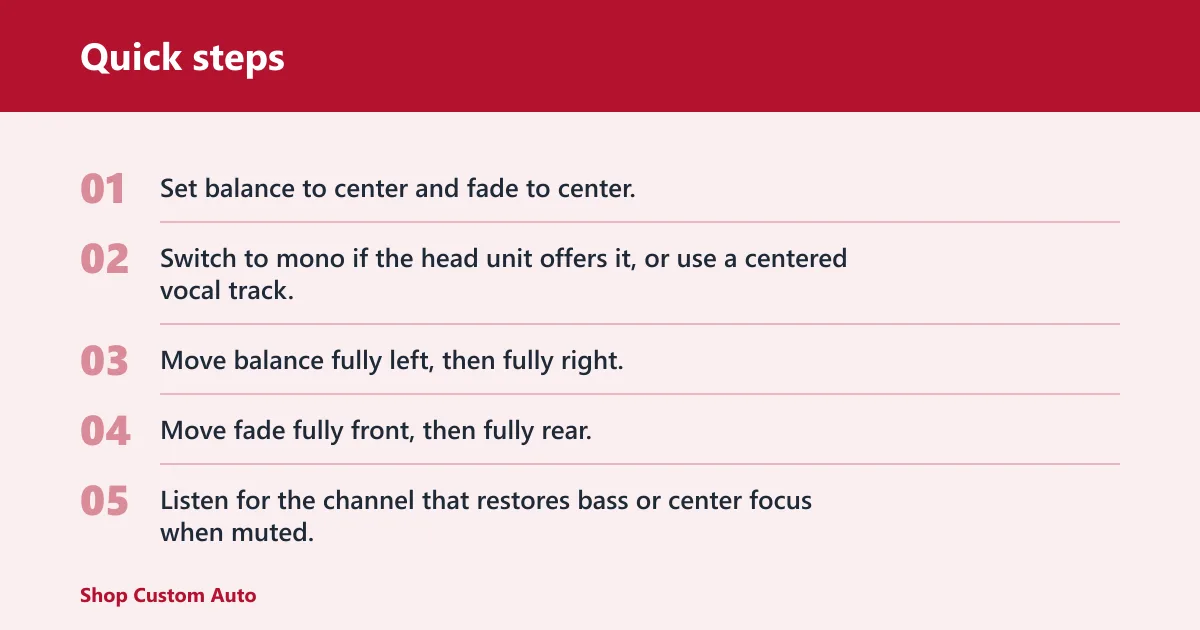
Set the head unit to a centered tone or vocal track. Then move balance fully left and right, followed by fade front and rear. If the hollow sound or bass drop changes sharply when one channel is muted, the problem is likely in that speaker path.
- Set balance to center and fade to center.
- Switch to mono if the head unit offers it, or use a centered vocal track.
- Move balance fully left, then fully right.
- Move fade fully front, then fully rear.
- Listen for the channel that restores bass or center focus when muted.
If the stereo image snaps back when one rear speaker is faded out, that rear speaker is a strong suspect. If the issue only shows up with both front speakers active, the bad wire is more likely in the front pair or their source feed.
Use a 1.5V battery pop test
A 1.5V battery pop test gives a quick polarity check on a disconnected speaker. Briefly touch the battery to the speaker leads and watch cone movement. A quick outward move on the marked positive side confirms the polarity direction, as long as the test is short and low-level.
Keep the contact brief. This is a diagnostic pulse, not a power test. A safe, short touch is enough to see direction. If the cone jumps inward when you expected outward, the leads are reversed relative to your reference point.
Use a multimeter or polarity tester
A multimeter can help with wire tracing, continuity checks, and low DC voltage tests at the connector. A speaker polarity tester gives a faster yes-or-no check, often with a battery-style indicator that shows lead direction. Both are useful when you need to confirm the speaker leads without guesswork.
For a multimeter, check continuity from the head unit or connector end to the speaker end if the wiring is accessible. If you have access to the signal feed, a brief DC voltage test can help identify which conductor is positive relative to the source reference. Use the tester at low level only.
What happens if you wire car speakers backwards?
If car speakers are wired backwards, one driver moves opposite the others and the system can lose bass reinforcement, center focus, and some fullness. If only one speaker is reversed, the problem is usually obvious in shared bass content. If both left and right are reversed together, the whole system may still sound mostly normal because the pair remains matched to each other.
Single speaker reversal versus both speakers reversed
One reversed speaker is the common trouble spot because it creates a mismatch between channels. Two reversed speakers in the same stereo pair often cancel the obvious symptom because they are wrong in the same direction. That is why a pair wired backward can sound less broken than a single reversed driver.
Do not confuse that with a correct system design that inverts one driver at a crossover or DSP point. In that case, the intended acoustic result may still be correct even though one lead looks opposite on paper.
Why bass loss is usually the first clue
Bass loss is usually the first clue because low-frequency content is more likely to be shared by both speakers in a pair. When one cone moves the wrong way, the output can cancel part of the other cone’s pressure wave. The ear hears less punch and less weight before it hears a clean, obvious failure.
Suppose the front speakers play a kick drum centered in the mix. With correct polarity, both fronts reinforce that hit. With one reversed, the kick sounds smaller, and the vocal may seem to hover without a firm center.
What usually does not fail right away
One reversed speaker usually does not immediately damage the amp or head unit. It does degrade playback, and it can hide other faults by making the system sound weak even when the electronics are fine. If the speaker itself is healthy, the fix is wiring, not replacement.
That said, a reversed speaker can make diagnostics harder. A weak woofer, loose connector, or amp setting may all seem guilty because the sound is already thin. Fix the wiring question first, then judge the rest of the system.
Swap the two speaker leads at the speaker or at the connector after you confirm the polarity with a test. Then repeat the same balance, fade, or battery check you used first. The repair is simple, but only after you know which speaker is actually reversed.
Swap the leads at the speaker or harness
Disconnect the speaker, note the current terminals, and move the positive lead to the positive terminal and the negative lead to the negative terminal. If the connector allows it, repin the connector instead of cutting wires. That keeps the fix clean and easier to reverse if the system design calls for an exception.
Check the connector for loose pins while it is apart. A loose terminal can mimic a polarity error by causing dropouts or intermittent bass loss. If the connector is damaged, repair that before buttoning up the door panel.
Verify the correction with the same test you used first
After the swap, use the same method that exposed the fault. If balance and fade were the clue, repeat that test. If the battery pop test showed inward cone motion, confirm that the cone now moves the expected direction. The sound should regain bass reinforcement and a firmer center image.
If the image is still off after the swap, do not keep changing random wires. Recheck for another reversed driver, a loose connector, or a DSP or amp output setting that is altering one channel.
Check for loose connectors while you are there
Any time you open a door speaker connection, inspect the terminals for corrosion, weak crimping, bent pins, or partially seated plugs. One bad contact can create a symptom that sounds very close to a polarity error. A clean connector helps confirm that the wiring fix is the real answer.
What if the problem is not polarity?
If the sound does not improve when you correct the leads, the fault may be a blown speaker, a loose connector, or an amplifier or DSP setting that is changing one output. The symptom pattern is the clue. A reversed speaker usually sounds hollow. A damaged speaker usually sounds distorted, weak, or physically rough.
Blown speaker symptoms versus reversal symptoms
A blown speaker often produces crackling, rattling, or a dead-sounding output that stays bad no matter how you change balance or fade. A reversed speaker usually still plays cleanly, just with poor bass summing and a shifted image. If the cone rubs or the voice coil is open, the issue is damage, not polarity.
Use a multimeter continuity check if you suspect an open voice coil. No continuity does not prove every failure, but it does separate a dead driver from a simple wiring reversal.
Loose connector symptoms versus reversal symptoms
A loose connector often changes when the door moves or when you touch the cable. The sound may cut in and out, or return at certain angles. A reversed speaker is steady; it sounds wrong all the time until the wiring changes.
If the problem appears only after a pothole or when the door is opened, inspect the cable first. That points to contact issues more than polarity.
Amp phase or DSP settings that can mimic the issue
An amplifier with a polarity invert switch, or a DSP with one output inverted, can mimic a reversed speaker. So can a factory tuning file that intentionally flips one channel for acoustic alignment. That is why you should check settings before changing hardware in a system with processing.
Head unit balance and fade are still useful here because they isolate channels without changing the processor. If the problem moves with one output stage instead of one speaker, the fault may be upstream rather than at the driver.
Frequently asked questions
What happens if one car speaker is wired backwards?
One reversed speaker usually makes the system sound thin, with weaker bass and a less stable center image. The effect is strongest when both speakers play the same low-frequency content. It rarely causes immediate hardware damage, but it can hide other faults and make the car audio seem far worse than it is.
How can I tell if one speaker is out of phase?
Use balance and fade to isolate each speaker, then listen for the channel that restores bass or center focus when muted. A quick battery pop test or polarity tester can confirm the suspect driver. If the speaker still plays cleanly but the bass disappears, polarity is the first thing to check.
Will one backwards speaker damage my amp or head unit?
Usually no. A single reversed speaker is mainly a sound-quality problem, not an immediate electrical failure. The bigger risk is wasted diagnostics, because the system can seem weak or odd even when the amp and head unit are fine. Fix the wiring first before replacing parts.
Can a single reversed speaker cause bass loss?
Yes. It can reduce bass because low-frequency content is shared across speakers and cancels when one cone moves the wrong way. That is why the symptom is often strongest with centered kick drums or bass lines. The rest of the music may sound less broken, which makes the problem easy to miss.
How do I fix a speaker wired backwards?
Confirm the bad speaker with a battery pop test, polarity tester, or balance and fade check. Then swap the positive and negative leads at the speaker or connector. Recheck the same test afterward. If the sound does not improve, look for a blown speaker, loose connector, or amplifier setting instead.
What happens if you wire door speakers backwards?
A reversed door speaker often makes the front stage sound hollow, especially because door speakers handle much of the midbass that anchors the cabin. The door location can make the error more obvious at the driver’s seat. Correct the polarity at the connector, then verify with the same listening test you used first.
What happens if you put speaker wires backwards?
Putting the speaker wires backwards flips that driver’s motion relative to the others. The result is not usually a dead channel. It is a sound that lacks punch, with weaker shared bass and a less focused stereo image. Matching the leads again usually restores the expected balance and center focus.
What happens if you wire car speakers wrong?
If you wire car speakers wrong, the symptoms depend on the mistake. A polarity reversal gives thin bass and image shift. A loose connector gives dropouts. A blown speaker gives distortion or no output. Start with channel isolation, then confirm the exact fault before changing parts.