
Can You Ground an Amp to a Seat Bolt Safely?
A seat bolt can sometimes ground an amp if it has a solid structural path to bare chassis metal and passes a loaded voltage-drop test of about 0.2 V or less; otherwise, choose a better chassis ground. Skip that check, and you can get noise, weak output, protection faults, or a hot, unreliable ground connection. This guide shows how to verify a seat bolt ground, how to test it with a meter, and when to move to a different point.
Can you ground an amp to a seat bolt safely?
Only sometimes. A seat bolt is safe for amplifier grounding when the bolt clamps to bare metal, the seat structure actually connects to the vehicle body, and the point stays low resistance under load. If the bolt goes through paint, primer, insulation, or bonded panels, treat it as a poor ground until it proves otherwise.
The basic rule is simple: a seat bolt is not automatically a ground path just because it is large, threaded, or easy to reach. Some bolts only hold the seat in place. Others tie into a seat track or body structure. The electrical result depends on what the fastener contacts, not on its size alone.
Use a seat bolt only as a candidate, never as an assumption. If the point fails continuity, shows noticeable resistance to battery negative, or runs warm with the system playing, move to a better chassis point.
| Seat bolt type | Test method | Pass/fail threshold | Recommended action |
|---|---|---|---|
| Manual seat bolt | Check continuity to battery negative, then test under load while the amp plays | Target resistance is less than 0.01 ohm; loaded drop should stay near the amplifier’s allowance | Use only if the bolt clamps to clean, bare metal and the loaded reading stays low; otherwise choose another point |
| Seat belt anchor | Measure continuity to battery negative and inspect for paint, corrosion, or isolated brackets | No reliable low-resistance path, or any questionable structure, fails the check | Reject for permanent amp grounding unless it clearly meets the same low-drop standard as a chassis bolt |
| Seat track bolt | Inspect the track, then test continuity between the bolt, the floor, and battery negative | Near-zero resistance is acceptable; visible paint, rust, or flexible isolation hardware fails | Use only after cleaning to bare metal and proving the track is bonded to the body |
| Direct floor or chassis bolt | Check a clean floor-pan or factory chassis point with the meter | Near-zero resistance and low loaded voltage drop | Preferred choice for most amp installs |
Loaded voltage-drop note: a point can read close to zero ohms with no load and still fail once the amp draws current. That is why the seat bolt has to survive a loaded test, not a static continuity check alone. The supplied comparison also shows why this matters: a proper 4 AWG ground loses 0.59 volts at 137 amps, while a 12 AWG ground loses 3.74 volts at that same draw.
Simple multimeter checklist
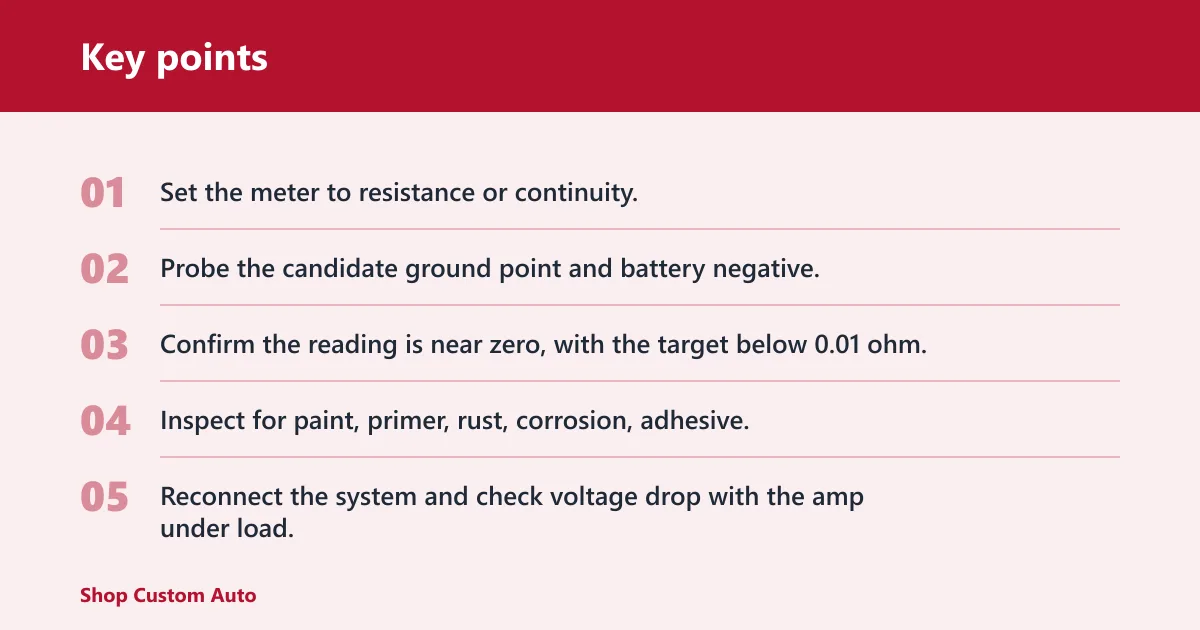
- Set the meter to resistance or continuity.
- Probe the candidate ground point and battery negative.
- Confirm the reading is near zero, with the target below 0.01 ohm.
- Inspect for paint, primer, rust, corrosion, adhesive, or a spacer between the bolt and body metal.
- Reconnect the system and check voltage drop with the amp under load.
- Stop and choose another point if the wire or connection gets warm.
What makes a ground point safe?
A safe amplifier ground is short, low resistance, and built on bare metal. The return path should be direct enough that current does not have to pass through paint, primer, corrosion, or a loose stack of brackets and washers. A seat bolt can work only if the path is genuinely metal to metal.
Bare metal and metal-to-metal contact
Clean, shiny steel is the usual target. Remove paint and surface corrosion from the contact area so the lug, washer, and body metal touch each other directly. A star washer helps here because it bites into the surface and improves contact at the grounding point.
Do not assume factory hardware is electrically clean. A bolt may clamp the seat securely and still sit on coated metal. If there is primer under the fastener, the electrical path can be poor even when the bolt feels tight.
Structural fastener versus electrical path
A structural fastener holds parts together. An electrical ground path lets current return without excessive resistance. Those are not the same thing. A seat bolt may be structurally strong, but if the seat frame is isolated from the body, it is a bad amplifier ground.
Modern vehicles make this more important. Some use bonded aluminum, adhesive layers, or isolated seat structures that interrupt the path you expect. In those cases, a bolt that looks promising may not be bonded to the body metal at all.
How do you test a seat bolt ground with a multimeter?
Test it in two stages. First, check for continuity to battery negative with the vehicle off. Then confirm the point under load while the amplifier is operating. A seat bolt that looks fine on an ohms test can still fail once current flows.
Set the multimeter reference point
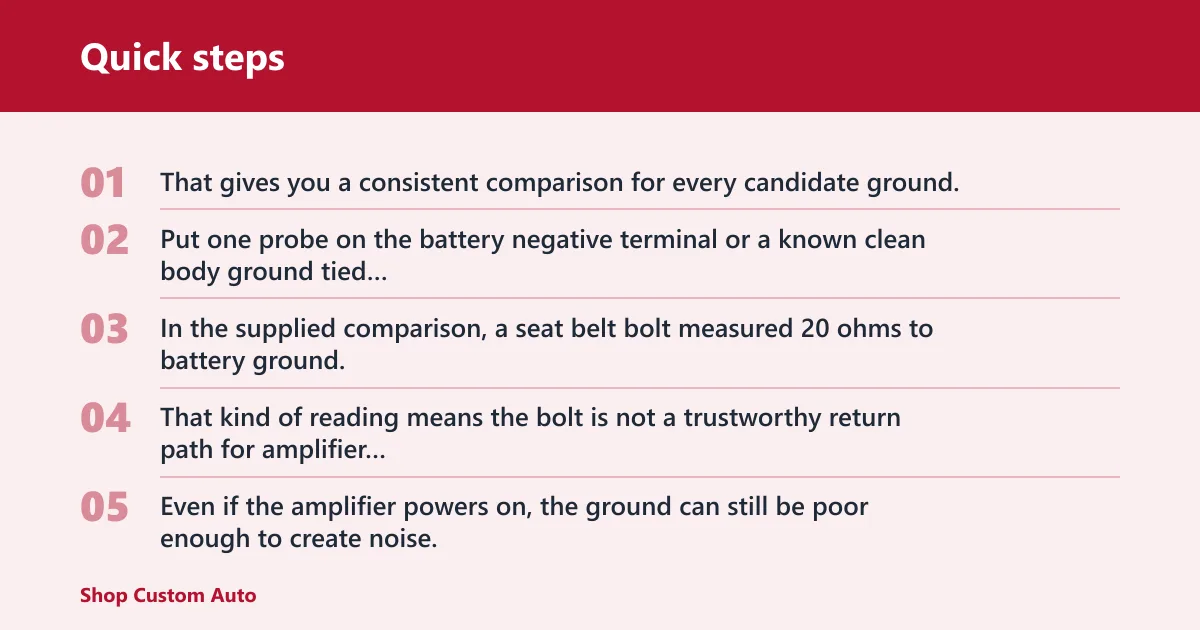
Use battery negative as the reference point. That gives you a consistent comparison for every candidate ground. Put one probe on the battery negative terminal or a known clean body ground tied directly to it, then touch the other probe to the seat bolt or the cleaned ground point.
Check continuity to battery negative
The meter should show near-zero resistance. The target resistance is less than 0.01 ohm. In the supplied comparison, a seat belt bolt measured 20 ohms to battery ground, which is far beyond what an amp ground should show.
That kind of reading means the bolt is not a trustworthy return path for amplifier current. Even if the amplifier powers on, the ground can still be poor enough to create noise, voltage loss, or heat.
Read the result with the seat loaded
Do not stop at the static reading. A seat that is bolted through a bracket can change behavior when weight shifts the structure or when the amp starts pulling current. Measure voltage drop with the system playing so the result reflects real use.
The comparison supplied for this article uses a 1,400-watt amplifier drawing 137 amps. At that draw, a proper 4 AWG ground loses 0.59 volts, while a 12 AWG ground loses 3.74 volts. That gap is why a seat bolt that passes a quick continuity check can still fail in service.
Watch for heat and voltage drop
Heat at the connection is a warning sign. So is a drop in amplifier performance, shutdowns, or repeated protection faults. If the ground point warms up, the connection is resistive enough to deserve replacement, not another layer of hope.
Say your amplifier is wired with 4 AWG power cable and the seat bolt ground also uses 4 AWG. If the amp still makes the bolt area warm after a short playback session, the path is not behaving like a proper low-resistance chassis ground and should be moved.
Can a seat belt bolt be used as an amp ground?
Sometimes people cite a seat belt bolt because it is strong and close to the cabin. That does not make it the best electrical choice. A seat belt anchor is often questionable because structural hardware and electrical bonding are separate issues, and the anchor may not provide a clean return path.
Why seat belt anchors are questionable
Seat belt anchors are safety hardware first. They may sit on coated metal, reinforcement plates, or isolated body sections that are not ideal for amplifier return current. The supplied comparison also notes a seat belt bolt measured 20 ohms to battery ground, which is too high for a serious amp ground.
That does not mean every anchor is unusable. It means you should reject it unless it passes the same bare-metal and loaded-drop checks you would demand from any other ground point.
When to reject the anchor
Reject the seat belt bolt if you see paint under the washer, corrosion around the hole, an isolated bracket, or any reading that does not stay near zero under load. If the structure is difficult to inspect, move to a floor or chassis point you can verify more easily.
What is the safest place to ground an amplifier in a car?
The safest choice is usually a clean, bare-metal chassis point near the amplifier. A floor pan or factory chassis bolt that is clearly bonded to the body is preferred over a random interior fastener. Keep the run short and match the ground wire gauge to the power wire gauge.
Floor pan or factory chassis bolt
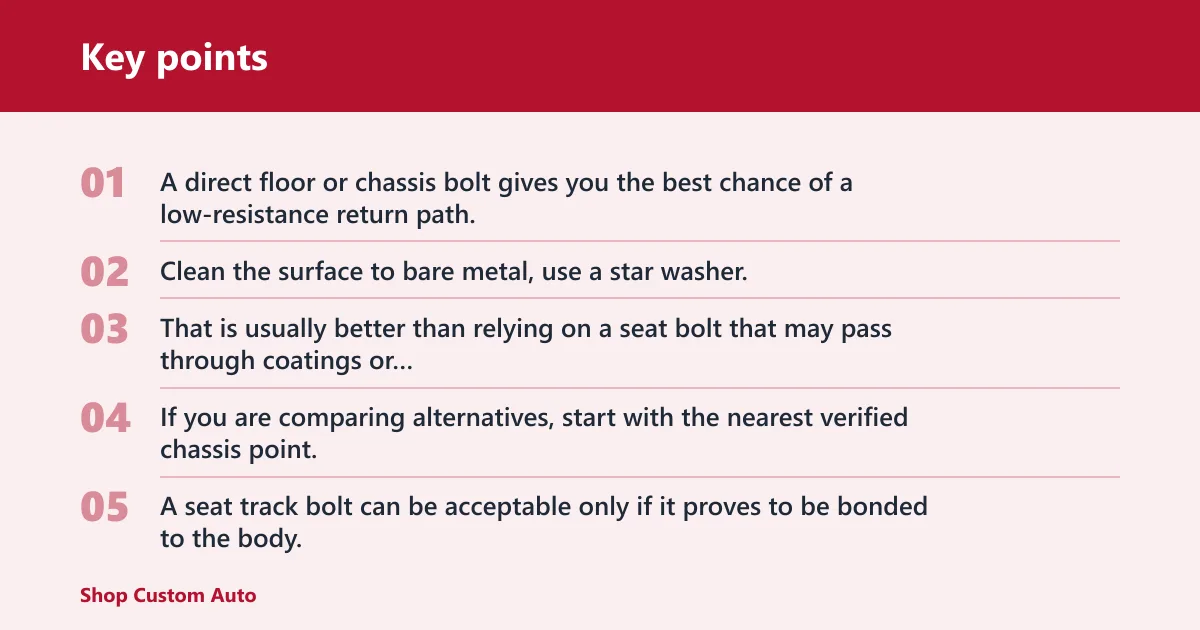
A direct floor or chassis bolt gives you the best chance of a low-resistance return path. Clean the surface to bare metal, use a star washer, and tighten the connection so the lug grips the metal firmly. That is usually better than relying on a seat bolt that may pass through coatings or isolated brackets.
If you are comparing alternatives, start with the nearest verified chassis point. A seat track bolt can be acceptable only if it proves to be bonded to the body. A floor-pan point that is already part of the vehicle structure is easier to trust.
Match the wire gauge to the amplifier
Ground wire size should match the power wire size. The supplied guidance lists 8 AWG for under 600 W, 4 AWG for a 1,000-watt amp on both sides, and 1/0 AWG for 1,200–3,000 W. For very large systems, 2/0 AWG may be appropriate, but confirm the amplifier and cable listing for your model.
The article’s supplied figures also say a 1,000-watt amp needs 4 AWG on both sides and gets 500 mV of headroom. Keep the ground run under 18 inches when possible, and do not assume that a longer cable will cause alternator whine by itself. Ground quality and routing matter more than length alone.
Why do bad grounds cause noise and heat?
Poor grounding raises resistance in the return path. That can create voltage loss, heat at the connection, amplifier shutdowns, and audible noise. Alternator whine is one possible symptom, but it is a symptom of grounding trouble, not proof that wire length alone is the cause.
Loose or resistive connections
Loose hardware, corrosion, paint, and primer all increase resistance. Even a small amount of resistance becomes a problem when the amp draws high current. The result can be weak output, a warm ground lug, or an amp that keeps entering protection mode.
A common first-timer mistake is bolting the ground ring to a painted seat bracket because the bolt feels tight. Tight does not mean conductive. If the paint stays under the lug, the connection may look solid and still act like a resistor.
Signs the point is failing
Watch for alternator whine, uneven bass output, amplifier clipping at normal volume, or heat at the ground point. If the amp works until the system is pushed, then complains only under load, the ground point may be marginal rather than fully failed.
Suppose a 1,400-watt system plays cleanly at low volume but starts whining and getting hot at the seat bolt when the bass hits harder. That pattern points to a loaded grounding problem, not a speaker issue. Move the ground to a verified bare-metal chassis point and retest.
Frequently asked questions
Is a seat bolt a good ground for a car amp?
Sometimes, but not by default. A seat bolt can be fine if it is bonded to the body and the resistance stays near zero to battery negative. If the point needs guesswork, it is better to choose a direct floor or chassis bolt you can inspect more easily.
How much resistance is too much for an amp ground?
The target resistance is less than 0.01 ohm. Anything clearly above that, or anything that changes when the seat is loaded or the system is playing, should be treated as suspect. If the meter shows a high reading like 20 ohms, the point is not suitable.
Should I remove paint under a seat bolt for amp grounding?
Yes, if you choose that bolt at all. The contact area should be clean, shiny, bare metal so the lug and bolt touch the body directly. A star washer helps bite into the surface and improve contact. Paint, primer, rust, and corrosion all work against the connection.
Will grounding an amp to a seat bolt cause alternator whine?
It can, but whine is a symptom, not a certainty. A poor seat bolt ground may create the noise because of resistance or bad bonding, while a properly verified seat bolt may stay quiet. If whine appears, check the ground first before blaming cable length alone.