Dual 2-ohm vs Dual 4-ohm Subs: Which Should You Buy?
Buy a dual 2-ohm sub if you need 1 ohm with one driver or a lower load with multiple drivers; buy a dual 4-ohm sub if you want 2 ohms with one driver or more wiring flexibility later. Pick wrong, and you can end up with an amp that runs hot, leaves power unused, or cannot be wired to its safe load. This guide shows how each option wires, what load it creates, and which one fits your current amp and future plan.
| Decision factor | Dual 2-ohm | dual 4-ohm subs | Winner |
|---|---|---|---|
| One-sub final load options | 1 ohm or 4 ohms | 2 ohms or 8 ohms | tie |
| Two-sub final load options | 0.5 ohm or 2 ohms | 1 ohm or 4 ohms | dual 4-ohm subs |
| Best match for a 1-ohm-stable mono amp | Direct path to 1 ohm with one sub; 0.5 ohm with two subs | Direct path to 1 ohm with two subs | dual 4-ohm subs |
| Best match for a 2-ohm-stable mono amp | Direct path to 2 ohms with two subs | Direct path to 2 ohms with one sub | tie |
| Best match for a 4-ohm-stable mono amp | Direct path to 4 ohms with one sub | Direct path to 4 ohms with two subs | dual 4-ohm subs |
Dual 2-ohm vs dual 4-ohm basics
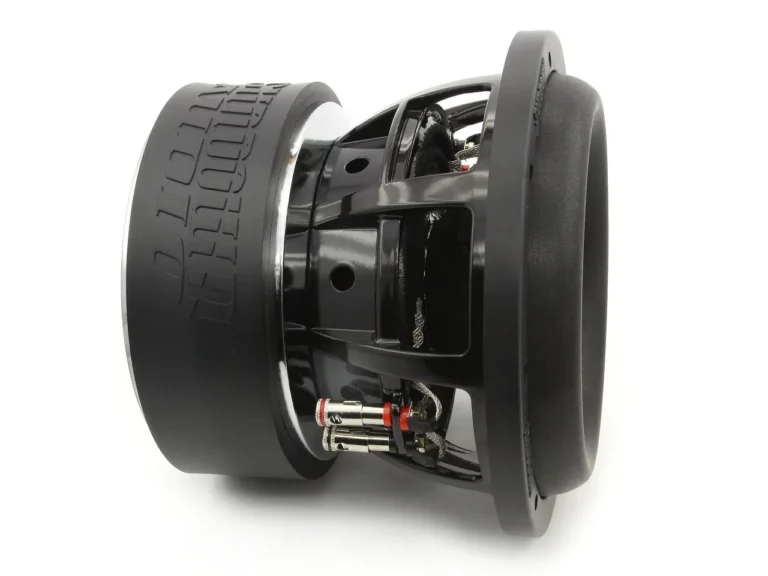
Both options are dual voice coil subwoofers, so each driver has two separate voice coils. The difference is the nominal rating of each coil: 2 ohms on a dual 2-ohm sub, or 4 ohms on a dual 4-ohm sub. That rating sets the wiring paths you can reach before the amplifier ever sees the load.
Nominal impedance versus measured resistance
Impedance is a nominal AC rating, not the same thing as the DC resistance you read with a multimeter. A meter usually shows a lower number than the printed ohm rating, because that printed rating is an average target over frequency, not a fixed resistance value.
That matters because the amp does not “see” the coil label alone. It sees the final load created by your series and parallel wiring, then it reacts by changing current draw and output behavior.
Why the coil rating matters before wiring
Series wiring adds impedance. Parallel wiring lowers it. With a dual 2-ohm sub, series on the coils gives 4 ohms and parallel gives 1 ohm.
That is why the coil rating is not a small detail. It decides whether your one-sub or two-sub layout can hit the amp’s safe minimum load, or miss it entirely.
Wiring chart for final loads
This is the part that usually decides the purchase. The same driver can land on very different final loads depending on whether you wire the coils in series or parallel, and whether you have one sub or two.
| Setup | Dual 2-ohm final load | dual 4-ohm subs final load | Best amp match |
|---|---|---|---|
| One sub, coils in series | 4 ohms | 8 ohms | 4-ohm-stable amp for Dual 2-ohm; 4-ohm-stable amp only if you accept a very light load with dual 4-ohm subs |
| One sub, coils in parallel | 1 ohm | 2 ohms | 1-ohm-stable amp for Dual 2-ohm; 2-ohm-stable amp for dual 4-ohm subs |
| Two subs, each pair wired series then subs paralleled | 2 ohms | 4 ohms | 2-ohm-stable amp for Dual 2-ohm; 4-ohm-stable amp for dual 4-ohm subs |
| Two subs, each pair wired parallel then subs series | 2 ohms | 4 ohms | same as above |
| Two subs, all coils paralleled | 0.5 ohm | 1 ohm | 1-ohm-stable amp for dual 4-ohm subs; rare 0.5-ohm-capable system for Dual 2-ohm |
One sub versus two subs changes everything
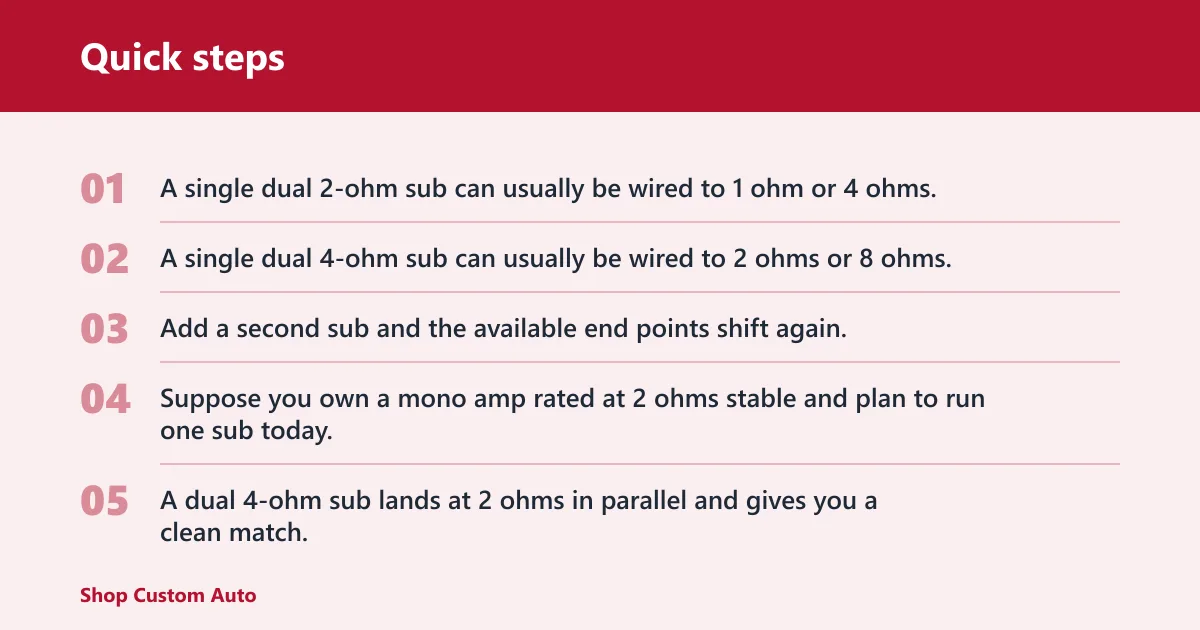
A single dual 2-ohm sub can usually be wired to 1 ohm or 4 ohms. Add a second sub and the available end points shift again, which is why “dual 2-ohm is better” or “dual 4-ohm is better” is too vague to be useful.
Suppose you own a mono amp rated at 2 ohms stable and plan to run one sub today. A dual 4-ohm sub lands at 2 ohms in parallel and gives you a clean match. The same amp with a dual 2-ohm sub forces you to choose between 1 ohm and 4 ohms, neither of which is the stated target.
How amplifier load changes the answer
The safe choice depends on the amp’s minimum rated load. Lower impedance asks the amp for more current, which can raise output, but it also raises heat and the chance of clipping if the amp is pushed beyond what it can supply cleanly. Higher impedance is easier on the amp, though it usually leaves power unused.
1-ohm-stable mono amps
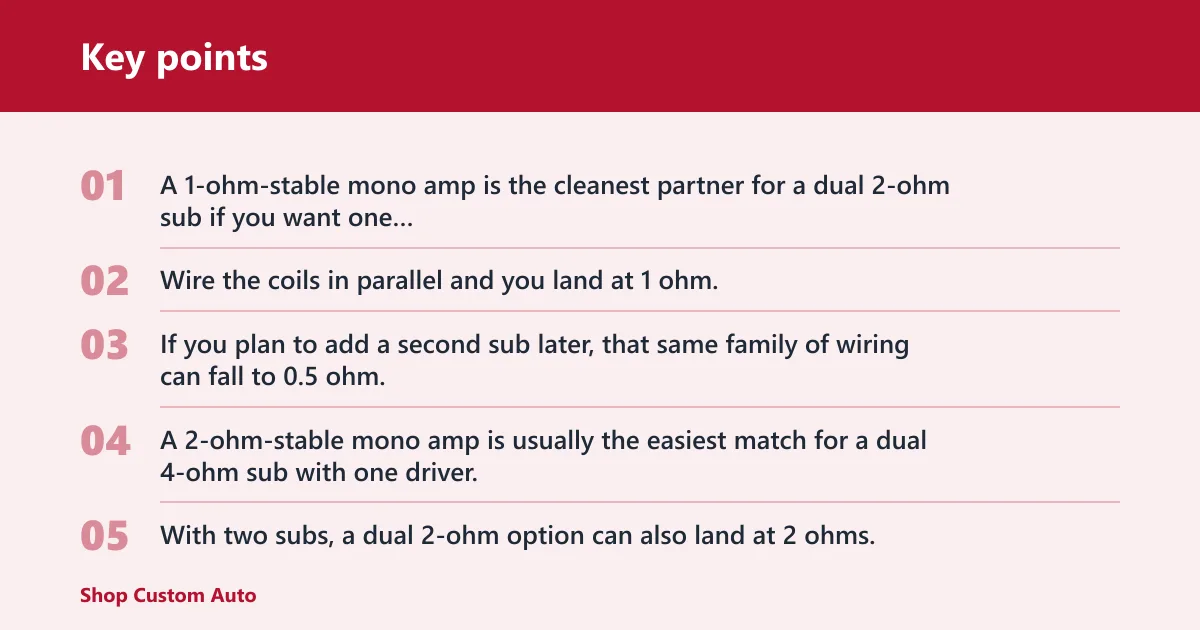
A 1-ohm-stable mono amp is the cleanest partner for a dual 2-ohm sub if you want one driver. Wire the coils in parallel and you land at 1 ohm. If you plan to add a second sub later, that same family of wiring can fall to 0.5 ohm, which is outside the safe range for many amps.
2-ohm-stable mono amps
A 2-ohm-stable mono amp is usually the easiest match for a dual 4-ohm sub with one driver. Parallel wiring gives you 2 ohms. With two subs, a dual 2-ohm option can also land at 2 ohms, so the right pick here depends on whether you are buying one driver now or planning a two-sub layout later.
4-ohm-stable mono amps
A 4-ohm-stable mono amp fits a dual 2-ohm sub in series for one driver, or a dual 4-ohm sub when you use two drivers and wire them to 4 ohms. This is the safer, lighter-load side of the chart, but it usually produces less amplifier output than the lower-load setups.
A common first-timer mistake is buying the lower-ohm sub because it “sounds stronger” on paper, then pairing it with an amp that is only comfortable at 2 ohms or 4 ohms. The result is heat, protection mode, or clipping before the system reaches its real potential.
Which gives more wiring options?
Dual 4-ohm subs usually give the more useful wiring paths for a buyer who may change amplifiers later. They can land at 2 ohms with one sub, 1 ohm with two subs, or 4 ohms with two subs, which covers more common mono-amp targets without forcing an unsafe load.
Dual 2-ohm flexibility
Dual 2-ohm subs are the better fit if you already know you need a 1-ohm load or a 2-ohm load from a multi-sub layout. They also work well when the amp is rated for 1 ohm stable and you want the highest power setting the amp can safely deliver.
Dual 4-ohm flexibility
Dual 4-ohm subs are easier to place into common 2-ohm and 4-ohm systems. That matters because many mono amps are rated at 2 ohms stable, and many buyers want a second sub later without painting themselves into a corner.
Best pick for future amp changes
If the upgrade path is uncertain, dual 4-ohm subs preserve more useful wiring paths for mainstream amps. That is not a guarantee of future compatibility, but it gives you more options if the next amplifier is 1-ohm stable, 2-ohm stable, or 4-ohm stable.
Will one sound louder than the other?
No. Impedance by itself does not decide bass output. The amplifier’s power at the final load, the enclosure, and the sub’s own design decide how much bass you get. Dual 2-ohm and dual 4-ohm subs can sound the same when the system is set up to deliver the same real power.
Power depends on the final load
A mono amp usually makes different power at 1 ohm, 2 ohms, and 4 ohms. If the lower load is within the amp’s safe rating, it can increase output. If the load is too low, the amp may clip or shut down, and the extra “potential” never reaches the speaker cleanly.
Why box design still matters
Ported versus sealed, enclosure volume, and tuning all affect how the sub behaves. A correctly matched amp feeding the wrong box can still sound thin or boomy. That is why impedance choice should be tied to the amplifier first, not treated as a standalone bass decision.
Why impedance alone does not set bass output
Two setups can both be 2 ohms and still sound different if one amp delivers 400 watts and the other delivers 1,000 watts, or if one enclosure is tuned properly and the other is not. The coil rating only sets the wiring path. It does not set loudness on its own.
Choose Dual 2-ohm if… / Choose dual 4-ohm subs if…
Choose Dual 2-ohm if your current mono amp is 1-ohm stable and you want one sub at 1 ohm, or if you plan a multi-sub layout that lands cleanly at 2 ohms. Choose dual 4-ohm subs if your current amp is happiest at 2 ohms or 4 ohms, or if you want more usable wiring paths for a future amp.
Choose Dual 2-ohm if…
- Your amp is rated for 1 ohm stable and you want one sub wired in parallel.
- Your planned two-sub system should land at 2 ohms on a mono amp.
- You already know you do not want an 8-ohm or 4-ohm-only outcome from the same driver family.
Choose dual 4-ohm subs if…
- Your amp is rated for 2 ohms stable and you are running one sub now.
- You want a cleaner path to 1 ohm later with two subs on a 1-ohm-stable amp.
- You want a safer high-load option on a 4-ohm-stable amp with limited current reserve.
Dual 2-ohm vs dual 4-ohm subs decision table
This table turns the wiring math into a buying rule. Use the amp class you own today, then check whether the sub leaves you a real path to the final load you want. That is the decision that matters.
| Amp stability | Dual 2-ohm | dual 4-ohm subs | Recommended buy |
|---|---|---|---|
| 1-ohm-stable mono amp | 1 ohm with one sub; 0.5 ohm with two subs | 2 ohms with one sub; 1 ohm with two subs | dual 4-ohm subs |
| 2-ohm-stable mono amp | 4 ohms or 1 ohm with one sub; 2 ohms with two subs | 2 ohms with one sub; 4 ohms with two subs | tie |
| 4-ohm-stable mono amp | 4 ohms with one sub | 4 ohms with two subs | dual 4-ohm subs |
Quick buyer takeaways
If you own a 1-ohm-stable amp, dual 4-ohm subs are often the cleaner long-term play because they keep a legal 1-ohm path with two subs and a usable 2-ohm path with one sub. If you own a 4-ohm-stable amp, dual 4-ohm subs also fit the safer high-load side better.
If you own a 2-ohm-stable amp, the answer turns on your layout. One sub favors dual 4-ohm subs. Two subs can make either option work, so the better buy is the one that preserves your next step without forcing an odd load.
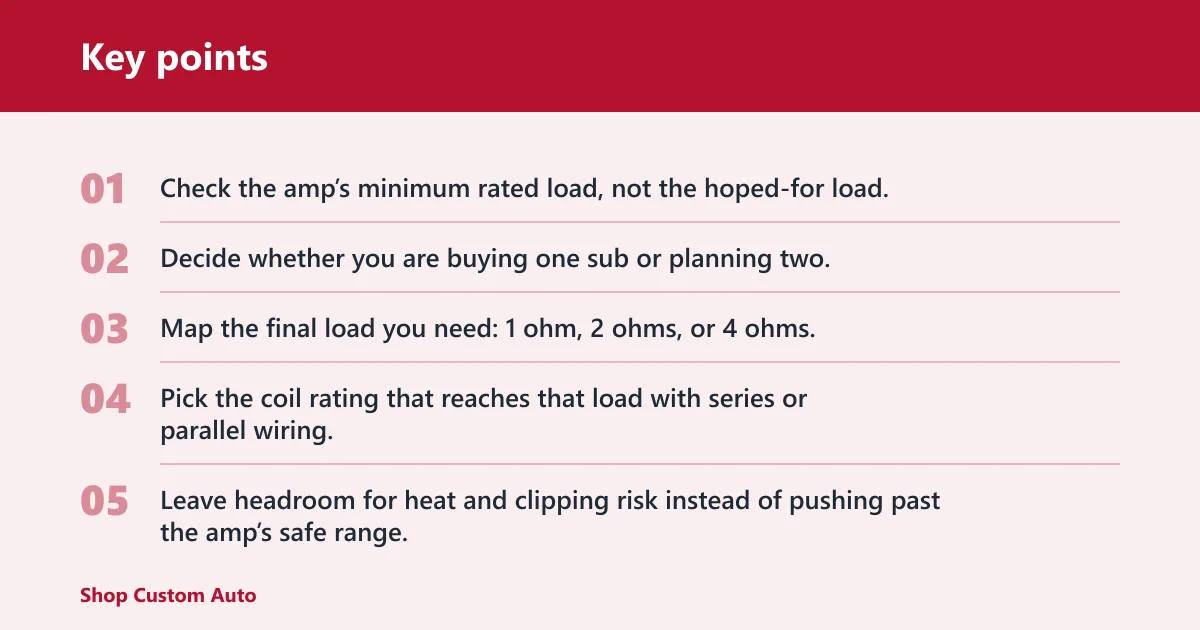
- Check the amp’s minimum rated load, not the hoped-for load.
- Decide whether you are buying one sub or planning two.
- Map the final load you need: 1 ohm, 2 ohms, or 4 ohms.
- Pick the coil rating that reaches that load with series or parallel wiring.
- Leave headroom for heat and clipping risk instead of pushing past the amp’s safe range.
Say your mono amp is 2-ohm stable and you want one 12-inch sub in a daily driver. A dual 4-ohm sub in parallel lands at 2 ohms, which fits the amp without forcing a risky load. A dual 2-ohm sub would leave you choosing between 1 ohm and 4 ohms instead.
Suppose you already own a 1-ohm-stable mono amp and plan to add a second sub after the enclosure change. Dual 4-ohm subs keep a 1-ohm path available with two drivers, while dual 2-ohm subs can drop to 0.5 ohm and push the amp beyond its safe operating range.
Frequently asked questions
Should I buy dual 2-ohm or dual 4-ohm subs?
Buy dual 2-ohm if your current amp needs 1 ohm from one driver or 2 ohms from a two-sub layout. Buy dual 4-ohm if your amp wants 2 ohms from one driver or you want more common wiring paths for a later upgrade. The amp’s minimum load should decide first.
Which dual voice coil sub gives more wiring options?
dual 4-ohm subs usually give more useful options for mainstream systems. They can be wired to 2 ohms with one sub, 1 ohm with two subs, or 4 ohms with two subs. That covers more common mono-amp targets than a dual 2-ohm sub in typical buyer setups.
Will a dual 2-ohm sub make more bass than a dual 4-ohm sub?
Not by itself. Bass output depends on the amplifier’s power at the final load, the enclosure, and the subwoofer design. A dual 2-ohm sub can play louder only if the wiring lets the amp deliver more clean power within its safe range.
What amp impedance will a dual 2-ohm sub give me?
With one sub, a dual 2-ohm driver can be wired to 1 ohm in parallel or 4 ohms in series. With two subs, common end points are 0.5 ohm or 2 ohms, depending on how the coils and subs are combined.
What amp impedance will a dual 4-ohm sub give me?
With one sub, a dual 4-ohm driver can be wired to 2 ohms in parallel or 8 ohms in series. With two subs, common end points are 1 ohm or 4 ohms, depending on the wiring pattern you choose.
Can I wire dual voice coil subs in series or parallel?
Yes. Series wiring adds the coil ratings together and raises the final load. Parallel wiring lowers the final load. Those two options are the core reason dual voice coil subs give you flexibility when you are trying to hit a specific amp load.
Which option is safer for my amplifier?
The safer option is the one that keeps the amp at or above its minimum rated load. For many systems, that means dual 4-ohm subs because they more often land on 2 ohms or 4 ohms, which are easier loads for common mono amps than 1 ohm or 0.5 ohm.
Which sub is better if I might upgrade my amp later?
dual 4-ohm subs are usually the better placeholder if the future amp is unknown. They preserve more standard wiring paths across 1-ohm, 2-ohm, and 4-ohm stable mono amps. That said, if you already know the next amp will be 1-ohm stable, dual 2-ohm can be the better match.