Where Does the Amp Turn on Wire Go on an Aftermarket Radio?
The amp turn-on wire on an aftermarket radio goes to the head unit’s blue/white remote output, not the solid blue power antenna lead, and it should read 12 volts only when the radio is on. Wire it wrong and the amp may stay off, pop on and off, or drain the battery. This guide shows how to identify the correct lead with a meter and route it for single-amp, factory-amp, and multi-amp installs.
Turn-on paths decision table
| Wire or path | When to use it | When not to use it | Expected voltage behavior | Common failure signs |
|---|---|---|---|---|
| Blue/white remote | Use for most aftermarket radios to trigger one amp or a relay. | Do not use as the main power feed to the amplifier. | About 12V only when the head unit is on. | Amp stays off, amp clicks on late, or remote wire reads 0V when radio is on. |
| Blue power antenna | Use only if the manual says it stays on in the mode you need. | Do not assume it is a true amp remote lead. | May show 12V only in radio mode, then drop in other sources. | Amplifier works on FM but shuts off on Bluetooth, USB, or AUX. |
| Factory amp interface output | Use when retaining a factory amplifier with the correct interface module. | Do not wire the head unit directly to the OEM amp if the system needs an interface. | Interface sends a trigger or control voltage the factory amp expects. | No sound, no wake-up, or intermittent factory amp turn-on. |
| Relay-fed multi-amp setup | Use when one remote lead must trigger several amps or accessories. | Do not load the radio’s remote output with the full accessory current. | Head unit sends a low-current trigger to the relay coil; relay feeds the devices. | Remote lead voltage sag, random shutoff, or multiple amps not waking together. |
Where does the amp turn on wire go on an aftermarket radio?
The amp turn-on wire goes to the head unit’s remote output, usually the blue/white lead labeled REM, AMP REM, or remote. That lead connects to the amplifier’s REM terminal, which expects a low-current 12V trigger. It does not carry the main amplifier power load.
Find the remote output on the head unit harness
Most aftermarket radios place the remote output in the color-coded wiring loom, but brand and model matter. Do not treat every blue wire as the same wire. The wiring diagram and radio manual tell you which lead is remote output, which is power antenna, and which is a different control wire.
The amplifier remote terminal is only a trigger input. It should not replace the main fused power cable that comes from the battery. That main cable needs its own inline fuse close to the power source, sized to the wire gauge and amplifier draw.
Connect it to the amplifier REM terminal
Run the chosen remote lead from the radio loom to the amp’s REM terminal. Keep the route neat and away from sharp edges. If the amp has a remote in and remote out terminal, use the input side unless the installation plan specifically calls for daisy-chaining multiple devices.
Check the radio manual before you trust color alone
Color helps, but it is not proof. Some units use blue/white for remote, some use blue for power antenna, and some models label the same function differently. The manual and the wiring diagram are the final word.
Which wire on an aftermarket stereo turns the amp on?
On most aftermarket stereos, the blue/white wire turns the amp on. A solid blue wire is often the power antenna lead, which may only energize in radio mode. That difference matters because an amplifier usually needs a trigger any time the head unit is on, not only during tuner playback.
Blue/white remote versus blue power antenna
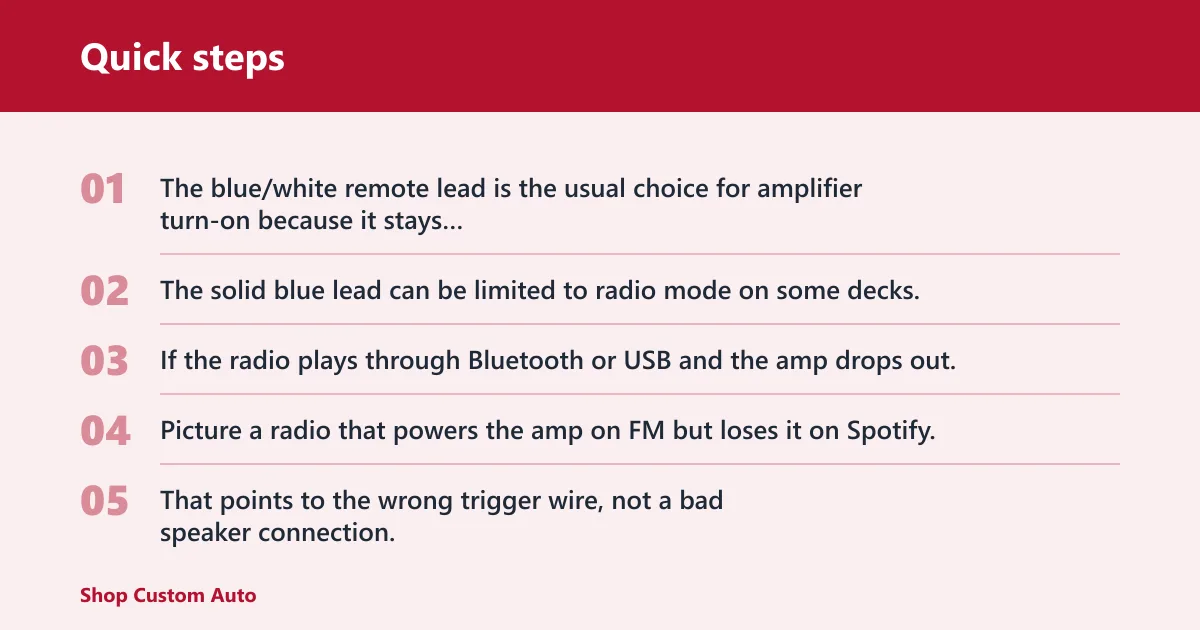
The blue/white remote lead is the usual choice for amplifier turn-on because it stays tied to head-unit power state. The solid blue lead can be limited to radio mode on some decks. If the radio plays through Bluetooth or USB and the amp drops out, the antenna lead is a likely cause.
Picture a radio that powers the amp on FM but loses it on Spotify. That points to the wrong trigger wire, not a bad speaker connection. Swap to the true remote output only if the manual confirms it is separate from the antenna lead.
When the antenna lead is safe to use
Use the power antenna lead only when the manual says it behaves like a proper remote output in every source you plan to use. Some units keep that wire live whenever the unit is on. Others do not. Verify before you connect it to an amplifier REM terminal.
When you need a separate remote source
If the head unit has no dedicated amp remote output, use an interface module, a relay, or another switched source that the manufacturer approves. Do not tie the amp trigger into accessory power at random. That can create delayed turn-on, turn-off pops, or battery drain.
How do you wire the remote lead to the amp?
For a single amplifier, connect the head unit’s blue/white remote output directly to the amp’s REM terminal. For multiple amps or extra accessories, use the radio remote output to trigger a relay, then feed the relay output to each device. If you are keeping a factory amplifier, use the proper interface output instead of guessing.
Single-amp direct hookup
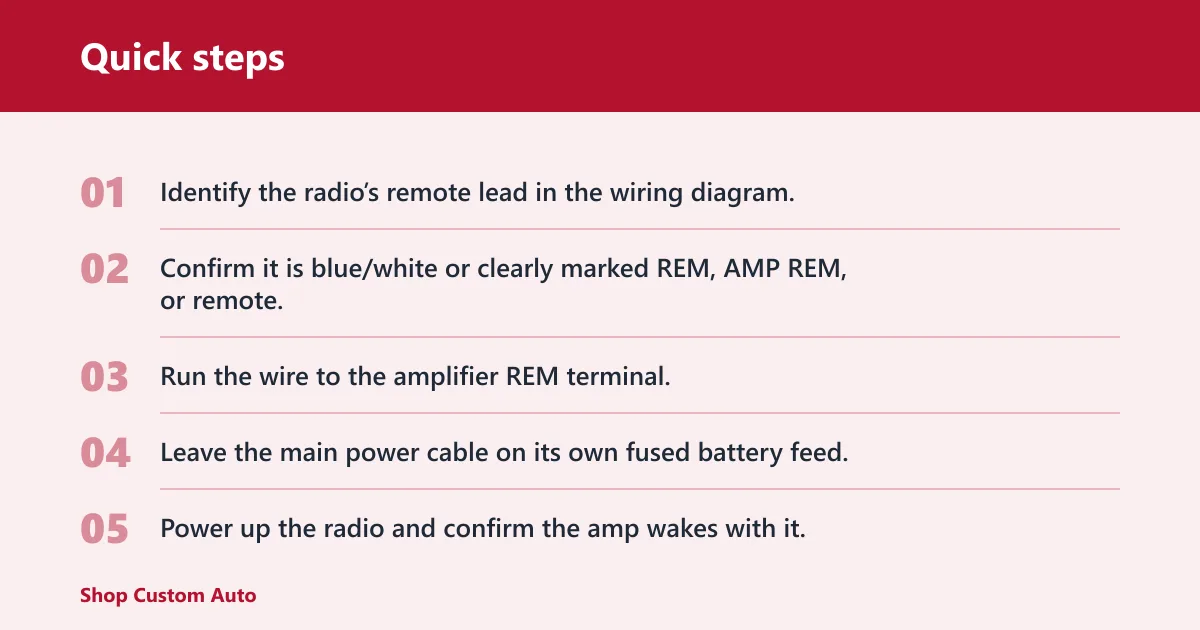
This is the simplest path. The radio remote output sends a low-current 12V signal to the amp’s REM terminal, and the amp wakes up with the head unit. The main amp power wire still comes from the battery through an inline fuse. The remote wire never replaces that fused feed.
- Identify the radio’s remote lead in the wiring diagram.
- Confirm it is blue/white or clearly marked REM, AMP REM, or remote.
- Run the wire to the amplifier REM terminal.
- Leave the main power cable on its own fused battery feed.
- Power up the radio and confirm the amp wakes with it.
Multiple amps with a relay
Use a relay when one remote lead must trigger more than one amplifier or accessory and the head unit cannot supply the current comfortably. The radio remote output energizes the relay coil, and the relay sends battery power to the remote terminals of the other devices. That keeps the head unit output from being overloaded.
Say your system has two amplifiers and a powered processor. The head unit remote output may read 12 volts with no load, yet still struggle once three devices are tied to it. A relay isolates the radio from that load and gives each device a cleaner trigger.
Factory amp integration with an interface
If the vehicle keeps its factory amplifier, the new radio may need an interface module that provides the correct amp turn-on output. In that case, the aftermarket head unit remote lead may trigger the module, and the module triggers the factory amp. Direct wiring can leave the OEM amp asleep.
How do you test the remote wire with a multimeter?
Set the meter to DC volts and check the suspected remote lead against ground. A correct remote wire reads about 12 volts only when the radio is on. If the voltage is present all the time, or only in one source mode, you may have the wrong wire.
Verify 12V only with the radio
Turn the head unit off. The remote lead should drop to 0 volts or close to it. Turn the head unit on. The lead should rise to battery voltage. That on-off behavior is what the amplifier wants from a trigger wire.
Rule out accessory, constant, and illumination wires
A constant power wire shows voltage all the time. An accessory wire follows key position, not head-unit power state. An illumination wire changes with the lights. Those wires can fool a quick visual check, so the meter matters more than color alone.
A common first-timer mistake is seeing 12 volts on a blue wire with the key on and assuming it is the amp remote. If that wire stays live with the radio off, it is not the right trigger for most amplifiers.
Why is the amplifier not turning on?
If the amp will not wake up, check the remote lead first, then the amp ground, then the main power fuse and the factory interface if one is installed. A remote wire can read 12 volts and the amp can still stay off if the ground is poor, the fuse is wrong, or the interface is not sending the right signal.
No 12V at the remote lead
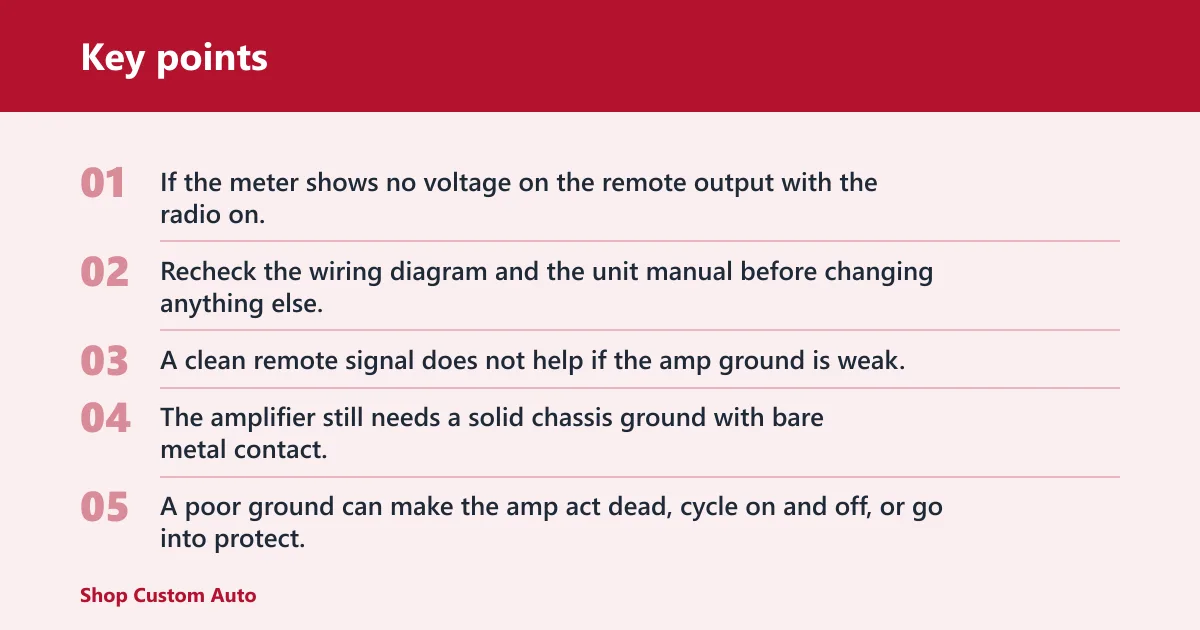
If the meter shows no voltage on the remote output with the radio on, the head unit may not be on the correct wire, the connector may be pinned wrong, or the radio may not provide a dedicated remote output. Recheck the wiring diagram and the unit manual before changing anything else.
Bad ground at the amplifier
A clean remote signal does not help if the amp ground is weak. The amplifier still needs a solid chassis ground with bare metal contact. A poor ground can make the amp act dead, cycle on and off, or go into protect.
Blown fuse or wrong fuse location
The main amplifier power wire needs its own inline fuse near the battery. If that fuse is open, the amp will not turn on no matter what the remote wire does. The remote circuit is separate and low current. It does not protect the main feed.
Factory interface or relay problem
If a factory amp interface or relay is in the path, check it as part of the turn-on chain. A bad module, the wrong trigger wire, or a missing relay connection can leave the amp without the signal it needs. This is common in systems that keep OEM amplification or run several amps from one trigger.
Frequently asked questions
Does the remote turn-on wire connect to the blue wire or blue/white wire?
Usually it connects to the blue/white wire, not the solid blue wire. The blue/white lead is commonly the remote output, while the solid blue lead is often the power antenna wire. The wiring diagram and radio manual are the final check because color assignments vary by brand and model.
What if my aftermarket radio has no remote turn-on wire?
If the radio has no dedicated remote output, use a factory amp interface when needed, or use a relay triggered by an approved switched source. Do not guess at a random wire color. The goal is a low-current 12V trigger that follows radio power, not a constant or accessory feed.
Can I use the power antenna wire for amp remote turn-on?
Only if the radio manual confirms that the power antenna lead stays active in every mode you need. Many units energize that wire only in tuner mode, which can make the amp shut off during Bluetooth or USB playback. The remote output is the safer default for amplifier turn-on.
How do I test the remote turn-on wire with a multimeter?
Set the meter to DC volts, place the black probe on a known good ground, and probe the suspected wire with the radio off and then on. The correct remote lead should be near 0 volts off and near 12 volts on. That behavior separates it from constant, accessory, and illumination wires.
Do I need a relay for the remote turn-on wire?
You usually do not need a relay for one amplifier. Use a relay when one remote output must wake multiple amps or extra accessories and the head unit may not supply enough current. The relay lets the radio control the load without asking the remote output to do the heavy work.
Why is my amplifier not turning on after installing an aftermarket radio?
Check the remote lead voltage, the amp ground, the main power fuse, and any factory interface or relay in the path. A 12-volt reading at the radio does not guarantee the amp is getting a proper trigger at its REM terminal. The issue is often wiring, not the amp itself.