Subwoofer Parallel vs Series Wiring: What Impedance Will You Get?
Parallel wiring lowers impedance and series wiring raises it. For identical drivers, two 4-ohm subs wired in parallel end at 2 ohms, while series wiring ends at 8 ohms. Wire it wrong and your amp can run hot, clip early, or shut down. This guide maps common single- and dual-coil sub layouts to exact final impedance and shows which amplifier loads are safe.
Quick decision checklist
- Identify the sub type: SVC or DVC.
- Read the nominal impedance on the label, not the DC resistance on a meter.
- Check the amplifier’s minimum stable impedance for the exact mode you will use.
- Pick a final load that is at or above the amp’s minimum.
- If you want more output, only lower impedance within the amp’s rated operating range.
- If you want more safety margin, raise impedance with series wiring or fewer parallel paths.
| Factor | Subwoofer parallel | series wiring | Winner |
|---|---|---|---|
| Final load | Lower impedance. Good for hitting 4 ohms, 2 ohms, or 1 ohm when the amp is built for it. | Higher impedance. Good for stepping up to 8 ohms or preserving a safer load. | Depends on target load |
| Power potential | Can raise output if the amp is stable at the lower load and operating within its rated range. | Usually reduces power output versus a lower load, but increases electrical safety margin. | Subwoofer parallel |
| Heat and protection risk | Higher risk if the amp is not stable at the resulting load. | Lower risk because the amp sees less current demand. | series wiring |
| Best-fit use case | Daily system matched to a monoblock that is rated for 1 ohm or 2 ohms. | Systems that need a safer load, or a target like 4 ohms or 8 ohms. | Depends on amp |
Quick formulas
| Series | Zt = Z1 + Z2 + … |
| Parallel | 1/Zt = 1/Z1 + 1/Z2 + … |
| Identical parallel shortcut | Zt = Z ÷ number of loads |
| Non-identical example | 4 ohms in parallel with 8 ohms: 1/Zt = 1/4 + 1/8 = 3/8, so Zt = 8/3 ohms, or about 2.67 ohms. |
If your amp is 1/2/4-ohm stable, choose these final loads
| Amp rating | Choose these loads | Do not choose below |
|---|---|---|
| 1-ohm stable | 1 ohm, 2 ohms, 4 ohms, 8 ohms, 16 ohms | Below 1 ohm |
| 2-ohm stable | 2 ohms, 4 ohms, 8 ohms, 16 ohms | Below 2 ohms |
| 4-ohm stable | 4 ohms, 8 ohms, 16 ohms | Below 4 ohms |
Series vs parallel wiring
How series changes total ohms
Series wiring adds impedances directly: Z total = Z1 + Z2 + …. That means two identical 4-ohm loads wired in series are commonly said to present about 8 ohms, and two 8-ohm speakers wired in series are commonly said to present about 16 ohms. It is the safer direction when you need to raise the final load.
How parallel changes total ohms
Parallel wiring reduces impedance. For identical loads, total impedance is divided by the count, so two 4-ohm loads in parallel become 2 ohms and two 8-ohm speakers in parallel become 4 ohms. Parallel is the usual choice when you need a lower target load.
When to use each layout
Choose subwoofer parallel when the amplifier is designed for a lower minimum load and you want more output potential within that amp’s rated operating range. Choose series wiring when you need to stay above the amp’s minimum stable impedance or when the available sub options would otherwise pull the load too low.
What impedance will you get?
The number printed on the sub is the nominal impedance, not a fixed meter reading. Real impedance varies with frequency, and a meter checks DC resistance, which is lower than nominal in practice. A 4-ohm sub can read about 3 ohms on a multimeter, so the label and the meter are answering different questions.
Nominal impedance versus measured resistance
Use nominal impedance for wiring math. Use DC resistance, or Re, only as a sanity check that the voice coil is intact and in the expected range. If a “4 ohm” sub measures much lower than that, the coil may be damaged or wired incorrectly.
Why a “4 ohm” sub may read lower on a meter
A multimeter reads steady DC resistance, not the changing AC impedance the amplifier sees during music playback. That is why a 4-ohm sub can meter around 3 ohms and still be a 4-ohm nominal driver. The label still guides the wiring decision.
How to read the label before you wire
- Check whether the sub is SVC or DVC.
- Read the nominal impedance on the label, such as 2 ohm or 4 ohm.
- Check the amplifier’s minimum stable impedance on the spec sheet.
- Choose a final load that stays at or above that minimum.
Subwoofer wiring outcome table
| Setup | Series | Parallel | Series-parallel | Best amp match | Avoid if amp is not stable at… |
|---|---|---|---|---|---|
| 1x SVC 4 ohm | 4 ohms | 4 ohms | Not applicable | 4-ohm stable amp | Less than 4 ohms |
| 1x DVC 2 ohm | 4 ohms | 1 ohm | Not applicable | 2-ohm or 1-ohm stable amp, depending on wiring goal | 1 ohm if the amp is not 1-ohm stable |
| 1x DVC 4 ohm | 8 ohms | 2 ohms | Not applicable | 2-ohm stable amp for parallel, 4-ohm stable amp for series | 2 ohms if the amp is not 2-ohm stable |
| 2x SVC 4 ohm | 8 ohms | 2 ohms | Not applicable | 2-ohm stable amp for parallel, 4-ohm or 8-ohm use for series goals | 2 ohms if the amp is not 2-ohm stable |
| 2x DVC 2 ohm | 8 ohms: each sub coils in series, then subs in series | 0.5 ohm: each sub coils in parallel, then subs in parallel | 2 ohms: each sub coils in series, then subs in parallel | 2-ohm stable amp for the common daily target | 0.5 ohm if the amp is not built for that load |
| 2x DVC 4 ohm | 16 ohms: each sub coils in series, then subs in series | 1 ohm: each sub coils in parallel, then subs in parallel | 4 ohms: either coils in series then subs in parallel, or coils in parallel then subs in series | 4-ohm stable amp if you want the safer load; 1-ohm stable amp if you want maximum output | 1 ohm if the amp is not 1-ohm stable |
How do you wire a dual voice coil sub to a target load?
A dual voice coil subwoofer has two coils on one driver, so you can wire the coils in series or parallel first, then choose the final load with the rest of the system. That gives you more options than a single voice coil subwoofer, which has one coil and fewer wiring paths.
Wiring a DVC sub for 2 ohms
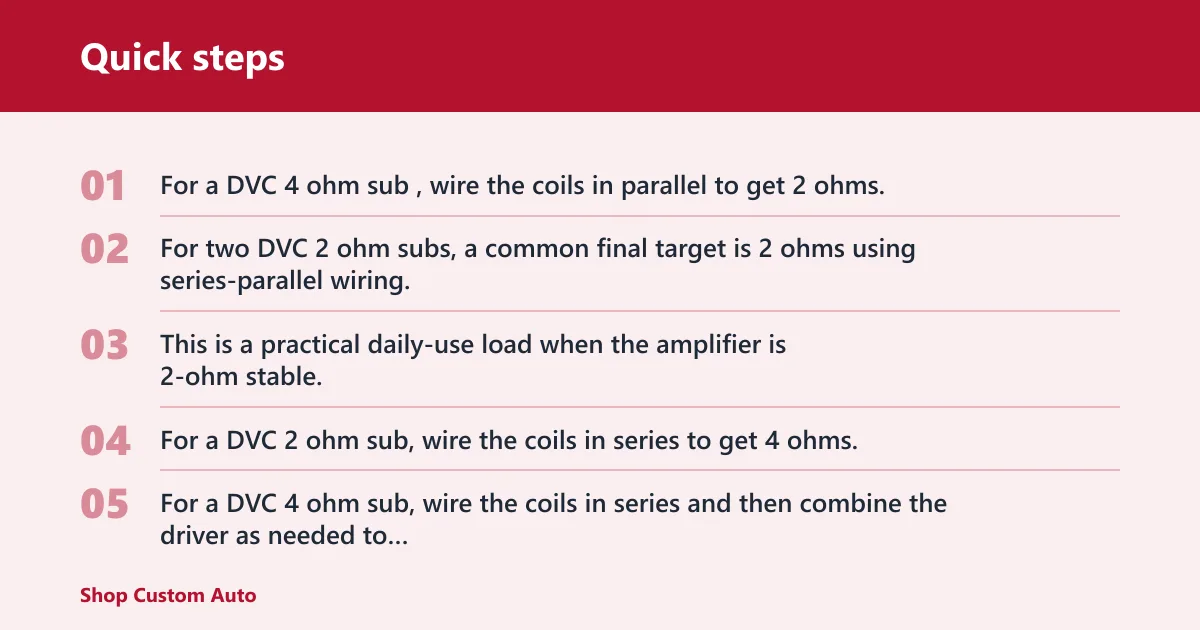
For a DVC 4 ohm sub, wire the coils in parallel to get 2 ohms. For two DVC 2 ohm subs, a common final target is 2 ohms using series-parallel wiring. This is a practical daily-use load when the amplifier is 2-ohm stable.
Wiring a DVC sub for 4 ohms
For a DVC 4 ohm sub, wire the coils in series and then combine the driver as needed to land on 4 ohms in a larger build. Two dual 4 ohm subs can be wired to a 4 ohm load in one configuration, and also another way to a 4 ohm load.
Wiring a DVC sub for 8 ohms
For a DVC 4 ohm sub, wire the coils in series for 8 ohms. That gives a high-impedance option when the amp prefers a lighter load. A DVC 2 ohm sub can also be made into a 4 ohm load, but 8 ohms is not the usual target for that driver by itself.
Say your monoblock is 1-ohm stable and you want daily reliability more than peak output. A DVC 4 ohm sub wired for 2 ohms can be the smarter choice than forcing a lower load that adds heat and triggers protection during long bass notes.
Can series-parallel wiring hit a specific load?
Yes. Series-parallel wiring combines both methods by wiring groups in series, then tying those groups in parallel, or the reverse. That is the standard way to hit a target load when one wiring method alone lands too high or too low.
Using series-parallel for two subs
Two dual 4 ohm subwoofers can be wired to a 4 ohm load in one configuration, and also another way to a 4 ohm load. One common path is coils in series and subs in parallel. Another is coils in parallel and subs in series. Both are valid, and both land on 4 ohms.
Using series-parallel for four coils
When you have multiple coils to arrange, the order matters. Wire equal groups the same way first, then combine those groups with the opposite method. That is how you hit 1 ohm, 2 ohms, 4 ohms, or 8 ohms without guessing.
Where this layout fits best
Series-parallel is most useful in two-sub builds and in larger multi-coil systems where the final load must match a specific amplifier target. It is less about “more power” by itself and more about landing on a load the amp can safely deliver.
How do you match the load to your amp?
Read the amplifier spec sheet first. A 4 ohm amplifier rating is described as a minimum load in manufacturer guidance, and the same idea applies to 2-ohm and 1-ohm stable amps. The load you choose must stay at or above that minimum.
Reading the minimum stable impedance on the amp label
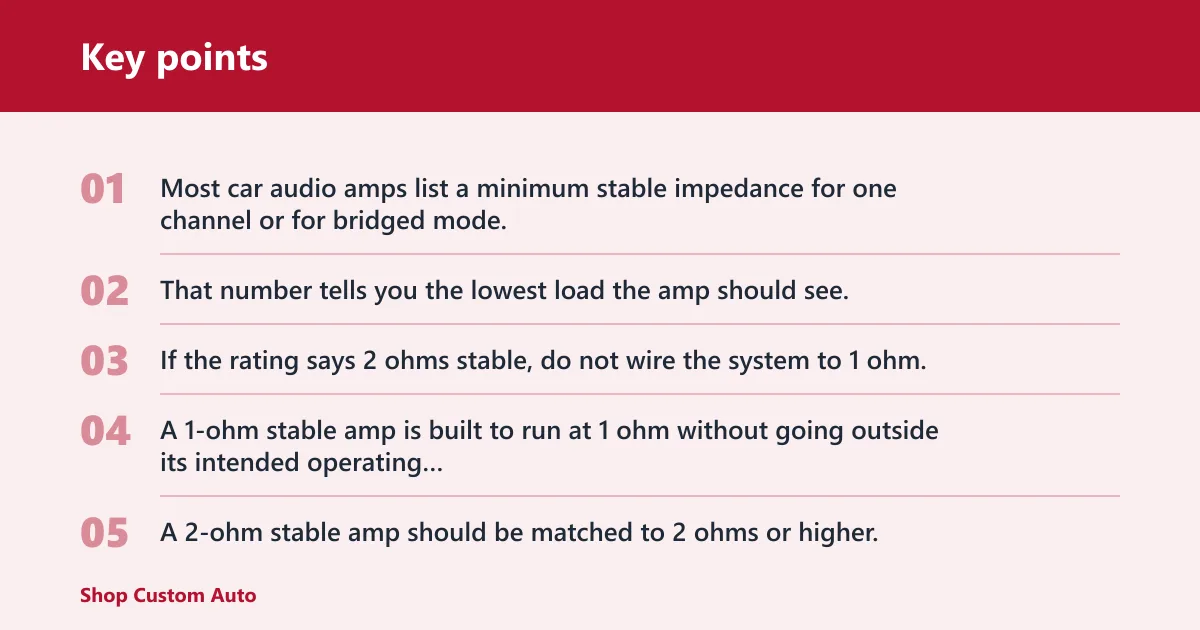
Most car audio amps list a minimum stable impedance for one channel or for bridged mode. That number tells you the lowest load the amp should see. If the rating says 2 ohms stable, do not wire the system to 1 ohm.
1 ohm, 2 ohm, and 4 ohm stable examples
A 1-ohm stable amp is built to run at 1 ohm without going outside its intended operating range. A 2-ohm stable amp should be matched to 2 ohms or higher. A 4-ohm stable amp should not be forced below 4 ohms.
Why extra headroom matters on daily systems
Lower impedance can increase power output within the amplifier’s rated operating range, and 4 ohms to 2 ohms can often raise output if the amp is designed for it. In daily use, a little headroom helps with heat, alternator voltage drop, and long listening sessions. A technically correct load can still be a poor choice if it leaves no margin.
Suppose a two-sub build lands exactly at 1 ohm on paper, but the amp is only rated for 2 ohms. The system may play briefly, then heat up, clip earlier, or shut down once voltage sags. The wiring math is correct; the amp match is not.
What happens if the load is too low?
If the amplifier sees a lower impedance than it is stable for, current demand rises fast. That can trigger protection mode, raise heat, and push the amp into clipping. In bad cases, the output devices or power supply sections fail under sustained stress.
Heat rise and protection mode
Heat is the first warning sign. Many amps will reduce output or shut down before damage spreads, especially when the load is too low for too long. If that happens, the wiring choice is the problem, not the music.
Distortion and clipped output
Clipping is common when the amp cannot cleanly supply the load. The result can sound louder for a moment, then harsher and less controlled. That is a real daily-use tradeoff, because raw power at the wrong load often comes with worse sound quality.
Damage risk when the amp is pushed past its rating
Repeated overload can damage the amp and, in some systems, the subs too. The fix is simple: raise the final impedance, reduce the number of parallel paths, or choose an amp that is stable at the load you want.
Choose Subwoofer parallel if…
Choose Subwoofer parallel if your amp is rated for the lower load you want and your goal is more output potential from a safe final impedance. It is the better pick for 2-ohm and 1-ohm targets, especially in monoblock setups where the spec sheet clearly supports that load.
Choose series wiring if…
Choose series wiring if you need to protect a limited amplifier, raise a load to 4 ohms or 8 ohms, or avoid heat and protection mode in a daily system. It is the better pick when the wiring math must favor safety margin over maximum power.
Frequently asked questions
What impedance will two 4 ohm subwoofers be in series?
Two 4-ohm subwoofers in series become 8 ohms. Series wiring adds impedances directly, so the math is simple: 4 plus 4 equals 8. This is the safer choice when you need a higher final load than a 4-ohm amp or setup can handle.
What impedance will two 4 ohm subwoofers be in parallel?
Two 4-ohm subwoofers in parallel become 2 ohms. Parallel wiring lowers impedance, and identical loads divide by the count, so 4 ohms divided by 2 equals 2 ohms. That can raise output only if the amplifier is built for 2 ohms.
How do you wire a dual voice coil subwoofer to 2 ohms?
For a DVC 4 ohm sub, wire the two coils in parallel to get 2 ohms. For a larger multi-sub build, series-parallel can also land on 2 ohms when the system is arranged around that target. Always check the amp’s minimum stable impedance first.
How do you wire a dual voice coil subwoofer to 8 ohms?
For a DVC 4 ohm sub, wire the two coils in series to get 8 ohms. That is a straightforward way to raise the load when the amplifier needs a lighter demand. It is less common than 2 ohms or 4 ohms, but it is valid.
What impedance do two dual 4 ohm subs make wired different ways?
Two DVC 4 ohm subs can be wired to 1 ohm, 4 ohms, or 16 ohms, depending on how the coils and subs are combined. Two dual 4 ohm subwoofers can be wired to a 4 ohm load in one configuration, and also another way to a 4 ohm load.
What are the safe final impedance options for DVC 2 ohm and DVC 4 ohm subs?
A dual 2 ohm subwoofer can be wired to 1 ohm or 4 ohms, and two DVC 2 ohm subs can be wired to 0.5 ohm, 2 ohm, or 8 ohms. A dual 4 ohm subwoofer can be wired to 2 ohms or 8 ohms, and two DVC 4 ohm subs can be wired to 1 ohm, 4 ohms, or 16 ohms.
Sources
- JBL technical materials on loudspeaker impedance and nominal impedance behavior.
- Rockford Fosgate tech library and manuals covering subwoofer wiring, impedance, and amplifier load limits.
- Kicker support articles and manuals explaining voice coil wiring, series/parallel combinations, and amp stability.
- JL Audio owner’s manuals and technical notes on amplifier minimum load ratings and safe operating limits.
- Crutchfield learning center articles on speaker impedance, DC resistance vs. nominal impedance, and wiring diagrams.
- Manufacturer amplifier manuals and spec sheets showing minimum impedance behavior in bridged and mono operation.