Subwoofer Phase 0 or 180: Which Setting Should You Use?
Set the subwoofer to 0° or 180°, whichever gives the most bass at the driver’s seat after the sub level and crossover are already set. If both phase settings are close, a common starting point is 0°. A wrong phase setting can cancel bass at the seat and make the system sound weak or uneven. This guide explains how the switch works, how crossover points affect it, and how to choose the better setting by ear.
| Factor | Subwoofer phase 0 | 180 | Winner |
|---|---|---|---|
| Best first reference after setup | Matches the default reference point most systems start from. | Useful as the compare-and-check position. | Subwoofer phase 0 |
| Best when bass is weak around the crossover | Can be right if the sub and mains already sum well. | Often restores bass if the current timing is subtracting at the seat. | 180 |
| Best for seat-by-seat tuning | May win at one seat and lose at another. | May reverse the result at a different seat. | Tie |
| Best when the crossover is already sane | Can give stronger, cleaner overlap if timing lines up. | Can give stronger, cleaner overlap if timing lines up after the flip. | Tie |
What 0° and 180° mean
Subwoofer phase switches usually give you two positions: 0° and 180°. That is a comparison tool, not a full variable phase control. It helps you line up the subwoofer with the main speakers near the crossover region so bass sums cleanly at the listening seat.
What the switch changes
The switch changes the timing relationship in a simple way. In many systems it acts like a polarity-style flip, which means it can turn a bass peak into a dip, or a dip into a peak, depending on the cabin and where you sit.
What it does not change
It does not fix a bad crossover choice, a badly placed sub box, or reversed speaker wiring. It also does not make both settings equally right at every seat. The best result depends on where the sub sits, where you sit, and where the crossover is set.
📊 Professional live sound subwoofers are typically below 100 Hz. Source: Subwoofer.
Why phase changes with the seat
Phase alignment is the timing relationship between the subwoofer and the main speakers near the crossover region. Because the cabin changes arrival time, the best setting can differ between the driver seat and another seat. Bass may peak in one seat and cancel in another.
Driver seat versus other seats
The seat you care about matters most. A setting that sounds full at the passenger seat may sound thin at the driver seat, especially if the sub is closer to one side of the cabin. The head-move effect is real at low frequencies near the crossover overlap.
How sub location changes arrival time
Subwoofer placement changes how far the bass has to travel before it reaches you. A corner location can load the cabin differently than an open cargo area or a rear-side mount. That extra path difference can make 0° work better in one placement and 180 better in another.
Say your sub is in the trunk on the passenger side, and the driver seat loses bass around the crossover. Flipping the switch may bring the low end back because the sub and front stage are summing better at that seat, even though the box and amp did not move.
Set crossover and level first
Judge phase only after the crossover and sub level are already set appropriately. Phase differences are easiest to hear where the sub overlaps the mains, and a bad crossover setting can fake a phase problem. Lowering sub volume can make integration easier to hear.
Why the crossover matters
Consumer subwoofers typically reproduce about 20–200 Hz, while THX-certified systems use subwoofers below 80 Hz. The exact blend point changes how much overlap you hear with the main speakers. If the crossover is too high or too low, the switch may seem to do the wrong thing. (Wikipedia)
How to set up the listening test
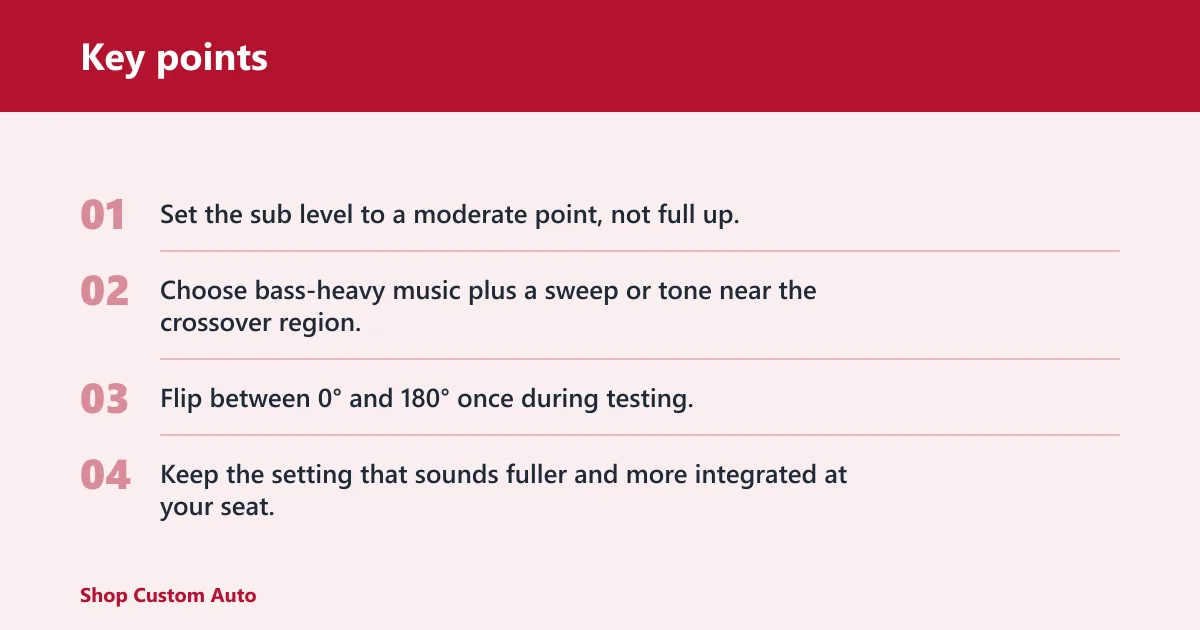
- Set the sub level to a moderate point, not full up.
- Choose bass-heavy music plus a sweep or tone near the crossover region.
- Flip between 0° and 180° once during testing.
- Keep the setting that sounds fuller and more integrated at your seat.
A common first-timer mistake is turning the sub all the way up, then deciding phase from that. At high level, the sub can mask the overlap with the main speakers. A lower, sane level makes the difference between 0° and 180 easier to hear.
How do you choose between 0 and 180?
Use bass-heavy music and a sweep or tone around the crossover region, then compare 0° and 180 at the seat that matters. Keep the setting with the stronger, cleaner bass, not the setting that only sounds louder in a random part of the cabin. Fullness and integration matter more than raw boom.
What to listen
Listen for bass that stays even through the handoff from the front speakers to the sub. The better setting usually sounds fuller, with less hollowness around the crossover. If one position makes kick drums sound bigger but also blurrier, the cleaner setting is often the better one.
Which setting wins?
Subwoofer phase 0 wins when it gives the strongest bass at the seat after setup is corrected. 180 wins when the flip restores the missing low end or fills a dip near the crossover. If both are nearly equal, keep the cleaner one and revisit placement before chasing tiny changes.
Phase decision checklist
This checklist turns the comparison into a seat-by-seat decision. Use it after level and crossover are already close, because the switch is for fine integration, not for repairing a bad setup.
| Seat position | Sub location | Crossover range | Result at 0° vs 180° | Keep the switch |
|---|---|---|---|---|
| Driver seat | Rear corner | 70–90 Hz | Choose the setting that gives more midbass punch without a hollow dip. | The stronger, smoother one |
| Driver seat | Open rear cargo area | 60–80 Hz | Compare kick drum weight and the handoff from the front speakers. | The one that sounds more joined |
| Passenger seat | Trunk pass-through | 70–100 Hz | One setting may sound louder because the seat sits closer to the sub path. | The seat-specific winner |
| Center seat | Behind rear seat | 60–90 Hz | Both settings may seem similar if the cabin averages the difference. | Either if the result is tied |
Decision rule: Yes, keep the switch position that gives stronger and cleaner bass at the seat you care about. No, do not keep that result if both positions sound weak; re-check placement, crossover, and wiring polarity before assuming the switch failed.
What if both settings sound the same?

If 0° and 180 sound almost identical, the switch may not be the main issue. The sub may already be far enough from the mains that the overlap is small, the level may be too high, or a wiring or polarity mistake may be hiding the difference. The test then shifts from phase to setup.
When placement is masking the difference
Room acoustics can affect the phase decision, and vehicle acoustics do the same. If the sub location and seat geometry place the bass outside the main overlap region, the switch may only move the response a little. In that case, moving the box can matter more than flipping the switch.
When to suspect wiring or polarity
If the bass is thin in both positions, check for reversed speaker polarity before blaming phase. The phase switch compares timing between sub and mains; it does not correct a wiring error. A true polarity mistake can make both settings sound wrong in a similar way.
Suppose the sub sounds almost unchanged in a hatchback with the crossover set very low. That can happen when the overlap with the front stage is small. Before calling the switch useless, raise the crossover slightly, lower the sub level, and compare again at the driver seat.
Should you recheck phase after moving the box?
Yes. Moving the sub box changes arrival time, and that can change which setting works best. A corner placement and an open placement can favor different phase positions in the same vehicle. Re-run the quick listening test any time the box moves.
Why placement changes the answer
Distance from the listener changes when the sub wave reaches the seat. A few inches of change can matter near the crossover region, where bass from the sub and the main speakers overlap. That is why the better setting can change after a move.
What to repeat after a move
Repeat the same short test: sane level, sane crossover, bass-heavy music, then one sweep or tone near the blend point. Keep the setting that gives the most even bass at the seat you care about. Do not assume the old answer still fits.
Choose Subwoofer phase 0 if…
Choose Subwoofer phase 0 if it gives the stronger, cleaner bass at your listening seat after the crossover and level are already set. It is also the best first reference when both settings are close, because it gives you a stable starting point for comparison.
Choose 180 if…
Choose 180 if the switch makes the bass fuller, smoother, or more integrated at the seat you care about. That usually means the first setting was letting the sub and mains cancel around the crossover region. Keep the setting that wins at the seat, not the one that sounds louder elsewhere.
Frequently asked questions
Should my subwoofer phase be 0 or 180?
Use whichever setting gives the strongest, cleanest bass at the seat you care about after level and crossover are already set. If both are close, start with Subwoofer phase 0. If 180 clearly fills a dip or sounds more even, keep 180.
How do I know which subwoofer phase setting sounds better?
Play bass-heavy music plus a sweep or tone near the crossover region, then switch once between 0° and 180. The better setting sounds fuller and more integrated, not merely louder. Judge from the driver seat if that is your main listening position.
Why does my subwoofer get louder when I flip phase?
Flipping the switch can move the sub and mains from partial cancellation to better summing at the seat. That raises bass output near the crossover region. The gain is not magic; it is a timing change that makes the overlap work better in that cabin.
Can the wrong subwoofer phase make bass weaker?
Yes. If the sub and main speakers arrive out of step near the crossover, they can cancel part of the low end at your seat. The result is weaker, thinner bass, even though the sub is working normally. That is why the seat matters.
What if my subwoofer phase switch seems to do nothing?
If both positions sound nearly the same, the issue may be placement, level, crossover choice, or a wiring or polarity mistake. Try a lower sub level and a quick recheck near the crossover. If nothing changes, move the box or inspect the wiring before assuming the switch is bad.
Can I use my head unit time alignment instead of the phase switch?
Time alignment and the phase switch solve related but different problems. Time alignment changes delay for the speakers, while the switch gives a fast 0° versus 180 comparison for the sub. Many systems benefit from using both, with the switch chosen after the crossover is set.