What Happens If You Put a Subwoofer in a Small Box?
A subwoofer in a box smaller than the manufacturer’s recommended volume usually loses low-bass extension, shifts its system resonance upward, and changes cone motion. In sealed alignments, the main effect is a stiffer air spring; in ported alignments, box volume also changes tuning and low-frequency control. (See Thiele/Small parameter relationships for sealed and vented designs in Loudspeaker Design Cookbook, and manufacturer application notes from Dayton Audio, JL Audio, and WinISD documentation.)
How net volume and driver specs affect subwoofer performance
A smaller-than-spec enclosure raises the air spring stiffness seen by the woofer. That typically reduces deep-bass extension, increases the system’s resonant frequency, and can create a stronger peak in the upper bass. The result may sound punchier at first, but the lowest notes usually fall off sooner. In ported boxes, the tuning point can shift as well. [Loudspeaker Design Cookbook; manufacturer enclosure guides from Dayton Audio and JL Audio.]
How enclosure size affects deep bass extension
Use net internal volume, not outside dimensions, when judging a box. Net volume is the airspace left after subtracting driver displacement, bracing displacement, terminal cup displacement, and, in a ported box, port displacement. If those deductions are skipped, the box will seem larger than it really is. [Manufacturer spec sheets for model-specific displacement data; enclosure design guides from Dayton Audio and JL Audio.]
Driver behavior is tied to Fs, Vas, and Qts. Fs is the driver’s free-air resonance, Vas reflects suspension compliance, and Qts helps predict how the driver will behave in sealed or vented alignments. Those values are why one woofer can tolerate a smaller box better than another. [Thiele/Small parameter references; WinISD documentation.]
One concise example: if a sealed design was intended for 1.25 cubic feet net and ends up at 1.13 cubic feet, the box is 10% undersized; at 0.94 cubic feet, it is 25% undersized; at 0.63 cubic feet, it is 50% undersized. The smaller the net volume, the more the response tends to rise in the upper bass while deep extension drops. For a ported design, the same percentage loss also changes the relationship between box volume, port area, and tuning, so the response can move more dramatically. [Enclosure design references from JL Audio and Dayton Audio.]
Will it sound louder?
It can sound louder in a narrow band because a smaller enclosure often raises the response peak around resonance. That does not mean the subwoofer is reproducing bass more accurately. It usually means the response has become more concentrated in one region while the deepest notes lose output. [Loudspeaker Design Cookbook; enclosure response references from manufacturer application notes.]
Sealed vs ported subwoofer enclosures
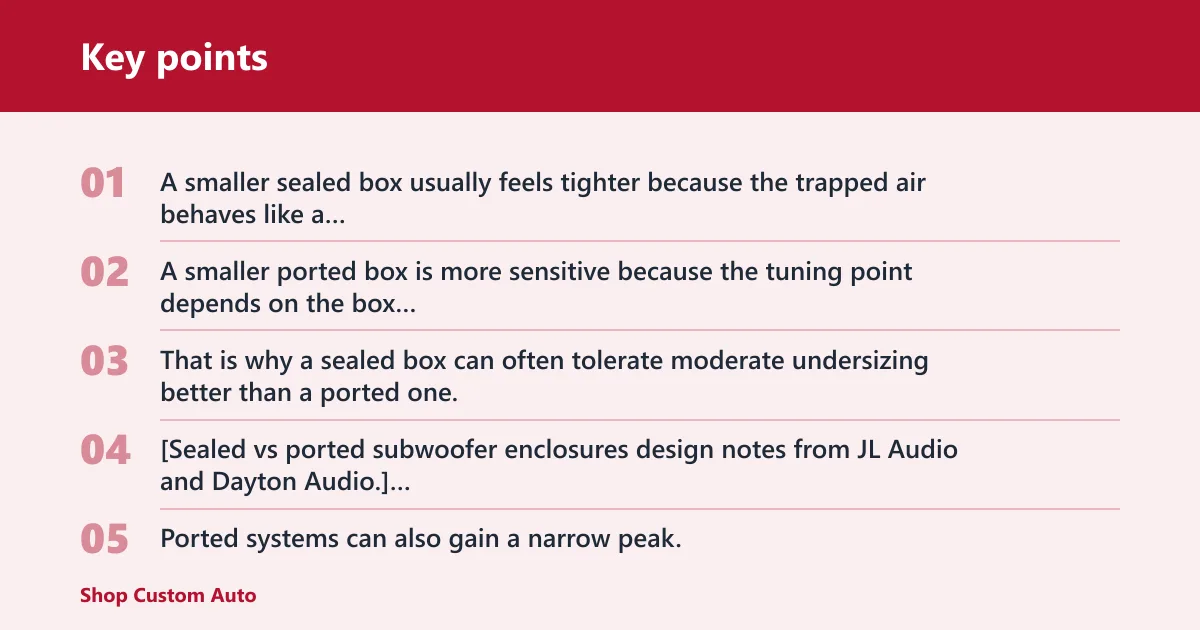
A smaller sealed box usually feels tighter because the trapped air behaves like a stronger spring. A smaller ported box is more sensitive because the tuning point depends on the box volume and the port geometry together. That is why a sealed box can often tolerate moderate undersizing better than a ported one. [Sealed vs ported subwoofer enclosures design notes from JL Audio and Dayton Audio.]
Sealed systems often trade extension for control when volume drops. Ported systems can also gain a narrow peak, but they may lose the low-end support they were designed to provide. That difference is the core reason the same percentage undersize is less risky in sealed enclosures than in vented ones. [Loudspeaker Design Cookbook; manufacturer enclosure guides.]
One sealed example and one ported example show the trend clearly: at 10% undersized, a sealed box may sound a little punchier with slightly less extension, while a ported box may already show a tuning shift and some response change. At 25% undersized, the sealed box is more likely to sound noticeably lean, and the ported box may begin to lose deep output and gain more port noise. At 50% undersized, both alignments are far enough off target that a rebuild is usually the right answer. [Enclosure design references from JL Audio, Dayton Audio, and WinISD.]
Why some subs sound louder before they sound better
A smaller box can push output into a narrower band, so the sub may seem louder on quick listening tests. The downside is that the bass may be peaky instead of extended, and the added “loudness” can come with more distortion and less usable deep bass. [Loudspeaker Design Cookbook; enclosure design application notes.]
Can it damage the sub?
Yes, if the enclosure is far enough outside the recommended range or if the system is driven hard in the wrong band. In sealed boxes, the most common risks are distortion, bottoming, and excess heat from inefficient operation. In ported boxes, the biggest risk is losing proper control below tuning, where excursion rises quickly. [Manufacturer enclosure design guidance; vented-box excursion references from JL Audio and Dayton Audio.]
Excursion below tuning and why it matters
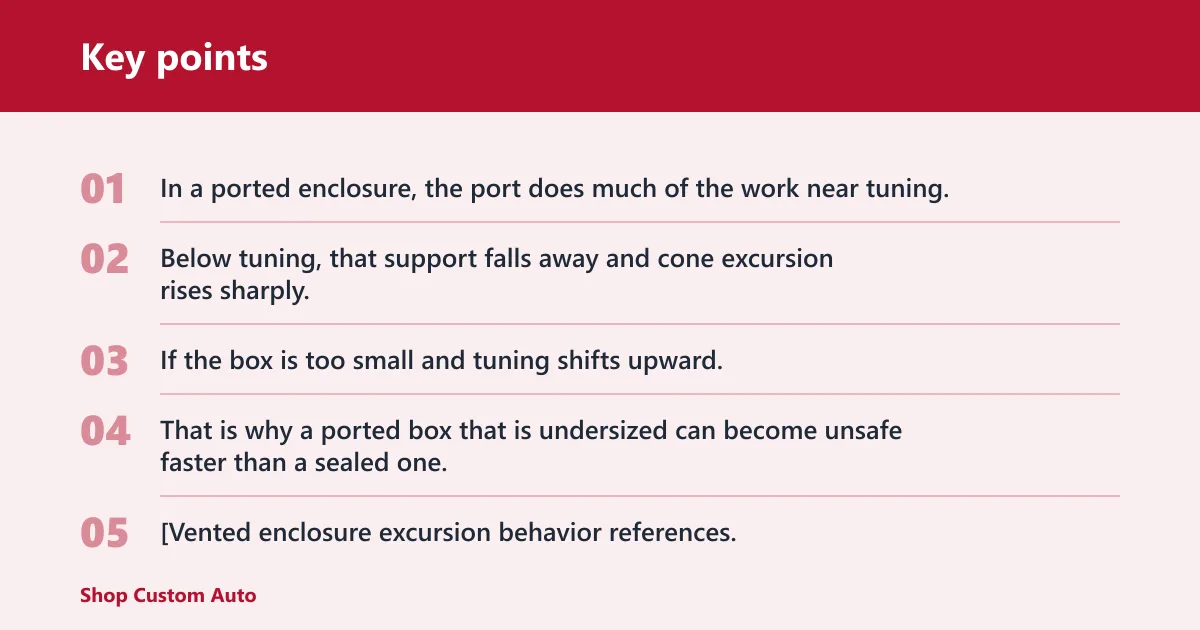
In a ported enclosure, the port does much of the work near tuning. Below tuning, that support falls away and cone excursion rises sharply. If the box is too small and tuning shifts upward, the woofer can be asked to work hard in the region where protection is weakest. That is why a ported box that is undersized can become unsafe faster than a sealed one. [Vented enclosure excursion behavior references; WinISD documentation.]
Danger signs include bottoming out, harsh distortion, and in ported systems, chuffing or a sudden loss of output below tuning. Those symptoms are more important than a simple “it sounds louder” impression because they indicate that the driver is no longer operating in its intended range. [Manufacturer enclosure and port design guidance.]
Why ported enclosures are more sensitive to undersizing
Ported enclosures depend on the relationship between box volume, port geometry, and the driver’s parameters. When the volume drops, tuning can move upward enough to alter both output shape and cone motion. That is why a ported box may sound stronger in one band while becoming less usable overall. [JL Audio enclosure design references; WinISD documentation.]
A compact powered sub can still be well designed, but its physical size does not prove the internal air volume is correct. The only reliable check is the net volume after displacement is removed and then compared to the intended alignment. [Manufacturer spec pages for model-specific volume and displacement data.]
How small is too small?
Too small means the net internal volume falls outside the manufacturer’s recommended range for that exact driver and box type. The same enclosure can be acceptable in one alignment and unsafe in another, so the check must be based on the specific sealed or ported target rather than a generic box size. [Manufacturer enclosure specifications; Thiele/Small references.]
What happens triage table
| Box type | Severity | Symptoms | Likely acoustic change | Danger level | Recommended fix |
|---|---|---|---|---|---|
| Sealed | Mild undersizing | Slightly tighter bass, small upper-bass rise, a bit less low-end depth | Higher system resonance, modest extension loss | Low | Verify net volume, keep if within spec, use light damping only if appropriate |
| Sealed | Moderate undersizing | Noticeably thin deep bass, clearer peak in upper bass, earlier distortion | More pronounced response peak, reduced low-bass reach | Moderate | Recheck displacement math, compare with spec, rebuild if outside the recommended range |
| Sealed | Severe undersizing | Bottoming out, harshness, very limited deep bass | System is far from intended alignment; excursion and heat stress rise | High | Reduce power immediately and rebuild the enclosure |
| Ported | Mild undersizing | Slight tuning shift, small loss of deep extension, minor port noise changes | Higher tuning, altered response shape | Moderate | Verify port length and net volume; retune if possible |
| Ported | Moderate undersizing | Audible chuffing, weaker deep bass, strong peak near tuning | More tuning error, less low-end support | High | Confirm tuning, adjust port geometry, or rebuild the enclosure |
| Ported | Severe undersizing | Harsh output, abrupt loss below tuning, bottoming risk | Unloading below tuning, unsafe excursion increase | Very high | Stop high-power use and rebuild to the intended volume and tuning |
Net-volume formula box
Net internal volume = gross internal volume − driver displacement − bracing displacement − terminal cup displacement − port displacement
Measure the inside length, width, and height first, then subtract every item that occupies airspace. Compare the final number to the manufacturer’s sealed or ported recommendation for the exact driver. [Manufacturer spec pages for model-specific displacement data; enclosure design references.]
Checklist for dangerous signs
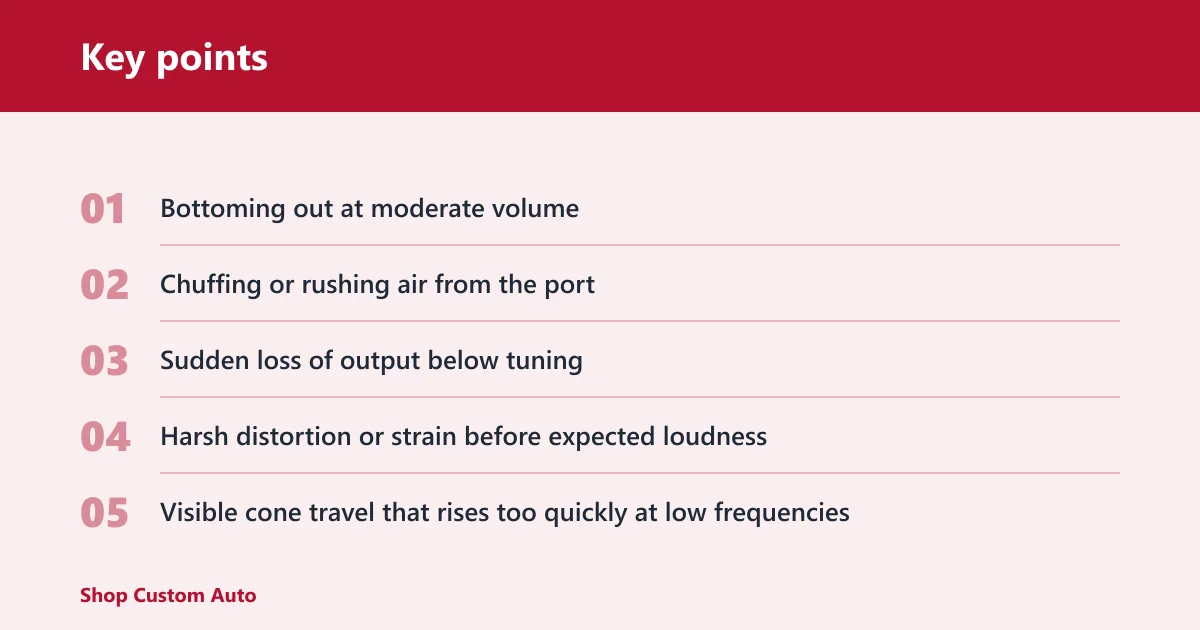
- Bottoming out at moderate volume
- Chuffing or rushing air from the port
- Sudden loss of output below tuning
- Harsh distortion or strain before expected loudness
- Visible cone travel that rises too quickly at low frequencies
- Deep bass that disappears while upper bass gets louder
Should I add polyfill?
Polyfill can slightly change the apparent behavior of a sealed box, but it is not a cure for an enclosure that is badly undersized. It can make a sealed box behave as if it is a little larger by slowing air movement inside the cabinet, but the effect is limited. In a ported box, stuffing near the port can interfere with airflow and tuning. [Polyfill and damping references from manufacturer enclosure guides and published loudspeaker design texts.]
What polyfill can and cannot do
If a sealed box is only a little below the recommended net volume, modest fill may soften a small peak and slightly improve perceived depth. It will not turn a far-too-small cabinet into the correct design. That is why damping material should be treated as fine-tuning, not as a repair for a wrong volume. [Loudspeaker design references on stuffing and apparent volume.]
In a ported design, the priority is correct tuning and correct net volume. If the cabinet is undersized, the better fix is to correct the enclosure rather than rely on stuffing to compensate. [Manufacturer enclosure design guidance.]
How do I fix it?
The fix depends on how far the box misses the target and whether it is sealed or ported. Start with the net-volume calculation, then compare the result with the driver’s specified range. Small sealed errors may be acceptable; ported errors usually require a more exact correction because tuning is volume-dependent. [Manufacturer enclosure specifications; vented-box design references.]
How to measure net internal volume
- Measure the inside length, width, and height of the enclosure.
- Multiply those dimensions to get gross internal volume.
- Subtract the driver displacement listed by the manufacturer or calculated from the basket and motor.
- Subtract bracing displacement.
- Subtract terminal cup displacement.
- If the box is ported, subtract port displacement too.
- Compare the result to the manufacturer’s recommended sealed or ported range.
What to check before you decide
Look at the enclosure requirements for the exact subwoofer, not a generic size chart. A factory enclosure may be small because space is limited, while a custom box may be small because the builder reduced volume without checking the driver’s parameters. The correct answer depends on the exact alignment and the final net volume. [Manufacturer spec pages for model-specific volume and displacement data.]
If the box is sealed and only slightly small, keeping it may be reasonable. If the box is ported and the volume is off enough to shift tuning, the better answer is usually to rebuild or retune the enclosure rather than try to compensate after the fact. [Enclosure design references from JL Audio and Dayton Audio.]
Sources
- Thiele/Small loudspeaker parameter references and enclosure alignment discussions in standard loudspeaker design texts
- Dayton Audio enclosure design and subwoofer application resources
- JL Audio subwoofer enclosure design guides
- WinISD documentation on vented and sealed enclosure behavior
- Manufacturer specification pages for model-specific displacement, volume, and tuning data