
How Long Should the Ground Wire Be for an Amp?
For most car amps, keep the ground wire under 18 inches and long enough only to reach clean bare-metal chassis. Extra length adds resistance, which can create noise, heat, or low-voltage faults. This guide gives a quick rule for ground length, plus how to judge the ground point and when to move it.
Keep the ground run under 18 inches to minimize voltage drop
The practical answer is short: keep the amp ground wire only long enough to reach a solid bare-metal chassis point. For most installs, that means under 18 inches. If the shortest safe path needs more than that, the problem is usually the grounding point, not the wire itself.
That rule is about electrical loss, not installer preference. A longer ground adds resistance, and resistance creates voltage drop and heat. The goal is a direct return path to chassis metal, not extra slack coiled under trim.
When short means short enough
Short enough means the wire reaches the grounding bolt without stretching, crossing hot parts, or forcing a bad route. If the cable can be trimmed so it lands cleanly on the chassis, trim it. Do not leave unused length bundled up “just in case.”
If your amp is in the trunk and the nearest clean chassis point is about 14 inches away, that is often described as a good layout for the ground run. That is a good layout. If the only reachable bolt is about 26 inches away, it is generally better to move the ground point closer to the amp instead of accepting the longer return path.
Why extra length is a problem
Extra ground length is not harmless slack. It adds conductor resistance, which can reduce the amplifier’s available voltage under load. That matters most when current draw is high, wire size is marginal, or the system already sits close to its limits.
One extra foot may not break a mild system with plenty of margin, but it is still avoidable loss. The shorter path is the safer path because it reduces the chance of noise, protect mode, and heat at the connection.
Amp ground wire decision table
Use this table as a quick rule for common layouts. It treats the ground wire as a return path that should stay short, land on clean bare metal, and use a solid bolt or factory grounding point. If the setup falls outside the “OK” range, shorten the wire or move the ground point.
| Layout | Recommended maximum ground length | Acceptable mounting point | Red-flag symptoms | Recommendation |
|---|---|---|---|---|
| Trunk-mounted amp | Under 18 inches; keep it as short as the route allows | Bare trunk floor, rear seat brace, or factory chassis stud on clean metal | Protect mode, dimming headlights, bass drops out at higher volume | OK if short; shorten if the route is loose or coiled; relocate ground point if the nearest bolt is far away |
| Under-seat amp | Usually 12 to 18 inches | Seat base chassis metal only if it is clean, solid, and verified as a true chassis point | Alternator whine, weak output, amp runs hot | OK if the bolt is true chassis metal; shorten if extra slack is bundled; relocate if the seat bolt is painted or isolated |
| Rack-mounted system | As short as the rack layout allows, often under 18 inches | Rack frame only if it is bonded to bare chassis metal with a solid ground path | Noise between tracks, random shutdowns, unstable bass output | OK if the rack is bonded well; shorten if the lead is long; relocate ground point if the rack is not actually tied to chassis ground |
OK, shorten, or relocate
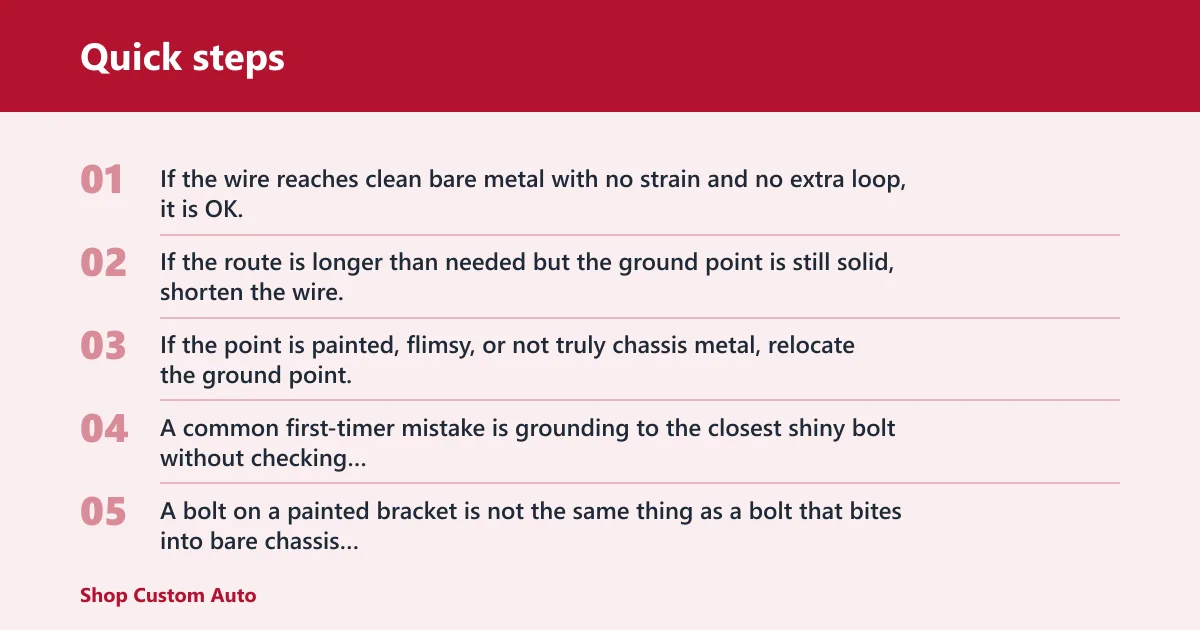
Use a simple decision rule. If the wire reaches clean bare metal with no strain and no extra loop, it is OK. If the route is longer than needed but the ground point is still solid, shorten the wire. If the point is painted, flimsy, or not truly chassis metal, relocate the ground point.
A common first-timer mistake is grounding to the closest shiny bolt without checking what it attaches to. A bolt on a painted bracket is not the same thing as a bolt that bites into bare chassis steel.
What makes a ground point good?
A good ground point is clean bare metal, a solid bolt, and a real chassis connection. The wire should land on unpainted metal that can carry current without relying on loose hardware or a coated surface. A tight connection matters as much as the wire length.
Bare metal contact
The guide recommends grounding on clean bare metal. That usually means scraping paint, primer, or surface coating from the contact area until the ring terminal touches metal directly. Corrosion should be removed too, because oxide layers add resistance and can turn a decent ground into a weak one.
Solid bolt or factory ground point
Use a solid bolt that threads into chassis metal or a verified factory ground point. Avoid sheet-metal screws, flimsy brackets, and parts that can flex. The bolt needs to hold steady under vibration so the connection does not loosen over time.
Why paint and corrosion matter
Paint and corrosion act like insulation in this context. They reduce the contact area between the terminal and the chassis, which raises resistance. That can show up as heat at the ring terminal, random noise, or low voltage at the amp when the system is under load.
Can the ground wire be too long?
Yes. A ground wire can be too long when the extra length adds avoidable resistance and reduces current return quality. The issue is not a single magic cutoff. The issue is whether the wire is longer than the install requires and whether that extra length sits between the amp and a solid chassis point.
Resistance and voltage drop
Longer wire has more resistance. More resistance means more voltage drop. The cited guide sizes wire to keep voltage drop to roughly three quarters of a volt, so a long ground path pushes the system away from that target and makes the amp work harder to stay stable.
Heat and poor current return
Heat is a sign that current is fighting resistance somewhere in the path. A long or undersized ground can warm the conductor or the termination point, especially on high-output systems. If the ground point itself gets hot, the connection is often the real problem.
When one extra foot matters
One extra foot may not matter much on a low-power amp with a clean connection and generous wire size. It matters more on larger systems, on long trunk runs, and when the amplifier already sees a heavy load. In those cases, shorten the ground or move the grounding point closer.
Should the ground wire match the power wire?
Yes. The guide says the ground should be the same gauge as the power wire. That keeps the return path from becoming the weak link. If the power cable is sized to carry the current, the ground should be able to do the same job.
Same gauge rule
Matching gauge is the clean rule because current leaves the battery on the power cable and returns through the ground. A smaller ground can bottleneck the circuit even if the power wire is correct. The same gauge on both sides keeps the system balanced.
OFC vs CCA
OFC copper is preferred because it conducts better than CCA. CCA, or copper-clad aluminum, is less conductive, and the guide models it at 1.6 times the resistance of OFC. The guide also says CCA should be stepped up a size, which means you should not size CCA and OFC the same way.
How run length changes sizing
Use the actual one-way cable route, not the straight-line distance, when sizing the system. A common trunk amp cable run is usually 15 to 17 feet, and that real route affects voltage drop. Longer runs usually call for larger wire, especially when the amp draws more current.
How do amp size and class affect the wiring?
Start with total RMS watts, not peak ratings. Then account for amplifier class, wire material, and the actual one-way route. Total RMS watts tells you the real load better than a peak number, and that matters when you choose power and ground wire size.
Use total RMS watts
If you run multiple amps, add their RMS watts together. That combined number gives a more useful estimate of current draw than any single peak value. A 300-watt system and a 1,000-watt system do not belong in the same wire category.
Class D vs Class AB current draw
Class D amplifiers are more efficient than Class AB amplifiers. The guide uses 80% efficiency for Class D and 60% for Class AB. That means a Class AB amp draws more current for the same output, so it can require heavier wire than a Class D amp at the same RMS power.
Why the cable route matters
The route matters because wiring is sized by actual length, not as-the-crow-flies distance. The guide’s chart shows 300 W with a 10 ft run uses 10 AWG OFC, 1,000 W with a 20 ft run uses 2 AWG OFC, and 3,000 W with a 20 ft run uses 4/0 AWG OFC. That jump reflects current draw and length together.
Picture a 1,000-watt Class AB amp mounted in a hatchback with a 20-foot power run. If the installer treats it like a short, mild Class D setup, the wire may be undersized. The result can be a hot cable, low voltage, or shutdowns when the bass hits.
What are the signs of a bad amp ground?
A bad ground often shows up as protect mode, shutdowns, noise, weak output, dimming lights, or hot wiring. Those symptoms usually point to resistance in the return path, a poor mounting point, or both. The amp may still power on, but it will not behave consistently under load.
Protect mode and shutdowns
If the amp goes into protect mode when volume rises, the ground connection is one of the first things to inspect. A weak ground can cause voltage sag at the amplifier, which some amps interpret as a fault condition.
Noise, weak output, and dim lights
Alternator whine, hiss, weak bass, or lights dimming with heavy notes can all point to grounding trouble. Those symptoms do not always mean the ground is the only issue, but they are strong clues that the return path needs attention before anything else is blamed.
When to move the ground point
Move the ground point if the current one is painted, loose, or far from the amp. Also move it if the wire is short enough but the symptoms remain. That is a sign the connection quality is the issue, not just the wire length.
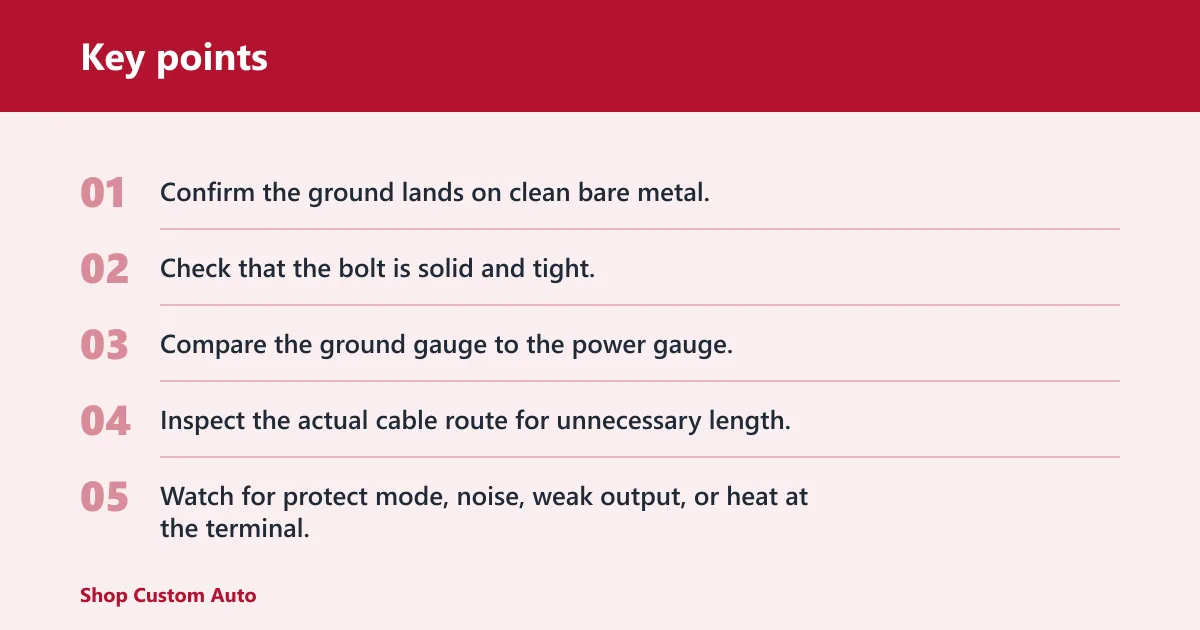
- Confirm the ground lands on clean bare metal.
- Check that the bolt is solid and tight.
- Compare the ground gauge to the power gauge.
- Inspect the actual cable route for unnecessary length.
- Watch for protect mode, noise, weak output, or heat at the terminal.
- If symptoms remain, shorten the wire or relocate the ground point.
Should the system ground have the same gauge as the power wire, the answer is yes in the guide’s rule set. That does not mean the power wire can be guessed. It means the whole run should be sized together, with total RMS watts, amplifier class, wire material, and the actual route all in the decision.
Frequently asked questions
How long should the ground wire be for an amp?
For most car amps, the ground wire should be under 18 inches and only long enough to reach a solid bare-metal chassis point. Shorter is better if the amp can still land on a secure, clean connection. Extra length adds resistance that can lead to noise, heat, or low-voltage faults.
Can the amp ground wire be too long?
Yes. A ground wire that is longer than needed adds resistance, which raises voltage drop and can hurt current return. One extra foot may not ruin a small system, but long rear-trunk return paths and marginal connections can create heat, protect mode, or weak output.
Should the ground wire be the same gauge as the power wire?
Yes. The guide says the ground should be the same gauge as the power wire. That keeps the return side from becoming the restriction in the circuit. If you step up the power wire, the ground should match that choice, especially on higher-current systems.
Where is the best place to ground an amp in a car?
The best place is a clean bare-metal chassis point close to the amplifier, secured with a solid bolt or verified factory ground point. The location should be short, solid, and free of paint or corrosion. A good ground point is usually better than a longer wire to a questionable one.
Can I ground my amp to a seat bolt?
Only if that seat bolt is a true chassis connection and the contact area is cleaned to bare metal. Many seat bolts are acceptable, but not all are. If the bolt threads into a painted bracket or an isolated structure, it is not a reliable ground point and should be changed.
Does the ground wire length affect amp performance?
Yes. Ground wire length affects resistance, and resistance affects voltage drop. That can change how the amp behaves under load, especially on larger systems or long runs. The effect is usually small when the wire is short and the connection is clean, but it grows with added length and current.
How do I know if my amp ground is bad?
Look for protect mode, shutdowns, alternator whine, weak output, dimming lights, or heat at the ground terminal. Those are common signs that the return path is weak. If the wire is short but the symptoms remain, inspect the mounting point first, then move it if needed.
Do I need to sand paint off the grounding point?
Yes. The guide recommends grounding on clean bare metal, so paint and corrosion should be removed where the ring terminal contacts the chassis. The terminal needs direct metal-to-metal contact. A painted surface can look tight while still acting like a poor conductor.
What happens if the ground wire is too long on an amp?
A too-long ground wire adds resistance and can increase voltage drop. That can lead to heat, noise, reduced output, or protect mode. The fix is usually simple: shorten the wire if possible, or move the grounding point closer to the amp and onto cleaner metal.
Can I ground an amp to the battery?
Usually no. In a car audio install, the amp ground should go to clean bare chassis metal, not the battery terminal, unless a specific system design calls for something different. The battery fuse should be within 18 inches of the battery terminal, but the amp ground itself should stay on the chassis.