Is the Battery Pop Test Safe for Car Speakers?
A battery pop test is generally safe for passive car speakers if you use a 1.5V AA cell for a brief tap; do not use 9V batteries or hold the connection on a tweeter. A bad pop test can damage voice coils, scratch cones, or give you a false polarity read. This guide shows when the test is acceptable, when you can skip it, and when a multimeter or test tone is safer.
Speaker polarity safety table
| Setup type | Battery pop test risk level | Recommended alternative |
|---|---|---|
| Passive door speakers | Low if you use a 1.5V cell for a brief tap and stop immediately | Battery pop test, then confirm with wire markings or a multimeter |
| Tweeters | Higher than a door speaker, because the parts are lighter and more delicate | Speaker polarity tester or multimeter; avoid direct battery use if the driver is small or unknown |
| Subwoofers | Use caution, especially with powered subs or shared amp wiring | Test tone, polarity tester, or meter check at the amp and speaker leads |
| Speakers already connected to an amp | Moderate to high, because the amp and signal path can complicate the result | Disconnect power, then use a multimeter or speaker polarity tester |
| Unknown or old speakers | Higher, because damaged voice coils or clipped wires can give false results | Inspect labels, check continuity, and use a tester before any pulse test |
📊 Consumer Reports charges and discharges car batteries 180 times in testing. Source: Consumerreports.
Is the battery pop test safe?
For a bare passive speaker, yes, but only with a small low-voltage battery and only for a moment. The goal is a brief pulse that makes the cone move, not a sustained feed. If the speaker is already on an amplifier, is a tweeter or subwoofer, or has questionable wiring, choose another method.
Why duration matters more than voltage alone
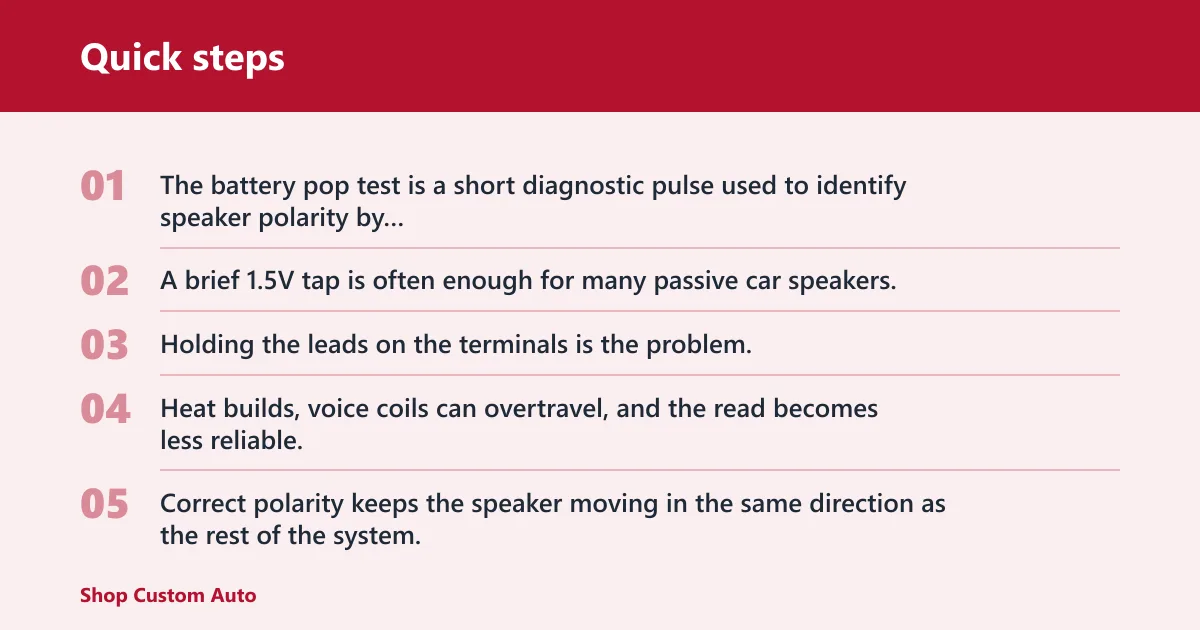
The battery pop test is a short diagnostic pulse used to identify speaker polarity by watching cone movement. A brief 1.5V tap is often enough for many passive car speakers. Holding the leads on the terminals is the problem. Heat builds, voice coils can overtravel, and the read becomes less reliable.
Correct polarity keeps the speaker moving in the same direction as the rest of the system. That helps preserve bass and sound balance. Reversed polarity can leave one speaker pushing while another pulls, and that can thin out low frequencies or make the image feel off.
Consumer Reports charges and discharges car batteries 180 times in testing, simulates under-hood heat with a 167º F water bath, and checks cold-weather performance at 0º F. That is battery diagnosis, not speaker checking. A 6V/12V battery tester belongs in the battery-health category, while a speaker pop test is a wiring check.
When to stop and use another method
Stop if the cone does not move clearly, if the speaker is already wired into an amp, or if the terminals are not obvious. That is also the time to inspect the wire run, check for clipped conductors, and verify the speaker’s condition before applying any more power.
Suppose a door speaker is out of the car and the cone barely twitches on a 1.5V cell. That weak response can point to a tired voice coil, a bad contact, or a terminal issue. Do not keep repeating the pulse. Move to a meter or a tester.
What the battery pop test checks
The test checks whether the positive and negative terminals are wired in the same direction as the rest of the system. A quick pulse makes the cone jump outward or inward. That movement shows polarity. It does not tell you everything about sound quality, but it can confirm which lead is positive.
How cone movement shows polarity
When the battery touches the speaker terminals, the cone moves because current passes through the voice coil. If the cone moves outward on the positive battery contact, the speaker terminals are marked in one direction. If it moves inward, the leads are reversed relative to that contact.
In-phase wiring means speakers move together. Out-of-phase wiring means one speaker moves opposite another speaker on the same signal. That mismatch can cause bass cancellation, especially across left and right channels or across multiple drivers in the same enclosure.
Positive and negative terminals
Most speakers mark the positive terminal with a plus sign, a wider tab, or a colored mark. The negative terminal is usually the smaller or unmarked tab. Do not guess. Check the label, compare the terminals, and confirm the wire path before final connection.
Speaker wire can use factory colors, tracer stripes, printed markings, or a solid and striped pair. Verify which conductor is positive and which is negative before you connect anything. A quick check now is easier than redoing an entire door panel later.
When should you avoid it?
Avoid the battery pop test on powered systems, on speakers already tied to an amplifier, on unknown or old drivers, and on any setup where the terminals or wire condition are unclear. Those cases raise the chance of damage or a bad reading, and a meter or tester is the cleaner choice.
Speakers already connected to an amp
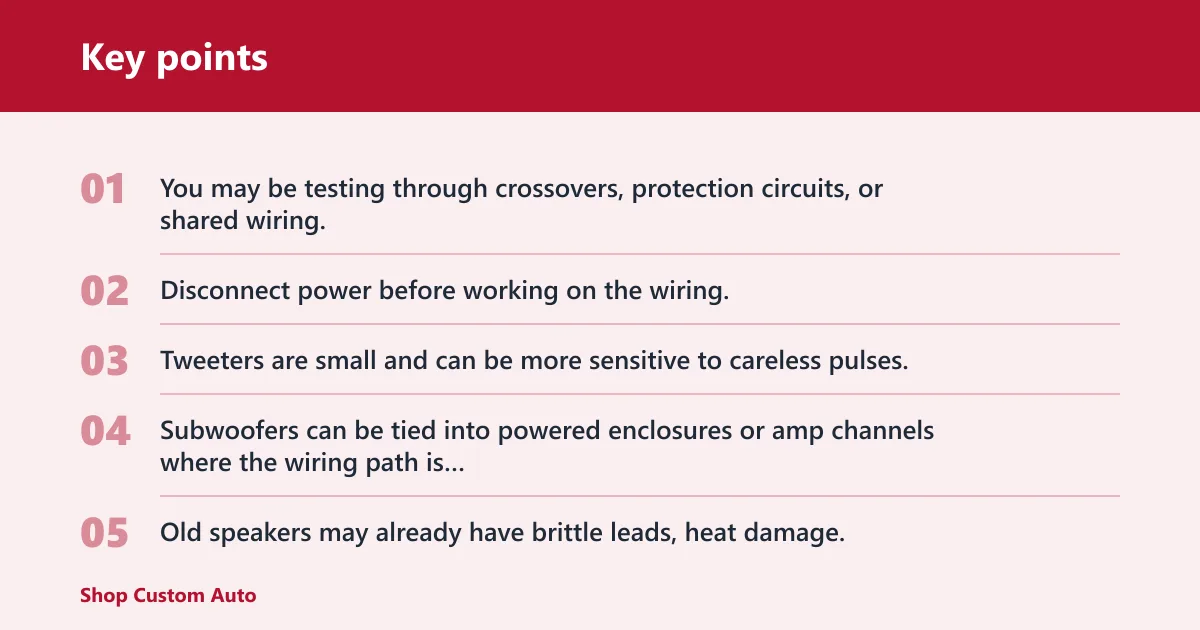
An amplifier changes the picture. You may be testing through crossovers, protection circuits, or shared wiring, so a battery pulse can tell you less than you think. Disconnect power before working on the wiring, then test the speaker leads directly with a meter or polarity tester.
Tweeters, subwoofers, and unknown old speakers
Tweeters are small and can be more sensitive to careless pulses. Subwoofers can be tied into powered enclosures or amp channels where the wiring path is not simple. Old speakers may already have brittle leads, heat damage, or a voice coil that is close to failure.
A common first-timer mistake is to pop-test a speaker with a clipped wire end and assume the lack of movement means reverse polarity. The fault may be a broken conductor, not the wiring direction. If the terminals are dirty, bent, or corroded, clean and inspect first.
Clipped wires, damaged voice coils, and unclear terminals
Clipped wires can stop current flow and make the cone stay still. A damaged voice coil can do the same. Unclear terminals make the result hard to trust. In any of those cases, use a multimeter for continuity or a dedicated speaker polarity tester before touching the cone again.
Speaker polarity safety
This table gives the practical decision rule. Use the battery pop test only when the speaker is bare, passive, and easy to reach. When the setup includes an amp, a subwoofer enclosure, or an unknown driver, a meter, polarity tester, or test tone is the cleaner choice.
What is the safer alternative?
A multimeter, a speaker polarity tester, or a test tone is safer when the wiring is not simple. These tools reduce guesswork. They also avoid direct cone movement checks on drivers that may already be stressed, amplified, or hard to access.
Use a multimeter to identify wires
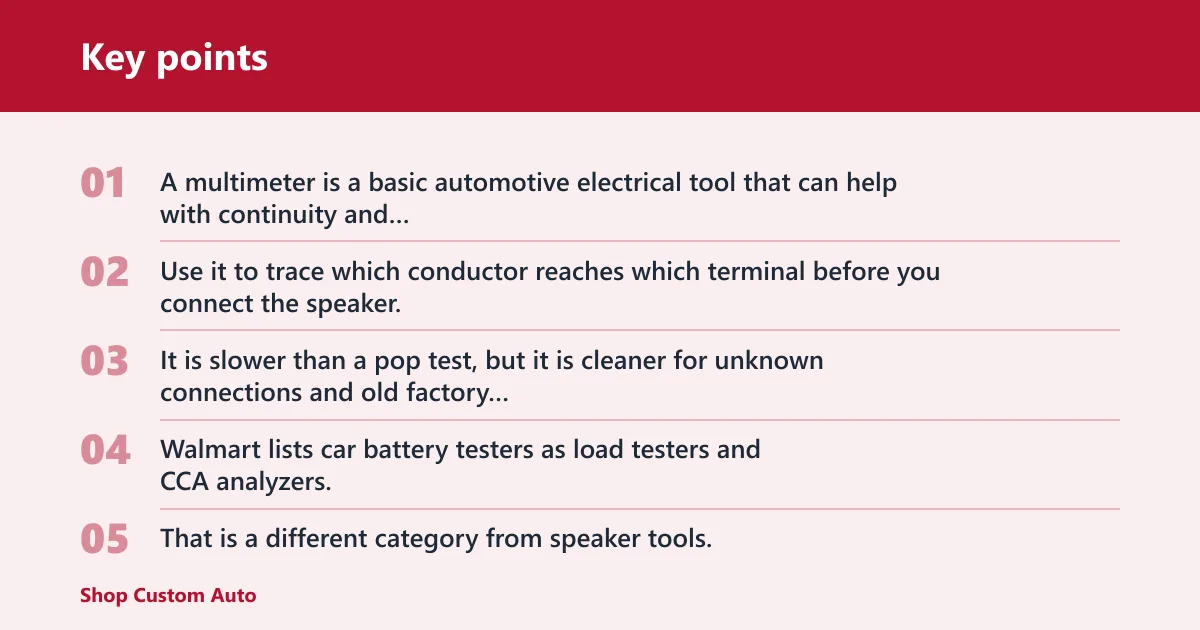
A multimeter is a basic automotive electrical tool that can help with continuity and wire identification. Use it to trace which conductor reaches which terminal before you connect the speaker. It is slower than a pop test, but it is cleaner for unknown connections and old factory wires.
Walmart lists car battery testers as load testers and CCA analyzers. That is a different category from speaker tools. Walmart also shows a 100A car battery load tester and voltmeter, and a featured Schumacher tester that works with 6V and 12V batteries. Those tools are for battery diagnosis, not speaker polarity.
Use a speaker polarity tester for a faster check
A dedicated speaker polarity tester is built for this job. It is faster than a manual battery tap and confirms polarity without pushing directly on the cone. For a car audio owner who wants a quick go or no-go read, that is often the cleaner first choice.
Use a test tone to spot bass cancellation
A test tone is useful when you want to check phase in the car after wiring. Play a known low-frequency tone and listen for bass that disappears, thins out, or seems to move across the cabin. That method is especially helpful when more than one speaker is involved.
Say your left door speaker is new, the right side is factory, and the bass seems weak after a wiring change. A test tone can show phase cancellation even when each speaker seems to move the right way on a pop test. That makes it useful after installation, not before.
How do you identify speaker wire polarity?
Start with the wire itself. Factory wires often use colors, stripe markers, or printed labels. Before any connection, verify the positive and negative conductors against the vehicle diagram or the speaker markings. If the wire colors do not match the usual pattern, test the pair before final assembly.
Check factory wire colors and stripe markers
Look for a solid color paired with a striped version of the same color, or a marked conductor paired with an unmarked one. The markings are there to reduce mistakes. If the wire route has been repaired before, assume nothing and trace both ends with a meter.
- Disconnect power before you touch speaker wiring.
- Find the positive terminal on the speaker and the likely positive conductor in the wire run.
- Verify the negative side with the matching conductor or continuity check.
- Confirm the pair before you install the speaker fully.
- Use a brief battery tap only if the speaker is bare, passive, and easy to inspect.
Verify the positive and negative conductors before final connection
If the wire pair is reversed, fix it before the panel goes back on. That is the point where mistakes cost time. Recheck labels, stripe markers, and terminal size. If the system includes an amplifier, verify polarity at the amp output and at the speaker end.
How do I test speaker polarity with a battery?
Touch a 1.5V battery to the speaker terminals for a brief moment and watch the cone. The movement tells you which terminal is positive relative to that battery contact. Use only a short tap. Remove the battery immediately after the cone moves, and stop if the speaker is not a bare passive driver.
What battery should you use for a speaker pop test?
A small low-voltage battery is the correct choice. A 1.5V AA cell is a common starting point for a quick pulse. Do not use a larger battery just because it is nearby. The point is a brief signal, not a stronger one. More voltage is not better here.
Can a 1.5V battery damage car speakers? Usually it is the least risky option for a passive speaker, but damage is still possible if you hold the contact too long, use the wrong speaker type, or apply the pulse to a driver that is already damaged. Brief contact matters more than the exact cell size.
What happens if you test speaker polarity backwards?
If the battery is reversed relative to the intended polarity check, the cone will move the opposite way from what you expected. That does not automatically mean the speaker is bad. It often means the reference lead was chosen the other way around. Recheck the positive and negative terminals before changing the wiring.
What if the cone does not move?
If the cone does not move, do not keep applying power. Check the contact points, confirm the battery is a small low-voltage cell, and look at the speaker condition. Silence can mean a bad lead, a broken wire, a failed voice coil, or a speaker that needs a different test method.
Check your contact points and battery type
Make sure both battery contacts touch the correct speaker terminals at the same time. A dirty terminal, a loose clip, or the wrong battery can leave the cone still. If the wiring is already installed, test continuity first so you are not chasing a wiring fault with a pulse test.
Never keep the battery on the speaker just to force movement. That can heat the coil and give you a false result. If nothing changes after a clean, brief contact, inspect the speaker and wiring before you try again.
Frequently asked questions
Is the battery pop test safe for car speakers?
It is generally safe for passive car speakers when you use a 1.5V battery for a brief tap and remove it right away. It is not the right choice for every setup. Avoid it on powered systems, speakers already on an amp, or any driver with unclear condition.
Can a 1.5V battery damage car speakers?
A 1.5V battery is often the lower-risk choice, but damage can still happen if it is held on the terminals, used on a tweeter that should be handled more carefully, or applied to a speaker that already has a weak voice coil. Brief contact is the key limit.
How do I tell which speaker wire is positive and negative?
Check the factory wire colors, stripe markers, and any printed labels before you connect the speaker. Then verify the pair with a multimeter or continuity check if the wire run is old or repaired. Do not guess from color alone, because repairs and swaps can change the pattern.
Should I use a battery tester instead of a pop test?
Not for speaker polarity. A battery tester is for battery health, including load tests and CCA checks. Retailers list 6V and 12V battery testers, including load testers and voltmeters, for diagnosing the car battery itself. Use a speaker tool or meter for speaker wiring.
Is there a safer way to test speaker phase in a car?
Yes. A speaker polarity tester is the cleanest quick check, and a test tone is useful after installation to spot bass cancellation or out-of-phase wiring. A multimeter also helps identify the correct conductors before you connect anything, which is often the safest step of all.