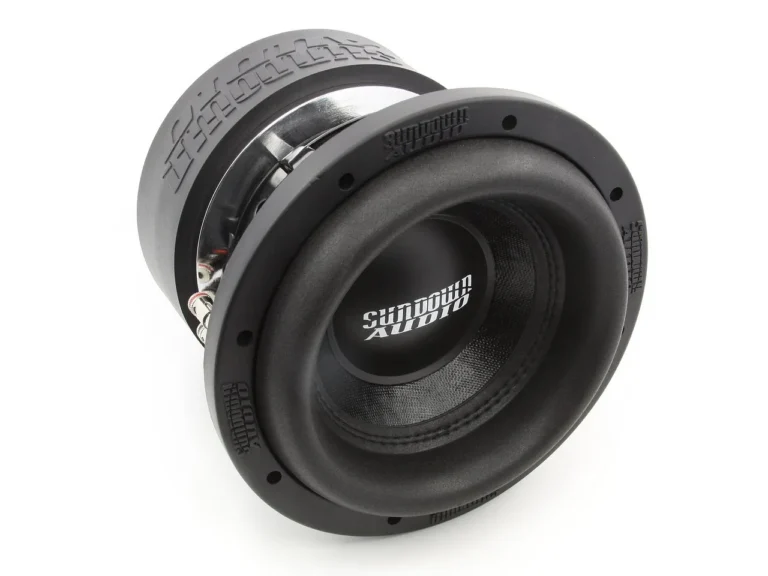
Subwoofer Phase: How to Set It for Stronger Bass
Set subwoofer phase where bass is strongest and most even at the driver’s seat near the sub-to-midbass crossover, starting at 0°, then comparing 180°, or sweeping a variable phase control in 15° steps for the loudest, fullest result. Set it wrong and the sub and front speakers can cancel each other, leaving weak punch, uneven bass, and a seat-to-seat mess. This guide shows a repeatable tuning workflow and how to tell when phase helps versus when polarity, crossover, placement, or time alignment is the real fix.
What subwoofer phase actually changes
Phase vs polarity: what a 0/180 switch really does
In a car audio system, phase is the timing relationship between the subwoofer and the main speakers at the listening position. When that timing lines up through the overlap region, bass adds together. When it does not, that same region can cancel, and you hear the problem most clearly near the crossover frequency. This seat-dependent summation behavior is standard loudspeaker interference and is the same reason installers check polarity and overlap first when bass sounds thin near crossover (see Audiofrog technical articles on polarity, delay, and crossover integration; JL Audio setup guidance).
Many subs use a simple 0/180-degree switch. That control flips polarity rather than giving a variable phase range. 0° is normal polarity, so it is the correct baseline for setup. 180° is reverse polarity, and it can fix cancellation in some systems, but it is never automatically right. In other words, a switch is a coarse check for whether the sub is adding or subtracting in the overlap band, not a precise time-alignment tool.
What a variable 0 to 180 dial changes at the crossover
Some powered subs and DSPs offer a continuous phase control that runs from 0 to 180 degrees. That control adjusts the sub’s timing relationship relative to the rest of the system, mainly where the sub and front speakers overlap. Treat it as a fine-tuning tool for the seat that matters most, usually the driver’s seat in a car. Manufacturers and tuners commonly use it to improve acoustic summation near the crossover rather than to change deep-bass output by itself (Audiofrog, Helix DSP tuning guides, and REW measurement practice all treat it this way).
The reason this matters in cars is simple: the cabin is asymmetrical. The sub box may be in the trunk, one side of a hatch, or behind a rear seat. The front midbass drivers are much closer to one seat than the other. The best setting changes with crossover point, physical path length between sub and seat, and the way the cabin reinforces or cancels bass, so the same gear can want a different setting in a different vehicle or after the box is moved.
What phase does not change
Phase control does not change frequency content, crossover slope, or amplifier power. It is not a bass boost. It is not a gain knob. It does not rescue a bad crossover choice.
That is why volume, crossover frequency, and phase need to be set together. If gain is too high, phase changes can sound dramatic for the wrong reason. If crossover overlap is too small, phase changes can seem useless because there is too little shared bandwidth to hear the effect. Car-audio setup guides from JL Audio and Audiofrog make the same point: the polarity or phase choice only matters where both sources are active enough to interact.
Why does phase matter most at the driver’s seat?
Phase matters most at the driver’s seat because that is where the timing between the sub and the front speakers is judged in an asymmetrical cabin. The driver and passenger can hear very different bass because path lengths are different, and phase errors show up first where the sub and midbass overlap around the crossover.
Seat-specific bass in a car cabin
A living room lets listeners move around. A car does not. The seat is fixed, the cabin is small, and reflections arrive fast. That makes sub integration far more seat-specific than many home-theater guides suggest.
The phase setting helps line up the sub’s bass with the main speakers at the listening position. What matters is not whether the control lands on a tidy number, but whether the sub and speakers reach the seat at roughly the same time. In practice, tuners usually prioritize one seat, lock the crossover and level, then judge whether the handoff around 60 to 100 Hz gets fuller or hollower as phase changes.
Why the driver and passenger can hear opposite results
A common complaint is strong bass on the passenger side and weak bass in the driver’s seat. That does not automatically mean the sub is defective or the box is wrong. It often means the timing and cabin modes favor one seat more than the other.
Phase can improve the driver’s seat if the weakness is centered near crossover overlap. It cannot erase every cabin-mode problem. If one seat sits in a deep null, placement or delay may be the better fix.
Picture a hatchback with a single 12-inch box mounted on the right side, firing rearward. The passenger gets solid upper bass, but the driver hears a hole around kick drum notes. Before touching EQ, keep gain and crossover fixed, compare 0° and 180° at the driver’s seat, then try delay if neither setting restores the handoff.
Why the crossover region is where the problem shows up
Phase problems are often heard where the sub and front speakers overlap, rather than in the deepest bass. That is why the signs are specific: thin kick bass, a missing band in upper bass, or a handoff that makes the sub sound separate from the doors. Car-audio setup guides typically place this listening check around the chosen low-pass and high-pass region because that is where both sources can either sum or cancel.
One useful reference point: at 80 Hz, 1 millisecond is about 29 degrees of phase error. The math is straightforward: one 80 Hz cycle lasts 12.5 ms, and 1/12.5 of a cycle is 0.08 cycle, which equals 28.8 degrees. That helps explain why small timing changes from seat position, box relocation, or head-unit delay can produce obvious bass changes around the crossover. This example follows standard acoustics math and matches the time-versus-phase relationship used in REW and car-audio DSP tuning references.
Should your subwoofer phase be 0 or 180?
Start at 0° because that is the normal wiring reference, then compare 180° at the driver’s seat with gain and crossover fixed. Keep the setting that gives the strongest bass through the crossover and the cleanest handoff to the front speakers, since either position can be right depending on cabin geometry and sub placement.
0 degrees as the default starting point
Use 0° first unless there is a known wiring inversion elsewhere in the system. It gives you a clean baseline and keeps you from chasing two variables at once.
With a simple switch, the fast test is easy: listen from the driver’s seat to a familiar bass passage that crosses the sub-to-midbass region, then flip between 0° and 180°. Ignore sheer boom. Keep the position that fills the crossover region and makes bass sound connected to the front stage.
When 180 degrees fixes cancellation
180° can help when the sub’s output is arriving in reverse relationship to the front speakers near the crossover. That can happen after a box relocation, opposite-side mounting, a wiring inversion, or a delay setting that moved the overlap into cancellation.
If 180° gives more punch and restores missing kick bass, the system was likely canceling around the crossover. The gain did not increase. The overlap simply summed better at the seat. This is why measurement guides often recommend checking polarity before reaching for EQ: if the problem is destructive summation, equalization rarely fixes the handoff cleanly.
When neither 0 nor 180 is the full answer
Some systems need a setting between the two switch positions. That is where a variable phase dial or DSP adjustment matters. A 0/180 switch is a coarse polarity tool. It can solve large errors, but it cannot place the blend exactly where the cabin wants it.
Say your sub crosses at 80 Hz, the doors are high-passed cleanly, and 0° sounds thin while 180° sounds thick but loose. That is the classic sign to sweep a variable phase control, because the best seat result may live between those endpoints. Continuous phase is especially helpful when the acoustic offset is moderate rather than a near-complete inversion.
How do you set subwoofer phase for stronger bass?
Set phase with one seat, one track or test sweep, fixed gain, and fixed crossover. Start at 0°, compare 180° if the sub has a switch, or sweep a variable dial in about 15° steps if available. Keep the setting that makes bass strongest and smoother through the crossover, not simply louder and boomier.
Lock down gain, crossover, and seat before you listen
- Choose the driver’s seat as the priority listening position.
- Set sub gain first, and do not turn the subwoofer volume up too much.
- Set crossover before phase. The sub needs real overlap with the front speakers for phase changes to be audible.
- Turn off bass boost and extra EQ changes for this test.
- Use one familiar passage with repeatable kick-bass content, or a slow sweep that clearly crosses the handoff region.
- Change one variable at a time.
This order matters because a properly tuned sub needs volume, crossover frequency, and phase controls set together. If gain, crossover, and phase all move at once, the result is impossible to judge. A practical car-audio workflow is crossover first, then level match, then polarity or phase, then delay if needed.
The fast test for a 0/180 switch
- Play the same 20 to 30 second section repeatedly.
- Sit in the driver’s seat with windows in the same position for each pass.
- Listen for kick drum weight, bass guitar continuity, and whether bass pulls toward the rear.
- Flip from 0° to 180°.
- Keep the setting that gives more even output through the handoff, even if overall bass is only slightly louder.
If one setting is louder but also turns into one-note boom, do not stop there. That can mean phase fixed a cancellation but exposed too much gain, too high a crossover, or a placement peak.
The sweep method for a continuous phase dial
- Start at 0°.
- Move the dial in 15° steps: 15°, 30°, 45°, and so on.
- After each change, replay the same passage from the driver’s seat.
- Mark the two best settings by ear.
- Go back and compare those two settings again.
- Keep the position with the strongest, fullest, and most attached bass through the overlap region.
Slow sweeps work because the audible effect is mostly in the crossover region. The best setting is usually the one where the sub stops sounding late or detached from the front speakers. On a measurement trace, that same best-by-ear region usually shows a stronger combined response around crossover rather than a deeper dip.
How to verify phase with REW or an RTA
If you want to confirm the by-ear result, use Room EQ Wizard or a real-time analyzer with the mic at the driver’s head position. Mute the sub and measure the front speakers alone through the crossover region, then mute the fronts and measure the sub alone, then measure both together at each phase setting. Keep gain and crossover fixed for every pass. The best phase setting is usually the one that produces the highest and smoothest combined response through the overlap band, not necessarily the highest single peak.
A simple verification routine is:
- Measure or watch the response from roughly one octave below to one octave above the crossover.
- Compare 0° and 180°, or measure each 15° step on a variable dial.
- Look for a shallower dip or better summation around the handoff frequency.
- If both settings still show a broad hole, adjust delay and recheck phase.
REW users often confirm this with the acoustic timing or impulse view, while an RTA user can still make the right call by watching which setting fills the crossover dip most consistently. This is standard measurement practice rather than a special car-only trick.
What result to keep: stronger and smoother, not simply boomier
The right phase setting usually gives more punch, a cleaner handoff, and less sense that bass comes from the cargo area. The wrong setting often creates a dip, weak impact, or an odd split where deep bass is present but upper bass vanishes.
A common first-timer mistake is picking the setting with the biggest low-note swell, then wondering why kick drums disappear. If the bass got louder only on a few notes and less even overall, phase was not fully solved. Recheck crossover, gain, or placement next.
Phase diagnosis matrix
How to read the matrix
Use the symptom at the driver’s seat to decide whether phase is the first move or whether another control deserves attention first. The order column matters. It keeps the process from turning into random knob-turning.
| Symptom at driver’s seat | Likely cause | Best phase test | Next fix | Adjustment order | Expected result |
|---|---|---|---|---|---|
| Bass is thin right around kick drum and upper bass | Cancellation in the crossover overlap | Compare 0° and 180° or sweep 0-180° slowly on the same passage | If one setting helps only partly, fine-tune crossover and then delay | Crossover, then phase, then delay | More punch and a smoother handoff to the front speakers |
| Bass gets louder but also boomier | Phase improved overlap, but gain or crossover is too high, or placement peak dominates | Keep the stronger phase setting, then lower gain slightly or lower crossover | Recheck placement if one-note boom stays | Phase, then gain, then crossover, then placement | Stronger bass without a swollen note range |
| Phase switch seems to do nothing | Overlap too small, crossover too low, gain mismatch, weak door midbass, or strong cabin mode | Raise overlap only within safe integration limits and retry; confirm front speakers contribute in upper bass | Check crossover, front speaker output, then placement or delay | Gain and crossover, then phase, then placement/delay | Audible phase effect appears only if both sources overlap enough |
| Bass changed after moving the box | Path length and cabin interaction changed | Reset to 0° and repeat the seat test from scratch | Try box orientation or location before deep EQ changes | Placement, then phase, then delay | Recovered punch after relocation without guessing |
| Driver seat is weak but passenger seat is strong | Seat-specific null or timing mismatch from asymmetrical paths | Judge only at the driver’s seat and compare phase positions there | If driver seat stays weak, use delay or move the box; accept tradeoff at passenger seat | Seat choice, then phase, then delay, then placement | Better driver-seat bass, though both seats may not match perfectly |
| Sub and front speakers sound disconnected | Poor timing through the overlap or crossover set too high | Sweep phase for the setting that pulls bass forward and blends with the doors | Lower crossover if bass still localizes to the rear | Crossover, then phase, then delay | Bass becomes less localizable and more attached to the front stage |
| Sealed box seems close at 0°, ported box sounds fussier | Ported systems can be more sensitive near tuning and overlap; sealed often needs less correction | Start sealed at 0° and verify; sweep ported systems more carefully through the overlap region | Revisit crossover choice if the ported setup gets thick near the handoff | Placement, then crossover, then phase | Cleaner starting point, with extra care where the ported box interacts strongly |
| Phase helps a little, but timing still feels off | Distance mismatch is larger than phase alone can tidy up | Set rough phase first, then use head-unit or DSP delay and fine-tune phase again | Use delay as the main fix when seat timing error is obvious | Delay first, then phase, then crossover review | Better alignment than phase alone can provide |
| 180° sounds better after opposite-side mounting | Mounting change flipped the useful polarity relationship at the seat | Keep 180° only if the crossover region fills in and bass pulls forward | Fine-tune delay if available | Placement change, then polarity, then delay | Recovered midbass impact after side change |
| Deep bass is strong, but upper bass has a hole | Classic crossover-region cancellation, not lack of sub output | Use a track with repeated kick bass, not a sub-bass-only tone | Adjust crossover and phase before adding gain | Crossover, then phase, then gain | Upper bass returns without overloading deep notes |
Why did phase make the bass louder, weaker, or do nothing?
Phase changes loudness at the seat because it changes reinforcement or cancellation where the sub and front speakers overlap. If the overlap lines up better, output rises there. If it lines up worse, output drops. If nothing changes, the crossover overlap may be too small, gain may be mismatched, or cabin acoustics may be dominating.
Louder because the overlap reinforced
When bass gets louder after a phase change, the gain did not suddenly increase. The sub and main speakers simply summed better in the shared range. This is often heard as restored kick, fuller bass guitar notes, and less of a hole between the doors and the sub.
Weaker because the overlap canceled
If bass gets weaker, the overlap moved further out of alignment at the listening position. That is common when a switch is flipped to the wrong side, or when a delay change made the previous phase setting obsolete.
No change because the overlap is too small or another issue dominates
If the switch seems useless, look at the setup before blaming the control. Common reasons are a crossover set too low, front speakers that cannot produce enough upper bass, sub gain set far above or below the rest of the system, or a strong cabin null at the seat.
Phase control adjusts timing relative to the rest of the system, but it does not override a seat sitting in a major null. In that case, placement or delay may matter more.
Louder but boomier: when phase fixed one problem and exposed another
This is one of the most misread results. The system may have had cancellation around crossover, and correcting it made the remaining low-frequency peak easier to hear. The fix is usually not “go back to the thinner setting.” It is to keep the better phase alignment and then trim gain, revisit crossover, or move the enclosure.
When should you change phase after moving the sub box?
Change phase any time the sub box moves, rotates, or switches sides because the path length and cabin interaction changed. Even a move that keeps the same hardware can change the best setting at the driver’s seat, so phase should be rechecked after relocation before changing EQ or gain.
How placement changes path length
Moving the box changes how far the sub is, acoustically, from the listening position relative to the front speakers. That shifts the timing relationship through the overlap region. The previous best setting may no longer be close.
This applies to trunk cars, hatchbacks, SUVs, under-seat subs, and side-mounted enclosures. Placement and phase are tightly linked.
Rear-corner, center, and opposite-side mounting effects
A rear-center box may behave differently from a right-rear corner box. An opposite-side mount can change the best polarity choice at the driver’s seat. A box rotated from rear-firing to up-firing or side-firing can also alter the cabin interaction enough to change the phase result.
Suppose a sealed 10-inch box was centered against the rear seat and sounded balanced at 0°. Move it to the left rear corner to free cargo space, keep the same gain and crossover, and the driver now loses kick. Recheck phase first, because the path relationship changed before anything electrical did.
Sealed vs ported starting points after relocation
Sealed systems often need less correction at the start, so 0° is a sensible first pass after a move. Ported systems can be more sensitive around tuning and the crossover overlap, so they often benefit from a slower sweep through the variable phase range if available. That difference is consistent with how ported systems add phase rotation around tuning, while sealed alignments are usually simpler to integrate near crossover.
Neither enclosure type gets a free pass. Both still need to be judged from the seat.
What is the difference between phase and delay?
Delay adds time based on distance settings in a head unit, DSP, or AVR-style alignment system, while phase changes the timing relationship through the overlap region between the sub and main speakers. They are related tools, but they are not identical, and one does not always replace the other.
How head-unit or DSP time alignment adds delay
Many modern processors can use distance-based delay to help with alignment. That can get the sub and front stage closer in arrival time at the listening position, which is often a better first move when the seat-to-sub distance is obviously long or uneven.
Delay is especially useful when the mismatch is broad and easy to identify: the sub feels late, rear-biased, or detached even before fine phase tuning begins.
When delay gets you closer than phase alone
If the system needs a substantial timing correction, phase alone may only improve one narrow part of the blend. Delay can shift the whole relationship closer before the finer overlap adjustment is made.
That 80 Hz reference helps here too: 1 millisecond equals about 29 degrees of phase error at 80 Hz. A few milliseconds of distance correction can make a major difference before phase is touched. REW, DSP manuals, and car-audio tuning guides all use this same time-domain logic when aligning a sub to front midbass.
When to set delay first and fine-tune phase after
Set rough delay first when the sub is far from the front stage or the head unit offers reliable time alignment. Then fine-tune phase at the driver’s seat. This order is often cleaner than trying to force the blend with phase alone.
Time alignment can get the system close, but phase still matters at the crossover and with enclosure or placement effects. Delay and phase work together.
Cases where delay is the better fix
If 0° and 180° both sound wrong, or the variable dial helps only a little, delay may be the better tool. It is also the stronger option when the sub was relocated far from the previous position, when opposite-seat timing changed sharply, or when the bass sounds late rather than simply thin.
Wrong phase will not damage the subwoofer or amplifier. The penalty is poor integration: a crossover dip, rear-biased bass, or boomy one-note output.
Frequently asked questions
Should my subwoofer phase be 0 or 180?
Start at 0° because that is the normal polarity reference, then compare 180° at the driver’s seat. Keep whichever setting gives the smoother, fuller crossover handoff. Either one can be right depending on placement, distance, and how the cabin affects the listening position.
Why does my subwoofer get louder when I change the phase?
The sub gets louder at the seat when the phase change improves reinforcement between the sub and the front speakers in the overlap region. Gain did not increase. The system simply summed better near the crossover instead of partly canceling.
Why does the phase switch do nothing on my sub?
If the switch seems ineffective, the crossover may be too low, overlap may be too small, front speakers may not have enough upper bass, gain may be badly mismatched, or the seat may be sitting in a strong cabin null. In those cases, placement or delay can matter more.
Can time alignment replace subwoofer phase?
Sometimes it gets very close, especially when distance mismatch is the main problem, but it does not always replace phase. Delay adds time based on distance, while phase still affects the blend around the crossover and can need fine-tuning after placement or enclosure changes.
Can the wrong subwoofer phase damage the sub or amp?
No. The wrong phase setting does not damage the subwoofer or amplifier by itself. The downside is acoustic, not mechanical: weaker punch, a hole around crossover, bass that seems detached from the front speakers, or output that gets louder but less even.
About the author: This guide was prepared by the Shop Custom Auto editorial team and reviewed against manufacturer setup guidance and measurement documentation commonly used in car-audio tuning. The workflow reflects standard practice for integrating a trunk or hatch sub with front midbass at the driver’s seat: lock crossover and gain, compare polarity, then verify the overlap by ear or with a measured response trace.
Sources
- Audiofrog technical articles on subwoofer polarity, phase, crossover overlap, and time alignment in car-audio systems.
- JL Audio setup guidance for crossover integration, polarity checks, and seat-based tuning.
- Room EQ Wizard documentation and help files on acoustic timing, impulse response, and response measurements around crossover.
- Basic acoustics relationship between frequency, period, and phase angle: phase angle = time offset / period × 360°.