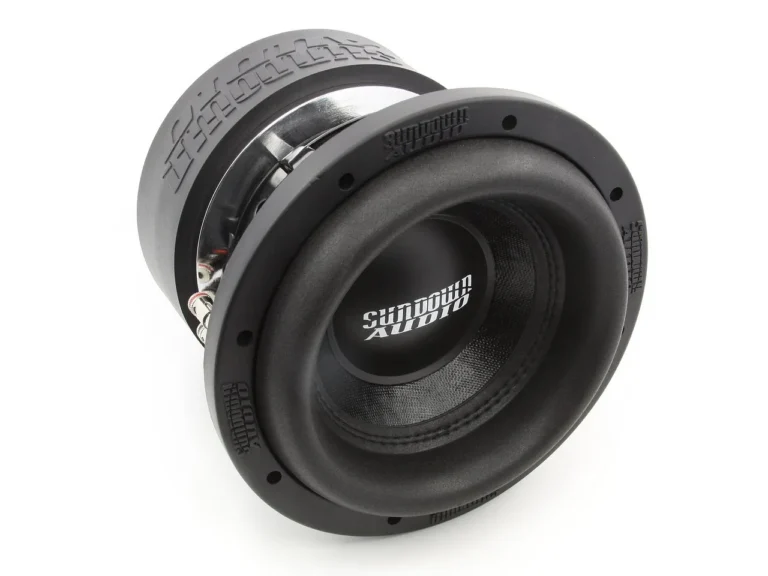
Does a Subwoofer Need a Box in a Car?
Yes, most car subwoofers need a sealed or ported box, and a bare driver should not be run free-air unless it is built for that use. Skip the right enclosure, and bass gets weak, distorted, and risky for the speaker and surrounding trim. This guide explains when a box is required, the rare exceptions, and how enclosure choice affects sound, safety, and fitment.
Does a subwoofer need a box?
Yes, for best performance. A subwoofer enclosure controls the air behind the cone and the air in front of it, which changes bass output, distortion, and how hard the speaker can work before problems start. A bare subwoofer can function in a few special setups, but that is the exception, not the norm. For a practical overview of why enclosure design matters, see Crutchfield’s enclosure guide and JL Audio’s subwoofer enclosure basics.
What changes when the sub runs without an enclosure
Without a box, the rear wave can meet the front wave and cancel bass output, especially at lower frequencies where the wavelengths are long. That makes bass sound thin, and in a car cabin it can also make the driver work harder for less result. The result is usually less output, more distortion, and less control at higher volume.
When the answer becomes a qualified maybe
Some free-air or infinite-baffle setups use the car body as the enclosure, but that only works with subwoofers designed for it. Most car owners should not assume a normal trunk or hatchback panel can replace a real box. For standard passive subwoofers, the enclosure is part of the design, not an optional accessory. See Crutchfield’s enclosure guide and Kicker’s free-air subwoofer explanation for more on when free-air use is appropriate.
Why an enclosure matters

An enclosure does more than hold the speaker in place. It shapes cone movement, keeps bass more controlled, and helps the sub reproduce the frequencies it is meant to play. The box volume also has to match the driver: too little air space raises stiffness and can make the bass sound peaky or strained, while too much or too little tuning can reduce control and change the low-end response. See JL Audio’s subwoofer enclosure basics for how enclosure volume affects performance.
How the box controls front and rear sound waves
The subwoofer enclosure keeps the air behind the cone separate from the air in front of it. That matters because rear-wave energy can cancel bass, especially in open or poorly matched spaces. A proper box gives the driver a defined air spring or vent tuning instead of an uncontrolled cavity, which helps keep bass output more stable.
How enclosure choice affects bass output and distortion
The wrong enclosure can change bass in ways you will hear quickly. A small box can raise distortion and reduce output, while a poor fit can increase rattles as the cabin panels and trim shake harder than they should. At high volume, the driver can also over-excursion if the box is too small or the tuning is wrong, which is one reason enclosure sizing matters so much.
Why the right box also helps protect the driver
A box helps keep the cone under control, which lowers the risk of physical stress and damaged sound quality. It also keeps the subwoofer more stable in the vehicle, which matters when the car turns, brakes, or carries cargo. That extra support is part of why a box is the default answer for car audio. For more on how enclosure alignment protects the driver, see Crutchfield’s enclosure guide.
Subwoofer box types
Sealed, ported, and bandpass are the main enclosure types. Sealed boxes are acoustic suspension enclosures. Ported boxes use a tuned port or vent. Bandpass boxes use two chambers. Each one changes loudness, accuracy, and fitment in a different way.
Sealed box: compact and accurate
A sealed subwoofer box is usually the safest choice when you want tighter bass response and a smaller footprint. It is compact, easier to place in a trunk, and tends to sound more accurate than a ported design. If you listen to music where bass notes need to stay clear, this is the box to start with.
Ported box: louder but less accurate
A ported subwoofer box uses a tuned port or vent to increase output around its tuning range. That usually means louder bass than a sealed enclosure, but it is often less accurate. If the goal is strong output for daily listening, a ported design can make sense, especially when cabin space can support the larger box. For a deeper comparison, see Sealed, ported, and bandpass.
Bandpass box: when output matters more than precision
A bandpass box uses two chambers and can produce strong output in a narrow range. It can be the right choice when peak loudness matters more than natural bass tone. The tradeoff is flexibility, because bandpass enclosures are less forgiving of bad tuning and poor placement than sealed boxes.
When can you skip a box?
You can skip a separate box only in setups built for that approach, such as some powered subwoofers, enclosed modules, or true free-air applications. Even then, placement still matters, and the driver still needs the right mounting surface and operating conditions. For most car audio installs, no box means worse sound and more risk.
Powered subwoofers and enclosed modules
A powered subwoofer has a built-in amplifier, so it does not require a separate amp to function. That makes it simpler to install, but it still benefits from proper placement and a stable location. Many powered units arrive in a built enclosure, which is why they are often easier to fit in small cabins or under seats.
Special cases that still need careful placement
Some factory-style or compact installs rely on a very specific enclosure shape to fit around cargo space, seat mounts, or load-through access. In those cases, a small enclosure may be acceptable only if it matches the subwoofer’s design and the available volume. A random small box is more likely to create distortion and reduced output than useful bass.
Why most free-air style setups are the exception
Free-air mounting can work only when the subwoofer and the vehicle layout are chosen for it. That is not the same as tossing a normal driver into the rear deck or cargo area and hoping for bass. Say your hatchback owner wants more low end without giving up cargo room; a compact sealed enclosure often makes more sense than an improvised open mount.
Subwoofer decision table
| Use case | Enclosure required or optional | Expected bass behavior | Risk if used naked | Best box type |
|---|---|---|---|---|
| Trunk install | Required for normal use | Strong cabin loading, good space for enclosure depth | Weak bass and wave cancellation | Sealed or ported |
| Small hatchback | Required in almost every case | Quick bass rise from the small cabin, easy to overload the space | Rattles, distortion, and over-excursion | Sealed |
| Loud daily driver | Required | Higher output with more cabin pressure | Heat, distortion, and trim buzz at high volume | Ported |
| SQ-focused setup | Required | Tight, controlled bass with better note definition | Poor bass shape and lower accuracy | Sealed |
| Powered sub | Usually built in, so optional as a separate box choice | Convenient bass boost with moderate output | Placement problems and overheating if boxed in | Factory enclosure or compact sealed module |
| DIY passive sub | Required | Depends on box volume and tuning | Bad tone, rattles, and cone stress | Sealed or ported to match the driver |
Do subwoofers need an amplifier too?

Passive subwoofers generally need external amplification. They can be used without a built-in amp, but they still need a car amplifier to play at normal volume. Powered subwoofers are different because they include amplification in the same unit, so they do not need a separate amp to function. For system matching and power basics, see Crutchfield’s amplifier guide.
Passive subwoofers and external amps
A passive subwoofer should be matched to an amplifier that can supply the right power and load. The enclosure still matters here, because the amp can only do so much if the box is too small or tuned badly. For a DIY passive sub, the box and amplifier should be chosen together, not one at a time.
Powered subwoofers with built-in amplification
Powered subwoofers simplify wiring because the amplifier is already attached to the driver or enclosure. That cuts down on separate component mounting, but it does not remove the need for good airflow and secure placement. A powered unit still needs enough room to stay cool and avoid being boxed in by cargo.
What the wiring kit should include
A basic car audio wiring kit should include a power wire, ground wire, RCA wire, remote wire, and an inline fuse. The car battery is the source, the fuse protects the circuit, and the wires carry power and signal to the sub or amp. Keep the ground short and solid, and route the power wire carefully away from sharp edges. For a clear overview of car amp wiring and fuse protection, see Crutchfield’s amplifier installation guide.
How to install/connect/wire a subwoofer in a car
Start with the subwoofer type you have, then wire it according to whether it is passive or powered. The key safety points are the same either way: protect the power lead with a fuse near the battery, secure the enclosure, and leave enough airflow around the electronics to reduce heat buildup and thermal shutdown risk. For wiring and protection best practices, see Crutchfield’s amplifier installation guide and JL Audio’s amplifier setup guidance.
Passive subwoofer connection
Connect the passive subwoofer to an external amplifier that matches the driver’s impedance and power needs. Run the amplifier’s speaker output to the subwoofer terminals, then confirm polarity and secure all connections so they cannot loosen from vibration.
Powered subwoofer connection
Connect the powered subwoofer’s power, ground, and signal leads as directed by the unit layout. Because the amplifier is built in, the main concern is clean power delivery, a solid ground, and enough space around the enclosure for cooling.
Battery fuse placement
Place the inline fuse close to the battery on the power wire so the circuit is protected if the wire shorts. That fuse is there to protect the vehicle and wiring, not just the amplifier. Keep the holder accessible and use the correct fuse rating for the wire and equipment.
Final safety checks
Before turning the system up, check that the enclosure is secured, the ground is tight on bare metal, the power wire is fused, and the amplifier has room to breathe. Verify that no wire can rub on metal edges or move into fans, hinges, or cargo hardware. If the amplifier or powered sub starts to overheat, reduce load and improve airflow to avoid thermal shutdown.
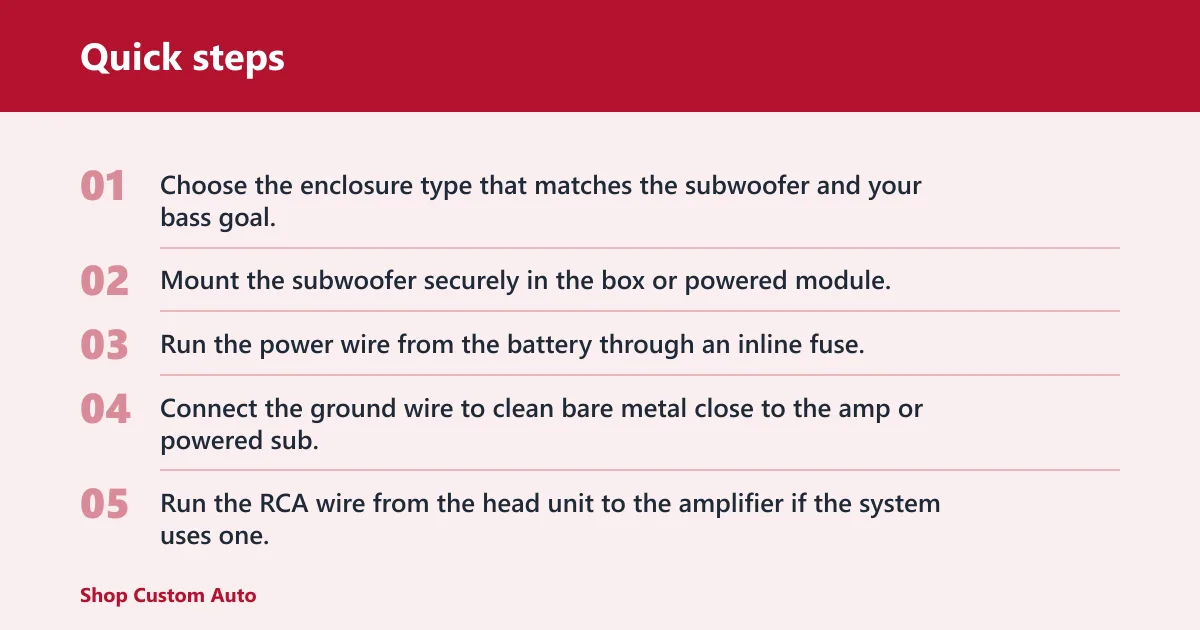
- Choose the enclosure type that matches the subwoofer and your bass goal.
- Mount the subwoofer securely in the box or powered module.
- Run the power wire from the battery through an inline fuse.
- Connect the ground wire to clean bare metal close to the amp or powered sub.
- Run the RCA wire from the head unit to the amplifier if the system uses one.
- Connect the remote wire so the amp turns on with the stereo.
- Check fitment, then verify that the enclosure is stable and ventilated.
Where should you place the sub?
The trunk is the most common install location because it usually offers enough space for an enclosure and room for an amplifier next to the subwoofer. It is also open and accessible, which helps with service and cable routing. In small cabins or hatchbacks, placement must balance bass output with cargo room and heat control.
Why the trunk is a common install spot
Most car owners use the trunk because of the space. That space helps when the box is larger, when the amp needs a mounting surface, or when the install needs a stable location away from passengers. Trunk placement also makes it easier to keep the wiring neat and the enclosure out of the way.
Ventilation and heat management
Keep the subwoofer and amplifier in a well-ventilated spot. Heat is a real problem in cramped installs, especially when the amp is stacked against a box or pushed into a corner with little airflow. A stable location with room around the equipment helps reduce overheating and thermal shutdown. See JL Audio’s amplifier setup guidance for more on cooling and safe amplifier placement.
Fitment limits in hatchbacks and small cabins
Small hatches and compact cabins leave less room for large ported boxes, so a sealed enclosure is often easier to fit. Load-through access also matters, because a box that blocks folding seats or cargo access can make the system annoying to live with. Picture a compact hatch with a ported box that fits only if the rear seats stay fixed; a sealed box may be the better compromise.
How do sealed and ported subwoofer boxes differ?
Sealed boxes are acoustic suspension enclosures that usually give tighter, more accurate bass in a smaller cabinet. Ported boxes use a tuned port or vent to produce louder bass output, but they are usually less accurate than sealed. Choose sealed for control and size, ported for output, and bandpass only when the goal is a very specific loudness target.
Frequently asked questions
Can you use a subwoofer without a box?
Usually only in special setups designed for free-air or infinite-baffle use. Most car subwoofers need a box because the enclosure controls the front and rear sound waves and keeps the driver from sounding thin or distorted. A normal bare driver without a box usually loses output and can become unsafe at higher volume.
What happens if you put a subwoofer in a small box?
A small box can raise distortion, reduce output, and push the cone into over-excursion when the volume climbs. That can also increase rattles as the cabin and trim shake harder. If the box is undersized for the driver, bass may sound tight at low volume but fall apart when pushed.
How do I install a subwoofer in my car?
Start by choosing the right enclosure, then place the box in a stable location, often the trunk. Run the power wire with an inline fuse from the car battery, add the ground wire to bare metal, and connect the RCA wire and remote wire if the setup uses a separate amp. Secure everything before playing music.
Where should I place a subwoofer in my car?
The trunk is the common choice because it has space for the box and often room for an amplifier beside it. In a hatchback or small cabin, choose a stable location that leaves airflow around the amp and does not block cargo access. Good placement matters as much as the box itself.