Subwoofer Impedance Explained for Car Audio
Subwoofer impedance is the amplifier load in ohms, and the right choice is the voice-coil and wiring setup that matches your amp’s rated stable load, often 1, 2, or 4 ohms at the amp’s output. Get it wrong and the amp may make less than rated power, pull excess current, run hotter, enter protect mode, blow fuses, or fail. This guide explains coil options, series/parallel wiring, final impedance math, and how to match subs to a mono or multi-channel amp.
For car audio, the sub’s printed ohm rating is only one part of the choice. The voice-coil layout, the way the coils are tied together, the number of subs, the amplifier’s minimum stable load, the DC resistance you see on a meter, and impedance rise in the box all have to line up.
That full-system view matters because subwoofer impedance directly affects current draw, heat, and how much power the amplifier can deliver while staying inside its safe operating range.
What subwoofer impedance actually means

The load the amplifier actually sees
Impedance is measured in ohms (Ω), but in a car-audio install the key point is where it matters, at the amplifier output. It is the electrical load seen by the amplifier, not a simple “speaker resistance” label that tells the whole story.
Lower nominal impedance makes the amplifier supply more current for the same output voltage. If the amp is built for that load, power can rise. If it is not, output devices heat up faster, current demand on the vehicle climbs, and the amp gets pushed closer to clipping or protection.
Nominal rating versus operating behavior
A subwoofer’s listed impedance is a nominal rating. It is the target category used for matching, not a fixed number that stays unchanged at every frequency and operating condition.
That is why a meter reading can look lower than the label, and why an amp may see a higher effective load at some frequencies once the sub is mounted in an enclosure. Those are normal electrical behaviors, not proof that the sub is mislabeled.
Power and heat follow the load
A 2-ohm load will typically double the power output compared to 4-ohm operation, assuming the amplifier is designed to make that power safely. In car audio, 4-ohm operation remains common because many amplifiers are rated there, thermal stress is lower, and wiring usually stays well clear of the amp’s minimum load limit.
That does not make 4 ohms “best” in every build. It makes 4 ohms a broad-compatibility starting point. The right final load is the one the specific amplifier is rated to handle continuously.
What does 2 ohm vs 4 ohm mean for a car subwoofer?
A 2-ohm sub presents a lower nominal load than a 4-ohm sub, so the amplifier usually draws more current and may produce more power if it is rated for that load. A 4-ohm sub asks less of the amp, runs with more margin, and often gives more wiring flexibility in multi-sub systems.
What changes electrically
When the final load drops from 4 ohms to 2 ohms, current demand rises. More current can bring more output from a capable mono amp, but the tradeoff is extra heat. If the amp is only comfortable at 4 ohms, that lower load can push it into clipping, thermal stress, or protect mode.
In practical terms, “2 ohm versus 4 ohm” means choosing how hard the amplifier has to work for a given signal and how much setup freedom you keep for future changes.
Why lower is not automatically better
Lower impedance is not a volume cheat code. If the amplifier is underrated for the load, the system may get noisier, hotter, and less reliable instead of stronger.
Suppose a mono amp is rated for 4 ohms minimum and a dual-2-ohm sub is wired for 1 ohm anyway. The sub may play at first, but the amp can run hot quickly, clip on peaks, shut down, or blow fuses when bass notes stack up.
Where 4-ohm loads still make sense
4-ohm operation remains common because many amplifiers are designed and rated around it, it leaves more thermal headroom, and it simplifies staying above the minimum stable load in multi-sub wiring plans. It also matters in multi-sub installs where a pair of drivers must combine to a target load without dropping below the amplifier’s limit.
8-ohm subwoofers are positioned for efficiency and low heat generation, but in mainstream car-audio bass systems the usual decisions revolve around 1, 2, and 4 ohms at the amplifier.
Which subwoofer ohm rating fits your amplifier?
The best ohm rating is the one that lets your exact amplifier see its rated minimum stable load after all coils and all subs are wired together. Start with the amp model and its load rating first, then choose the sub’s voice-coil configuration that lands on that target safely.
Read the minimum stable load first
Look for the amplifier’s power ratings at specific impedances. A mono sub amp may be listed as 1-ohm stable or 2-ohm stable. A multi-channel amp may have one minimum per channel in stereo and a different minimum when bridged.
That rating is the floor. Do not plan a wiring scheme that goes below it, even if someone says it “usually works.”
Mono amps and bridged channels
Mono sub amps are usually rated for lower loads than bridged multi-channel amps. Bridging changes how each channel sees the load, so a bridged amplifier often needs a higher final impedance than a dedicated monoblock would.
For a DIY buyer, that means the amp choice can dictate the sub coil choice. Buy the wrong coil version first and the clean wiring options may disappear.
A practical selection path
- Find the amplifier model and its RMS power ratings at each supported impedance.
- Note the minimum stable load at the mode you will use: mono, stereo, or bridged.
- Count the number of subwoofers you plan to run.
- Check whether each sub is SVC or DVC, and whether each coil is 2 ohms or 4 ohms.
- Calculate every possible final wiring load.
- Keep only the wiring options at or above the amp’s rated minimum load.
- Then compare RMS power handling so the amp and subs make sense together.
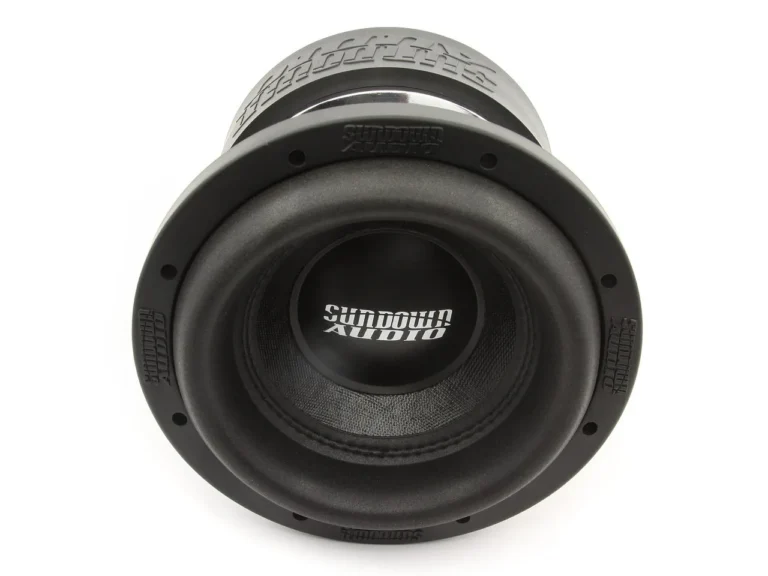
Power handling still matters. A safe impedance match does not replace RMS matching, because subwoofer models vary widely in thermal and mechanical limits. For example, Down4Sound sells the DVX 10-inch subwoofer in D4 and D2 versions, and Down4Sound lists the DVX-10 D2 at 1700W RMS. Sundown Audio lists the M-Series 8-inch subwoofer in 2 ohm and 4 ohm versions, and Sundown Audio’s SALT-1 Class D amplifier is listed in the brand store. Those listings show why buyers must match both ohms and RMS, not just one spec.
How do voice coils affect final impedance?
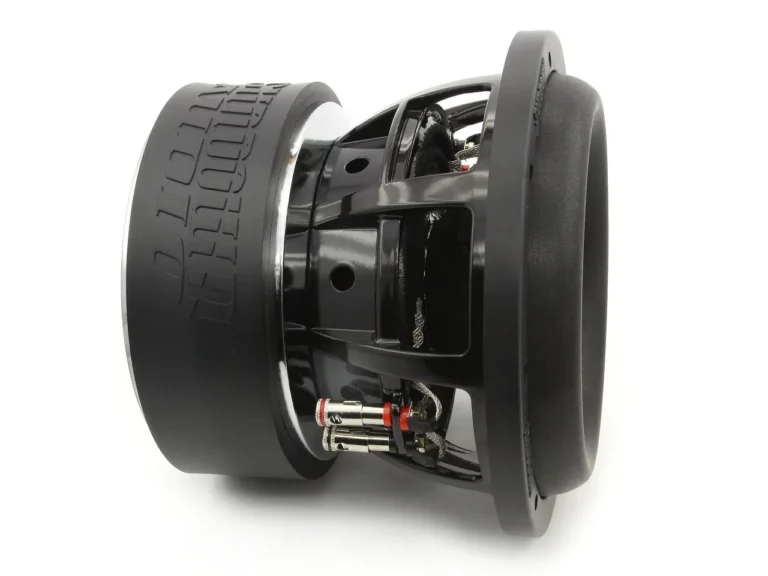
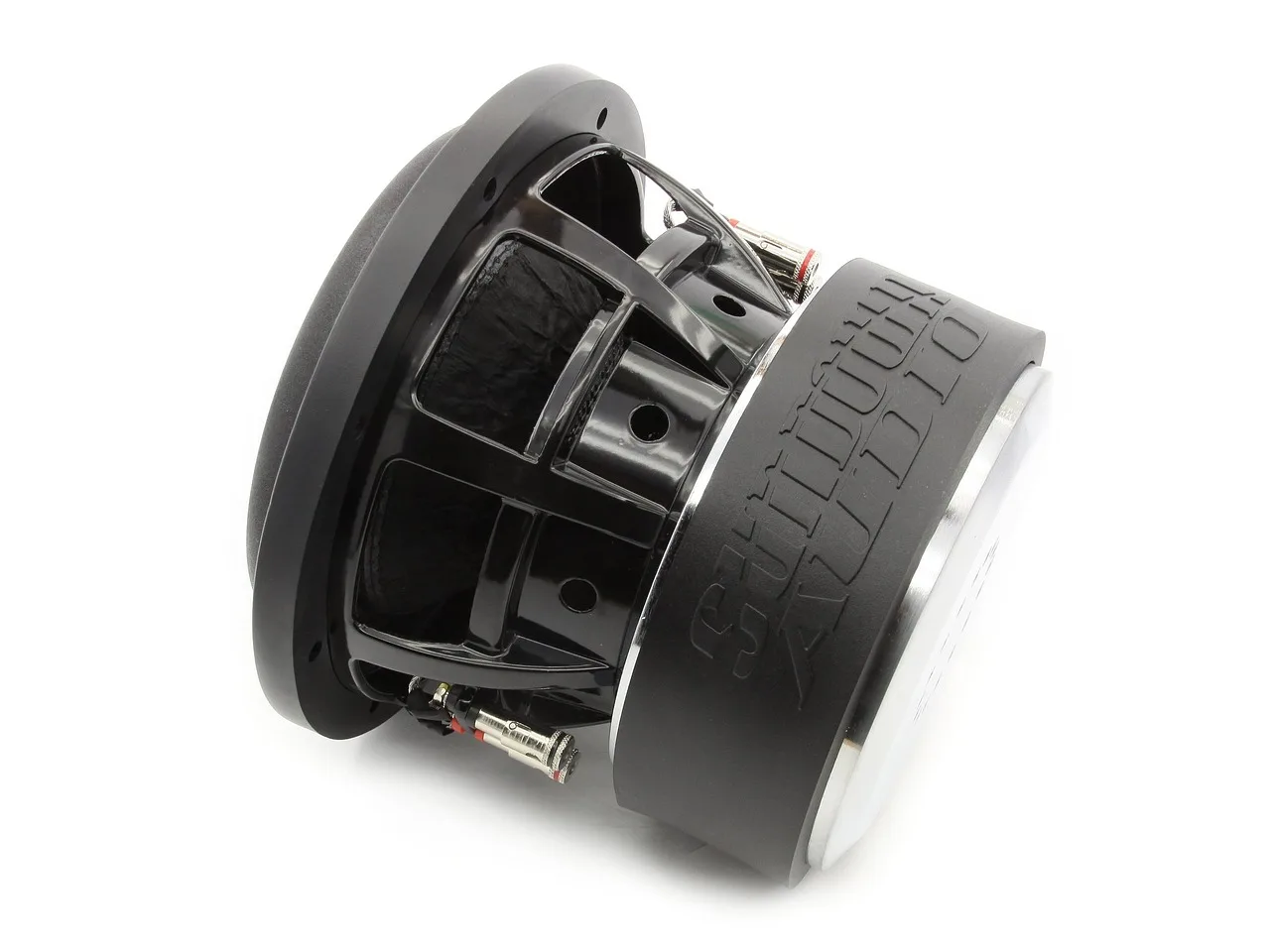
Voice coils determine how many wiring paths a subwoofer gives you. A single voice coil has one load to work with, while a dual voice coil sub has two coils on one driver, letting you wire them in series or parallel to reach different final nominal impedances.
SVC versus DVC
An SVC subwoofer is straightforward: one coil, one nominal impedance. If it is an SVC 4-ohm driver, the driver itself is 4 ohms unless paired with another speaker.
A DVC sub has two separate coils on the same woofer. A DVC 4-ohm sub has two 4-ohm coils. A DVC 2-ohm sub has two 2-ohm coils. That is where the flexibility comes from.
Why dual 2-ohm and dual 4-ohm versions exist
Manufacturers offer both because different amplifiers need different final loads. Dual 2-ohm models make it easier to reach 1 ohm with one sub or with some multi-sub layouts. Dual 4-ohm models make it easier to reach 2 ohms with one sub or common totals like 1 ohm and 4 ohms with two subs.
That is why a single product line can appear in multiple coil versions. The motor and cone may be similar while the buyer chooses the electrical fit.
Worked single-sub examples
One DVC 2-ohm sub can be wired in series for 4 ohms or in parallel for 1 ohm. One DVC 4-ohm sub can be wired in series for about 8 ohms or in parallel for about 2 ohms.
Those two choices alone often decide whether a monoblock will be fully loaded, lightly loaded, or mismatched.
How wiring changes total impedance
Series wiring raises total impedance because the loads add together, while parallel wiring lowers total impedance because current has multiple paths. In car audio, those two methods decide whether the amplifier sees a safe 4-ohm load, a harder 2-ohm load, or a risky load below its rating.
Series wiring formula
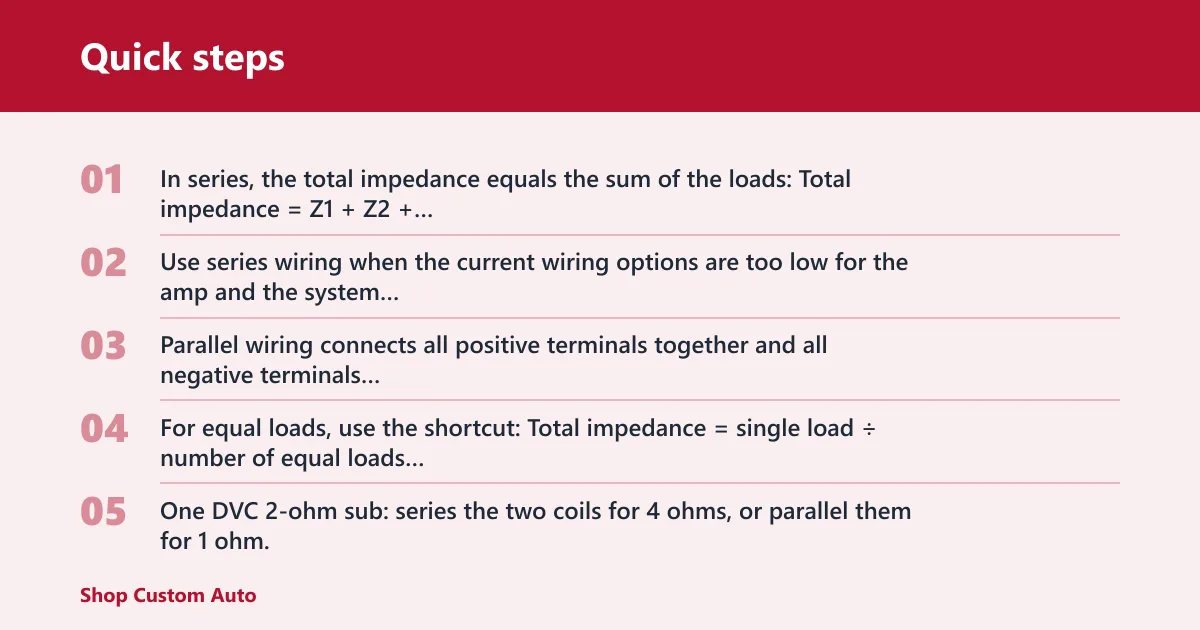
In series, the total impedance equals the sum of the loads:
Total impedance = Z1 + Z2 + Z3 …
Use series wiring when the current wiring options are too low for the amp and the system needs a higher final load. Two 4Ω subs in series equal 8Ω total. Two 2Ω subs in series equal 4Ω total.
Parallel wiring formula
In parallel, the total impedance decreases. Parallel wiring connects all positive terminals together and all negative terminals together.
For equal loads, use the shortcut:
Total impedance = single load ÷ number of equal loads
For unequal or more complex loads, use the reciprocal formula:
1 ÷ Zt = 1 ÷ Z1 + 1 ÷ Z2 + 1 ÷ Z3 …
Worked DVC examples
One DVC 2-ohm sub: series the two coils for 4 ohms, or parallel them for 1 ohm.
One DVC 4-ohm sub: series the two coils for 8 ohms, or parallel them for 2 ohms.
Two DVC 2-ohm subs: each sub can be wired series first to 4 ohms, then both subs in parallel for 2 ohms. Or each sub can be wired parallel first to 1 ohm, then both in series for 2 ohms. If all four 2-ohm coils are wired in parallel, the final load is about 0.5 ohm, which is below the rating of many amps.
Two DVC 4-ohm subs: each sub can be wired parallel first to 2 ohms, then both subs in parallel for 1 ohm. Or each sub can be wired series first to 8 ohms, then both subs in parallel for 4 ohms. There are other equivalent paths, but those are the common targets.
Mixed subwoofer loads are usually a bad plan
Mixed impedances and mixed coil layouts create uneven power sharing. One woofer may take more current and more amplifier power than the other, especially if the drivers differ in impedance curve, sensitivity, or box loading.
Picture a system with one SVC 4-ohm sub and one DVC 2-ohm sub in the same mono setup. The math may produce a number on paper, but the power will not divide evenly, and tuning the pair as one bass system becomes harder than choosing matched drivers from the start.
Impedance matrix decision table
Decision paths and red flags
| Setup | Amplifier minimum stable load | Wiring option | Final nominal load | Expected meter reading | Red-flag mismatch |
|---|---|---|---|---|---|
| 1 × DVC 2Ω sub | 1Ω mono amp | Coils in parallel | 1Ω | Below 1Ω DC is common; meter will read lower than nominal | Use only if the amp is rated for 1Ω operation |
| 1 × DVC 2Ω sub | 2Ω or 4Ω mono amp | Coils in series | 4Ω | Commonly around 3Ω to low-4Ω DC across the full sub path | Poor choice if the goal is maximum power from a 1Ω-only power rating |
| 1 × DVC 4Ω sub | 2Ω mono amp | Coils in parallel | 2Ω | Commonly lower than 2Ω DC; each coil alone often reads about 3Ω nominal-to-DC style | Do not assume a 2Ω final load because each coil “measures 4” on a meter |
| 1 × DVC 4Ω sub | 4Ω or higher amp | Coils in series | 8Ω | Lower than 8Ω DC | Very safe electrically, but power may be much lower than planned |
| 2 × DVC 2Ω subs | 2Ω mono amp | Each sub series to 4Ω, then both parallel | 2Ω | Lower than 2Ω DC at the amp terminals | All coils in parallel makes 0.5Ω, which is a stop sign for most amps |
| 2 × DVC 4Ω subs | 1Ω mono amp | Each sub parallel to 2Ω, then both parallel | 1Ω | Lower than 1Ω DC is normal at rest | Unsafe on amps that are only 2Ω stable |
| 2 × DVC 4Ω subs | 4Ω mono amp | Each sub series to 8Ω, then both parallel | 4Ω | Lower than 4Ω DC at the amp terminals | Wiring both subs fully parallel can drop far too low |
| Mixed subs: different ohms or coil layouts | Any | Varies | Varies | Meter may look acceptable while power sharing is still uneven | Avoid unless the system is engineered around separate channels and independent gain setting |
Subwoofer impedance checklist
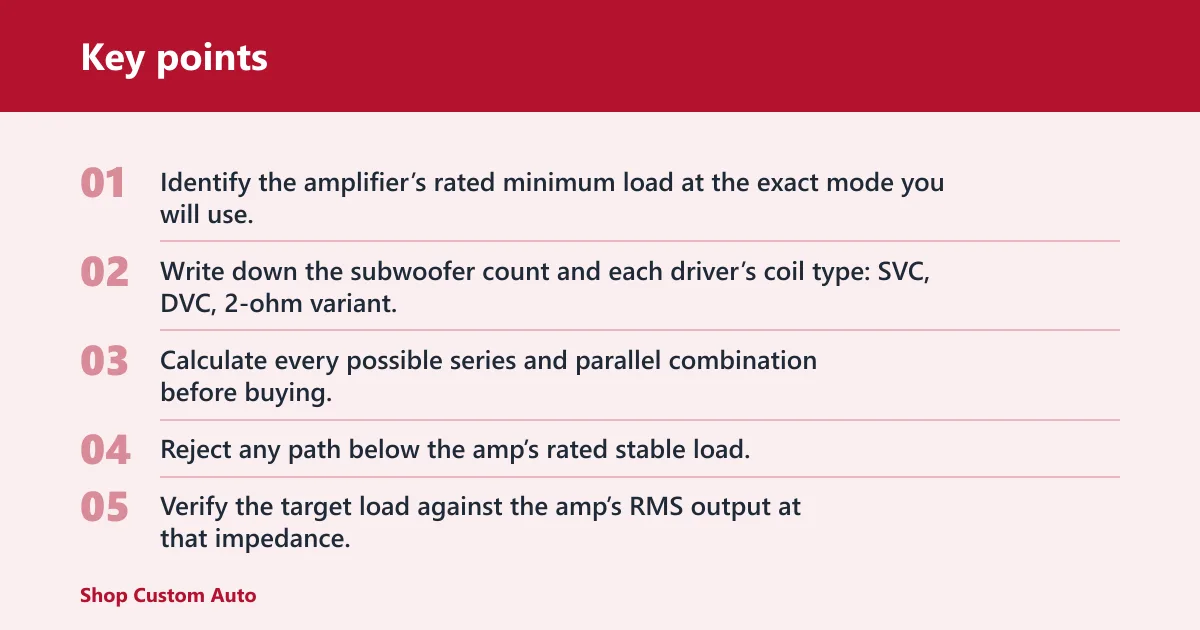
- Identify the amplifier’s rated minimum load at the exact mode you will use.
- Write down the subwoofer count and each driver’s coil type: SVC, DVC, 2-ohm variant, or 4-ohm variant.
- Calculate every possible series and parallel combination before buying.
- Reject any path below the amp’s rated stable load.
- Verify the target load against the amp’s RMS output at that impedance.
- Check the subwoofers’ RMS handling and box recommendations separately from wiring.
- After wiring, confirm DC resistance with a multimeter to catch open or shorted coils.
Why does a 4-ohm sub measure about 3 ohms?
A 4-ohm subwoofer can measure about 3 ohms on a multimeter because the meter reads DC resistance, often written as Re, while the speaker’s printed rating is nominal impedance. Those are related but not identical numbers, so a lower meter reading is usually normal rather than a fault.
What the meter is reading
A handheld multimeter applies DC and reports the voice coil’s resistance at rest. A speaker’s nominal impedance, by contrast, is an AC operating rating used for amplifier matching.
That is why a “4-ohm” driver often reads around 3 ohms on the meter. The same logic applies to other nominal ratings: DC resistance is normally lower than the printed impedance.
What readings can tell you
A meter cannot map the full impedance curve, but it can confirm basic coil health. Read each coil separately on a DVC sub, then read the full wired load if the coils are already connected.
Readings near zero suggest a shorted coil or a short in the wiring path. Infinite or open-circuit readings suggest a broken lead, open voice coil, or a disconnected wire.
What happens if the amp sees too low an impedance?
If the amplifier sees less impedance than it is rated to handle, it must supply more current than planned. That can lead to excess heat, clipped output, protect mode, shutdown, fuse trouble, or permanent failure if the amp cannot shed the heat or limit the current fast enough.
Common symptoms
In mild cases, the system may play normally at low volume but shut down on harder bass notes. In worse cases, the amp may become very hot, distort early, flash protect lights, or blow fuses.
Clipping is especially easy to miss because it can sound like “the sub is tapped out” when the real problem is the amplifier straining against too little load.
Vehicle electrical stress
Low-load wiring also pulls harder on the charging system. Voltage sag can increase, headlights may dim more, and the amplifier may become less stable during transients because the supply voltage is dropping while current demand rises.
A common first-timer mistake is choosing the lowest possible ohm load to chase amp power without checking the amp’s stable rating or the car’s electrical support. The result is often more protect mode than more bass.
Why real-world impedance is not the box rating
Impedance rise changes the operating load
Once the sub is playing in an enclosure, the amplifier does not see one fixed number at every frequency. The effective load can rise above the nominal rating, especially around resonance and other points in the impedance curve.
That is why a sub wired to a nominal 1 ohm may not behave like a flat 1-ohm resistor during actual music playback. The amp can see a higher load at some frequencies than the box label suggests.
Enclosure loading changes acoustics, not nominal wiring
Enclosure loading affects cone control, resonance behavior, and output across frequency. It does not change the basic nominal wiring result of your series or parallel connections.
A sealed box and a ported box can make the same woofer present different operating impedance curves while still being wired to the same nominal load at the terminals. Keep those two ideas separate: box behavior is acoustic and electromechanical, wiring load is electrical.
Why this matters when choosing parts
Impedance rise helps explain why an amp that is stable at a low nominal load may still survive normal use, yet the install can remain a bad match if the resting wired load is below the amp’s official minimum. The rating still controls the decision.
Best Buy categorizes a retail section specifically for subwoofer speakers, which reflects how often buyers shop speakers first. For a reliable bass setup, the order should be the opposite: start with the amp’s load limits, then choose the speaker coil version and wiring path.
Frequently asked questions
What is impedance in speakers?
In a car-audio system, impedance is the electrical load the speaker presents to the amplifier, measured in ohms (Ω). It affects current draw, heat, and possible power output. The key number is the load the amp sees after all coils and all subwoofers are wired together.
Is lower impedance better for subwoofers in a car?
Lower impedance is only better when the amplifier is rated to handle it and the rest of the system supports the extra current draw. A lower-ohm load can increase amp output, but it can also raise heat, clipping risk, and shutdown risk if the amp is underrated.
What ohm subwoofer is best for your amplifier?
The best subwoofer ohm rating is the one that lets your exact amplifier see its minimum safe load or a higher safe load after final wiring. Start with the amp’s stability rating, then pick SVC or DVC coil options that reach that target without dropping below it.
How do parallel and series wiring change total impedance?
Series wiring raises total impedance because the loads add together. Parallel wiring lowers total impedance because current has multiple paths. Two 4Ω subs in series equal 8Ω total, while equal loads in parallel divide by the number of drivers or coils in the circuit.
Why does a 4-ohm subwoofer measure about 3 ohms?
A multimeter reads DC resistance, not the subwoofer’s nominal AC impedance rating. Because DC resistance is lower than nominal impedance, a 4-ohm sub commonly reads about 3 ohms at rest. That lower reading is usually normal unless it is near zero or fully open.
How can I check subwoofer impedance with a multimeter?
Set the meter to ohms, disconnect the sub from the amplifier, and place the probes across each voice coil terminal pair. A normal reading will be lower than the nominal rating. Near-zero resistance suggests a short; an infinite reading suggests an open coil or broken connection.